How Personality Shapes Stress Responses
How Big Five traits influence stress perception, cortisol, heart rate, and coping—showing why tailored stress management outperforms one-size-fits-all.
Rachel Johnson

How Personality Shapes Stress Responses
Why do people handle stress differently? Personality plays a big role. Research shows that your personality traits influence how you perceive, react to, and recover from stress. Here's a quick breakdown:
- Neuroticism: Leads to heightened stress sensitivity and stronger emotional and physical reactions (e.g., elevated cortisol and heart rate).
- Extraversion & Openness: Linked to better stress management through social support and flexible thinking.
- Conscientiousness: Promotes proactive planning but can cause rigidity under uncertainty.
- Agreeableness: Supports emotional balance and positive relationships during stress.
Key findings:
- Personality explains 11% of emotional stress variance, 8% of blood pressure changes, and 4% of heart rate and cortisol shifts.
- Tailored stress management works better than a one-size-fits-all approach.
- Tools like Personos help match strategies to personality, improving outcomes in workplaces and coaching.
Understanding these connections can help you or your team handle stress more effectively by aligning coping strategies with personality traits.
Binghamton Faculty Focus - How Personality Impacts Stress Mindset and Stress Management
The Big Five Personality Traits and Stress Responses
The Big Five personality traits - neuroticism, extraversion, openness, conscientiousness, and agreeableness - play a key role in shaping how people respond to stress. A meta-analysis that examined over 1,500 effect sizes from 300 studies sheds light on these connections[1].
Neuroticism: The Biggest Predictor of Stress Vulnerability
Among the Big Five, neuroticism stands out as the strongest indicator of stress vulnerability. People with high levels of neuroticism often experience intense negative emotions and have exaggerated reactions to perceived threats or losses[1]. This heightened sensitivity not only amplifies their perception of stress but also increases the likelihood of encountering stressful situations.
On a biological level, individuals high in neuroticism often show increased activity in the hypothalamic-pituitary-adrenal (HPA) axis, evidenced by elevated daily cortisol levels[2]. This combination of heightened emotional reactivity and physiological stress responses can contribute to greater health risks, emphasizing the importance of tailored interventions for those with this trait.
Extraversion and Openness: Natural Stress Buffers
In contrast to neuroticism, extraversion and openness are traits that help reduce stress. Both are linked to lower perceived stress, reduced cardiovascular reactivity, and lower cortisol levels. Extraverts, for example, often rely on social support networks to manage stress effectively[4][5].
Openness, on the other hand, enhances flexibility and adaptability. People with high openness often respond well to short-term coping techniques like relaxation breathing or biofeedback. Their ability to think creatively helps them reframe stressful situations, which in turn reduces both hormonal and cardiovascular stress reactions[4].
Conscientiousness and Agreeableness: Proactive and Balanced Responses
While extraversion and openness reduce stress through adaptability and social support, conscientiousness and agreeableness influence stress differently - through proactive behaviors and emotional regulation.
Conscientiousness helps individuals avoid certain stressors by encouraging planning and organization. However, it can sometimes lead to rigidity when faced with uncertainty. This trait also shows unique links to how people emotionally respond to stress[2].
Agreeableness is particularly tied to maintaining positive emotions during stressful times. People with high agreeableness tend to build cooperative relationships, which provide emotional support. Additionally, how individuals appraise stressors - evaluating their severity, controllability, and meaning - explains over a third of the connection between personality traits and emotional responses to stress[2]. This suggests that agreeableness and conscientiousness not only shape stress responses but also influence how people interpret and cope with challenges.
These findings highlight how different personality traits contribute to stress responses in unique ways, paving the way for personalized stress management strategies, which will be explored in later sections.
How Personality Affects Stress Appraisal and Coping Methods
Stress Appraisal: How Personality Changes Perception
Imagine going through a performance review and receiving critical feedback. One person might see this as a devastating blow to their career, while another might view it as an opportunity to grow. Personality traits act like a lens, shaping how we interpret these situations. Studies suggest that how we appraise stressors accounts for over a third of the link between personality traits and emotional reactions to stress[2]. In essence, personality doesn’t just influence how much stress you feel - it changes how you see the situation in the first place.
Take individuals with high levels of neuroticism, for example. They often blow minor stressors out of proportion, interpreting them as major threats. If they receive criticism during a performance review, they might see it as proof of their shortcomings and a sign that their career is at risk. Their minds fixate on worst-case scenarios, amplifying the stress[1].
Now consider someone who scores high in extraversion. The same feedback might be seen as constructive and helpful. Extraverts are more likely to view challenges as opportunities, focusing on how they can improve and appreciating the collaborative nature of addressing feedback[4].
These differences come down to how personality influences automatic cognitive evaluations. When faced with a stressor - whether it’s a looming deadline, a disagreement, or an unexpected change - our personality traits shape how we assess its severity, controllability, and potential threat. These appraisals, in turn, trigger specific emotional and physiological responses[2].
This understanding is especially critical in workplaces. The same piece of feedback can be interpreted in vastly different ways depending on the recipient’s personality. For instance, when giving feedback to someone with high neuroticism, it’s important to focus on what they can control, provide actionable suggestions, and offer reassurance. On the other hand, extraverts might thrive when feedback is framed as a challenge to tackle.
Recognizing these patterns naturally leads to the question: how can coping strategies be matched to personality traits?
Matching Coping Strategies to Personality Types
Since appraisal influences emotional reactions, stress management strategies should align with an individual’s personality. Not all coping methods work for everyone, and mismatched strategies can sometimes make stress worse instead of better[1].
Coping strategies generally fall into two categories: problem-focused (addressing the stressor head-on) and emotion-focused (managing emotional responses to stress). Personality traits often determine which approach is more effective.
- Conscientious individuals excel with problem-focused strategies. They thrive on structure and planning, so techniques like organized problem-solving or accountability systems are ideal. Telling them to "just let it go" may not resonate and could feel unhelpful[2].
- Neurotic individuals lean toward emotion-focused coping. They benefit from methods like expressing their feelings, seeking social support, or practicing relaxation techniques. These approaches can help them manage their emotional responses before tackling the stressor itself[2].
- Openness to experience fosters adaptability. People high in openness often respond well to techniques like relaxation breathing or biofeedback. Their ability to consider different perspectives makes them open to trying diverse stress management methods, from reframing their thoughts to physiological interventions[4].
- Extraverts find strength in social support. For them, isolation during stressful times can remove one of their most effective coping resources. Encouraging them to connect with others can make a significant difference.
The takeaway? A one-size-fits-all approach to stress management simply doesn’t work. Tailoring strategies to an individual’s personality leads to better results. Coaches and managers who take personality into account can offer more effective guidance - whether it’s helping someone reframe their stress, suggesting strategies that align with their tendencies, or using tools like biofeedback to address physiological stress.
Platforms like Personos are designed to provide these kinds of personalized insights. By analyzing 30 personality traits, background details, and situational factors, Personos offers actionable recommendations tailored to specific roles. As addiction recovery counselor Carla Mendoza, LCSW, explains:
"In recovery, timing is everything. Personos helps me anticipate when a client is on the edge of shutting down and adjust my approach so we stay connected. That kind of in-the-moment support is priceless."[6]
When coping methods align with personality traits, stress management becomes more natural and effective. It avoids the frustration of using techniques that feel forced or ineffective, making the entire process smoother and more sustainable.
sbb-itb-f8fc6bf
The Biology of Stress: Physical Responses Across Personality Types
Stress isn’t just a mental experience - it’s a full-body event. When stress hits, your brain sets off a chain reaction of hormonal and cardiovascular changes. Interestingly, the way your body handles stress has a lot to do with your personality. This connection helps explain why some people recover from stress easily, while others feel its effects much longer. These differences in recovery rates are rooted in how our bodies respond biologically, depending on our personality traits.
Hormonal Responses and the HPA Axis
When faced with stress, your hypothalamic-pituitary-adrenal (HPA) axis springs into action, releasing cortisol, often referred to as the "stress hormone." This system is designed to help you respond to challenges and then return to a calm state. However, your personality plays a big role in how this system operates.
Studies using the Trier Social Stress Test - a lab experiment that involves tasks like public speaking and mental math - have revealed some fascinating patterns. People who score high in neuroticism tend to have an overactive HPA axis. They release more cortisol under stress, and their system takes longer to settle down. On the flip side, those who are high in extraversion or openness show a more subdued cortisol response, indicating a milder biological reaction to stress[4].
An especially interesting group includes individuals with high Communal Positive Emotionality - people who are naturally warm and socially connected. These individuals show smaller cortisol responses to social stressors, suggesting they may be less prone to stress-related illnesses[3]. Their bodies simply don’t react as intensely to stress.
On the other hand, people high in Negative Emotionality (which includes neuroticism) account for around 11% of the variability in emotional stress responses[3]. This isn’t just a minor detail - elevated cortisol levels over time can weaken the immune system, increase inflammation, and heighten the risk of cardiovascular disease. For instance, individuals with Type A personalities or high neuroticism often experience chronic stress, leading to these harmful effects[5]. Meanwhile, extraverts generally enjoy lower stress levels and stronger immune defenses[5].
Cardiovascular and Emotional Responses
Stress doesn’t stop at hormones - it also affects your heart and blood vessels, and once again, personality shapes these reactions. Your cardiovascular system’s response to stress offers another perspective on how personality influences physical health.
People high in Agentic Positive Emotionality - those who are assertive and socially dominant - experience extended heart rate spikes during stress. Even after the stressor is gone, their hearts take longer to calm down. This prolonged activation puts extra strain on their cardiovascular system[3].
In contrast, individuals with high Communal Positive Emotionality show smaller blood pressure spikes during acute stress[3]. Their blood vessels don’t constrict as much, and their blood pressure remains more stable, indicating better resilience.
Interestingly, those high in Negative Emotionality often feel heightened emotional distress during stress but exhibit relatively mild blood pressure changes[3]. This mismatch between emotional and cardiovascular responses could make them more vulnerable to chronic stress-related mood disorders, even if their immediate physical reactions seem less intense.
For individuals high in neuroticism and low in extraversion, the story is different. They tend to show heightened cardiovascular reactivity, particularly when anticipating stress[4]. On the other hand, extraverts and those high in openness experience lower cardiovascular reactivity overall, which may offer some protection against stress-related health issues[4].
Personality traits account for about 8% of the variability in blood pressure responses and 4% in heart rate responses during stress tests[3]. A large meta-analysis examining over 1,500 data points from nearly 300 studies confirmed that while all Big Five personality traits are linked to stress, neuroticism has the strongest connection[1].
These patterns matter for long-term health. Frequent spikes in heart rate and blood pressure, combined with elevated cortisol levels, can wear down the cardiovascular system over time. This makes it clear why personality-specific stress management strategies are so effective. For example, someone with high neuroticism might benefit from approaches like relaxation techniques or biofeedback to help regulate their HPA axis[4]. Meanwhile, extraverts might require less intensive interventions since their biological stress responses are naturally more moderate.
Stress isn’t just a mental challenge - it’s a deeply physical one. From hormone levels to heart rate and blood pressure, your personality influences how your body reacts to stress. These insights highlight the importance of tailoring stress management strategies to fit individual personality profiles, ensuring they address the unique ways each person’s body responds to pressure.
Applying Personality Insights to Improve Stress Management
Understanding how personality influences stress responses isn't just a theoretical exercise - it’s a practical way to reshape how we approach stress management. Research shows that a one-size-fits-all strategy simply doesn’t cut it. Instead, the focus needs to shift toward proactive, personality-based methods. This involves identifying individuals who may be more vulnerable before stress-related issues escalate, tailoring coaching techniques to align with their natural coping styles, and applying targeted interventions that address their unique stress triggers. By doing so, we can create strategies that resonate with each personality type.
Personalized Coaching Approaches
Effective coaching hinges on aligning strategies with individual personality traits. By leveraging the connection between personality and stress biology, tailored methods can help recalibrate both mental and physical responses to stress.
For those high in neuroticism, coaching should prioritize cognitive reframing and restoring a sense of control. These individuals often magnify stress through their appraisals - something that accounts for a significant portion of the link between personality and negative stress effects[2]. Breaking larger problems into smaller, manageable steps can be particularly effective, helping to interrupt this stress-amplifying cycle.
On the other hand, extraverts and individuals high in openness tend to display greater resilience. They naturally view stressors as more manageable and less severe[7]. Coaching for these groups can build on their strengths by encouraging creative problem-solving and leveraging their social networks. The goal here is to expand their coping strategies rather than rework their fundamental stress responses.
For conscientious individuals, structured routines are key. Their natural self-discipline and preference for planning make them well-suited to systematic stress management techniques. Helping them develop preventive strategies and structured approaches provides the sense of control they thrive on[4].
Using Tools Like Personos for Real-Time Insights
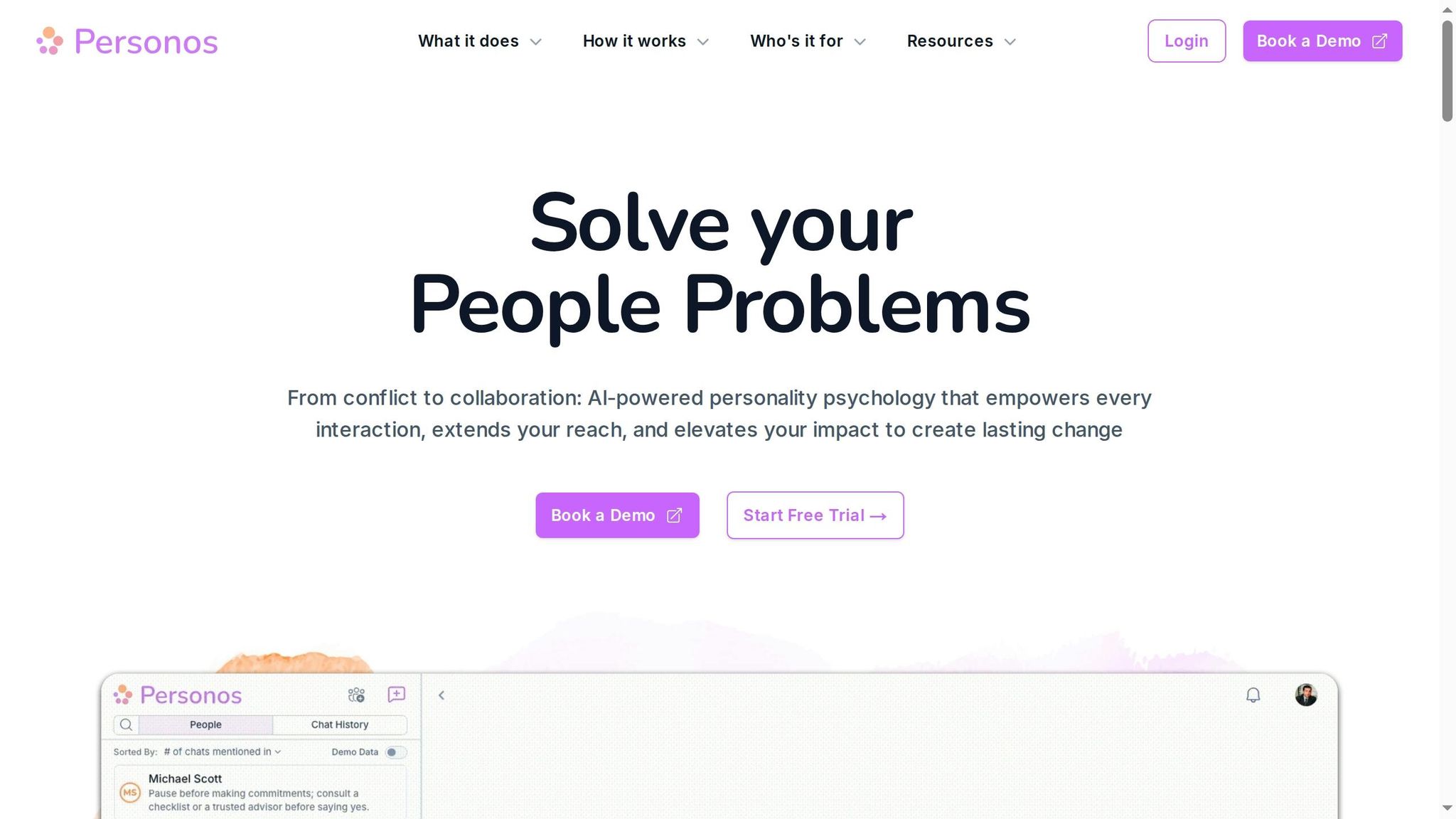
Advancements in technology have made it easier to apply personality insights in real-world scenarios, especially in professional and team environments. Platforms like Personos bridge the gap between personality theory and its practical application.
Personos uses AI-driven conversational tools to offer situational advice based on personality profiles. This is particularly helpful in high-stress workplace situations, where conflicts or challenges can escalate quickly. For example, the platform generates dynamic personality reports and provides communication prompts tailored to individuals or groups. These tools help users adjust their interactions based on personality differences, preventing small tensions from spiraling into major issues.
In team settings, these insights can clarify why stress responses vary among members. For instance, if a highly neurotic team member withdraws during a high-pressure project, colleagues can recognize this as a stress response rather than disengagement. They can then offer support by addressing specific concerns about control and outcomes - areas that often trigger stress for neurotic individuals.
The real-time nature of these tools is a game-changer. Simply assessing personality isn’t enough; people need actionable guidance during stressful interactions. Features like relationship analysis reports help team members anticipate potential friction points, while communication prompts provide practical ways to navigate those differences.
For coaches and managers, this technology enables a shift from generic advice to tailored support. Instead of recommending the same stress management app to everyone, they can match interventions to personality profiles, ensuring that strategies resonate with each individual.
Targeted Interventions for High-Risk Individuals
Real-time personality insights aren’t just about improving coaching - they’re also invaluable for identifying individuals at higher risk for stress-related health issues. Research highlights that people with high neuroticism and low extraversion are particularly sensitive to anticipatory stress[4]. These individuals are more vulnerable to anxiety, depression, and even physical health problems, making early intervention crucial.
Personality assessments can flag these high-risk profiles before stress-related challenges escalate. By offering tailored stress management training, organizations can address vulnerabilities proactively rather than waiting for issues to worsen[4].
Specific interventions have proven effective for different personality types. For instance, relaxation breathing and cardiac biofeedback are especially beneficial for individuals high in openness to experience[4]. These techniques target the physiological aspects of stress, helping to regulate heart rate and cortisol levels. For neurotic individuals, who often exhibit heightened heart rate and amygdala activity during stress, interventions focused on enhancing perceived control and using biofeedback can significantly reduce their stress responses.
The research supports a proactive approach to personality-based stress management over reactive crisis strategies[1]. This is particularly important in high-stress fields like healthcare and emergency services, where chronic stress can lead to burnout. By incorporating personality-based screening and targeted support, organizations can safeguard both individual well-being and overall effectiveness.
What sets these interventions apart is their precision. Instead of generic workshops that may only resonate with a portion of participants, personality-informed strategies ensure the right support reaches the right person at the right time. For example, a conscientious individual might excel with planning tools, while someone high in neuroticism would benefit more from emotion-regulation techniques and cognitive reframing. This personalized approach ensures that stress management efforts are both effective and meaningful.
Conclusion
The link between personality and stress isn't just a theoretical concept - it offers a practical way to better understand and manage stress in daily life. Studies reveal that personality traits account for about 11% of emotional reactions to stress, 8% of blood pressure changes, and 4% of both heart rate and cortisol levels during stress situations [3]. While factors like genetics, trauma history, and physical fitness explain much of the variability in stress responses, personality stands out as an important, adjustable factor we can use to improve outcomes.
This research challenges the idea of one-size-fits-all stress management. For example, individuals with high neuroticism benefit from strategies like cognitive reframing and building a sense of control. Extraverts thrive by leaning into their social networks, while those high in openness respond well to adaptive reframing techniques. Conscientious individuals, on the other hand, excel with structured plans [4]. These tailored approaches highlight how personality traits shape both mental and physical stress responses.
The practical implications of these findings go far beyond personal coaching. In workplaces, understanding how personality affects stress can help prevent conflicts and improve team dynamics during high-pressure moments. For instance, managers who recognize withdrawal as a neurotic stress response can offer specific support instead of generic solutions. Similarly, coaches aware that stressor-related appraisals explain over a third of the connection between personality and stress can focus on helping clients reframe stressful situations, rather than relying solely on relaxation techniques [2].
Early identification and targeted strategies are especially critical for those prone to anticipatory stress - such as individuals high in neuroticism or low in extraversion. For these groups, timely interventions can be the difference between managing stress effectively and facing chronic issues like anxiety, depression, or heart problems.
Tools like Personos make these insights actionable by integrating them into daily routines. Through features like personality-based communication tips and relationship analyses, stress management becomes a natural part of everyday interactions - no longer limited to occasional workshops or reactive crisis strategies.
FAQs
How can I identify my personality traits to better handle stress?
Understanding your personality traits can be a game-changer when it comes to managing stress. By recognizing your natural habits, strengths, and areas where you might struggle, you can create stress management techniques that actually match your needs.
Using tools like detailed personality reports, you can discover how your unique traits shape the way you handle stressful situations. This self-awareness not only helps you tackle challenges more effectively but also enhances how you communicate and work with others when the pressure is on.
How can I manage stress effectively if I have a more sensitive or reactive personality?
If you find yourself feeling stress more deeply due to a sensitive or reactive personality, there are a few strategies that might help you manage it more effectively. Start with mindfulness practices like deep breathing or meditation. These techniques can help ground you in the present moment and ease the tendency to overthink.
Building a steady routine is another way to manage stress. Make time for regular exercise, aim for quality sleep, and focus on eating a balanced diet. Physical activity, in particular, can work wonders by lowering stress hormones and boosting your mood. Journaling can also be a great outlet for processing emotions, while talking to a trusted friend, coach, or therapist can offer fresh perspectives and support.
For a more personalized approach, tools like Personos can help you understand your personality and communication style. This deeper self-awareness can make it easier to identify stress triggers and improve how you interact with others, ultimately helping you find a more balanced way to handle stress.
How can organizations use personality insights to better manage workplace stress?
Organizations can take a thoughtful approach to stress management by integrating personality-based strategies that cater to both individual and team dynamics. By understanding how various personality types react under pressure, leaders can adjust their communication styles, coaching methods, and conflict resolution techniques to better align with the unique needs of their teams.
Tools like AI-powered personality analysis can play a key role here. These tools offer features such as detailed personality profiles, relationship insights, and customized communication suggestions. With these resources, managers can promote healthier workplace interactions, address potential stressors more effectively, and build a more supportive environment. The result? Enhanced productivity and stronger teamwork across the board.