AI Tools for Conflict Resolution
How AI analyzes communication, offers real-time coaching and personality insights to detect and de-escalate workplace conflicts while emphasizing privacy and ethics.
Nick Blasi

AI Tools for Conflict Resolution
AI is reshaping how workplace conflicts are addressed, offering tools that analyze communication patterns, detect emotional triggers, and provide real-time feedback to de-escalate tension. By using natural language processing (NLP) and sentiment analysis, these tools can identify early warning signs like hostility or bias in emails, chats, and meeting transcripts. They also assist managers and HR teams by suggesting phrasing adjustments, offering coaching, and summarizing disputes to keep discussions focused on solutions.
Key takeaways:
- Early Detection: AI flags tension or negative sentiment before issues escalate.
- Real-Time Guidance: Tools provide live coaching for sensitive conversations.
- Personality Insights: Platforms like Personos analyze traits to tailor conflict strategies.
- Privacy and Ethics: Strong safeguards are needed to protect sensitive data and prevent bias.
AI complements human judgment, helping professionals focus on listening and problem-solving while reducing turnover and improving workplace communication.
AI Roleplay: Conflict Resolution (Live Example)
How AI-Assisted Conflict Resolution Works
AI tools aren't just about spotting potential conflicts early - they also help improve communication in real-time. By analyzing emails, chats, transcripts, and voice recordings, these tools can identify conflict patterns. Using techniques like natural language processing (NLP) and sentiment analysis, they assess tone and emotion, flagging warning signs such as hostility, blame-shifting, or invalidation.
For instance, HR teams can get alerts when internal communications show a spike in negative language. Similarly, a manager writing a tough performance review might use an AI writing assistant to adjust language that could come across as dismissive or harsh, offering suggestions to validate the employee's feelings instead.
Predictive analytics takes this further by continuously scanning organizational communications for trends like recurring negative sentiment or sudden tone changes. Large platforms like eBay and PayPal use these systems to handle millions of disputes each year, showing how AI can scale conflict management in ways human mediators can't match [3]. Beyond analytics, AI simulations provide teams with hands-on training in conflict resolution.
In online dispute resolution (ODR), AI helps streamline negotiations by summarizing key positions and offering settlement suggestions. Courts and public justice systems are increasingly adopting AI-enhanced ODR tools to manage high volumes of low-value civil disputes, signaling a broader shift toward AI-supported solutions.
AI also powers virtual coaching tools, giving professionals a safe space to practice difficult conversations. These tools analyze word choice and tone, providing feedback on de-escalation techniques and emotional intelligence - extremely useful for managers handling sensitive situations or leading distributed teams.
Some tools even incorporate personality insights, offering tailored advice on framing feedback, structuring meetings, or scheduling conversations to minimize defensiveness and improve collaboration. Sarah Mitchell, MBA and VP of Operations, shared her experience with one such tool:
"We reduced team turnover by 45% in six months. Personos helped us understand why certain team dynamics weren't working and gave managers the exact words to fix it." [1]
While AI can guide decisions, the ultimate judgment remains in human hands.
Emotional Intelligence in Conflict Management
Emotional intelligence - being able to understand and manage emotions, both yours and others' - is a key element of conflict resolution. AI tools act like an emotional mirror, flagging defensive language and suggesting rephrased, more validating responses in real time. Tools like Personos go a step further by not only revealing someone's emotional state but also explaining why they might be reacting that way, based on their communication style and stress triggers.
Carla Mendoza, LCSW and addiction recovery counselor, highlighted how this works in practice:
"Personos helps me anticipate when a client is on the edge of shutting down and adjust my approach so we stay connected. That kind of in-the-moment support is priceless." [1]
This kind of anticipatory guidance is especially helpful in diverse workplaces, where cultural differences or regional nuances can lead to misunderstandings. David Kim, PCC and Executive Leadership Coach, shared his perspective:
"I've coached C-suite executives for 15 years, and Personos changed my practice overnight. It surfaces blind spots I would have taken months to uncover. It's like having a co-pilot who never misses a detail." [1]
The ability to reflect someone's world back to them can be transformative. Jordan Parker, MA and juvenile diversion program coordinator, explained:
"What surprised me most was how quickly they picked up on the difference. They'll actually say, 'You get me,' because Personos helps me reflect their world back to them in a way that feels authentic." [1]
By combining real-time emotional feedback with personality insights, these tools enable more thoughtful and human-centered conflict strategies.
Ethics and Privacy in AI-Powered Tools
Using AI to analyze sensitive communications naturally raises ethical and privacy concerns. When systems process data like chat logs, HR notes, or mediation records, there’s always a risk of misuse or bias.
Bias is a major concern. For example, if assertive communication from women or people of color is historically labeled as "aggressive", the AI could unintentionally reinforce these biases. To address this, organizations should regularly audit for bias and compare AI outputs with human assessments, updating training data as needed.
Over-reliance on AI is another issue. Blindly trusting AI recommendations can lead to decisions that lack crucial context. Experts stress that AI should assist, not replace, human judgment - especially in sensitive cases like harassment, discrimination, or interpersonal disputes, where cultural nuances and power dynamics play a big role. These precautions emphasize that AI is a tool, not a substitute for human oversight.
Privacy is also critical. Organizations must use strong encryption, enforce strict access controls, and establish clear data retention policies to protect sensitive information. Employees should be informed about what data is being collected, why it’s being used, and have the option to opt out or challenge AI-generated insights.
Transparency is key to building trust. When deploying AI tools for conflict resolution, clearly communicate their purpose and limitations. Lisa Chen, MSW and domestic violence advocate, shared her experience:
"When you work with survivors, you're constantly balancing empathy with boundaries. Personos has helped me protect my own well-being while staying fully present for the people I serve. That balance keeps me in this work." [1]
Finally, organizations should set clear guidelines for how AI can be used in conflict situations. This includes limits on automated decision-making and robust processes for human review. Tracking metrics like the number and severity of complaints or resolution times can help determine whether these tools are creating a fair and supportive work environment.
What to Look for in AI Tools for Conflict Resolution
After recognizing the importance of early detection and real-time feedback in managing disputes, it's equally important to understand what features make conflict resolution tools truly effective. The right AI tool should blend emotional understanding, personality insights, and real-time support to help manage conflicts while safeguarding sensitive data. Here’s what you should prioritize when choosing a solution.
Emotional and Communication Analysis
The best tools use natural language processing (NLP) to pick up on subtle cues like blame-shifting or emotionally charged language, helping to neutralize these elements in conversations. For example, these platforms can identify negative sentiment trends in team communications, prompting HR to step in proactively [3]. By removing emotional intensity, these tools help keep discussions focused on resolving the real issues [2].
When evaluating emotional analysis capabilities, check if the tool can recognize specific patterns of manipulation and provide detailed, actionable reports. Advanced systems also pinpoint critical moments in conversations - like escalation triggers - that may need immediate attention [2][3][7].
Personality and Relationship Insights
Conflict resolution isn’t just about what people say - it’s also about understanding why they communicate the way they do. Tools grounded in personality psychology can create detailed profiles that reveal communication styles, stress triggers, and interaction patterns. These insights explain why certain team members may clash and help prevent conflicts from escalating [3]. Look for platforms that analyze a wide range of personality traits and integrate context to generate tailored reports [1].
For interpersonal conflicts, relationship compatibility insights are particularly valuable. Instead of guessing why two colleagues struggle to work together, these tools offer specific, actionable advice. For instance, instead of generic recommendations like "improve communication", a tool might suggest: "Frame feedback as questions instead of statements, and schedule difficult discussions in the morning when the other person is less likely to feel defensive." Personos is a great example of this approach, combining personality insights with real-time communication analysis to produce reports that not only explain what was said but also why someone may have reacted a certain way based on their stress levels and communication style [1][3].
Real-Time Guidance for Conflict Scenarios
In high-stakes interactions, immediate support can make all the difference. Real-time guidance features provide on-the-spot coaching, offering phrasing suggestions and de-escalation techniques tailored to the individuals and situation. For instance, a tool might flag an email before you send it, suggesting: "This language might come across as dismissive. Consider rephrasing to acknowledge their concerns first" [2][3].
Seamless integration with existing tools like Microsoft Teams, Slack, or email platforms is essential for adoption. Tools that work within your current workflow are more likely to be used consistently than standalone systems that require switching between platforms [3][7]. Additionally, the tool should explain its recommendations so you can learn from them and adapt over time, while still having the flexibility to override suggestions when necessary [3][5][6].
Privacy is another critical factor. Any tool analyzing sensitive communications must use end-to-end encryption, enforce strict data retention policies, and provide clear consent options. Ensure the platform complies with U.S. data protection laws and allows users to control how long their data is stored. Transparent practices build trust and reduce the risks of unintended consequences while resolving conflicts [2][6].
| Evaluation Area | What to Look For | Why It Matters |
|---|---|---|
| Emotional & Tone Analysis | NLP to detect sentiment, hostility, bias, and manipulation patterns [2][3] | Identifies escalation or harmful behaviors like gaslighting early [2][7] |
| Communication Patterns | Trend analysis, conversation mapping, and escalation triggers [2][3] | Reveals recurring issues and root causes rather than isolated incidents [3] |
| Personality & Relationship Insights | Validated personality models, compatibility reports, tailored advice [3] | Helps create empathetic, personalized solutions and improves teamwork [3] |
| Real-Time Guidance | Live prompts, phrasing suggestions, scenario-specific coaching [2][3] | Provides immediate, actionable steps to avoid missteps [7] |
| Privacy & Ethics | Encryption, data minimization, transparent consent, bias monitoring [2][6] | Protects sensitive information and ensures ethical AI use [4][6] |
| Integration & Usability | Compatibility with email, collaboration apps, and case systems [3][7] | Ensures smooth adoption by fitting into existing workflows [3] |
sbb-itb-f8fc6bf
Personos: Personality-Based Coaching for Conflict Resolution
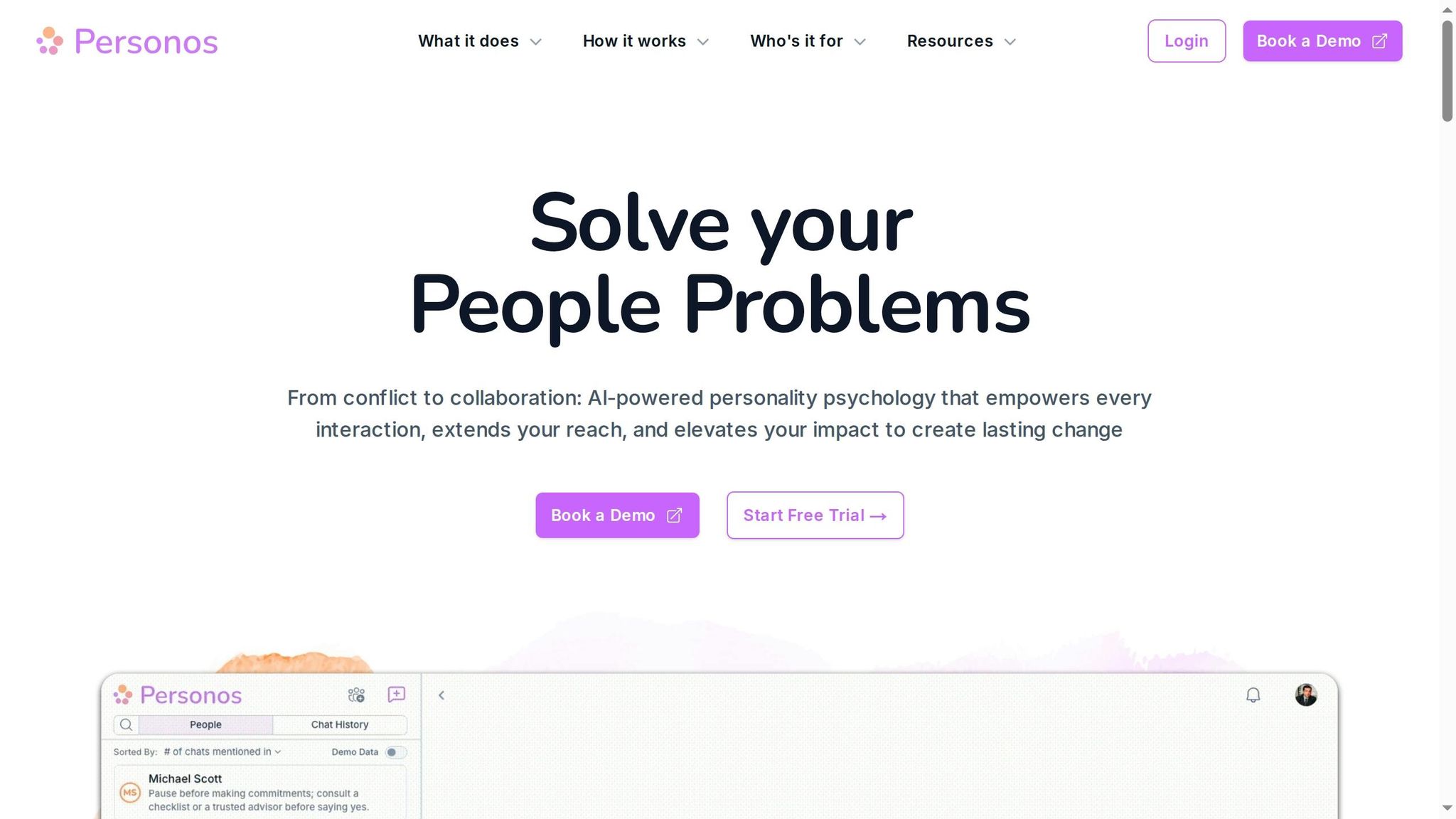
Personos blends AI with personality psychology to tackle conflicts head-on, offering a tailored approach that goes beyond generic communication tools. While many platforms focus on word choice or sentiment analysis, Personos digs deeper by aligning personality traits with conflict triggers, stress responses, and communication preferences. This allows it to provide situation-specific guidance that feels both practical and personalized.
For instance, consider a U.S. manager preparing for a tough performance review. Instead of vague advice like "be empathetic", Personos might recommend: "This employee responds well to structured, evidence-based feedback shared in the morning, followed by a written summary with actionable next steps." By offering such precise insights, the platform helps professionals navigate challenging conversations with greater confidence and clarity.
Personos acts as a conflict-coaching assistant, offering insights before, during, and after interactions. A manager can paste a draft email into the system to receive suggestions for rewording potentially inflammatory phrases while keeping the message clear. After a heated meeting, the same manager can use Personos to analyze what went wrong and plan a more effective follow-up. This kind of real-time support builds self-awareness around personal triggers and helps users better understand how others might perceive their tone - skills that align closely with U.S. leadership priorities like empathy, inclusion, and fostering psychological safety.
The platform also shines in identifying patterns within relationships and teams that might otherwise go unnoticed. For remote or hybrid U.S. teams, Personos can suggest ways to adapt communication - for example, using written agendas for detail-oriented team members or asynchronous check-ins for those who need more time to process information. Group insights might reveal assertive personalities dominating meetings or conflict-avoidant team members staying silent until issues escalate, enabling leaders to address these dynamics early.
Personos Features for Conflict Management
Personos is packed with tools designed to guide professionals through every stage of conflict resolution. Its conversational AI acts as a virtual coach, allowing users to describe disputes, outline goals, and detail the personalities involved. In return, the system provides tailored scripts, reframing suggestions, and strategies for de-escalating tension.
The platform also generates dynamic personality reports that link traits to conflict behaviors. These reports consider 30 personality traits, background details, and situational context to explain how someone might react under stress, what they find disrespectful, and their default negotiation style. Users can access three types of reports - personal, relationship, and group - each designed to provide actionable insights for specific individuals or teams.
Relationship and dyad reports are particularly useful for pinpointing friction between two people. For example, if one person prefers quick decisions while the other needs more time for discussion, the report might recommend slowing timelines, adding written follow-ups, or setting shared decision-making rules. Sarah Mitchell, MBA, VP of Operations, shared:
"We reduced team turnover by 45% in six months. Personos helped us understand why certain team dynamics weren't working and gave managers the exact words to fix it. Now we can't imagine work without it."
The platform’s ActionBoard provides real-time prompts to help users manage conflict as it unfolds. These prompts offer tips on adjusting tone, validating emotions, and defusing tension. Carla Mendoza, LCSW, an addiction recovery counselor, noted:
"In recovery, timing is everything. Personos helps me anticipate when a client is on the edge of shutting down and adjust my approach so we stay connected. That kind of in-the-moment support is priceless."
What sets Personos apart is its ability to explain the reasoning behind its recommendations. Users not only receive actionable advice but also gain a deeper understanding of why certain approaches work, making it easier to adapt strategies to their unique situations.
Personos is particularly well-suited for common U.S. workplace scenarios, such as manager-employee feedback sessions, cross-functional disputes, remote-team misunderstandings, and leadership challenges. By integrating personality insights with real-time prompts, the platform helps professionals communicate more effectively, time conversations strategically, and anticipate emotional reactions - all while aligning with U.S. workplace norms like directness, inclusivity, and psychological safety.
Pricing and Scalability
Personos offers a straightforward pricing model that makes it accessible for organizations of all sizes. At $9 per seat per month, the cost is easy to calculate. For example, a team of 50 would pay $450 per month, or $5,400 annually. This linear pricing structure works well for both small teams and large enterprises.
Organizations can allocate licenses strategically, focusing on managers, HR professionals, and others who frequently handle conflict or sensitive conversations. Individual coaches and consultants can also use the platform with active clients, incorporating Personos into sessions as a shared tool for planning and personality insights.
The financial benefits are clear when you consider the typical costs of workplace conflict - turnover, disengagement, lost productivity, and mediation fees. Even small improvements in these areas can offset the subscription cost, especially in industries where employee retention and productivity directly affect the bottom line.
To help potential users get started, Personos offers a 7-day free trial with no credit card required. Flexible contract lengths are also available, making it easier for organizations to align with their budget cycles.
Compared to traditional conflict-resolution methods like annual workshops or external consultants, Personos provides continuous, real-time learning that supports lasting behavior change. Instead of one-off interventions, users gain ongoing tools to tackle conflicts as they arise, making the platform a practical and cost-effective solution.
When implementing Personos, U.S. organizations should prioritize transparency and ethics. Clearly communicate how personality data will be collected, used, and protected, and avoid relying solely on Personos outputs for employment decisions. Pair the platform with human-led processes like trained mediators or HR oversight to ensure that insights lead to constructive dialogue rather than stereotyping or avoidance of deeper issues. By doing so, businesses can fully leverage Personos to create healthier, more inclusive workplace dynamics.
How to Integrate AI Tools into Conflict Resolution Practices
Using AI in conflict resolution is about complementing human expertise, not replacing it. Tools like Personos can provide real-time insights and support, but the key is to adopt them in a way that enhances human decision-making. Many professionals in the U.S. have found success by treating AI as a preparation and decision-support resource rather than relying solely on automation. Start small, build trust in the technology, and set clear boundaries for when AI assists and when human judgment takes over.
Combining Human and AI Insights
The best way to use AI is as a starting point, not the final word. For example, if a sentiment analysis tool detects rising tension in an email thread, treat it as an early warning to engage with the individuals involved, not as a definitive conclusion. AI can lighten the mental load by summarizing communications, identifying blame-shifting, and offering settlement suggestions. This frees up your energy to focus on building empathy, rapport, and understanding the nuances of the situation.
In real-time scenarios, AI tools can suggest alternative phrasing or clarifying questions. For instance, if Personos recommends a specific way to deliver feedback to a detail-oriented employee, you can tweak the wording to suit your personal style or the urgency of the moment. The platform’s transparent reasoning feature explains why certain approaches are effective, making it easier to adapt strategies to fit the context.
After a session, AI-generated reports on language patterns, emotional triggers, or recurring issues can aid in reflection and supervision. However, critical decisions - such as determining fairness, readiness for resolution, or ensuring psychological safety - should always remain in human hands. A clear guideline like "AI informs; humans decide" helps maintain trust and transparency when communicating with participants.
AI can be integrated at various stages of conflict resolution work:
- Prevention: AI tools can monitor internal communications for negative sentiment or exclusionary language, alerting HR to trends that may indicate burnout or team tension. This allows for early interventions, such as check-ins or training, before conflicts escalate.
- Mediation: During disputes, AI can summarize submissions, distill key interests, and generate neutral language to minimize misunderstandings.
- Post-Conflict Learning: Analyzing transcripts can uncover common triggers and effective de-escalation techniques, helping refine policies and training.
Personos, for example, enhances preparation by generating personality reports that identify potential friction points, such as between a direct communicator and a harmony-focused colleague. These insights help practitioners tailor their facilitation strategies. Additionally, Personos offers conversational AI and proactive prompts to guide team leaders or members before challenging discussions, suggesting language that reduces defensiveness.
To ensure autonomy and avoid labeling, present AI tools as supportive aids rather than definitive assessments. Encourage participants to validate or question the insights, and avoid making critical decisions based solely on personality profiles.
"Initially I thought Personos was just one more thing on my plate, but really it takes 20 things off your plate. Now I can reach twice as many families and provide better support because I'm not spending hours second-guessing my approach."
– Robert Fields, Community Outreach Coordinator
Next, we’ll explore how to combine AI insights with human intuition to strengthen conflict resolution practices. Effective training ensures U.S.-based professionals can maximize the benefits of these tools.
Training and Adoption for U.S.-Based Professionals
For successful AI adoption, professionals need training in three key areas: tool usage, interpretation, and ethics. Hands-on practice with AI tools - like running sample analyses, using coaching prompts, and integrating outputs into casework - helps users understand their capabilities and limitations. Interpretation training ensures professionals can critically evaluate AI insights, identify false positives or negatives in sentiment or bias detection, and balance AI suggestions with context, culture, and nonverbal cues. Ethics training focuses on addressing biases, privacy concerns, and confidentiality issues, often through role-playing challenging scenarios.
Before deploying AI, provide clear, plain-language explanations of what the tool does, the data it uses, and how the results will be applied. In many U.S. workplaces, it’s best to obtain explicit acknowledgment from participants - via employee handbooks, mediation agreements, or training forms - so everyone understands the tool’s role and limitations.
In mediation or coaching, agreements should clarify whether AI will analyze written submissions, session notes, or follow-up communications. It’s crucial to reaffirm that AI outputs are advisory and subject to human review. Communicating that AI is used to promote fairness and psychological safety - not to secretly monitor individuals - builds trust. Disclosing any involvement of third-party vendors and offering a process to question or challenge AI insights further aligns with U.S. standards for fairness.
Organizations should also create clear acceptable-use policies specifying when AI can be used in conflict resolution. For instance, AI might be allowed for coaching and pattern analysis but prohibited in monitoring private conversations. Data handling protocols should outline what communication data is collected, how it’s anonymized, retention periods, encryption standards, and who can access AI-generated outputs - all in compliance with U.S. privacy laws. Ethics committees that include HR, legal, and employee representatives can review AI tools for potential bias and ensure transparency before implementation.
Adoption tends to succeed when organizations start with clear, manageable challenges. For example, reducing email escalations or helping remote managers navigate tough feedback sessions are practical starting points. A pilot program focused on low-risk, internal use cases - such as coaching leaders or analyzing anonymized communication patterns for early tension warnings - can demonstrate quick results. Define specific goals, like reducing unresolved team conflicts by 20% within six months, and select one or two AI tools to support that objective. Initially, use AI in the background for preparation and reflection, keeping its role advisory. Avoid applying AI directly to high-stakes or highly emotional conflicts until trust in the tools is well established.
Choosing the Right AI Tools for Conflict Resolution
When it comes to selecting the right AI tools for conflict resolution, it’s all about finding the right balance between functionality, ethical considerations, and seamless integration. The key is to match the tool’s capabilities with your specific needs - whether it’s addressing workplace disputes, guiding leaders through tough conversations, or mediating family disagreements. Using the wrong tool can complicate matters instead of simplifying them, so it’s crucial to choose wisely.
One important factor to assess is the tool's ability to analyze emotional and communication cues. Go beyond basic sentiment analysis - look for features that detect emotional intensity and identify manipulation tactics like blame-shifting, gaslighting, or subtle biases. Reliable analysis ensures that conflict resolution efforts remain structured and effective.
For scenarios where personality dynamics are at the forefront - like coaching relationships, team development, or ongoing workplace tensions - tools with personality- and relationship-focused features are a must. For instance, Personos stands out with its dynamic personality reports, which translate individual traits into actionable strategies. It provides tailored prompts based on communication styles and stress responses, highlights potential friction points before they escalate, and even offers real-time coaching for tasks like drafting emails or preparing for meetings.
Ethical safeguards and data protection are non-negotiable. Before committing to a tool, verify that it uses strong encryption, enforces clear data retention policies, and meets U.S. standards for bias testing. Transparency is another critical feature - tools that explain why certain language was flagged or why a specific approach is recommended help you validate AI insights against your own professional judgment, fostering trust in the process.
Integration is another essential consideration. The best tools work seamlessly with platforms you already rely on, such as email, Slack, Microsoft Teams, or HR systems. This kind of integration ensures conflict insights and coaching prompts are readily available within your existing workflow, reducing the hassle of switching between applications. For busy organizations, this can make proactive conflict resolution far more manageable.
Budget is, of course, a practical factor to weigh. Many enterprise platforms use pricing models like per-seat fees or organization-wide licenses. For example, Personos Pro costs $9 per seat per month and includes features like specialized chats, dynamic reports, transparent reasoning, and proactive prompts. A 7-day free trial (no credit card needed) allows you to test whether it aligns with your approach to conflict resolution before making a full commitment.
It’s important to remember that AI is a tool to assist, not replace, human judgment. The best AI tools highlight patterns, suggest language adjustments, and prepare you for challenging conversations, but they leave critical decisions - like fairness, sanctions, or relationship repair - in human hands. This approach not only ensures responsible conflict resolution but also helps build trust with the people you’re working with.
Starting with a small pilot program is a smart way to test the waters. Focus on one or two high-impact use cases and track metrics like time-to-resolution, employee satisfaction with conflict processes, or the frequency of repeat disputes. If the tool delivers measurable results, you can then roll it out across the organization with confidence.
FAQs
How do AI tools handle privacy and ethics when analyzing sensitive workplace communications?
AI tools built for conflict resolution put a strong emphasis on privacy and ethical practices, incorporating several layers of protection. These protections include secure data encryption, anonymizing sensitive details, and ensuring compliance with data protection laws like GDPR and CCPA. Many of these tools also offer adjustable privacy settings, giving organizations the flexibility to manage how data is handled and stored.
To promote ethical usage, these tools are designed to minimize bias by using transparent algorithms and following strict ethical standards. By prioritizing confidentiality, fairness, and accountability, they help build trust and provide a secure space for addressing workplace conflicts efficiently.
What features should you prioritize in AI tools for resolving workplace conflicts?
When selecting AI tools to address workplace conflicts, focus on features that improve communication and foster understanding. For instance, personalized conversational AI can guide discussions with empathy and clarity, while dynamic personality insights offer context to better manage interpersonal relationships. Tools with relationship and group analysis can highlight areas where conflicts might arise, and proactive communication prompts help keep interactions on track. To ensure accountability and sustained collaboration, features like task tracking are invaluable for monitoring progress and follow-through.
How can organizations effectively combine AI tools with human judgment to resolve conflicts?
Organizations can combine AI tools with human insight to improve interpersonal communication and teamwork. Take Personos, for example - this tool offers features like dynamic personality reports, relationship and group analysis, and proactive communication tips. These capabilities help professionals address conflicts with a greater sense of emotional awareness.
While AI can deliver helpful insights and practical suggestions, human judgment is still critical for grasping context and making thoughtful decisions. By working together, AI tools and human expertise can create a more balanced approach to resolving conflicts, leading to stronger connections and better results.