AI-Driven Crisis Solutions for Nonprofit Leaders
AI helps nonprofits prevent crises, cut response times, and reduce staff burnout with predictive analytics, real-time monitoring, and people-centered guidance.
Nick Blasi

AI-Driven Crisis Solutions for Nonprofit Leaders
AI is helping nonprofit leaders tackle growing challenges in crisis management. With staff burnout affecting 95% of leaders, surging service demands, and limited funding, nonprofits are struggling to respond quickly and effectively. Tools like ImpactAI, Reflex AI, and Personos are transforming how organizations handle crises by automating tasks, improving decision-making, and reducing burnout. Key takeaways:
- AI predictive tools like ImpactAI analyze data 99% faster, enabling proactive planning.
- Real-time systems like Reflex AI enhance call routing and quality assurance, cutting response times by 15-20%.
- Personos supports staff by offering real-time advice for managing interpersonal challenges, reducing turnover by 45%.
- Pilot programs and clear metrics ensure smooth AI adoption.
AI offers nonprofits a way to improve efficiency and protect staff well-being while addressing growing community needs.
Nonprofit Crises in Resource-Limited Settings
Common Nonprofit Crisis Scenarios
Nonprofits often face overlapping crises, with burnout among staff and volunteers being a major issue. A staggering 90% of nonprofit leaders acknowledge that burnout is affecting their teams [6]. This issue is particularly severe in crisis services, where 70% of behavioral-health workers and college counseling staff report experiencing burnout [2].
Another significant challenge arises when demand for services spikes unexpectedly. For instance, events like a celebrity suicide or a natural disaster can cause call volumes to triple overnight. Since many organizations operate on fixed volunteer schedules, this surge can overwhelm their capacity [3]. This leads to what experts call the "impossible choice": either accept dangerously long wait times for those in need or compromise on quality to manage the increased volume [3].
Administrative burdens also drain resources that could be better spent on frontline work. Over 65% of frontline workers’ time is consumed by documentation, yet only 3% of crisis interactions are reviewed, leaving most cases unchecked [5][3]. Michael Wroczynski, CEO of Samurai Labs, highlights the importance of human involvement, stating:
"For crisis, we need human operators" [3]
However, these operators are often overwhelmed by excessive administrative tasks, making it even harder to focus on their core responsibilities.
How Resource Constraints Worsen Crises
Limited funding and staffing shortages magnify these challenges, weakening nonprofits’ ability to respond effectively. When government funding is slashed by 15–20% or more, organizations lose the support needed to maintain their infrastructure, not just individual programs [7]. This creates a ripple effect: reduced capacity to showcase impact to donors, lower donor retention rates, and further funding cuts [7].
Training new volunteers during emergencies adds another layer of difficulty. Each recruit requires 30–40 hours of training, which diverts supervisors’ attention from critical operations [3]. During crises, this dual strain of onboarding new volunteers and managing experienced staff pushes organizations to their limits [3]. Digital exhaustion compounds the problem - 84% of workers report unmanageable workloads, and 90% of nonprofits juggle three or more third-party systems [6]. This combination of factors leads to slower response times, higher turnover, and reduced capacity, precisely when communities are most in need.
Addressing these intertwined challenges requires fresh, data-driven approaches to improve how crises are detected and managed using real-time communication tools.
AI Tools for Crisis Detection and Response
Using Predictive Analytics to Prevent Crises
AI-driven predictive tools are transforming how nonprofits approach crisis management. Instead of waiting for disasters to unfold, these tools analyze historical data and patterns to provide early warnings, enabling organizations to prepare in advance.
Take ImpactAI, developed by the World Bank's Development Impact group (DIME) in October 2024. This generative AI assistant scans research on poverty and public health at lightning speed - 99% faster than manual methods. By automating data analysis, it equips policymakers with the insights needed to make informed decisions during global development crises [1].
Another example is the Crisis Sensitivity Simulator, created by the Fund for Peace and SAS. In June 2024, humanitarian organizations in Port Harcourt, Nigeria, used this tool to simulate the ripple effects of catastrophic flooding. Drawing from 19 years of data across 179 countries, the simulator modeled how a single event could impact social, economic, and security systems. This approach helps prioritize preparedness strategies. As Nate Haken explains:
"It is much harder to predict the cascading impacts of the crisis after it occurs" [8].
The UNDP has also made strides with its Crisis Risk Dashboard, implemented in countries like Sri Lanka and Ecuador between 2024 and 2025. This system integrates data from satellite imagery, social media, and night-light patterns to identify potential crisis hotspots. By summarizing and cleaning data from diverse sources, the dashboard provides real-time insights that help prevent situations from escalating [9].
While predictive tools focus on prevention, real-time monitoring ensures swift responses when crises strike.
Real-Time Crisis Monitoring Systems
When emergencies arise, timing is everything. Real-time monitoring systems powered by AI are designed to detect unfolding crises and allocate resources where they're needed most.
Organizations like The Trevor Project and Lines for Life have turned to AI-powered routing to handle surges in demand. These systems analyze caller data - such as voice tone, text content, and interaction history - to predict needs and connect high-risk individuals with specialized counselors. This has reduced average call times by 15% to 20% by minimizing transfers and improving matches between callers and counselors [3].
Lines for Life, based in Oregon, introduced Reflex AI in January 2026 to enhance quality assurance. Unlike traditional methods that reviewed only 3% of calls, Reflex AI evaluates 100% of call transcripts for signs of empathy and safety. This allows counselors to receive instant feedback and enables supervisors to concentrate on urgent cases flagged by the system [3].
In another initiative, CARE collaborated with Valorem Reply and Microsoft in June 2024 to create a sentiment analysis tool using Azure OpenAI Service. Led by Cherian Varghese, CARE automated the review of open-ended survey responses, cutting analysis time from weeks to just 30 minutes. This efficiency saved staff 20% of their time while maintaining human-level accuracy. As Varghese points out:
"Using AI to derive insights in a timely manner helps us address problems more proactively. We're therefore more ready to address a disaster or can even work to prevent an emergency" [10].
AWS re:Invent 2024 - Transforming humanitarian aid with AI (IMP103)
Personos: AI for People-Centered Crisis Management
While predictive analytics and monitoring systems excel at managing data-driven crises, nonprofit leaders often face a tougher challenge: navigating interpersonal conflicts. Whether it's a client withdrawing during a critical intervention or team tensions disrupting service delivery, these moments call for a deeper understanding of human dynamics.
Personos steps in to address this gap. Unlike tools focused on logistics or operations, Personos is an AI-powered platform designed to tackle the human side of crisis management. Built on insights from the Five Factor Model, which analyzes 30 scientifically validated personality traits, Personos provides real-time guidance to help nonprofit leaders handle high-stakes interactions effectively.
How Personos Enhances Crisis Intervention
Successful crisis management often hinges on interpersonal dynamics, and Personos delivers targeted, actionable support when it’s needed most.
Personos Chat offers real-time conversational advice during difficult interactions. For instance, if a case manager notices a client becoming defensive, they can describe the situation to Personos and receive tailored recommendations based on the personality profiles involved. Carla Mendoza, LCSW and addiction recovery counselor, highlights its value:
"In recovery, timing is everything. Personos helps me anticipate when a client is on the edge of shutting down and adjust my approach so we stay connected. That kind of in-the-moment support is priceless." [2]
Dynamic Reports provide detailed insights that pinpoint the root causes of relationship friction. These reports offer precise communication strategies, whether you're working with a resistant domestic violence survivor or addressing team conflict in a reentry program. For example, a program director can use these insights to guide interventions with precision.
The ActionBoard turns these insights into actionable steps. Staff can track recommendations and ensure they’re implemented quickly. In one instance, Sarah Mitchell, MBA, VP of Operations, used this feature to reduce team turnover by 45% in just six months. By identifying failing team dynamics and providing clear communication strategies, Personos empowered managers to resolve conflicts effectively. [2]
What truly sets Personos apart is its Transparent Reasoning feature. This explains the personality traits and principles behind its advice, helping staff understand the logic and build their confidence in managing future crises independently.
To address privacy concerns, Personos ensures sensitive information remains protected. Names are anonymized before AI processing, and personality scores are only shared if explicitly authorized. This approach avoids the labeling issues often associated with traditional assessments.
By improving client interactions and reducing stress for staff, Personos strengthens the overall capacity of nonprofits to respond to crises.
Tackling Staff Burnout with AI
Burnout is a major challenge in the nonprofit sector, with 80% of behavioral health workers citing it as a top barrier to hiring and retention. [2] Personos directly addresses this issue by lightening the emotional and mental load on frontline staff.
Steve Huff, PhD, a seasoned social worker with three decades of experience, explains the impact:
"With Personos, I no longer feel the burden of solving my client's problems. Instead, I walk beside them as they discover their own solutions. It's truly a game changer." [2]
The platform helps practitioners maintain healthy boundaries without compromising empathy. Lisa Chen, MSW and domestic violence advocate, shares her perspective:
"When you work with survivors, you're constantly balancing empathy with boundaries. Personos has helped me protect my own well-being while staying fully present for the people I serve." [2]
Personos positions itself as a collaborative partner, not a replacement. By simplifying complex interpersonal dynamics, it reduces the mental toll on staff. Robert Fields, a community outreach coordinator, admits he was initially hesitant about adopting another tool:
"I went in thinking I didn't have bandwidth for another tool. What I didn't expect was that it would make me so much more effective that I actually ended up with more bandwidth." [2]
Affordably priced at $9 per month per seat for the Pro plan, Personos includes all core features and even provides grant-writing assistance to help nonprofits secure funding for implementation. [2]
Comparing AI Platforms for Nonprofit Crisis Management
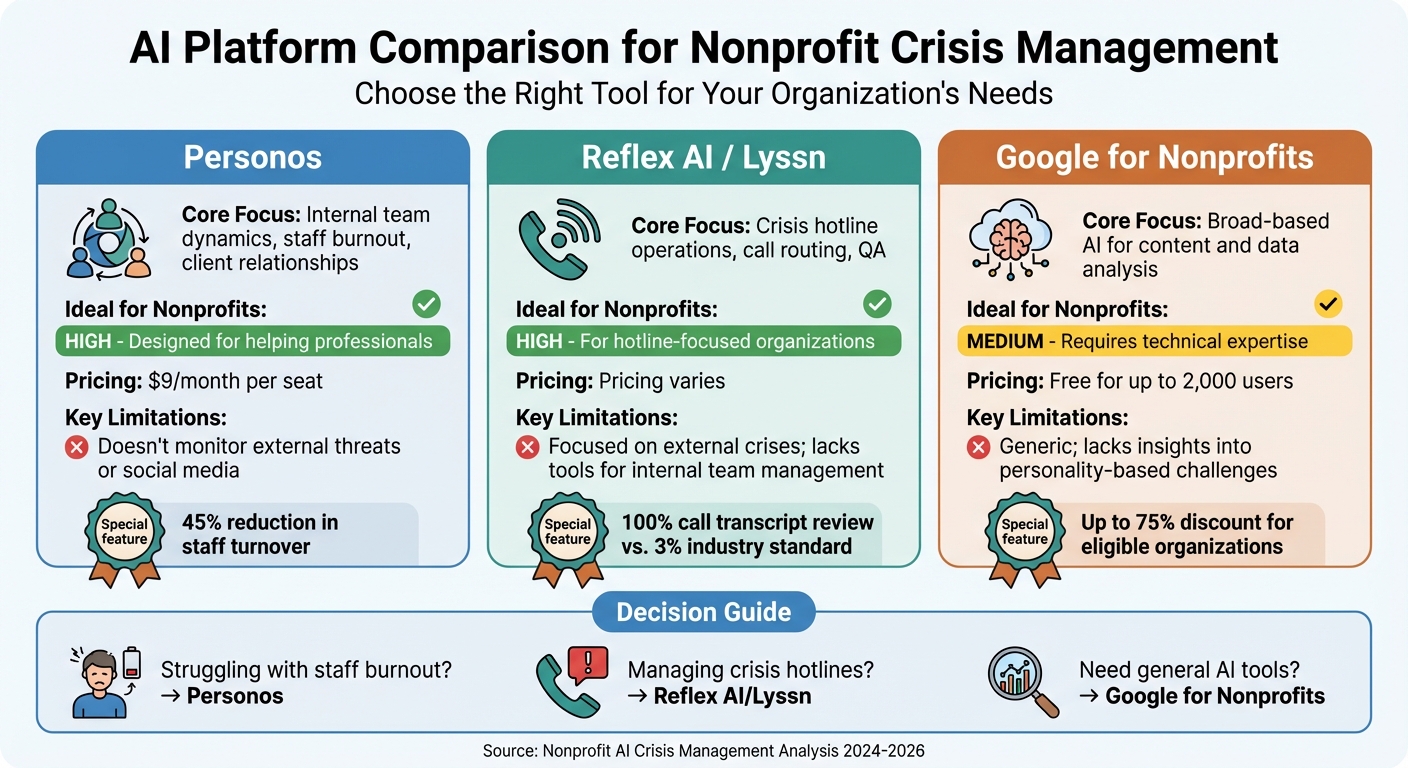
AI Crisis Management Platform Comparison for Nonprofits
When choosing an AI platform for nonprofit crisis management, it's essential to align the tool with the specific challenges you're facing. Some platforms are tailored for operational tasks like call routing and hotline management, while others, such as Personos, focus on internal challenges like staff burnout, team conflicts, and managing tough client interactions.
For crisis hotline operations, tools like Reflex AI and Lyssn are designed to handle intelligent call routing and ensure quality assurance. These platforms excel at identifying high-risk interactions, helping to prevent counselor exhaustion during peak crisis periods[3]. However, their scope is limited to external crisis response, leaving internal team dynamics unaddressed - often a key factor in staff retention.
On the other hand, general-purpose platforms like OpenAI and Google for Nonprofits can be a good fit for nonprofits needing assistance with tasks like content creation or data analysis. Google, for example, offers up to 75% discounts for eligible organizations and even provides free access for up to 2,000 users[11]. However, these tools don't specialize in areas like personality psychology or interpersonal relationship management, which are crucial for handling internal crises.
To help you decide, here's a quick comparison of some leading platforms, highlighting their focus, suitability for nonprofits, pricing, and limitations:
Platform Comparison Table
| Platform | Core Focus | Ideal for Nonprofits | Pricing | Key Limitations |
|---|---|---|---|---|
| Personos | Internal team dynamics, staff burnout, client relationships | High - designed for helping professionals | $9/month per seat | Doesn't monitor external threats or social media |
| Reflex AI / Lyssn | Crisis hotline operations, call routing, QA | High - for hotline-focused organizations | Pricing varies | Focused on external crises; lacks tools for internal team management |
| Google for Nonprofits | Broad-based AI for content and data analysis | Medium - requires technical expertise | Free for up to 2,000 users | Generic; lacks insights into personality-based challenges |
This breakdown should help you weigh the strengths and limitations of each platform, ensuring you select the right tool for your nonprofit's unique needs.
How to Implement AI Crisis Management Tools
Evaluating Your Organization's Needs
To get started, it’s crucial to assess how prepared your organization is to adopt AI tools. NetHope's AI Readiness Benchmark can help by evaluating six areas: Responsible AI practices, Skilling and Change Management, Data Readiness, Organizational Resources, Strategy and Opportunity, and Technology Infrastructure [12].
Ask yourself a few key questions:
- Are there 2–3 specific problems AI could address for your organization?
- Is your data accessible and exportable?
- Do you have someone on staff willing to take the lead on this initiative?
- Is there room in your budget for this kind of investment?
- Does leadership back the idea of experimenting with AI? [12]
Remember, AI thrives on clean, well-organized data. If your donor records are outdated, client files are scattered, or naming conventions are inconsistent, AI tools could amplify these issues rather than solve them. Taking the time to organize and standardize your data is a critical first step [12][13].
This evaluation process ensures that the AI tools you choose align with your nonprofit's specific crisis management challenges.
Testing AI Tools with Pilot Programs
Once you’ve pinpointed your needs, the next step is to test AI tools through a pilot program. A structured 90-day plan works well: spend 30 days preparing, 30 days running the pilot, and 30 days analyzing the results.
During the first 30 days, conduct readiness assessments, draft AI policies (NTEN templates can help), and identify 1–2 "AI champions" within your team to lead the effort [12].
For the pilot phase (days 31–60), start small. Focus on a specific team or problem area. For instance, The Trevor Project used an AI training simulator to help new volunteers practice crisis intervention with AI-generated caller personas. Volunteers who completed the simulation showed stronger initial skills and needed less supervision during their first few weeks [3].
If you're testing tools like Personos, consider starting with your leadership team. At $9 per seat per month, you can explore features like the ActionBoard, Dynamic Reports, and Transparent Reasoning. Weekly check-ins with the team can help gather feedback, highlight successes, and troubleshoot challenges [2]. These pilot programs allow you to fine-tune your approach, reduce staff burnout, and improve crisis response.
Look for "quick wins", such as automating repetitive tasks with clear outcomes. Examples include drafting donor emails, summarizing meeting notes, or translating materials for multilingual audiences [12].
Training Staff and Tracking Results
After piloting, focus on training your team and setting up metrics to measure the tool's effectiveness. Establish baseline data before launching AI tools. For example, track current response times, staff burnout levels, and intervention outcomes. This allows you to measure progress accurately and avoid guessing whether the tools are working [12][3].
Training should go beyond basic functionality. Tools like Personos’ Transparent Reasoning feature help staff understand the logic behind AI-generated recommendations, such as which personality traits were considered or the psychological principles applied. This kind of transparency builds trust and encourages deeper learning [2].
An example of effective implementation comes from Lines for Life, a nonprofit in Oregon. In 2026, they partnered with Reflex AI to create an automated quality assurance system that reviews 100% of crisis calls, a significant improvement over the industry standard of just 3% [3]. The system evaluates transcripts for empathy markers and adherence to safety plans, giving counselors immediate feedback and transforming training into a continuous learning process. Tools like these have been shown to reduce turnover by 45% in six months by improving team dynamics and providing managers with actionable insights [3].
It’s also important to monitor for unintended consequences. For instance, ensure risk-assessment AI doesn’t unfairly flag marginalized populations due to biased data. Use AI to distribute high-intensity crisis calls evenly across the team to prevent burnout and secondary traumatic stress. While AI can be a powerful support tool, it should never replace human judgment [3].
| Metric Category | What to Track | Why It Matters |
|---|---|---|
| Efficiency | Response time & call duration | Shortens wait times for high-risk clients [3] |
| Quality | Completeness of safety planning | Ensures adherence to evidence-based protocols [3] |
| Staff Health | Counselor turnover & burnout rates | Reduces trauma by balancing workloads [2][3] |
| Financial | Cost-effectiveness ratio | Improves resource utilization by 300–500% [12] |
Conclusion
Nonprofits are facing a perfect storm: growing demands, tighter budgets, and teams stretched to their limits. In this challenging environment, AI is emerging as a practical solution. These tools address critical "people problems" like team conflicts, burnout, and the emotional toll of crisis work[2]. At the same time, systems like quality assurance and intelligent routing help organizations handle surges with greater efficiency[3].
The real power of AI lies in how it’s integrated. Nonprofits that weave these tools into shared workflows, instead of relying on individual efforts, tend to achieve more impactful results[4]. Starting small with pilot programs, setting up clear governance, and focusing on key metrics - like response times, staff retention, and client outcomes - can help build trust and momentum. For example, Personos, priced at $9 per seat per month, has shown a 45% drop in staff turnover, proving that AI can safeguard both operations and the well-being of team members[2]. When used effectively, AI becomes a force multiplier, freeing up leaders to focus on the mission and build stronger relationships[14]. As Steve Huff, PhD, a seasoned social worker with 30 years of experience, puts it:
"With Personos, I no longer feel the burden of solving my client's problems. Instead, I walk beside them as they discover their own solutions. It's truly a game changer."[2]
FAQs
Where should we start with AI in a crisis?
Start by pinpointing the challenges AI can help tackle - things like improving communication, streamlining decision-making, or boosting staff efficiency. For example, tools like Personos offer tailored, real-time guidance for crisis intervention and client interactions, complementing human efforts and making processes smoother.
It’s important to prioritize ethical practices, invest in proper staff training, and start with small pilot projects. These initial steps can help you measure outcomes effectively and scale up with confidence. Begin with specific, proven applications - like crisis hotlines or mental health support systems - to establish clear goals and demonstrate success early on.
How do we protect client and staff privacy with AI?
When using AI tools, safeguarding the privacy of clients and staff is non-negotiable. This means putting strong data protection measures in place and adhering to ethical practices every step of the way.
Start by ensuring that any AI tools you use comply with relevant data protection laws. It's essential to securely store sensitive information, limit access strictly to authorized personnel, and anonymize data whenever possible to reduce risks.
Clear policies for how data is used should also be established. Regular audits can help identify potential vulnerabilities, and maintaining open communication with stakeholders about how data is handled builds trust.
Platforms like Personos are designed with privacy in mind, making them a great choice for nonprofits that deal with sensitive matters like crisis management or human services. These tools prioritize keeping data secure while supporting the unique needs of organizations working in these challenging areas.
How do we measure ROI from AI in crisis work?
Evaluating the return on investment (ROI) from AI in crisis work involves more than just calculating time saved. It’s about considering the broader benefits AI brings to the table, such as improved response efficiency, greater accuracy in triage, the capacity to assist more individuals, and better crisis intervention outcomes.
To make a compelling case to stakeholders, use measurable frameworks. These frameworks should clearly demonstrate how AI impacts key performance areas while aligning the results with your organization’s goals. By focusing on tangible improvements and outcomes, you can effectively highlight the value AI brings to crisis work.