AI Coaching Plans for Relationship Goals
Practical AI coaching methods to improve communication, resolve conflicts, rebuild trust, and track relationship progress for couples, families, and teams.
Rachel Johnson

AI Coaching Plans for Relationship Goals
AI coaching is transforming how we approach relationships by offering personalized, 24/7 support to improve communication, resolve conflicts, and build trust. Using tools like natural language processing and personality analysis, platforms such as Personos create tailored strategies for romantic, family, and workplace dynamics. The process involves setting measurable goals, tracking progress, and using real-time feedback to refine skills like active listening and emotional regulation.
Key Takeaways:
- What it does: AI coaching evaluates communication styles, identifies triggers, and suggests exercises to improve interactions.
- How it works: Combines personality psychology with AI to deliver custom plans based on traits and relationship dynamics.
- Who it helps: Couples, families, and teams looking to improve trust, reduce conflicts, or enhance collaboration.
- Why it’s effective: Tracks progress with data-driven insights and offers constant availability for support.
- Privacy matters: Strong security measures ensure data protection and ethical use.
AI coaching is a tool to complement - not replace - human professionals, making relationship support more accessible and actionable.
I turned ChatGPT into a Relationship Coach
Core Principles of AI Relationship Coaching
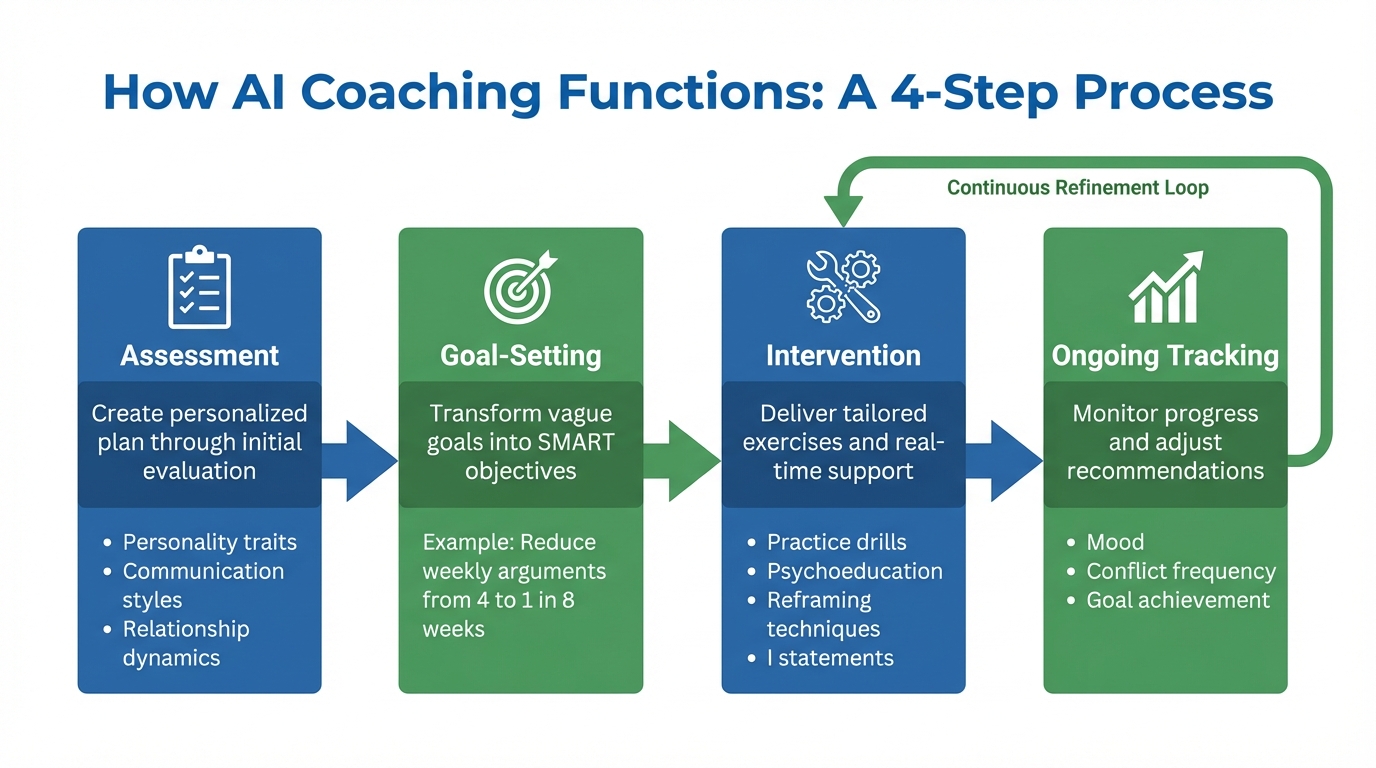
AI Relationship Coaching Process: 4-Step Framework from Assessment to Progress Tracking
AI relationship coaching is built around four key ideas: personalized support, constant availability, data-driven insights, and skill-building. Unlike one-size-fits-all advice, AI digs into your conversation history, emotional patterns, and personality traits to craft guidance that feels natural and relevant. By using personal data, the advice aligns with your unique situation, making it easier to apply. Plus, the 24/7 accessibility means help is there when you need it most - whether during a heated budget talk or a tense workplace moment - without waiting for a scheduled session. AI coaches also focus on practical skills like emotional regulation, effective communication, and boundary setting. They offer structured exercises designed to create real behavior changes. Many platforms combine psychological techniques into a clear, step-by-step process, making it easier to work toward your goals.
Relationship Goals AI Can Support
AI coaching is particularly effective in five key areas: improving communication, rebuilding trust, resolving conflicts, setting boundaries, and fostering collaboration. For communication, AI helps you prepare for tough conversations by turning accusatory language into constructive formats like observation-feeling-need-request statements. It also lets you practice active listening techniques before diving into real discussions. When it comes to rebuilding trust - whether after a breach or in long-distance relationships - AI offers tools like transparency exercises, jealousy management strategies, and shared agreements, along with regular check-ins to ease insecurities. For conflict resolution, AI analyzes your emotional triggers and thought patterns, providing calming techniques and new perspectives to defuse tension before it escalates. In boundary setting, AI guides you in creating clear, respectful boundaries with actionable consequences, offering practice scripts and role-playing exercises to build confidence. For workplace collaboration, AI helps align goals, improve feedback exchanges, and facilitate post-meeting reviews, often including shared activities for all parties to complete. These tools make tackling relationship challenges more manageable and actionable.
How AI Coaching Functions
AI coaching follows a clear process: assessment, goal-setting, intervention, and ongoing tracking. It starts with an assessment to create a personalized plan. Broad goals like "argue less" are broken down into measurable steps, such as "reduce weekly arguments about chores from 4 to 1 in 8 weeks." The AI then provides a tailored plan with exercises, prompts, and regular check-ins. During sessions, you share recent experiences, and the AI identifies emotions and behavior patterns, offering psychoeducation, reframing techniques, and practice drills like using "I statements." Over time, it tracks progress in areas like mood, conflict frequency, and goal achievement, adjusting its recommendations if you hit a plateau or face setbacks.
Platforms like Personos take this approach further by integrating conversational AI with dynamic personality reports. These reports analyze 30 personality traits, background details, and situational factors, updating as new data comes in. This allows the system to refine prompts, conflict strategies, and collaboration methods tailored to your personality. Personos also provides real-time nudges during critical moments, such as reminders to "pause and breathe" before a budget discussion or suggested phrases for delivering feedback. In team settings, it generates group reports that recommend collaboration norms and role assignments based on individual strengths, improving communication and reducing unnecessary friction.
Privacy and Ethical Guidelines
Privacy and ethical considerations are at the heart of AI coaching, ensuring your data and progress stay secure. Tools should provide clear consent options, collect minimal data, use strong encryption, and maintain transparent data usage policies. For example, platforms should explain in plain terms what data they collect - like conversation transcripts, mood logs, or personality assessments - how it’s stored (encrypted both in transit and at rest), and who can access it. Minimizing data collection to what’s strictly necessary for effective coaching is crucial, along with options to delete your history or export data if you decide to stop using the service. While most AI coaching apps in the U.S. aren't bound by HIPAA unless tied to licensed healthcare providers, they should still follow strict security standards and avoid sharing identifiable relationship data without explicit, opt-in consent. Users should also have control over notifications and device access to protect private conversations, especially in shared living spaces or sensitive situations.
It’s important to note that AI coaching is a supplementary tool, not a replacement for licensed professionals in cases of crisis or abuse. These tools should clearly recommend professional human support when necessary and guide users to escalate appropriately in such scenarios. AI coaching works best as part of a broader support system, not as a standalone solution in critical situations.
Creating AI Coaching Plans for Relationship Goals
Defining Clear Relationship Goals
Turning vague relationship aspirations into actionable plans starts with setting SMART goals - Specific, Measurable, Achievable, Relevant, and Time-bound. For example, instead of saying, "I want fewer fights with my partner", you could reframe it as: "Improve how we discuss finances without yelling." Or, instead of "I want my team to trust me more", you might say: "Reduce weekly arguments about money from three to one and resolve them without either person walking away."
AI plays a key role in this process by asking targeted questions like, "When does this usually happen?" or "What would success look like in measurable terms?" These answers help the system create trackable metrics - things like the frequency of arguments or the tone of communication. These metrics are then displayed on a dashboard, allowing you to monitor progress and receive reminders if you're falling off track.
When juggling multiple goals - like improving trust, setting boundaries, and reducing micromanaging - the AI helps you prioritize. It organizes these goals into themes (e.g., communication, emotional regulation, setting boundaries) and asks you to rank their importance and urgency on a 1–5 scale. The system then suggests focusing on one to three main goals for the first 4–8 weeks, while placing less urgent ones in a queue for later. This approach helps create momentum, as early successes in one area often make progress in others easier.
With clear priorities and metrics in place, the next step is building a personalized coaching plan that fits your unique personality and relationship dynamics.
Components of an AI Coaching Plan
Once your goals are defined, the AI constructs a detailed coaching plan. This plan typically includes:
- Baseline Assessment: This initial step involves questionnaires covering relationship satisfaction, communication habits, conflict frequency, and emotional well-being. For deeper insights, users can opt to integrate past conversation logs for pattern analysis.
- Personality Profiling: The AI identifies traits like introversion or extraversion, preferred communication styles, and approaches to conflict, helping tailor the plan to your natural tendencies.
- Relationship Dynamics Map: A visual tool that connects key issues - such as trust, communication, or boundaries - with your SMART goals and necessary sub-skills, like active listening or making clear requests.
From there, the AI provides practice modules and exercises. These might include guided conversations, role-play scenarios, journaling prompts, or CBT-inspired tools like pre-conflict grounding techniques and post-conflict reflections. Progress is tracked through visual dashboards, showing trends in conflict frequency or communication tone, and weekly summaries highlight areas for improvement.
Regular check-ins are built into the plan to review progress, identify challenges, and adjust goals as needed. Platforms like Personos streamline this process by integrating dynamic personality reports, relationship analysis tools, and task tracking to connect every goal to specific, actionable steps.
Customizing Plans Based on Personality
The most effective coaching plans are those tailored to your personality and conflict style. For instance:
- Introverted or Sensitive Users: These plans might focus on asynchronous tools like journaling or written scripts, paired with shorter, more frequent check-ins. Pre-social self-regulation exercises may also be included.
- Extraverted Users: These individuals might benefit from live role-plays or real-time feedback sessions, which align with their preference for interactive, verbal activities.
- Autonomy-Driven Users: Suggestions are framed as options rather than directives, giving them the flexibility they value.
- Structure-Oriented Users: These plans include detailed, step-by-step instructions to align with their need for clear guidance.
Conflict styles further refine the approach. For someone who avoids confrontation, the AI might introduce low-stakes practice scenarios to gradually build confidence for tougher conversations. On the other hand, those who lean toward confrontation might focus on reflection prompts and empathy exercises to balance their approach.
Personos enhances this process with dynamic personality reports, which illustrate how different personalities interact - pinpointing both areas of tension and strengths. For teams, it generates group reports that recommend collaboration norms and role assignments based on individual strengths, helping to improve overall communication and reduce friction.
sbb-itb-f8fc6bf
Sample AI Coaching Plans for Common Relationship Challenges
Here are some examples of targeted strategies designed to tackle common relationship challenges.
Plans for Better Communication
Start with a four-week plan that includes five-minute daily journaling based on Nonviolent Communication (NVC) principles - observations, feelings, needs, and requests. In Week 1, practice simulated conversations with a focus on these elements. Week 2 involves empathy exercises using hypothetical arguments, with progress tracked through app logs. By Week 3, engage in role-play sessions with AI feedback, aiming for at least 80% positive sentiment scores. Finally, in Week 4, apply these skills in actual conversations with your partner, reviewing progress weekly. The goal? Cut misunderstandings in half (based on self-reports) and boost meaningful daily interactions from one to three [3][6].
Personos provides tailored conversational AI tools that help users prepare for challenging discussions and practice active listening. These tools offer real-time feedback on tone and empathy through sentiment analysis, making it especially useful for long-distance relationships by helping partners express emotions effectively across distances [2][3].
Jordan Parker, MA., Juvenile Diversion Program Coordinator, shared: "What surprised me most was how quickly they picked up on the difference. They'll actually say, 'You get me,' because Personos helps me reflect their world back to them in a way that feels authentic." [1]
Plans for Conflict Resolution and Relationship Repair
After a serious argument, begin with a three-day solo reflection using AI-guided journaling to explore triggers and personal contributions. Days 4–7 focus on rehearsing a repair conversation using the NVC framework, such as, "When X happened, I felt Y because I need Z." In Week 2, initiate the conversation with your partner, followed by AI-monitored follow-ups. Weekly trust-building exercises continue from there [2][3].
The AI creates conflict maps based on conversation history, identifying common triggers like criticism or defensiveness. It might suggest strategies like a three-minute breathing exercise before responding. Additionally, it generates relationship analysis reports to highlight potential personality clashes [3][6]. For more complex, multi-party conflicts, Personos offers group analysis to craft tailored repair strategies, complete with task tracking to ensure commitments are followed through [2][3]. This timely support helps adjust approaches when individuals are close to shutting down, keeping the connection intact.
Next, let’s look at how these strategies can be applied to workplace dynamics and team performance.
Plans for Workplace Relationships and Team Performance
Expanding on individual and couple-focused strategies, workplace coaching plans address team dynamics with structured assessments and collaborative exercises. During Weeks 1–2, team members complete AI-driven quizzes to identify communication styles. Weeks 3–4 introduce group activities like virtual role-plays for handling conflicts. By Month 2, feedback routines are established and tracked using dashboards. Success is measured by a 20% boost in team satisfaction scores and a 15% reduction in meeting durations [5][6].
Personos enhances this process with group analysis reports that identify issues such as dominant personalities overshadowing others. It offers targeted interventions, like prompts for inclusive communication or boundary-setting exercises (e.g., "I need clearer deadlines to perform effectively"). Performance tracking helps address hidden tensions before they escalate [5][6].
Sarah Mitchell, MBA., VP of Operations, reported measurable results: "We reduced team turnover by 45% in six months. Personos helped us understand why certain team dynamics weren't working and gave managers the exact words to fix it. Now we can't imagine work without it." [1]
Using and Improving Your AI Coaching Plan
Daily and Weekly Coaching Routines
Incorporating AI coaching into your routine can start with quick daily check-ins. These sessions, lasting just five to ten minutes, can be prompted by app notifications. For example, a morning session might encourage you to reflect on the previous day’s communication: “What went well in your interactions yesterday?” In the evening, you could log your emotions and patterns in a journal, with the AI offering sentiment analysis to help you identify trends. Before heading into a tough conversation, the AI might guide you through a simple three-minute breathing exercise to help you stay grounded. These daily practices set the stage for more in-depth weekly reviews.
On a weekly basis, you can dedicate 20 to 30 minutes for a more comprehensive review. During these sessions, the AI can summarize your progress and suggest scenarios for practice. For instance, you might rehearse a difficult conversation using a structured approach like the observation–feeling–need–request script: “When we go several days without quality time, I feel disconnected because I need connection - would you set aside one evening for us?” Tools like Personos enhance these routines by providing proactive communication prompts and tracking tasks, ensuring you stay consistent. Its conversational AI features can also help you prepare for challenging discussions and practice active listening in real time. These regular check-ins not only promote consistency but also generate valuable data that helps refine your approach over time.
Measuring Progress and Making Adjustments
To track your progress, rely on both quantitative metrics and qualitative feedback. Quantitative measures might include how often you complete sessions, your goal completion rate (aim for hitting 80% of your weekly tasks), or sentiment scores from conversation logs - such as improving positivity from 60% to 85% over a month [3] [6]. On the qualitative side, you can assess improvements like better communication or fewer conflicts, which can be captured in journal entries. The data from your daily and weekly routines helps ensure your goals remain realistic and achievable.
Personos offers dynamic personality reports and relationship analysis tools that automatically track patterns and progress toward your goals. AI-generated dashboards can highlight metrics like improvements in communication tone or trust levels, helping you make informed adjustments. For example, if your data shows a rise in jealousy, the AI might suggest strategies like practicing transparency, trying somatic exercises, or reframing financial goals from “budget restrictions” to “shared dreams planning” for a more positive outlook.
Combining AI Coaching with Human Professionals
Pairing AI coaching with human expertise creates a powerful combination. The AI can assist with daily practice and data tracking, while insights like progress reports or pattern summaries can be shared with your human coach during deeper sessions. This hybrid approach allows the coach to focus on emotional subtleties and relational dynamics that AI alone can’t fully address. Research shows that combining AI and human coaching can lead to 30% better outcomes compared to relying on one method alone [4].
Personos facilitates this integration by offering personality-based reports and relationship analyses that you can export and discuss with your coach. Features like group analysis and proactive prompts provide valuable context on communication dynamics, helping you and your coach refine strategies for growth. By blending AI-driven insights with expert human guidance, you can create a more personalized and effective coaching experience.
David Kim, PCC, Executive Leadership Coach, noted: “I’ve coached C-suite executives for 15 years, and Personos changed my practice overnight. It surfaces blind spots I would have taken months to uncover. It’s like having a co-pilot who never misses a detail.” [1]
Conclusion and Key Takeaways
AI coaching is changing how we approach communication, conflict resolution, and relationship building by turning abstract advice into practical, measurable steps. Instead of vague suggestions like "communicate better", these tools offer daily exercises, rehearsal scripts, and progress tracking to help you see real improvements over time. Whether you're navigating a romantic relationship, family dynamics, or workplace interactions, AI provides a neutral, always-available space to practice difficult conversations, refine your approach, and develop repeatable skills before stepping into high-pressure situations. This structured approach lays the groundwork for personalized and actionable guidance.
Personos takes this concept further by using personality psychology to deliver customized prompts. Its detailed personality and relationship reports help identify why certain interactions go off track, showing how your natural communication style might conflict with someone else's. From there, it delivers tailored suggestions that align with both your personality and the unique needs of your relationship. Whether it's conflict de-escalation techniques or trust-building exercises, Personos turns self-awareness into actionable steps that fit your specific dynamic.
While AI provides consistent, daily coaching, combining its insights with human expertise can amplify results. AI tracks patterns, facilitates skill-building, and logs progress, while therapists, counselors, or coaches dive deeper into the emotional and psychological layers. This hybrid approach blends data-driven precision with the empathy and nuance of human guidance, creating a powerful framework for lasting change.
AI coaching is making relationship support more accessible than ever, offering psychology-backed tools to anyone who needs them. Progress becomes tangible through metrics like improved communication tone, fewer recurring conflicts, and higher completion rates for shared goals. Whether you're working to resolve workplace challenges, rebuild trust in a partnership, or simply become a better listener, AI coaching equips you with the tools, practice, and accountability to create meaningful, lasting improvements.
FAQs
How does AI coaching protect my privacy and personal data?
AI coaching takes your privacy seriously. It uses advanced data protection measures and always seeks your clear consent before gathering or using any of your information. To keep your personal and relationship details safe, encryption technology is employed, ensuring your data stays secure and private.
These systems are also built to manage sensitive information with care, following established industry standards and regulations. This approach ensures that you remain in full control of your data at all times.
Can AI coaching work effectively without a human coach?
AI coaching has proven to be powerful on its own, especially with tools like Personos. These tools blend AI with personality psychology to offer personalized insights and strategies for things like communication, conflict resolution, and building stronger relationships. They provide real-time, practical advice that helps users work toward their goals independently.
Still, human coaches bring something unique to the table - emotional understanding, accountability, and a nuanced grasp of context. While AI can function independently, pairing it with human expertise often creates a more well-rounded and effective approach.
How can AI coaching support your relationship goals?
AI coaching offers tailored support to help you achieve various relationship goals. It provides personalized advice and actionable tips to improve communication, address conflicts, and strengthen connections in both your personal life and workplace interactions.
From enhancing emotional awareness to encouraging teamwork or fostering deeper understanding, AI-powered tools deliver strategies designed to bring about meaningful and lasting improvements in your relationships.