5 Personality Traits That Shape Work Resilience
Personality patterns—especially low neuroticism and conscientiousness—predict who helps teams stay resilient through stress and conflict.
Nick Blasi

5 Personality Traits That Shape Work Resilience
Work resilience is less about grit alone and more about how people handle stress, repair conflict, and keep trust over time.
From the research in this article, low neuroticism has the strongest link with resilience at about r = -0.46, while conscientiousness, agreeableness, extraversion, and openness also show positive links. In plain English: the way you react under pressure, deal with people after friction, and show up day after day often follows stable personality patterns.
Here’s the short version:
- Conscientiousness often shows up as reliability, planning, and follow-through
- Agreeableness often shows up as warmth, support, and smoother repair after tension
- Extraversion often shows up as visible communication and fast social re-connection
- Openness often shows up as flexibility with change and new ways of solving problems
- Emotional stability often shows up as calm, steady responses under strain
A few numbers stand out:
- Neuroticism: strongest negative link with resilience, about r = -0.46
- Team agreeableness: linked with team performance at r = 0.24
- Team conscientiousness: linked with team performance at r = 0.20
- Trust repair through apologies: d = 0.44, p < .001
- Openness and resilience: reported at β = .31 and r = 0.565
7 Reasons to Build Emotional Resilience at Work plus 7 Ways to do it
Quick Comparison
| Trait | Under Stress | After Conflict | Day-to-Day Signal | Main Risk |
|---|---|---|---|---|
| Conscientiousness | Leans on plans and structure | Wants clear fixes and follow-through | Reliability | Can become rigid or too controlling |
| Agreeableness | Turns to support and cooperation | Tries to smooth things over | Warmth | Can avoid hard conversations |
| Extraversion | Talks things through | Moves toward direct discussion | Visibility | Can overpower quieter people |
| Openness | Tries new angles | Looks at different views | Curiosity | Can keep changing direction |
| Emotional Stability | Stays calm and steady | Repairs without much escalation | Predictability | Can seem detached if too flat |
If I were to sum up the whole article in one line, it would be this: resilient teams work better when people understand these patterns and use them to shape feedback, repair, and trust.
Why Personality Shapes Long-Term Workplace Relationships
In the Big Five framework, traits are fairly stable patterns that shape what people expect from each other at work. Over time, coworkers build a mental picture of each person: who follows through, who stays calm when pressure spikes, and who gets shaken when things go off track. In day-to-day work, the five traits below shape those expectations in direct ways.
Team-level studies show that higher average agreeableness (r = 0.24) and conscientiousness (r = 0.20) are tied to better team performance, while more variation in those traits within a team hurts performance.[10][11] So it’s not only about having one steady person in the room. What matters is how consistent the group is, because that affects how well people work together, bounce back under pressure, and keep trust intact over time.
At the person-to-person level, one employee’s way of coping can affect the whole team. An emotionally stable coworker may calm things down before tension spreads. A highly neurotic coworker, by contrast, may pass stress along through anxiety or withdrawal.[7][9] These differences show up across all three lenses in this article: stress response, conflict repair, and day-to-day trust. After months or years of working together, people learn each other’s stress patterns and adjust how much support, freedom, or caution they give in return.
Long-term workplace trust grows from repeated behavior: showing up, keeping commitments, managing emotions, and dealing with conflict in a fair way.[3][4][6] Traits such as agreeableness and emotional stability make repair more likely because they support empathy, calm behavior, and timely apologies.[12][13] Meta-analytic evidence shows that apologies have a medium positive effect on trust repair (d = 0.44, p < .001), especially for competence-based violations.[13] Coworkers use these patterns to judge reliability, decide how much support to give, and choose who can handle sensitive work.[3][5][7] The next five traits show how these patterns shape stress, repair, and trust in daily work.
1. Conscientiousness
Conscientiousness is the tendency to be organized, reliable, and thorough. At work, you can spot it in plain ways: meeting deadlines, doing what you said you’d do, and catching details other people miss. A review of 92 meta-analyses ranks conscientiousness as the strongest noncognitive predictor of job performance.[15][17] Over time, that kind of reliability gives teams steadiness. It matters because conscientiousness shapes how people deal with stress, fix mistakes, and stay dependable across the long haul.
Stress Response
When pressure builds, conscientious people often respond by planning, prioritizing, and tightening their routines. That can work well for a while. But chronic overload is different. When work keeps stacking up and no system can hold it together, highly conscientious employees often turn the frustration inward. They may feel guilty or become hard on themselves when they fall short of their own standards.[16] That same pull toward control often shows up after conflict too.
Conflict Repair
Conscientious employees usually want a clear, practical path forward. An apology alone often isn’t enough. They want a plan that lowers the chance of the same problem happening again. In most cases, they prefer direct repair over avoidance. But if they feel blamed, they can get stuck on process instead of actual repair. Conversations tend to go better when the focus stays on accountability and next steps rather than fault.
Day-to-Day Trust Signals
Conscientious coworkers build trust through consistency. They show up on time, follow through, and deliver accurate work. After a while, that consistency turns into reputation. People start sending sensitive projects, tight deadlines, and coordination work their way because they trust it will get done.
There’s a catch, though. When conscientiousness slides into perfectionism or micromanagement, trust can start to feel like pressure. That can look like:
- correcting others again and again
- enforcing rules too rigidly
- reacting poorly when plans change
Those habits can quietly chip away at psychological safety on a team. Conscientious people often become a team anchor, but that works best when reliability is paired with warmth.
2. Agreeableness
If conscientiousness keeps work steady through follow-through, agreeableness does it through goodwill. Agreeableness is the tendency to be cooperative, empathic, and focused on keeping relationships smooth. At work, you see it in small but telling moves: checking in on people, sharing credit, and helping without being asked.
In long-term teams, this trait matters because resilience depends a lot on how people protect trust when things get tense. Agreeableness is the strongest Big Five predictor of trust propensity and trust behavior[2]. Put simply, agreeable people tend to trust more easily, and they’re also more likely to act cooperatively even when the outcome is unclear.
Stress Response
Highly agreeable employees often deal with pressure by turning toward other people. They look for social support, work with others instead of against them, and try to preserve mutual goodwill, which can lower perceived threat.[18][19] Agreeableness is also tied to lower stress reactivity at work. The catch is pretty human: agreeable employees may say yes too often, take on other people’s stress, and stretch themselves too thin. Meta-analytic data also links agreeableness with less burnout and a stronger sense of effectiveness.[23]
That same relationship-first style also shapes how they deal with conflict and how they rebuild trust after strain.
Conflict Repair
Agreeable employees usually lean toward collaboration and compromise instead of competing or dominating.[6][22] That makes them especially helpful when a team needs to cool things down fast. But there’s a flip side. Sometimes they smooth things over without fixing the root issue. They may dodge needed confrontation, accommodate too much, or let the same problem come back again.
A simple fix helps here:
- State the facts
- Ask clarifying questions
- Listen before giving ground
Those habits matter because long-term teams don’t stay strong through cooperation alone. They stay strong because they know how to repair strain when it shows up.
Day-to-Day Trust Signals
The small, steady behaviors of agreeable coworkers matter more than they may seem. Sharing credit, offering help without being prompted, and assuming positive intent all signal benevolence and fairness, which are core parts of interpersonal trust.[18][19] Over time, those habits build trust and social support that help teams recover faster under strain.
When something goes wrong, coworkers with higher agreeableness are also more likely to forgive quickly and move on. They’re less likely to jump straight to bad motives.
The long-term risk is that high agreeableness can make blunt feedback and firm boundaries harder. Agreeable employees may put their own advancement on the back burner or put up with poor behavior just to avoid friction. Managers should set clear expectations for honest feedback and firm boundaries so agreeableness can hold up over time.[20][21]
3. Extraversion
If conscientiousness brings steadiness to work and agreeableness eases tension, extraversion keeps communication in motion. Extraversion is the tendency to seek social interaction, speak up, and draw energy from being around other people. At work, that often shows up as starting conversations, sharing ideas, and helping a team keep its pace.
Stress Response
Extraverts often deal with pressure by turning to other people. After a rough client call or a tense stretch, they may bounce back by talking it through with a coworker, using humor, or jumping into shared problem-solving. That style can help them recover through interaction, novelty, and fast feedback. In teams that work together for a long time, it also shapes how stress spreads or dies down.
There’s another side to it. Extraverts can feel more strain when social contact, recognition, or variety is missing, like during long periods of solo work or repetitive tasks. Brief check-ins, mentoring, and shared problem-solving can help. Autonomy can also soften the strain when the work feels less stimulating.[24]
Conflict Repair
Extraverts often move toward direct engagement after a disagreement. That matters most when teammates still need to work side by side once the conflict ends. Research links extraversion with more engaged conflict styles, including integrating, dominating, and compromising approaches.[6][28]
That directness can help repair happen faster when the timing is right. But there’s a catch. An extravert who wants to fix things right away may come across as pushy to a more reserved coworker who needs time to think first. A simple rule helps here: ask first, then match the other person’s timing and preferred format.
Day-to-Day Trust Signals
Extraverts tend to build visibility fast. Frequent check-ins and offers to help can signal warmth and inclusion. Extraversion is also linked with networking, cooperation, conflict management, and persuasion, providing valuable behavioral insights for leaders.[27]
Still, friendliness isn’t the same as dependability. Reliability matters more than sociability.[25][26] Quiet coworkers can be every bit as dependable as highly social ones. Over time, highly extraverted employees often become connectors who help keep people informed and make morale easier to spot.
At the far end, very high extraversion can hurt teamwork, especially when conflict is already high.[14] The point isn’t to tone extraversion down across the board. It’s to pair it with clear turn-taking, written input options, and norms that protect focus time, so social energy helps coordination without drowning out quieter coworkers. That energy can keep teams connected, but resilience also depends on how people adjust when work starts to shift.
4. Openness to Experience
If extraversion keeps communication moving, openness helps teams handle change when work shifts. Openness to experience means curiosity, imagination, and comfort with new situations. At work, it often looks like a willingness to try a different approach, consider other points of view, and deal with ambiguity without shutting down. Research ties higher openness to stronger psychological resilience. One study found β = .31 (p < .001) between openness and resilience, and another reported r = 0.565 (p < .001).[8][29] That kind of flexibility matters during stress, after conflict, and in the small trust signals people send every day.
Stress Response
Employees with high openness often treat stress like something they can work through. If one tactic stops working, they shift gears. They might change a workflow, reframe a deadline, or use humor to ease tension. Employees with lower openness usually do better when expectations stay steady and change happens bit by bit. Sudden restructuring or vague instructions can hit them harder, so advance notice and step-by-step guidance tend to help more.
That same flexibility also shapes how people deal with disagreement and team conflict.
Conflict Repair
High-openness employees often lean toward integrating and compromising styles. They ask exploratory questions and look for solutions that last instead of patching things over. The flip side is that, without enough structure, they may reopen decisions that teammates thought were already settled. A clear deadline for resolution helps keep that kind of exploration useful instead of draining.
Day-to-Day Trust Signals
High-openness employees often show trust by testing ideas, staying open to feedback, and changing course when new evidence comes in. Low-openness employees send a different signal. They show trust through steady follow-through, sticking to process, and protecting shared standards. Managers sometimes read that pushback as resistance, when what those employees actually need is more context and evidence before they commit. Both styles can build trust in long-term teams. They just look different. Seeing that difference early can prevent friction that doesn't need to happen. In teams that are changing, openness tends to work best when new ideas move through structured pilots with clear review points.
Openness helps teams adjust; the next trait matters when adjustment has to hold under pressure.
5. Emotional Stability (Low Neuroticism)
Emotional stability, the calmer end of neuroticism, helps people stay steady when work gets tense. It links to higher job satisfaction, better performance, and lower burnout. On the job, you usually see it in three areas: stress, repair, and trust.
Stress Response
Emotionally stable employees tend to see stressors as problems to handle, not threats. That matters because emotional stability predicts lower burnout and less job strain. A big reason is coping style: these employees are more likely to deal with the issue itself instead of getting stuck in rumination or avoidance.
There’s an easy trap here, though. Someone can look calm on the surface and still be under a lot of strain. So managers shouldn’t rely only on visible distress. They should watch for changes in behavior too. That same steady manner also makes it easier to reset after tension spikes.
Conflict Repair
Emotionally stable employees are less likely to take disagreement as a personal attack or assume bad intent. They usually listen, admit their part, and work toward a fix instead of shutting down or striking back.
Research found a correlation of r = .26 between higher neuroticism and how often employees experienced interpersonal conflict at work [30].
There is a downside at the very high end. Some people move on so fast that they skip emotional validation. The issue gets solved, but the other person may still feel brushed off. Over time, that can wear away trust in quiet ways. One practical fix is to pair emotionally stable team members with more empathetic colleagues during post-conflict debriefs. That helps cover both sides of repair: the practical side and the emotional one.
Day-to-Day Trust Signals
Emotionally stable employees often build trust through predictability. Their mood stays fairly even. Their response to setbacks is measured. Their communication doesn’t swing all over the place. That sends a clear message to coworkers: it’s safe to admit mistakes and bring up concerns.
Over months and years, that steadiness makes them the people others want on high-stakes projects. But there’s a catch. In many U.S. workplaces, visible enthusiasm gets read as commitment. So calm behavior can sometimes come across as distance or indifference.
That’s why plain reassurance helps. Phrases like "be honest with me" or "we're good after that tough conversation" make the signal clearer. The goal is simple: let steadiness feel like safety, not detachment.
Trait-to-Resilience Snapshot Table
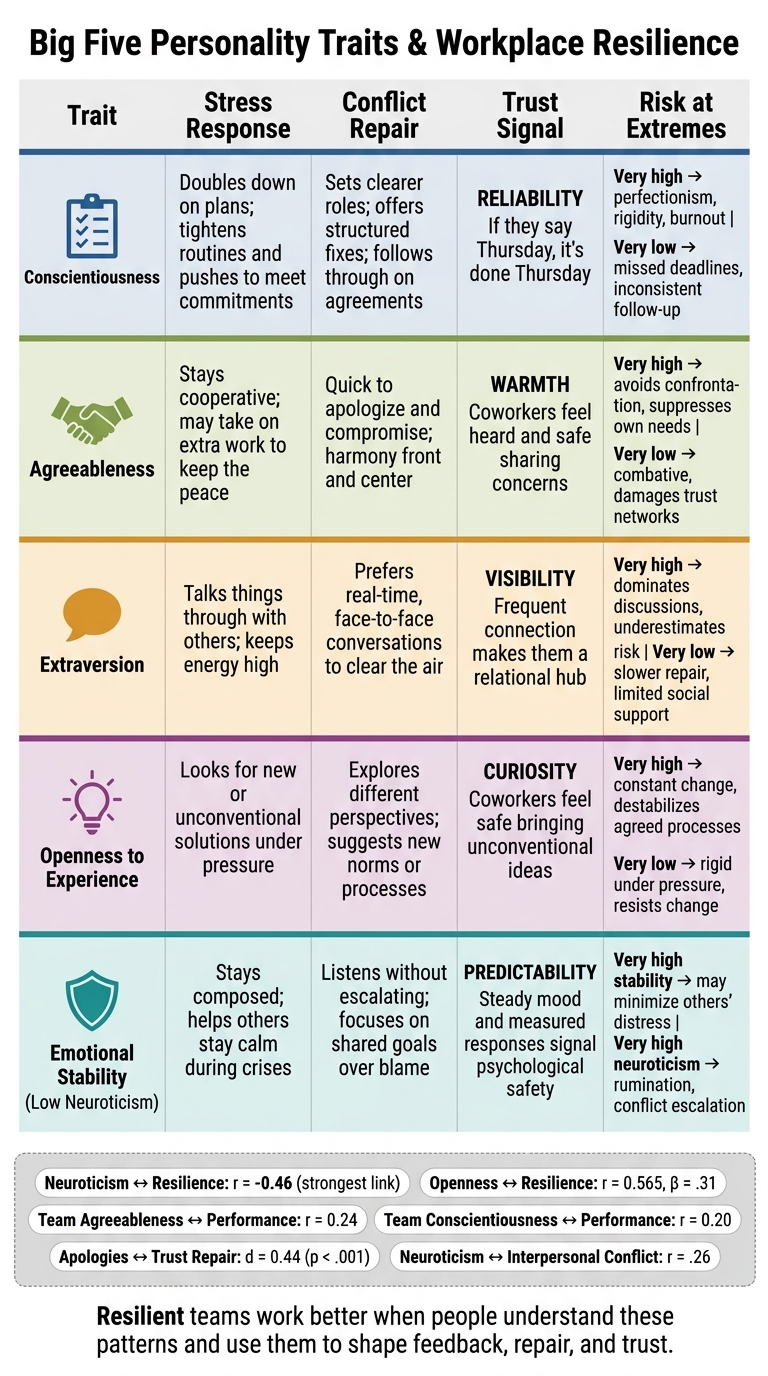
Big Five Personality Traits & Workplace Resilience: A Visual Guide
Here’s the quick side-by-side look at how the Big Five can shape stress response, conflict repair, trust, and the downside when a trait gets pushed too far. Research points to the strongest resilience tie with low neuroticism, with positive ties for conscientiousness, extraversion, agreeableness, and openness.[1][31]
| Trait | Stress Response | Conflict Repair | Trust Signal | Risks at Extremes |
|---|---|---|---|---|
| Conscientiousness | Doubles down on plans and pushes harder to meet commitments | Sets clearer roles, offers structured fixes, and follows through on agreements | Reliability - if they say Thursday, it’s done Thursday | Very high: perfectionism, rigidity, burnout; very low: missed deadlines, inconsistent follow-up |
| Agreeableness | Stays cooperative and may take on extra work to keep the peace | Quick to apologize and compromise, with harmony front and center | Warmth - coworkers feel heard and safe sharing concerns | Very high: avoids needed confrontation, suppresses own needs; very low: combative, damages trust networks |
| Extraversion | Talks things through with others and keeps energy high | Likes real-time, face-to-face conversations to clear the air | Visibility - frequent connection makes them a relational hub | Very high: dominates discussions, underestimates risk; very low: slower repair, limited social support |
| Openness to Experience | Looks for new or unconventional solutions under pressure | Explores different perspectives and suggests new norms or processes | Curiosity - coworkers feel safe bringing unconventional ideas | Very high: constant change, destabilizes agreed processes; very low: rigid under pressure, resists change |
| Emotional Stability (Low Neuroticism) | Stays composed and helps others stay calm during crises | Listens without escalating and focuses on shared goals over blame | Predictability - steady mood and measured responses signal psychological safety | Very high emotional stability: may under-react or minimize others’ distress; very low emotional stability (very high neuroticism): rumination, conflict escalation, impaired decisions |
You can use these patterns to shape feedback, repair conflict faster, and build more trust across your team.
How to Use Personality Insight to Build Team Resilience
Use trait patterns as signals for how to resolve conflict and strengthen teams.
Tailor Feedback to Each Person's Stress Pattern
Feedback doesn't land the same way for everyone. Someone high in conscientiousness usually does best with clear goals and specific next steps. Someone high in agreeableness may need explicit permission to disagree or push back. Emotionally reactive people often respond better when feedback starts calm and concrete. People high in openness tend to engage more when the conversation includes problem-solving. And extraverts may need structure around turn-taking so quieter voices don't get talked over.
The key is simple: describe the action, the impact, and the next step, not the person. Change how you deliver the message, but don't change the standard.
Once feedback is adjusted, conflict repair needs the same level of clarity.
Set Clear Norms for Repairing Conflict
That's why simple, agreed-upon repair norms matter.[35][36] Set three norms ahead of time:
- How fast repair should happen
- Who starts the conversation
- What accountability looks like
People high in conscientiousness often want structure. Agreeable people may need room to say what's wrong without feeling rude. Extraverts often prefer to talk it out live. Whatever the mix, end with one shared next step.[32][34]
After repair, what matters most is doing the small things the same way over time.
Build Everyday Trust Through Consistent Communication
Trust grows through repeated reliability: regular check-ins, transparent updates, and deadlines that are actually met.[33][34] For people higher in openness, it also helps to make room for unconventional ideas. That signals that new points of view have a place here.
Adjust your style to fit the person, but keep expectations, responsibilities, and consequences the same for everyone.[34]
Use Personality Tools Responsibly
If you use a personality tool, use it to guide action, not to box people into fixed types. Personos is one AI-powered Five Factor tool that gives real-time, situation-specific guidance for feedback, conflict repair, and trust-building. Unlike static assessments, it supports decisions in the moment.
Use tools like this to cut down on misreads, not to label people.
Conclusion
Workplace resilience is shaped by relationships, not just individual grit. Taken together, the Big Five gives teams a practical way to understand how people tend to respond under pressure. And that matters when stress hits, because those differences are often predictable and something teams can act on. When you can name the pattern, it gets a lot easier to deal with friction.
Resilient teams tend to repair conflict more easily because they rely on clear norms, direct communication, and follow-through. The upside is pretty simple: better self-awareness, better repairs, and stronger trust. Tools like Personos can help turn personality insight into real-time guidance for feedback, conflict repair, and trust-building. When used well, using AI to analyze personality moves from abstract awareness to daily practice.
FAQs
Can personality traits change over time?
Yes. Research shows personality traits are fairly stable, but they can still change over time.
Core traits often stay consistent. At the same time, people do shift as life unfolds. Personos reflects that reality by using the Five Factor Model to adjust guidance as individuals and group dynamics change.
Which trait matters most for work resilience?
No single trait decides work resilience. Research points to something more layered: resilience comes from how all 30 facets of the Five Factor Model interact to shape stress response, communication, and conflict repair.
Tools like Personos can help people see how their own profile affects workplace relationships, trust, and burnout management.
How can managers use this without labeling people?
Managers can put these insights to work without boxing people in with fixed personality types, colors, or letter-based labels. Instead, Personos relies on the scientifically validated Five Factor Model, which measures 30 traits on an 80-point scale and reflects how people differ from one another.
Individual scores remain private. Managers only see high-level, action-focused communication guidance, not limiting labels or bias-prone judgments about employees.