Why the Next Wave of AI Is About People, Not Productivity
AI that strengthens human relationships using personality insights, emotional cues, and informed consent—shifting focus from efficiency to real connection.
Christian Thomas

Why the Next Wave of AI Is About People, Not Productivity
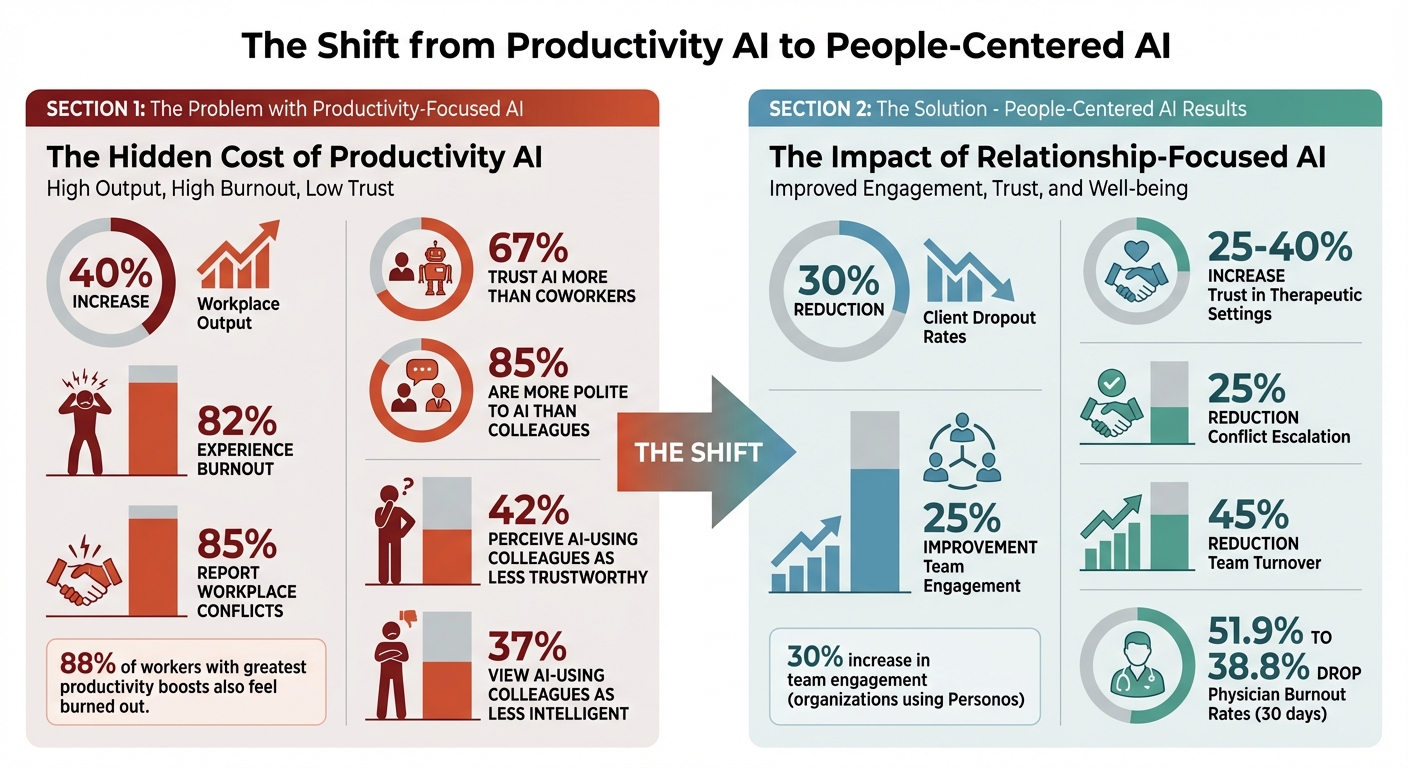
AI is shifting from prioritizing speed and efficiency to focusing on improving human relationships. While productivity tools boosted workplace output by 40%, they also led to unintended consequences: 67% of users trust AI more than coworkers, and 85% are more polite to AI than colleagues. This over-reliance on AI has weakened human connections, contributing to burnout (82%) and workplace conflicts (85%).
The solution? AI designed to strengthen relationships by understanding emotional cues and personality traits. Tools like Personos use the Five Factor Model to create tailored communication strategies, improving trust and engagement. For example, therapists and social workers can use these insights to better connect with clients, reducing dropout rates by 30% and improving team engagement by 25%.
Unlike traditional AI tools, Personos prioritizes ethical use, transparency, and user consent. It supports professionals by offering real-time guidance, personality-aligned strategies, and actionable insights, all for $9 per seat per month. This focus on human connection over productivity marks a critical shift in how AI can improve workplaces and personal interactions.
The Impact of Productivity-Focused AI on Workplace Relationships and Burnout
Why Productivity-Focused AI Falls Short
Moving Beyond Automation to Emotional Intelligence
AI designed for productivity shines when it comes to speed and efficiency, but it often sacrifices the human touch that builds trust and understanding. Imagine a coach using AI to craft a response for a struggling client or a manager relying on it to address a team conflict. The result? The response may look polished, but it lacks genuine connection. Experts call this "workslop" - content that appears professional but leaves recipients questioning whether they're interacting with a person or a machine[3]. This uncertainty chips away at trust among colleagues, a problem that research continues to highlight.
This isn't just an annoyance - it has measurable consequences. Studies reveal that 42% of workers perceive colleagues who use AI-generated communication as less trustworthy, while 37% view them as less intelligent[3]. For professionals like therapists, coaches, and HR leaders - roles that depend on authentic relationships - this erosion of credibility can be catastrophic. Constance Hadley, a professor specializing in workplace dynamics, puts it bluntly:
"We could lose our personal capability to diagnose and address conflict, which is not a skill loss any of us can afford in these polarized times"[3].
This challenge is why newer AI models are beginning to prioritize fostering human connection over simply maximizing productivity.
What Productivity-Centric AI Misses
The shortcomings of productivity-focused AI go beyond a lack of authenticity. These tools often fail to address the deeper issues that plague modern workplaces. In fact, 88% of workers who experience the greatest productivity boosts from AI also report feeling burned out[2]. Instead of solving workplace problems, these tools can make them worse. They can’t differentiate between moments that call for encouragement and those that require constructive criticism. Nor can they recognize when conflicts stem from personal dynamics rather than work-related disagreements. This inability to adapt underscores the need for AI systems that consider individual personalities and interpersonal complexities.
Take sensitive situations as an example. When medical results are delivered with "clinical precision but zero empathy", patients often feel more anxious rather than reassured[6]. These tools focus on outcomes, ignoring the importance of the process. Emily Zohar, a psychology doctoral researcher at the University of Toronto, captures this perfectly, describing how these systems bypass "the struggles that teach us" and "the labor that makes life meaningful"[4]. This lack of nuance leaves a gap that no amount of productivity can fill.
How Personality Psychology Powers People-Centric AI
Understanding the Five Factor Model
The Five Factor Model, often referred to as the Big Five, is one of the most reliable ways to understand human personality. Since the 1930s, researchers have used this framework to describe personality through five main traits: Openness (imagination and curiosity), Conscientiousness (organization and reliability), Extraversion (energy and sociability), Agreeableness (kindness and cooperation), and Neuroticism (emotional stability)[8][9]. These traits exist on a spectrum, so each person has a unique personality profile.
What makes this model especially useful for AI is its consistency and ability to predict behaviors. Studies show that test-retest reliability scores exceed 0.80, meaning results remain stable over time[8][9]. The Big Five also links strongly to real-world outcomes, like job success and relationship quality, outperforming other personality models. AI systems trained on Big Five data can analyze user responses to scientifically validated questionnaires, creating detailed personality profiles. These profiles help predict behaviors and preferences with impressive accuracy. For instance, someone with high Neuroticism might respond well to soothing language in therapy, while someone with high Extraversion might thrive in group-based activities[8][9].
Unlike older personality tools that place people into fixed categories, modern AI systems like Personos measure 30 traits on an 80-point scale[7]. This detailed approach recognizes that personality is complex, avoiding one-size-fits-all labels. The result? AI that adapts in real-time, offering personalized guidance based on individual traits. This deeper understanding of personality allows AI to improve communication and foster better human connections.
Why Personality Insights Matter for Helping Professionals
Personality insights bring a human touch to tools often focused solely on productivity. For therapists, coaches, social workers, and other helping professionals, understanding a client's personality can transform how they interact and build trust. By tailoring communication to personality traits, professionals can engage clients more effectively. For example, someone with low Agreeableness might respond better to direct, fact-based communication, while someone high in Neuroticism may need a more empathetic and patient approach. Research even shows that mismatched communication styles can increase dropout rates in counseling by as much as 30%[8][9].
These insights are especially critical for supporting vulnerable populations. For trauma survivors, AI can identify traits like high Neuroticism and suggest personalized coping strategies, such as mindfulness exercises for those high in Openness. This approach not only boosts emotional safety but also helps avoid re-traumatization[8][10]. Studies reveal that personality-aligned interactions can improve trust by 25-40% in therapeutic settings, creating the safe and supportive environment clients need[8][9][10]. This aligns with trauma-informed care principles, emphasizing the importance of understanding individual differences as the foundation for effective support.
Personos: AI Built for Helping Professionals
What Personos Offers
Personos takes a different approach compared to traditional productivity-focused AI by emphasizing relational intelligence, a critical need for professionals like social workers, counselors, coaches, and nonprofit staff. At $9 per seat per month, it offers enterprise-level tools tailored to managing the intricate dynamics of human relationships. Unlike AI systems that simply agree or provide surface-level insights, Personos introduces "creative abrasion" - a process of offering constructive friction and critical feedback to refine complex ideas and address interpersonal challenges[3][12]. This directly tackles the gap in fostering meaningful human connections.
Its features are designed to solve real-world challenges faced by helping professionals. For instance:
- Personos Chat provides a conversational AI experience that incorporates personality profiles and situational context, offering tailored advice for crisis intervention, dealing with resistant clients, and managing team conflicts.
- Dynamic Reports go beyond static assessments, delivering evolving insights for individuals and groups.
- ActionBoard translates psychological insights into actionable, trackable steps.
- Transparent Reasoning explains the logic behind AI recommendations, helping users deepen their expertise over time.
Another standout aspect is its real-time capabilities. The AI analyzes vocal cues like tone, pitch, and cadence, alongside language, during live interactions to detect emotional shifts such as frustration or disengagement. For example, if a client begins to shut down emotionally, Personos can suggest immediate adjustments to help maintain connection. Organizations using the platform have reported up to a 30% increase in team engagement and a 25% reduction in conflict escalation[13].
How Personos Works in Practice
The platform's impact is best understood through real-world examples. Sarah Mitchell, VP of Operations, implemented Personos during 2025–2026 to address team communication issues. By equipping managers with communication guides tailored to personality insights, her organization achieved a remarkable 45% reduction in team turnover.
Carla Mendoza, LCSW, an Addiction Recovery Counselor, shared her experience:
"Personos helps me anticipate when a client is on the edge of shutting down and adjust my approach so we stay connected. That kind of in-the-moment support is priceless."
Steve Huff, PhD, Founder of THRiVE Coaching, also incorporated Personos into his work with individuals facing terminal illness, trauma, and housing instability. Acting as a "teaching partner", the AI provided tools to navigate high-stakes conversations, improving outcomes for both clients and staff[14]. These examples highlight how Personos not only alleviates burnout but also enhances interpersonal connections and effectiveness in demanding fields[1][11].
How Personos Compares to Other AI Tools
Feature Comparison
When it comes to blending emotional intelligence with productivity, Personos stands apart from other AI tools by focusing on building meaningful human connections. While other platforms target specific use cases, Personos takes a broader, relationship-driven approach grounded in the scientifically validated Five Factor Model, often considered the gold standard in personality psychology.
For example, Crystal Knows is tailored for sales and recruiting teams, relying on the DISC assessment model and public LinkedIn data to enhance outreach efforts. On the other hand, Imentiv AI specializes in emotion recognition, analyzing facial expressions and vocal tones, which appeals to HR analytics teams and market researchers. Personos, however, is designed for professionals like social workers, counselors, and coaches who need to create deep, lasting relationships rather than focus on transactional goals.
Christian Thomas, CEO of Personos, captures this vision perfectly:
"AI has made us more efficient in how we work and communicate, but not smarter about how we connect with people. We built Personos to change that."[15]
This philosophy sets the foundation for Personos's unique features. Unlike Crystal Knows, which offers browser-based suggestions for outreach, Personos provides real-time, context-sensitive insights to help social workers and counselors adapt their approach during client interactions. And while Imentiv AI tracks immediate emotional reactions, Personos goes deeper by uncovering stable personality traits that influence long-term behaviors, enabling users to foster genuine connections.
Ethics also play a key role in distinguishing these tools. Crystal Knows uses public data scraping, and Imentiv AI collects biometric data during emotion tracking - both raising concerns about consent and privacy. In contrast, Personos operates with a strict consent-based model. Users maintain full control over their personality data, which is only shared with others, such as coaches, with explicit permission. This commitment to ethical practices is highlighted by Nick Blasi, Co-Founder and COO:
"Personos gives people the confidence to communicate with empathy, not just efficiency. It's about using AI to strengthen the skills that make us human."[15]
| Feature | Personos | Crystal Knows | Imentiv AI |
|---|---|---|---|
| Personality Model | Five Factor Model (Big Five) | DISC Assessment | Multimodal Emotion AI |
| Target Users | Social workers, counselors, coaches, nonprofit staff | Sales and recruiting teams | HR analytics, market researchers |
| Primary Goal | Strengthening human relationships and empathy | Improving sales conversion rates | Analyzing emotional responses |
| Real-Time Guidance | Contextual prompts for crisis intervention and relationship building | Browser suggestions for outreach (e.g., email/LinkedIn) | Real-time emotion tracking |
| Data Approach | Consent-based, user-controlled privacy | Public web scraping | Biometric and sentiment analysis |
| Pricing | $9 per seat per month | Varies by plan | Custom enterprise pricing |
Personos's pricing and accessibility further underscore its value. At just $9 per seat per month, it provides advanced personality insights to professionals on the front lines, such as social workers and nonprofit staff, rather than limiting access to corporate executives. The personality assessment is quick and easy, taking only a few minutes to complete, and the platform is already being used in counseling centers, social work agencies, and coaching practices.[15]
Using People-Focused AI Ethically
Steps for Ethical Adoption
The move from using AI for productivity to focusing on people-centered applications brings a new layer of ethical responsibility. For instance, if you're using tools like Personos to shape sensitive conversations, it's crucial to be upfront about it. Always let clients know when AI has played a role in your work - whether it helped you prepare for a session or suggested communication strategies. Research shows that failing to disclose AI involvement can erode trust and authenticity in professional relationships[3].
Informed consent is key. Before integrating AI-driven insights, explain how the technology works, how it uses data, and what benefits it offers. This is especially important in professions where trust forms the backbone of relationships[17]. Opt for platforms like Personos that prioritize strict consent protocols and encryption. Ensure the provider does not sell sensitive data or use it to train general AI models[18].
It's also important to monitor measurable outcomes to confirm that AI is genuinely improving your work rather than complicating it. For example, a study published in JAMA Network Open found that physicians using ambient AI scribes experienced a drop in burnout rates - from 51.9% to 38.8% - within just 30 days[19]. When you can point to similar results in your practice, whether it's reduced stress, better client engagement, or faster rapport-building, you're demonstrating the tool's value while staying accountable.
By adopting AI ethically, you ensure these tools act as supportive allies in professional decision-making, rather than replacements.
Combining AI with Human Expertise
When guided by ethical principles, AI should always enhance - not replace - professional judgment. The goal is to strengthen genuine human connections. The American Psychological Association underscores this by reminding professionals that they remain fully responsible for their decisions and should not rely solely on AI-generated suggestions[17]. Think of tools like Personos as collaborators that expand your perspective or help you avoid mental ruts, while leaving the final call in your hands. Clinical psychologist Harvey Lieberman captures this balance perfectly:
"The value lies in widening the field of possibilities. Judgment and decision-making remain entirely mine."[16]
It's also important to embrace the natural challenges that come with human interactions. While AI might make it easier to draft difficult emails or manage conflicts, some level of friction is essential for personal growth - for both you and your clients. As workplace dynamics expert Constance Hadley cautions:
"We could lose our personal capability to diagnose and address conflict, which is not a skill loss any of us can afford in these polarized times."[3]
Use AI to handle routine tasks like reviewing case notes or creating session outlines. But when it comes to the real work of building trust and fostering meaningful change, lean into the messiness of human-to-human interactions. By 2025, over 50% of psychologists reported using AI tools in their practices[16]. However, the most effective practitioners use AI as a tool to deepen human connection, not as an end in itself[3].
Sandra Matz: How AI, Data, and Personality Shape Human Behavior
Conclusion
This shift reflects a broader vision: developing technology that strengthens human connection rather than simply prioritizing efficiency. Moving from productivity-driven AI to tools designed with people in mind isn't just a passing trend - it’s becoming essential for professionals whose work relies on meaningful human interactions. When AI takes on routine tasks, it frees up time to be fully engaged with those you serve. Research even shows that delegating administrative duties to AI can significantly reduce burnout, highlighting the value of technology that prioritizes human well-being[5].
Take tools like Personos, for example. By blending personality psychology with AI, it offers insights into not just who someone is, but also how to connect with them effectively. Whether you're handling a crisis, building rapport with a hesitant client, or navigating team dynamics, this kind of personality-aware guidance can help turn obstacles into opportunities. As Josh Schoeller, CEO of Qualifacts, aptly states:
"In a field where healing depends on human presence, technology that protects that presence isn't optional anymore."[5]
While tools like Personos amplify your ability to connect, the ultimate responsibility always lies with your professional expertise. AI is not a replacement for human interaction; it’s a tool to deepen it. The most impactful practitioners use AI to enhance trust and understanding, ensuring that while technology broadens what’s possible, it never replaces the human element at the heart of building meaningful connections. Transparency and sound judgment remain key to making this balance work[3].
FAQs
How is people-first AI different from productivity AI?
People-first AI prioritizes strengthening human connections, building trust, and promoting well-being. This contrasts with productivity-focused AI, which mainly emphasizes efficiency and automating tasks. For instance, tools like Personos leverage behavioral science to enhance communication and minimize conflict, helping to nurture healthier relationships. This approach highlights a broader trend in AI development - using technology to address emotional and relational needs, positioning it as a partner in fostering human connection rather than solely a tool for boosting productivity.
How can personality insights improve trust and communication?
Understanding personality traits allows AI systems to engage with people in a way that feels more personal and meaningful. By adapting to an individual's emotional state, communication style, and preferences, these systems can make interactions feel more thoughtful and considerate. This level of personalization helps build trust, as users are more likely to feel understood and appreciated.
AI equipped with emotional intelligence takes this a step further. It can pick up on emotional cues and respond in a way that feels natural and appropriate. This not only makes conversations clearer but also helps avoid potential misunderstandings. When AI adjusts its tone and language to match someone's personality, it fosters a connection that feels less like interacting with a machine and more like engaging with a human - something especially important in roles where trust and effective communication are key.
How do I use personality AI ethically with clients?
To use personality AI responsibly with clients, focus on transparency, privacy, and human oversight. Be upfront about how client data will be used and make sure to get their informed consent. Safeguard sensitive information by implementing strong security protocols, and treat AI as a tool to assist - not replace - human decision-making. Actively address any potential biases in the AI system and be clear about its limitations to ensure trust, protect autonomy, and uphold confidentiality.