Ultimate Guide to Personality-Driven Team Dynamics
Personality frameworks like the Big Five, DISC, and MBTI reshape how teams communicate, assign roles, resolve conflict, and boost productivity.
Christian Thomas

Ultimate Guide to Personality-Driven Team Dynamics
Personality shapes how teams work, communicate, and solve problems. When team members understand each other’s traits, they work better together, meet deadlines more effectively, and resolve conflicts faster. Studies show that 86% of workplace failures stem from poor communication, but personality frameworks like the Big Five, DISC, and MBTI can help fix this.
Here’s what you need to know:
- Why it matters: Personality affects communication, decision-making, and conflict resolution. Teams with high agreeableness and conscientiousness perform better.
- Frameworks to use: Big Five (OCEAN), DISC, MBTI, and CliftonStrengths are tools to align roles with strengths and improve collaboration.
- Proven results: Companies using these tools report up to 30% higher productivity and 25% better project completion rates.
- Practical tips: Assign roles based on personality traits, tailor communication to preferences, and use AI tools like Personos for real-time personality insights.
Want to build a stronger team? Start by understanding how personality drives performance.
DiSC for Teams: A Guide to Building Stronger, More Aligned Teams
Personality Frameworks and Team Applications
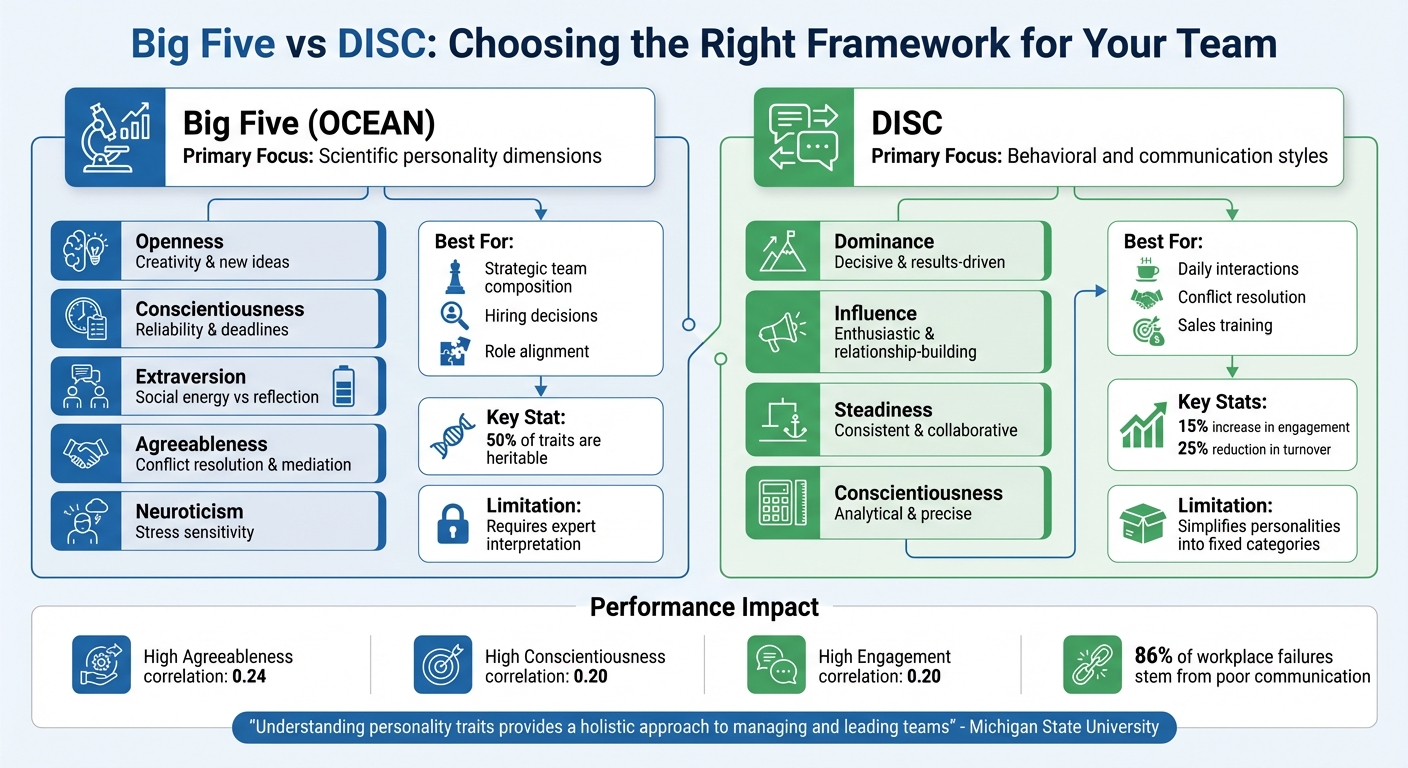
Big Five vs DISC Personality Frameworks Comparison for Workplace Teams
Big Five (OCEAN) in Team Settings
The Big Five framework breaks personality into five key traits that influence teamwork dynamics. Openness drives creativity and a willingness to embrace new ideas. Conscientiousness reflects reliability, helping identify who will meet deadlines and stick to commitments. Extraversion highlights those who energize group discussions versus those who prefer to reflect quietly before sharing ideas. Agreeableness affects conflict resolution, with highly agreeable individuals acting as natural mediators, while those lower in agreeableness might challenge ideas more often. Lastly, Neuroticism reveals stress sensitivity, offering leaders insights to provide stability during high-pressure moments [7][9].
"Understanding the Big Five personality traits in the workplace can provide you with a more holistic approach to assessing, managing and leading your team."
– Michigan State University [2]
Effective leaders use these traits strategically. For instance, pairing high-Openness innovators with high-Conscientiousness planners ensures that creative ideas are actually executed [7][9]. In remote work environments, Conscientiousness and Openness are linked to better performance, while high Extraversion might lead to disengagement due to reduced social interaction [7]. Research also shows that about 50% of Big Five traits are heritable [8][10], and traits like conscientiousness, emotional stability, and agreeableness tend to increase with age, a trend known as the "Maturity Principle" [10]. While the Big Five focuses on intrinsic traits, the DISC framework shifts attention to observable behaviors.
DISC Profiles in the Workplace
DISC categorizes behavior into four types, offering practical insights for workplace interactions. Dominance types are decisive and results-driven, thriving in leadership roles but sometimes needing to adapt their style to maintain team harmony. Influence types are enthusiastic and excel at building relationships, though they may miss finer details. Steadiness profiles bring consistency and collaboration, providing stability but occasionally resisting rapid change. Conscientiousness in DISC highlights analytical individuals who prioritize precision and quality [2].
DISC simplifies understanding team dynamics, making it easier to tailor communication. For example, direct communication works best with Dominant types, while Influence types respond well to relationship-building. Steady profiles appreciate reassurance during changes, and Conscientious types value detailed information before making decisions. Companies that regularly use personality assessments report a 15% increase in employee engagement and a 25% reduction in turnover rates [11].
Tools for Reading Team Personality Data
Both the Big Five and DISC frameworks bring unique strengths to understanding team dynamics. The Big Five works well for strategic decisions like hiring and role alignment, while DISC is better suited for improving everyday communication and managing conflicts. A study of 377 dyadic teams found that teams with members scoring low on agreeableness showed notable improvement during virtual collaborative problem-solving [4].
| Framework | Primary Focus | Best Workplace Application | Key Limitations |
|---|---|---|---|
| Big Five (OCEAN) | Scientific personality dimensions | Strategic team composition, hiring, role alignment [9][2] | Requires expert interpretation [9] |
| DISC | Behavioral and communication styles | Daily interactions, conflict resolution, sales training [2] | Simplifies personalities into fixed categories |
"The Big Five personality traits offer a powerful compass for navigating the complex terrain of team building. When used wisely, they can enhance understanding, communication, and performance within teams."
– TeamDynamics [9]
Building Teams Based on Personality Traits
Balancing Different Personality Types
Creating a high-performing team often comes down to blending task-oriented and relationship-oriented personalities. Task-focused individuals, often referred to as "Thinking" types, emphasize logic and objective decision-making. On the other hand, "Feeling" types prioritize emotional well-being and harmony, which can help maintain morale and resolve conflicts smoothly. Professionals can further support these efforts using AI tools for helping professionals to track team dynamics and reduce burnout. For instance, 95% of Diplomat personality types (those who are Intuitive and Feeling) report getting along well with coworkers. Similarly, 93% of Sentinel types (Observant and Judging) excel at maintaining strong workplace relationships by fostering a drama-free environment [12].
When it comes to specific traits like Conscientiousness and Agreeableness, teams tend to perform better when these traits are consistently high across members. This creates a shared sense of responsibility and minimizes interpersonal friction. However, for traits such as Extraversion, a mix of high and low levels is often more beneficial. Too many highly extroverted individuals (like multiple ENTJs) can lead to power struggles or overshadow quieter team members. Studies back this up, showing that teams with high average Agreeableness have a 0.24 correlation with performance, while high Conscientiousness correlates at 0.20 [5][13].
These strategies help establish a solid foundation for aligning individual strengths with team dynamics.
Matching Personalities to Team Roles
Once personality balances are in place, assigning roles that align with individual traits can significantly boost team output. For example, Commanders (ENTJ) and Executives (ESTJ) thrive in leadership positions, where they can streamline processes and establish structure. Meanwhile, Logisticians (ISTJ) and Defenders (ISFJ) excel as implementers. Notably, 88% of Defenders say they perform best when given clear instructions, and they take pride in meeting deadlines without compromising quality [12].
For creative problem-solving and adaptability, Debaters (ENTP) and Campaigners (ENFP) shine in dynamic, fast-changing environments. Strategic roles are well-suited for Architects (INTJ) and Logicians (INTP), whose analytical thinking and long-term vision help keep teams focused on critical decisions. In contrast, Entertainers (ESFP) thrive in collaborative settings, with 87% reporting they enjoy working on team projects - the highest percentage among personality types. On the flip side, only 9% of Architects (INTJ) prefer collaborative environments, as they often excel in independent, strategic work [12].
"Personality theory should not be used to assemble a work group... This knowledge is best applied to understanding a team or group that you are already part of, not to attempting to assemble an 'ideal' team." – 16Personalities [12]
Leading Teams with Different Personalities
Effective leadership in diverse teams requires flexibility and an understanding of individual personality traits. Leaders need to adapt their management styles to meet the needs of their team members. For example, creative leaders who score high in Openness may need to adjust their approach for detail-oriented, structured team members. In such cases, focused one-on-one goal-setting discussions can be more effective than group activities [2]. Similarly, teams with a significant number of Introverted members or Advocate (INFJ) types often benefit from quiet workspaces and asynchronous communication, as 86% of Advocates report working best in calm environments [12].
Emotional stability also plays a key role in leadership. Teams with higher average levels of Emotional Stability and Extraversion tend to show better social cohesion, which directly impacts performance. On the other hand, leaders who display inconsistent emotions can negatively affect team dynamics [2][6]. For teams requiring frequent collaboration, even one low-scoring individual in Agreeableness can disrupt overall harmony [13]. Leaders working with Mediators (INFP), who often feel overwhelmed by heavy workloads (78%), can improve productivity by breaking tasks into smaller, manageable steps [12].
Communication Strategies for Different Personalities
Adjusting Communication by Personality Type
To communicate effectively within a team, it’s crucial to understand that people process information in different ways. For instance, introverts tend to think things through internally before speaking, while extroverts often work through their ideas by talking them out.
"Extroverts tend to think out loud, and introverts keep their thoughts inside their heads. They complete their thoughts before speaking." – Alice Rush, Career Advisor at the University of Phoenix
When collaborating with sensing types, it’s helpful to provide clear, step-by-step instructions that include practical details and observable data. As Rush explains:
"If you gravitate more toward a sensory personality type, your response will be more practical. Those people are more in the weeds."
On the other hand, intuitive types are more focused on big-picture thinking and innovation. They prefer to understand the reasoning behind decisions and may feel bogged down by excessive details. For team members who are highly conscientious, communication should include detailed task lists, specific deadlines, and structured schedules. Meanwhile, individuals with high agreeableness may find it hard to handle critical feedback due to their desire to maintain harmony. In such cases, delivering constructive criticism tactfully and clearly outlining areas for improvement is key.
A practical way to address these differences is by using communication preference sheets. These allow team members to document their preferred communication styles, tools, and even personality assessment results. Mandy Gilbert, Founder and CEO of Creative Niche, highlights the value of this approach:
"The simple beauty of [a work-with-me cheat sheet] is that it eliminates the guesswork of communication, and social interactions." [14]
By tailoring communication strategies to individual personality profiles, teams can foster better collaboration and understanding. Up next, let’s look at how these strategies can be expanded for cross-functional teams.
Cross-Functional Team Communication
Cross-functional teams bring unique challenges because different departments often attract specific personality types. For example, engineering teams may lean toward introverted, analytical individuals who prefer written communication and time to process information. In contrast, sales and marketing teams often include more extroverted members who thrive on face-to-face interactions and dynamic brainstorming.
To bridge these differences, adjust your communication style to suit the audience. For detail-oriented teams, focus on clear, step-by-step instructions. For creative or strategic groups, emphasize broader goals and the overall impact rather than getting stuck in the specifics. In mixed meetings, managers can create balance by encouraging highly vocal participants to pause, giving quieter team members a chance to share their insights.
Organizations that embrace these tailored approaches often see measurable improvements. For instance, Salesforce reported a 25% increase in project success rates after using psychometric assessments to align team strengths. Similarly, Zocdoc observed a 30% improvement in meeting project deadlines when teams included a balanced mix of DISC behavioral styles [1].
Resolving Conflict Using Personality Data
Workplace conflicts often arise from mismatched communication styles rather than actual disagreements. Thinkers, for example, value logic and enjoy debating, while feelers may perceive such behavior as confrontational and harmful to relationships.
"The thinking types love to debate. They can be really fierce. So, they might [argue] and call each other names, and then they're patting themselves on the back and saying, 'Let's go have a beer,' afterwards." – Alice Rush, Career Advisor at the University of Phoenix
By reframing conflicts as differences in working styles, teams can reduce defensiveness and foster productive resolutions. Tools like the Thomas-Kilmann Conflict Mode Instrument have proven effective in this area. For example, one non-profit organization reported a 40% drop in workplace conflicts after implementing this approach [1].
| Personality Trait | Conflict Style | Resolution Strategy |
|---|---|---|
| High Openness | Prefers collaboration and transparency | Involve them in brainstorming and creative problem-solving |
| High Conscientiousness | Focuses on details and organization | Provide clear schedules and detailed action plans |
| High Agreeableness | Avoids conflict; prioritizes harmony | Use tact for feedback and encourage open sharing of perspectives |
| High Neuroticism | May express frustration or anxiety under stress | Offer consistent praise and reassurance |
| Low Agreeableness | May appear competitive or standoffish | Assign independent tasks and use direct, objective communication |
For team members with high neuroticism, offering reassurance and validation during challenging tasks can go a long way in preventing anxiety from escalating into conflict. Tailoring conflict resolution strategies to individual personalities not only reduces tension but also strengthens team cohesion.
sbb-itb-f8fc6bf
AI Tools for Personality-Based Team Management
Real-Time Personality Insights with AI
Traditional personality assessments often feel like a snapshot frozen in time - a static PDF that lands in your inbox after a test. But AI-powered personality tools are changing the game. These tools don’t just stop at a one-time analysis; they continuously evaluate personality data in tandem with real-world context, like calendar events, meeting notes, and ongoing projects. The result? Tailored recommendations for communication, coaching, and even conflict resolution.
For U.S.-based teams juggling packed schedules, these tools provide a clear picture of participants' communication styles. They can suggest agenda structures for meetings or even craft specific coaching prompts for one-on-one sessions. For instance, highly agreeable employees might benefit from open-ended, values-driven questions, while conscientious team members may thrive with metrics-focused discussions.
What sets these tools apart is their ability to adapt. As team dynamics and projects evolve, so do the insights. This kind of agility lays the groundwork for advanced platforms like Personos, which take personality-based management to the next level.
Personos Features for Team Dynamics
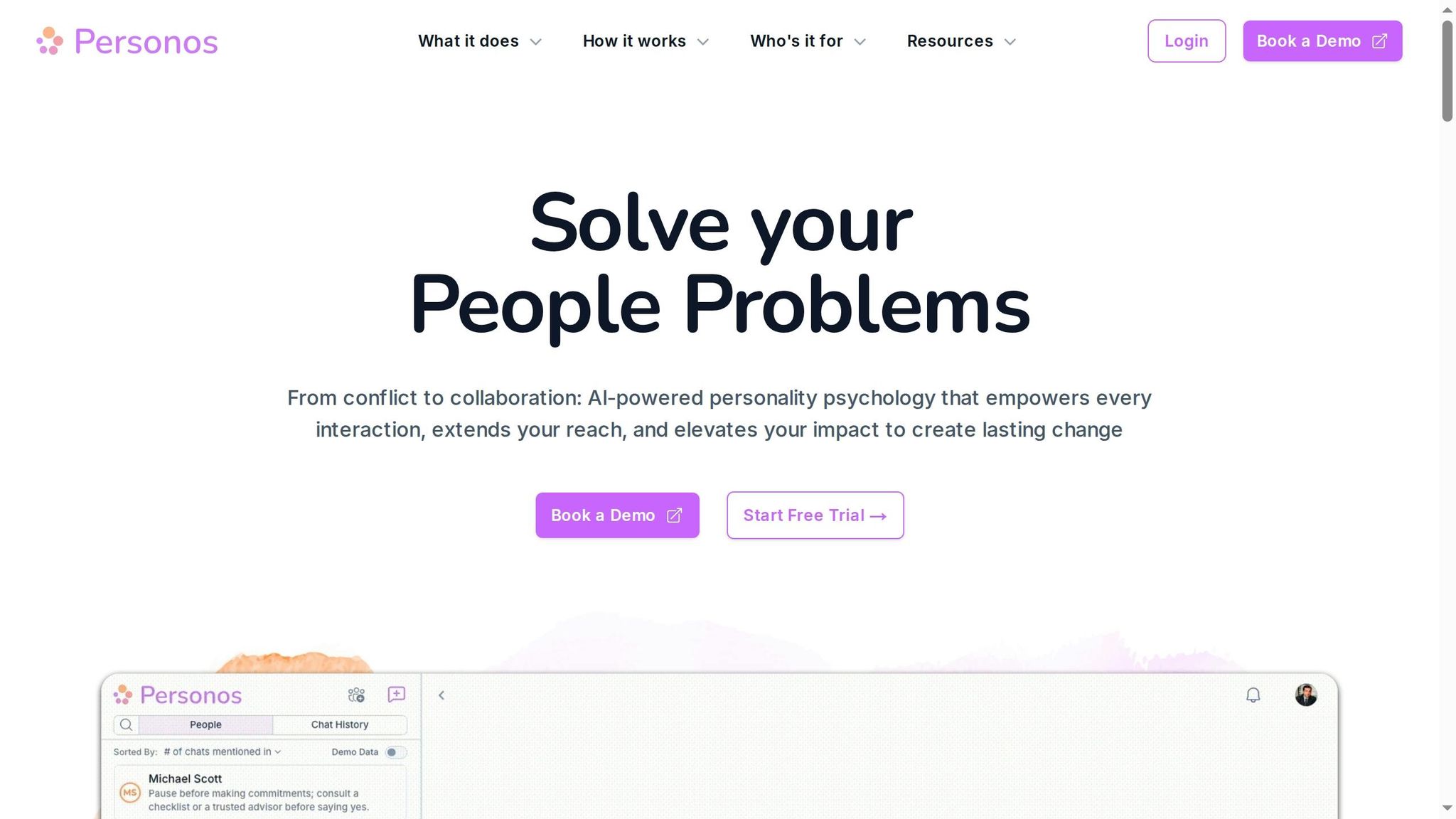
Personos combines AI with personality psychology to provide real-time, actionable insights for managing communication, resolving conflicts, and boosting team performance. Unlike older tools that simply present raw personality scores, Personos focuses on privacy and delivers recommendations tailored to specific situations.
Here’s what makes Personos stand out:
- Personalized Conversational AI: Think of it as your virtual coach. It helps managers and team members plan conversations, rehearse difficult feedback, or adjust messaging to better align with a colleague’s personality profile.
- Dynamic Personality Reports: These reports don’t just sit still - they evolve. They reveal how someone’s behavior might shift under stress, during conflicts, or in brainstorming sessions, updating continuously as new data comes in.
- Relationship and Group Analysis: By mapping how different personalities interact, Personos identifies potential friction points and complementary strengths. This helps leaders create balanced teams with a mix of visionary thinkers, detail-oriented planners, and relationship-focused collaborators - avoiding teams dominated by just one personality type.
- Proactive Communication Prompts: Before key interactions like performance reviews or team meetings, managers receive tailored guidance. For example, a manager preparing to give feedback to a relationship-focused employee might be prompted to “Start with appreciation and personal impact; avoid purely transactional language.” On the other hand, an analytical contributor might respond better to “Lead with specific results and data; be concise and direct.”
The platform also integrates with tools like Slack and Microsoft Teams, making it easy to link personality-informed actions - like clarifying expectations or scheduling quick check-ins - to tasks and workflows. This seamless integration aligns perfectly with common U.S. productivity practices like weekly sprints and quarterly OKRs.
Beyond day-to-day management, Personos tackles deeper team challenges by addressing the personality-driven roots of many issues.
Solving Team Problems with Personality Insights
When teams struggle, personality differences are often at the heart of the problem. Personos tackles these challenges head-on with targeted solutions.
Take priority misalignment, for example. Visionary, big-picture thinkers and detail-oriented executors often interpret goals differently, leading to confusion or delays. Personos identifies this mix and suggests alignment strategies, such as using written decision records and recap emails to bridge the gap between strategic goals and actionable tasks.
Low engagement is another common issue. Sometimes, it’s simply a matter of mismatched roles or management styles. Personos can uncover hidden strengths and recommend adjustments - like assigning more stakeholder-facing tasks to a social, extroverted team member or giving a self-starter more autonomy to thrive.
Recurring interpersonal conflicts? They’re often tied to personality clashes. For instance, direct “driver” types and harmony-focused personalities can butt heads. Personos reframes these differences as variations in working style rather than personal attacks, offering coaching on neutral language, validation techniques, and compromise strategies to ease tensions.
Here’s a quick look at how Personos addresses specific team challenges:
| Common Team Challenge | Insight | Personos Solution |
|---|---|---|
| Misalignment on priorities and decisions | Conflicts arise when high-urgency "drivers" and cautious, analytical personalities clash over speed versus thoroughness. | Personos identifies these differences, suggests structured agendas with clear segments for exploration and decision-making, and provides scripts to summarize trade-offs. |
| Low engagement | A mismatch between work style (collaborative vs. independent, structured vs. flexible) and role can lower motivation. | The platform highlights untapped strengths, recommends role adjustments, and advises on offering greater autonomy to self-starters. |
| Recurring interpersonal conflict | Clashes between direct "driver" types and harmony-focused personalities are common. | AI-driven coaching provides tips on neutral language, validation, and compromise tailored to individual preferences. |
The stakes are high. According to a 2023 Grammarly/Harris Poll report, poor communication costs U.S. knowledge workers an estimated 7.47 hours per week in lost productivity. Tools like Personos aim to reclaim that time by offering scalable, executive-level support to tackle these challenges head-on.
Maintaining Personality-Based Team Practices
Adding Personality Insights to Team Workflows
To make personality data impactful, it needs to be woven into the team’s daily routines. A great starting point is integrating personality insights into onboarding. This allows new hires to quickly grasp the team’s communication norms and working styles. As Roger D., a startup founder, explains:
"TeamDynamics is a staple in our onboarding process. It helps new employees understand their team culture from day 1, getting them started on the right foot" [15].
Beyond onboarding, these insights can enhance other key team activities. For example, incorporate personality data into project kickoffs and retrospectives. During retrospectives, assess how different personality traits contributed to successes or challenges. This creates a feedback loop that keeps personality awareness alive throughout the project lifecycle.
Adjust meeting formats to suit various personality types. For instance, structured agendas might work well for "Sentinels", while open brainstorming sessions might resonate more with "Analysts" and "Explorers" [12]. Make working preferences visible using digital tools or project management platforms. This builds what researchers call "Transactive Memory Systems" - a shared understanding of who excels at what and how they prefer to operate [4].
Once these practices are in place, it’s essential to monitor how they influence team dynamics over time.
Measuring Results Over Time
Evaluating the success of personality-based practices means looking beyond task completion rates. Set up a quarterly review system to assess collaboration metrics like engagement, conflict trends, and team alignment alongside your personality-driven strategies [15]. This regular check-in ensures that insights remain relevant as team dynamics shift.
Keep an eye on both positive and negative trends. Are communication clarity, trust, and project completion rates improving? At the same time, watch for red flags like rising absenteeism, stress levels, or turnover, which could signal mismatches between personalities and roles [3]. Alarmingly, only 36% of managers can accurately describe their team’s core behaviors, highlighting the need for structured assessments [16].
A Team Health Score can be a useful tool for tracking alignment in areas like communication, decision-making, and execution [16]. It’s worth noting that 90% of people have working preferences that differ from at least one core team behavior. While this doesn’t prevent success, it does require careful monitoring of potential tensions and proactive management [16].
These regular evaluations can make the impact of personality-based practices more visible.
Before and After: Tracking Improvements
Measuring the difference before and after implementing personality-driven strategies can reveal significant changes. Companies using personality assessments for team building often see improvements across various areas [15].
| Practice Area | Before | After |
|---|---|---|
| Communication | Misunderstandings; mismatched styles | Tailored dialogue; reduced friction; improved clarity [15] |
| Project Management | Disorganized efforts; missed deadlines | Clear roles based on strengths; better tracking [9] |
| Conflict Handling | Tension; unresolved issues | Constructive discussions; empathetic resolutions [9][15] |
| Team Morale | High stress; low engagement | Increased job satisfaction; supportive culture [9] |
| Innovation | Stagnation; lack of fresh ideas | Encouraged risk-taking; openness to new concepts [9] |
Tim C., Director of Learning & Development, highlights the transformation:
"Since we started offering TeamDynamics to our managers, we've developed a shared language for how we work. It's like an instruction manual for teamwork" [16].
This shared language fosters open discussions about work styles, removing personal bias and turning personality insights into practical tools for collaboration.
Regular reassessments are crucial to keeping up with evolving team dynamics [9]. Personalities and roles shift over time, so treating personality data as a living document ensures continued relevance. Platforms like Personos simplify this process by offering dynamic personality reports that update automatically as new data becomes available. This helps teams measure progress and adjust without the hassle of manual re-testing, keeping personality insights actionable as the team evolves and grows.
Conclusion and Next Steps
Key Points from This Guide
The Big Five (OCEAN) and DISC frameworks provide valuable tools for building stronger, more balanced teams. By pairing complementary strengths - such as teaming up high-Openness innovators with high-Conscientiousness executors - teams can create a balance where ideas are both imaginative and actionable [9]. When conflicts arise, understanding traits like Agreeableness and Neuroticism can help teams approach disagreements with greater empathy and understanding [9].
The most effective use of personality insights treats them as flexible tools rather than rigid rules [9]. Leaders who take the time to understand their own personality traits often develop deeper self-awareness, which can lead to more open and ethical leadership. Tools like Personos enhance this process by offering dynamic personality reports that evolve alongside your team, making these insights a continuous part of your operations. The goal is to weave personality data into your team’s everyday practices - whether during onboarding, project planning, or retrospectives - so it becomes a shared framework for collaboration.
These strategies provide the foundation for meaningful and immediate improvements in your team’s dynamics and performance.
How to Get Started
Ready to implement personality-driven strategies? Here’s how to take the first steps.
Start by clearly explaining the purpose of personality assessments to your team. Make it clear that the goal is to strengthen collaboration and mutual understanding, not to critique individuals [9][15]. Host a workshop to review the assessment results together, focusing on team-wide patterns and insights rather than singling out individuals. Use the findings to align roles with strengths - for example, assigning highly conscientious team members to detail-heavy tasks and placing those high in openness on projects requiring fresh ideas [9][15].
Develop a shared language for talking about work styles and potential conflict areas [15]. This is crucial, especially since 92% of people experience some tension with at least one of their team’s core behaviors [15].
If you’re ready to explore AI-powered tools, Personos offers a suite of features designed to bring personality insights to life. Starting at $9 per seat per month, it provides personalized conversational AI, group analysis reports, and communication prompts to help you apply these insights in real time. Whether you’re managing conflict, coaching individuals, or refining team dynamics, these tools can help you turn theory into action. By adopting these strategies, you’ll create a team that leverages personality insights for sustained success.
FAQs
How does understanding personality traits enhance team performance?
Understanding personality traits can be a game-changer for leaders aiming to build stronger, more effective teams. These traits offer valuable insights into how people communicate, manage conflict, and respond to change. By using frameworks like the Big Five - extraversion, agreeableness, conscientiousness, neuroticism, and openness - managers can assemble teams that are well-balanced, innovative, and better equipped to tackle challenges.
AI-powered tools, such as Personos, take this concept to the next level. They analyze team dynamics in real time, flagging potential friction points, recommending role assignments, and sharing tips for better communication. This helps teams stay aligned and productive, even when circumstances shift. When personality data becomes part of daily workflows, task distribution becomes smoother, conflicts are minimized, and overall performance improves. The result? A workplace culture rooted in collaboration and continuous improvement.
How do the Big Five and DISC personality models differ?
The Big Five and DISC models serve different purposes and focus on distinct aspects of personality and behavior. The Big Five framework is rooted in research and measures five core personality traits: Openness, Conscientiousness, Extraversion, Agreeableness, and Neuroticism. This model provides a comprehensive psychological profile, offering insights into a person’s overall personality rather than their specific actions.
In contrast, the DISC model zeroes in on observable behaviors and classifies individuals into four categories: Dominance, Influence, Steadiness, and Conscientiousness. It’s built for practical use, particularly in workplace environments, where it helps enhance communication, teamwork, and conflict management. While there are areas where the two models intersect, DISC is more focused on situational and action-based insights, making it especially effective for fostering better team dynamics and interpersonal relationships.
How does Personos use AI to improve team communication and collaboration?
Personos leverages AI-powered insights to examine communication styles, tone, and behavior patterns within teams. By utilizing well-known personality models like the Big Five and DISC, it generates detailed personality profiles that showcase individual strengths, predict how team members might work together, and pinpoint areas where conflicts could arise.
Armed with this information, Personos delivers real-time, tailored prompts designed to improve communication, address conflicts before they escalate, and boost collaboration. These insights enable teams to operate more smoothly and achieve stronger performance together.