You Have Tools for Email, Tasks, and Docs - What About Relationships?
Workplace tools ignore relationships — AI personality platforms help frontline pros communicate, de-escalate conflict, and turn insights into action.
Christian Thomas

You Have Tools for Email, Tasks, and Docs - What About Relationships?
Most workplace tools focus on tasks, not people. While apps like Gmail, Asana, and Slack streamline productivity, they fall short in helping you navigate complex human relationships. Enter AI-powered platforms like Personos, which analyze personality data to improve communication and connection in professional settings.
Key Takeaways:
- Why it matters: Emotional misunderstandings and strained relationships can lead to burnout and poor outcomes, especially in high-pressure roles like social work or counseling.
- How it works: Tools like Personos use psychological models (e.g., Five Factor Model, DISC) to offer tailored advice for handling feedback, resolving conflicts, and building trust.
- Who benefits: Helping professionals, such as social workers and coaches, gain actionable insights to manage relationships effectively in real time.
Personos stands out with its focus on frontline professionals, affordable pricing ($9/month), and privacy-first design, making it a practical choice for those managing sensitive interactions. If you’re ready to move beyond guesswork in building better professional relationships, these tools might be the missing piece.
Why Helping Professionals Need AI-Powered Relationship Tools
Common Relationship Challenges in Helping Professions
Helping professionals - social workers, case managers, coaches, and counselors - often grapple with the heavy toll of emotional labor. This involves managing their own emotions while fostering supportive and effective relationships, even in high-pressure scenarios. Whether dealing with trauma, addiction, or housing instability, these professionals face challenges that no standard task management app can solve - like delivering difficult feedback without triggering defensiveness. It’s a delicate balancing act that underscores the need for smarter communication tools.
In high-stress environments, communication can become overly transactional. For instance, case managers handling large caseloads might resort to sending quick, curt messages. While efficient, these interactions can come across as cold or dismissive, leading to misaligned expectations, strained team dynamics, and weakened relationships over time. Under pressure, even well-intentioned professionals might make reactive decisions that erode trust with clients or colleagues.
These communication struggles don’t just affect workplace harmony - they can directly influence client outcomes and contribute to burnout. Without tools to navigate complex personality dynamics, professionals are left guessing how to phrase feedback, resolve team conflicts, or build rapport with resistant individuals, often at the expense of long-term relationships.
How Personality Insights Improve Relationship Management
AI-powered relationship tools offer a way to tackle these challenges by refining communication strategies through personality data. These platforms enhance Relational Intelligence - the ability to understand not just what to say but how to say it effectively, taking into account individual personality traits. By applying models like DISC or the Five Factor Model (OCEAN), these tools help professionals tailor their approach, whether they’re delivering tough feedback, navigating conflict, or motivating someone to take action.
"Personos helps clients organize often overwhelming amounts of mental and physical information to make better, creative, more informed decisions that incorporate their values and preferences, as well as those with whom they are interacting."
- Mike Walker, Executive Leadership Coach and Founder, Dynamic Decisions Coaching [2]
What makes these tools stand out is their ability to scale empathy. In the past, sophisticated personality assessments and coaching services were mostly reserved for executives or elite athletes. But thanks to AI, these insights are now accessible to frontline professionals like social workers and nonprofit teams. Real-time, context-aware coaching enables them to adapt their communication style on the spot, defuse potential conflicts, and build trust with clients during pivotal moments.
"Personos gives people the confidence to communicate with empathy, not just efficiency. It's about using AI to strengthen the skills that make us human."
- Nick Blasi, Co-Founder and COO, Personos [2]
AI Dating & Team Matching Tool Review 💘 EP #369
The Psychology Behind AI Relationship Tools
AI relationship tools are grounded in psychological research that explores how personality influences behavior, communication, and collaboration. These platforms simplify complex personality theories into actionable advice, helping professionals adapt their communication styles, build trust with challenging clients, and improve team dynamics. Two popular frameworks underpinning these tools are the Five Factor Model (also known as OCEAN or the Big Five) and the DISC behavioral assessment, each offering unique perspectives.
The Five Factor Model (OCEAN) Explained
The Five Factor Model evaluates personality across five key dimensions: Openness (creativity and curiosity), Conscientiousness (responsibility and organization), Extraversion (sociability and assertiveness), Agreeableness (trust and compassion), and Neuroticism (emotional stability). Unlike older personality tests that box people into fixed categories, this model recognizes that every personality is unique[3]. Platforms like Personos measure 30 specific traits on an 80-point scale, offering detailed insights that go beyond generic labels[3].
This level of precision is especially valuable in high-pressure settings. Research from the University of Pennsylvania's Wharton School revealed that AI-generated personality scores based on the Five Factor Model could predict various career outcomes, such as salary, job rank, and career progression[4]. For instance, Extraversion was strongly linked to higher salaries and job seniority, while Conscientiousness correlated with lower turnover rates and steady salary growth[4].
"AI-derived personality scores were linked to a broad set of career outcomes, including salary, job seniority, mobility, and even the rank of the MBA program attended."
- Knowledge at Wharton[4]
The Five Factor Model’s scientific foundation makes it an excellent tool for understanding long-term behavioral trends and relationship dynamics. Modern AI platforms take this data and turn it into actionable recommendations, such as suggesting a creative individual lead brainstorming sessions or advising extra reassurance for someone less agreeable during conflict resolution[3]. While FFM provides deep, predictive insights, the DISC framework focuses on immediate, practical applications.
DISC Framework: Understanding Behavioral Styles
The DISC framework shifts the focus from personality traits to observable behaviors and communication preferences. It categorizes individuals into four styles: Dominant (direct and decisive), Influential (enthusiastic and outgoing), Steady (calm and accommodating), and Conscientious (precise and analytical)[1]. This framework offers quick, actionable guidance, helping professionals tailor emails, navigate difficult meetings, or deliver feedback effectively based on the recipient's style[1].
For example, a case manager dealing with a "Dominant" client might use concise, results-oriented language, skipping unnecessary details. Meanwhile, when working with a "Steady" individual, the manager might adopt a warmer tone, emphasize stability, and allow more time for decision-making. Users of AI tools like Crystal report being 30–35% faster at building meaningful professional relationships by applying these insights[1].
"With Crystal, I'm at least 30–35% quicker at building meaningful relationships."
- Heather Heefner, Founder, Dart Design Studio[1]
Comparing AI Relationship Platforms: Personos, Crystal Knows, and Humantic AI
AI Relationship Platform Comparison: Personos vs Crystal Knows vs Humantic AI
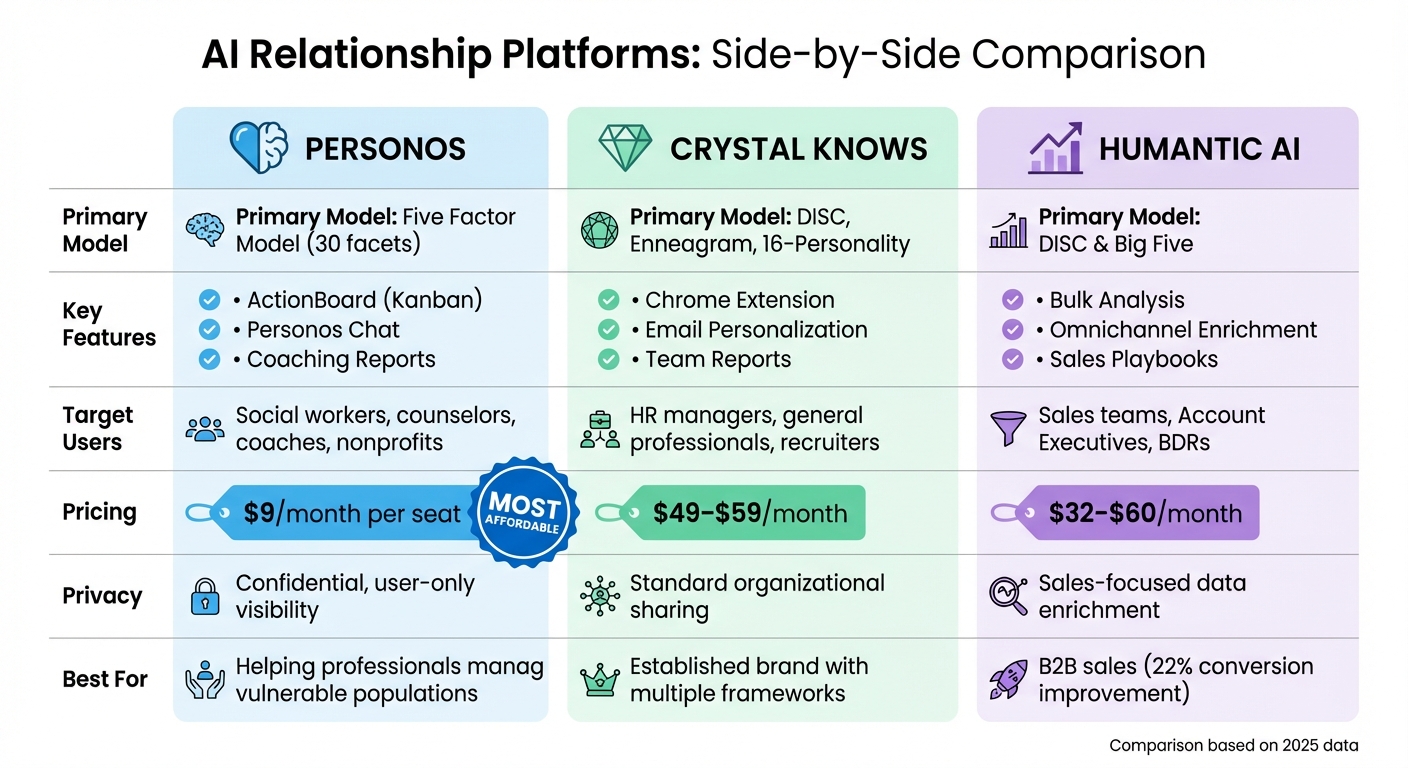
Trying to find the right AI relationship platform? For professionals navigating complex human interactions, Personos, Crystal Knows, and Humantic AI are three standout options. Each offers a unique perspective on personality insights, and knowing how they differ can help you make an informed choice.
Platform Comparison Table
| Feature | Personos | Crystal Knows | Humantic AI |
|---|---|---|---|
| Primary Model | Five Factor Model (30 facets)[5] | DISC, Enneagram, 16-Personality[8] | DISC & Big Five[8] |
| Key Features | ActionBoard (Kanban), Personos Chat, Coaching Reports[5] | Chrome Extension, Email Personalization, Team Reports[8][9] | Bulk Analysis, Omnichannel Enrichment, Sales Playbooks[8] |
| Target Users | Social workers, counselors, coaches, nonprofits[6] | HR managers, general professionals, recruiters[8] | Sales teams, Account Executives, BDRs[8] |
| Pricing | $9/month per seat[5] | $49–$59/month[8] | $32–$60/month[8] |
| Privacy Approach | Confidential, user-only visibility[5] | Standard organizational sharing | Sales-focused data enrichment[8] |
| Strengths | Purpose-built for helping professions, ActionBoard accountability[5] | Established brand, multiple personality frameworks[8] | High accuracy for B2B sales (22% conversion improvement)[8] |
This table outlines the main differences between the platforms. Let’s dive into why Personos stands out for professionals in helping fields.
Why Personos Works Best for Helping Professionals
Personos is specifically designed for professionals in fields like social work, counseling, and coaching[6]. Unlike Crystal Knows, which focuses on workplace empathy, or Humantic AI, which is geared toward sales teams, Personos addresses the unique challenges faced by those serving vulnerable populations. These include managing high caseloads, handling crisis situations, and supporting clients with complex needs.
Steve Huff, PhD, founder of THRiVE Coaching, has used Personos in programs for individuals dealing with terminal illness, trauma, addiction, and housing instability. He describes the platform as "a teaching partner."[7][2] What sets Personos apart is its commitment to confidentiality - client interactions are visible only to the user, a critical feature for sensitive work[5].
The ActionBoard is another standout feature. By using a Kanban-style system, it helps professionals close what Personos calls the "Insight-Action Gap." This means turning personality insights into actionable steps that lead to measurable outcomes[5]. Mike Walker, Executive Leadership Coach and Founder of Dynamic Decisions Coaching, highlights how this tool helps leaders manage team dynamics, saying Personos "connects the dots between personality and performance."[7][2] For professionals juggling multiple cases, this feature ensures insights lead to real progress.
At just $9 per month per seat, Personos is priced to be accessible while delivering powerful tools for helping professionals[5][6]. As Christian Thomas, CEO and Co-Founder of Personos, puts it: "AI shouldn't just help people be more efficient but help people truly listen and understand each other better to foster connection and create impact."[7][2]
How to Add AI Personality Tools to Your Daily Workflow
Step-by-Step Implementation Guide
AI personality tools can help you navigate professional relationships more effectively, and integrating them into your daily routine doesn’t have to be complicated. Start by completing a quick Five Factor Model assessment, which takes just five minutes to outline your baseline personality profile. During the onboarding process, you’ll provide details like your job role, organizational values, and professional goals. This step ensures the AI aligns with your specific needs and environment.
Next, incorporate your professional relationships by inputting email addresses or organizational domains. The system adjusts its recommendations based on the type of relationship - whether it’s a Social Worker and Member, Executive Coach and Leader, or Co-worker and Peer. You can refine this further by uploading relevant notes or context.
Use Personos Chat as your central hub. Simply type '@' followed by a name to pull up that person’s profile and interaction history for personalized advice. From there, you can turn insights into actionable tasks on the ActionBoard, a Kanban-style tool. To stay on top of things, set up custom Prompts for reminders - like daily client tips or weekly team dynamics updates - which can be delivered directly through Slack or Microsoft Teams.
These tools are designed to enhance your workflow without replacing your judgment. Always combine AI insights with your own understanding of the situation.
Common Mistakes to Avoid
AI is a tool, not a replacement for human intuition. Relying on it as an autopilot can lead to missteps. While AI offers helpful insights, it doesn’t account for external stressors, situational nuances, or unspoken dynamics that you might notice in real time. Use it as a co-pilot, not the sole decision-maker.
Another pitfall is labeling people too rigidly based on communication styles. For example, justifying behavior with statements like “They’re blunt because they’re a ‘D’ type” can limit growth and understanding. These tools are meant to provide context, not excuses. Additionally, overusing AI-generated scripts can make your interactions feel impersonal. To avoid this, use the platform’s "Scientific Explanation" feature to understand the reasoning behind its suggestions. This way, you can build your own skills and apply the advice thoughtfully, maintaining the authenticity that’s key to meaningful connections. Balance is everything - combine the efficiency of AI with the empathy that only you can bring.
Conclusion
You’ve mastered tools for emails, tasks, and documents. But when it comes to the relationships that define your work as a helping professional, instinct and sheer effort have often been your go-to strategies. AI-powered personality tools like Personos are changing that by offering science-backed insights to improve how you connect with others.
By using frameworks like the Five Factor Model, you can better understand personality dynamics, making it easier to communicate with empathy, resolve conflicts, and build trust - even in challenging situations. These tools turn uncertainty into clear, actionable steps, giving you the confidence to navigate high-pressure interactions.
In November 2025, Steve Huff, PhD, Founder of THRiVE Coaching, shared:
"A constant criticism of AI is that it makes us dumber. To the contrary, Personos helps make our members smarter about how they communicate, how to mitigate challenges, and the opportunities available to them for more successful outcomes." [2]
Getting started is simple: take a quick personality assessment and connect your professional contacts. With features like the ActionBoard, which translates insights into actionable steps, and Prompts that provide timely suggestions, Personos brings advanced personality psychology - once reserved for top executives - to professionals on the frontlines, all at a reasonable cost.
Why leave human connection to guesswork? Try Personos with a free trial [10] and see how AI can enhance the skills that make you better at what you do.
FAQs
Is this ethical to use with clients?
Using AI-driven personality insights can be done ethically when approached with care and responsibility, prioritizing privacy, consent, and transparency. This means ensuring individuals give informed consent, safeguarding their data, and being upfront about how the insights will be applied. Addressing challenges such as bias and privacy concerns is critical. When handled responsibly, tools like Personos can improve understanding, foster better communication, and build trust, all while respecting ethical boundaries.
How accurate are AI personality insights?
AI systems are impressively skilled at analyzing personality traits, thanks to tools like natural language processing (NLP), sentiment analysis, and established models such as the Big Five personality traits. These systems can achieve up to 81% accuracy by examining a person’s language, tone, and behavior patterns. However, their precision can vary depending on factors like regional communication differences and the quality of the data being analyzed. While AI serves as a helpful aid to human judgment, it’s essential to have ethical oversight in place to maintain fairness and build trust in these technologies.
Will this replace my professional judgment?
AI tools aimed at deciphering personality and communication styles are meant to complement your professional expertise, not take its place. These tools offer helpful insights, allowing you to make better-informed decisions while ensuring your knowledge and judgment remain central to the process.