Real-Time Emotion Analysis: Solving Stressful Conflicts
AI real-time emotion analysis detects tension, gives live feedback and tailored prompts to de-escalate conflicts while preserving privacy.
Christian Thomas

Real-Time Emotion Analysis: Solving Stressful Conflicts
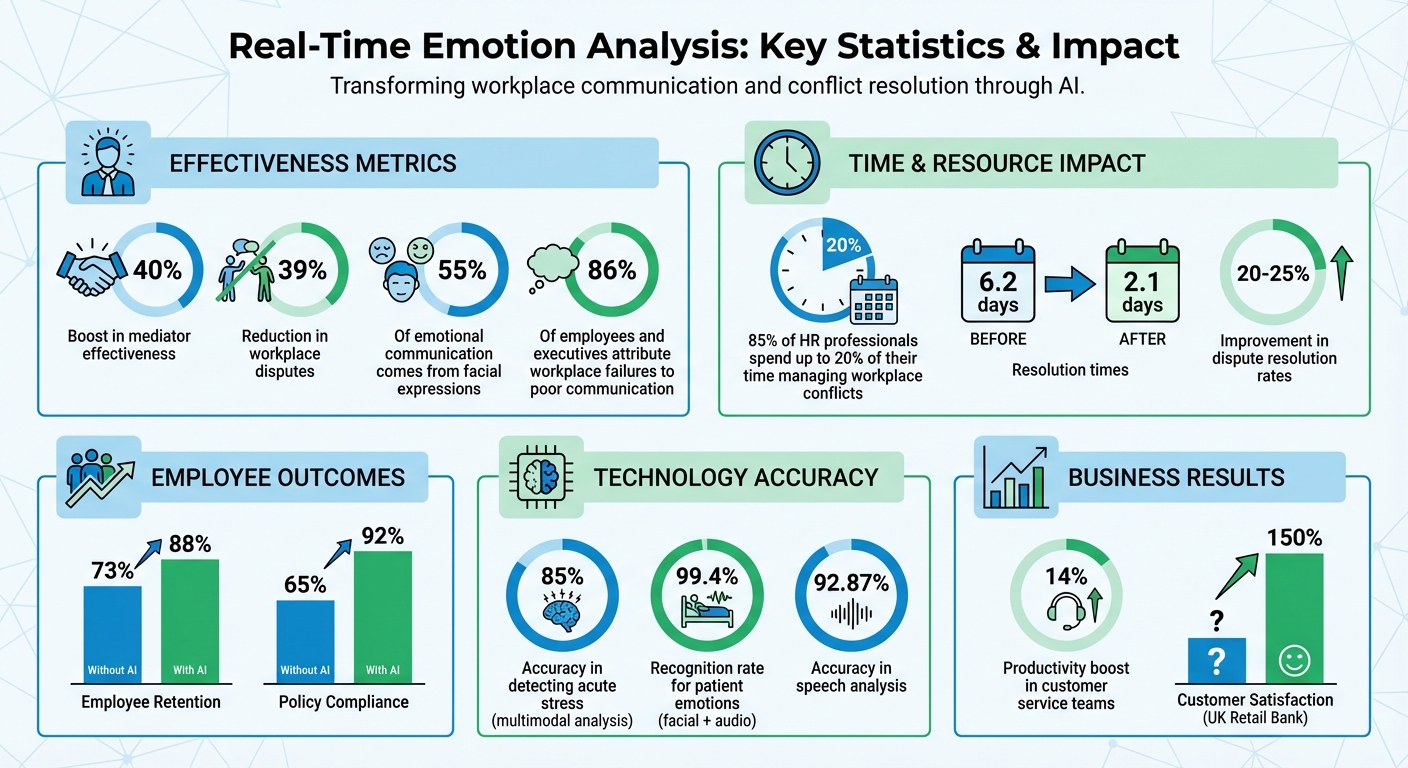
Real-time emotion analysis uses AI to interpret emotions during conversations by analyzing tone, words, facial expressions, and communication patterns. This technology helps detect early signs of tension, enabling faster conflict resolution, especially in remote work settings where nonverbal cues often get lost. By providing real-time emotion AI coaching, it improves communication, prevents misunderstandings, and reduces workplace conflicts. Studies show tools like these can boost mediator effectiveness by 40% and cut workplace disputes by nearly 39%. While privacy concerns exist, safeguards like user consent and encrypted data ensure ethical use.
Key Benefits:
- Improved Conflict Resolution: Early detection of emotions like anger or frustration prevents escalation.
- Enhanced Remote Communication: Bridges gaps in virtual workspaces where emotional cues are harder to read.
- Actionable Feedback: Provides real-time suggestions to adjust tone, language, or approach during tense interactions.
- Data-Driven Insights: Combines emotional analysis with personality profiles for tailored communication strategies.
This approach is reshaping how teams handle stress, offering tools to defuse conflicts and improve collaboration without replacing human judgment.
Real-Time Emotion Analysis Impact on Workplace Conflict Resolution
Problems with High-Stress Conflicts
Missing Emotional Signals in Communication
In high-stress situations, emotional signals are often the first casualty, especially in virtual environments. Subtle cues like a slumped posture, fleeting eye contact, or a shift in vocal tone can indicate rising tension. Yet, in text-based chats or hurried video calls, these important signals are entirely absent [1].
"Emotion-aware AI should act more like a mirror than a mask. It is about reflecting human emotion, not impersonating it." - Aniket Bera, Professor of Computer Science, Purdue University [1]
This problem is magnified by the fact that facial expressions account for up to 55% of emotional communication [5]. When those cues are stripped away in email or chat, interpreting intent becomes a guessing game. Ignoring these hidden signals often leads to conflicts escalating faster than they might in face-to-face interactions.
Common Conflict Situations
Real-world events illustrate how emotional disconnects can lead to chaos. In March 2023, Silicon Valley Bank collapsed after a poorly worded press release caused panic among customers, resulting in mass withdrawals and requiring federal intervention [7].
Around the same time, Anheuser-Busch faced backlash after working with influencer Dylan Mulvaney. The company’s vague and delayed response alienated both the LGBTQ+ community and conservative critics, leading to boycotts and a sharp decline in Bud Light sales [7]. These examples underline the importance of understanding and addressing emotional concerns in real-time to prevent conflicts from spiraling out of control.
This pattern is also evident in workplaces. Studies reveal that 86% of employees and executives attribute workplace failures to poor communication or lack of collaboration [7]. Whether it’s customer service disputes, remote team misunderstandings, or tense negotiations, the root issue is often the same: (a challenge often addressed through leadership and team coaching) missed emotional undercurrents that could have signaled trouble early on.
Effects of Emotional Disconnect
The fallout from ignoring emotional cues goes beyond immediate misunderstandings. Over time, unaddressed emotions build up, distorting how people perceive even neutral messages. Researchers call this phenomenon "negative sentiment override", where every interaction is filtered through a lens of negativity [6].
"The residual emotions from every interaction... accumulate over time, becoming a new dimension of the relationship that derails the objectivity of the current interactions." - Jinashree Rajendrakumar, Certified Gottman Couple Therapist [6]
The consequences are costly. 85% of HR professionals report spending up to 20% of their time managing workplace conflicts [8]. That’s a full day each week lost to issues that could have been mitigated with better emotional awareness. Over time, unresolved tensions lead to chronic stress, anxiety, and burnout, affecting both individuals and teams [1][7]. Morale plummets, customer trust erodes, and relationships often break down when these emotional signals are overlooked for too long.
| Missed Emotional Signal | Impact on Conflict Resolution |
|---|---|
| Slumped Posture / Drifting Eye Contact | Signals disengagement or burnout, causing teams to "tune out" [1] |
| Negative Urgency (Impulsivity) | Leads to poor self-control and reactive aggression [2] |
| Prototypic Anger/Disgust | Sparks the "Violence Escalation Cycle" and retaliatory behavior [2] |
| Vocal Tone Shifts | Often lost in text communication, leading to misinterpreted intent [1] |
| Emotional Exhaustion | Can spread across teams, increasing the risk of widespread burnout [1] |
sbb-itb-f8fc6bf
How Real-Time Emotion Analysis Works
Core Technologies for Real-Time Analysis
Real-time emotion analysis uses multimodal fusion, which means pulling together multiple data streams to create a detailed emotional profile. These systems analyze vocal tones, facial expressions, language patterns, and even physiological signals to capture subtle emotional cues. By combining these inputs, the technology delivers a far more accurate picture of stress or intent than relying on just one method.
For example, they pick up on tiny shifts in speech - like changes in tone, rhythm, or pitch - and micro-expressions, which are fleeting facial movements that often reveal hidden emotions. Some advanced systems even include wearable sensors to track physiological responses, such as heart rate, offering an objective look at nervous system activity.
"The voice is even richer with nonverbal cues than facial expressions. We pioneered decoding subtle qualities in speech prosody: intonation, timbre, and rhythm." - Hume AI [9]
Deep learning plays a big role here, mapping emotions onto a continuous, multi-dimensional scale. These models are impressively accurate, with some achieving over 85% accuracy in detecting acute stress by analyzing a mix of ECG data, vocal patterns, and facial expressions during psychological tests [12]. Another system combining facial and audio signals reached a 99.4% recognition rate for patient emotions using Gaussian mixture models [11].
By processing these data streams, real-time emotion analysis enables actionable insights, especially during live interactions using AI tools for conflict resolution.
Live Feedback During Conversations
This technology doesn't just analyze emotions - it provides real-time feedback to improve communication. In customer service, for instance, AI tools can analyze sentiment during live calls, offering agents suggestions or alerts when a customer appears frustrated. This approach has shown tangible results: customer service teams using AI saw a 14% productivity boost, while a UK retail bank reported a 150% increase in customer satisfaction for certain types of queries by using AI to handle natural language questions [14].
In collaborative settings, tools like "Moody" take it a step further. They offer visual dashboards with metrics such as a Happiness Indicator (average group mood), Peak Indicator (emotional variance), and Groupflow Indicator (emotional harmony) [13]. In one study, researchers from MIT and the Technical University of Munich tested these dashboards with 28 virtual teams (84 participants) during a Mars colony simulation. Teams receiving real-time feedback on happiness and groupflow performed significantly better in terms of simulation output quality compared to teams without this feedback [13].
"AI voice analysis isn't designed to replace people, but to empower them. By highlighting objective patterns that might be overlooked in live conversations, it offers interviewers, recruiters, and investigators an extra layer of clarity." - PolygrAI [10]
Feedback is delivered in subtle ways - like visual gauges, sound cues, or even haptic signals - so users stay focused on the conversation. In professional environments, this feedback is often aggregated at the group level to maintain individual privacy [13].
Privacy and Ethical Concerns
While the benefits of real-time emotion analysis are clear, its use raises valid privacy and ethical concerns. These systems rely on strict safeguards, such as end-to-end encryption and obtaining explicit user consent. Participants must know their emotional and physiological data is being analyzed before any session begins.
"User consent is fundamental to the process and voice samples are never repurposed for model refinement without explicit permission." - PolygrAI [10]
To protect user privacy, these systems are built with privacy-first architecture, ensuring data is processed securely and anonymously. Emotional data and voice samples are never used to train AI models without explicit, separate consent. Developers also work to minimize bias by designing algorithms that adapt to diverse accents, speech patterns, and demographics, ensuring fair and consistent insights across different populations.
These tools are meant to assist, not judge. Managers and mediators should use emotion analysis as an additional perspective to identify stress or tension, rather than relying on it as the final word on someone's intent. By providing objective data - like pitch, tone, or micro-expressions - these systems aim to reduce the unconscious bias that often affects human judgment. Transparency is vital: participants should have access to dashboards or summaries of the metrics being tracked, helping to build trust and ensure the process is seen as supportive rather than intrusive. This ethical approach is essential, especially when using emotion analysis in high-stress situations to defuse conflicts effectively.
Using Emotion Analysis to Resolve Conflicts
Calming Heated Conversations
When emotions run high, real-time emotion analysis steps in to identify anger, frustration, or fear before things escalate further. These systems monitor facial expressions, vocal tones, and speech patterns to detect when a conversation shifts from neutral to confrontational. Research highlights that facial expressions play a critical role in interpreting emotional states [5].
AI tools pick up on these cues and suggest calming language in response. Researchers Sushrita Rakshit, James Hale, and their team note:
"Findings support existing theoretical models for how emotional expressions contribute to conflict escalation and resolution and suggest that agent-based systems could be useful in managing disputes by recognizing and potentially mitigating emotional escalation." [4]
By analyzing emotional patterns over time, these tools provide insights into how conflicts arise, persist, and eventually de-escalate [5]. This kind of emotional mapping gives mediators a more detailed understanding of the situation, allowing for precise and timely interventions.
Improving Remote Team Communication
Remote teams often grapple with challenges like hidden frustrations, misunderstandings, and a lack of emotional connection - issues that can easily get overlooked during video calls or text-based chats. Emotion analysis tackles these problems by offering real-time insights into the emotional tone of the group, acting as a "virtual mirror" for the team's collective mood.
A study involving Moody software and 28 virtual teams found that real-time emotional feedback helps improve self-regulation and ensures more balanced participation [13]. Nicklas Schneider from MIT's Center for Collective Intelligence observed:
"The mere presence of feedback, regardless of its specific form, will likely lead to improved performance due to the Hawthorne effect." [13]
This means that simply making teams aware of their emotional dynamics can encourage better self-awareness and more thoughtful communication. Additionally, these tools monitor factors like conversation balance and turn-taking, ensuring everyone has a voice. This same approach to emotional clarity proves equally effective in negotiations and mediations.
Better Negotiation and Mediation Results
In high-stakes negotiations, real-time emotion analysis provides mediators with an objective look at emotional undercurrents, helping them manage the process more effectively. These tools can identify which of the five core concerns - Appreciation, Affiliation, Autonomy, Status, or Role - are being challenged [15].
For instance, if the system detects feelings of being undervalued (a threat to Appreciation), mediators can pivot to strategies like "thankful recognition", acknowledging the value of a party's perspective even if there’s disagreement. Similarly, when anger or disappointment is flagged, the system can recommend interventions based on the Emotions as Social Information (EASI) theory, which explains how emotional expressions influence others' reactions [3].
Edward J. Kelly and Natalija Kaminskienė summed it up well:
"Eliminate the emotional aspects of negotiation and we are left with nothing more than a dry transaction." [15]
Emotion analysis doesn’t aim to remove emotions from negotiations - it helps mediators work with them in a constructive way. By continuously tracking emotions rather than focusing on isolated moments, these tools offer a fuller picture of how conflicts progress and where resolutions might emerge [5].
At Personos, we combine these advanced emotion analysis techniques with tailored coaching insights, delivering real-time recommendations that empower mediators and teams to navigate even the most stressful situations effectively.
Analyzing Conflict Transformation with Natural Language Processing with Dr. Oliver Fink
Combining Personality Insights with Emotion Analysis
Integrating personality data with real-time emotion analysis takes conflict resolution strategies to the next level. Research confirms that personality traits and situational context both play a role in shaping behavior and emotional responses, offering a more detailed understanding of individual reactions [16].
Sherman, R. A., Rauthmann, J. F., Brown, N. A., Serfass, D. G., and Jones, A. B. highlighted this in their findings:
"Both personality traits and situation characteristics independently predict real-time expressions of behavior and emotion." [16]
This explains why two people facing the same stressful scenario can react in completely different ways. For instance, one person’s communication style paired with frustration might call for a direct de-escalation approach, while someone with a different temperament might respond better to empathy. Advanced tools now allow for real-time measurement of these combined influences, making tailored interventions possible [16].
Personalized Communication Prompts
When emotions like anger are detected, the system adjusts its responses based on the individual's personality. For some, this means offering direct and assertive communication, while for others, empathetic and relationship-focused approaches work better.
Large Language Models (LLMs) now match human annotators in detecting emotional intensity, providing highly accurate automated insights [4]. At Personos, we combine emotion detection with dynamic personality profiles to create communication prompts that are personalized to an individual’s traits and current emotional state. The system doesn’t just identify that someone is upset - it understands how they process conflict and suggests strategies that align with their unique style. This personalized method enables a deeper understanding of relationship dynamics as they evolve.
Dynamic Personality and Relationship Reports
Static assessments offer only a brief snapshot, but Personos' dynamic reports go further by tracking how personality traits interact with recurring emotional triggers over time. For example, if a team member consistently becomes defensive when their autonomy is challenged, the system can identify this pattern and recommend proactive strategies to prevent future issues.
These reports also shed light on how different personality pairings influence conflict. For instance, when two strong-willed individuals clash, the system analyzes the dynamic and suggests tailored interventions that consider both personalities. By integrating these insights with live emotion analysis, teams can anticipate and address conflicts before they escalate, fostering a more harmonious working environment [16].
Creating Emotionally Intelligent Prompts
Crafting effective prompts goes beyond identifying emotions - it’s about guiding conversations toward positive outcomes. For instance, when AI detects anger or aggression, it can step in with a suggestion like, “Let’s adjust the tone,” or propose alternative, more constructive phrasing [17][18]. These real-time nudges help keep discussions productive and on track.
Emotion-Based Responses
Different emotions require different approaches. If someone shows signs of fear or anxiety, the system can prompt facilitators to acknowledge these feelings verbally, which helps create a sense of psychological safety and trust [20]. On the other hand, if signs of boredom or disengagement are detected - often through vocal patterns - the system might suggest using interactive tools like polls, chat features, or structured turn-taking to re-engage participants [20].
Advanced systems take this a step further by recognizing mismatches between facial expressions and vocal tones. For example, a neutral expression paired with a fearful or disgusted tone might signal hidden tension. In such cases, the system can integrate visual, vocal, and textual cues to address underlying issues [20].
Real-world examples showcase these strategies in action. Cogito, a company specializing in real-time emotional intelligence, equips healthcare counselors with voice analytics that flag emotional moments during calls. These alerts encourage counselors to adjust their tone or show empathy [22]. Similarly, Synechron uses AI in banking to analyze customer emotions through tone and pitch, allowing agents to respond based on the customer’s emotional state, reducing potential friction [22].
Step-by-Step De-Escalation
When it comes to de-escalating tense situations, a structured approach works best. The process begins with validating the speaker’s emotions using mirroring statements like, “I understand you’re upset” [19]. From there, prompts can encourage reframing concerns in less emotionally charged terms and highlight ambiguous language that could escalate the situation [19].
Research underscores the effectiveness of combining AI and human efforts. In workplace disputes, hybrid AI-human systems have been shown to resolve conflicts 20–25% more effectively than relying on either method alone [21]. At Personos, emotionally intelligent prompts blend real-time emotion detection with personality insights. This combination provides personalized, situation-specific language that helps transition conversations from conflict to collaboration.
Measuring Results and Addressing Limitations
Tracking Success Metrics
Measuring outcomes is crucial to understanding the real-world impact of real-time emotion analysis. Organizations leveraging AI-assisted systems have seen impressive results: resolution times dropped from 6.2 days to just 2.1 days, dispute resolution rates improved by 20–25%, employee retention climbed to 88% (compared to 73% without these systems), and policy compliance soared to 92% (up from 65%) [21].
A study conducted between November 2023 and January 2024 by researchers from MIT, Tecnológico de Monterrey, and the University of Applied Sciences of The Hague explored these benefits further. They observed 84 participants across 28 teams using the Mars Star City simulation software (version 4.0). Teams that received real-time emotional feedback through Moody software (version 2.0) - which tracked happiness, peak emotional variance, and groupflow indicators - outperformed control groups based on Pareto Scores [13].
Current Challenges and Future Improvements
Despite advancements, challenges remain. Current systems achieve 92.87% accuracy in speech analysis [11] and 85.1% with multimodal fusion [12]. However, algorithmic bias still impacts 30–40% of mediation cases. Moreover, these systems struggle to interpret sarcasm correctly 68% of the time and misread high-context communication in 38% of cases [21].
"AI integration in conflict resolution offers data-driven solutions while retaining essential human insight." – Satyadhar Joshi, Researcher [21]
The future of emotion analysis lies in multimodal emotion recognition (MER), which integrates data from speech, visuals, text, and physiological signals. Interestingly, 80% of all MER research has been published since 2019, with more than 40% of studies since 2022 adopting trimodal configurations or transformer-style architectures [23]. At Personos, combining personality insights with emotion analysis addresses these limitations by not only identifying what emotions are being felt but also uncovering the reasons behind them. This approach enhances conflict resolution and highlights the importance of integrating deeper personality insights to refine real-time emotion analysis systems further.
Conclusion
Real-time emotion analysis is changing how we approach high-stress conflicts. Instead of relying on intuition, AI tools now provide data-driven insights that track how emotions unfold and shift during conversations [5]. This shift allows for more precise and proactive conflict management strategies.
By incorporating nonverbal cues, these systems achieve greater accuracy [5], and recent advancements have enabled them to match human annotators in identifying the intensity of emotions [4]. When used in real-world conflicts, these tools support quick de-escalation and foster constructive outcomes. They address conflict on various levels - shaping how individuals think, influencing responses from others, and determining whether groups work together or compete [3].
"Agent-based systems could be useful in managing disputes by recognizing and potentially mitigating emotional escalation."
- Sushrita Rakshit, James Hale, Kushal Chawla, Jeanne M. Brett, and Jonathan Gratch [4]
By combining emotional analysis with personality insights, systems like Personos go a step further. They not only identify what emotions someone is experiencing but also why they feel that way. This understanding helps tailor communication strategies to align with individual behavioral patterns. With real-time feedback during tense moments and long-term tools for strengthening relationships, Personos bridges theory and practice. Its proactive prompts and dynamic personality reports turn insights into actionable steps.
When human judgment is supported by real-time emotional insights, conflict resolution becomes more effective. As Lara Chehayeb et al. highlighted, "Being able to constructively regulate emotions not only benefits individual experience of emotions but also fosters effective interpersonal emotion regulation and influences how a situation is managed" [24]. By integrating emotion analysis with personality coaching, platforms like Personos transform high-stress situations into opportunities for meaningful and productive dialogue.
FAQs
How can real-time emotion analysis help resolve conflicts in remote work environments?
Real-time emotion analysis works by detecting stress or negative emotions in emails, chat messages, and video calls. It does this by examining factors like tone, word choice, and timing. The system then offers immediate, practical suggestions - like rewording a message or tweaking the timing of communication - to help avoid misunderstandings and diffuse potential conflicts before they escalate.
This technology is particularly helpful for remote teams, as it enables them to tackle issues early and improve communication. By bridging the gap left by the lack of face-to-face interaction, it helps create smoother collaboration and minimizes unnecessary friction.
How does Personos ensure privacy and ethical use of emotion analysis technology?
Personos takes privacy seriously, implementing strong measures to protect emotional data and ensure ethical practices. Data is encrypted both during transmission and while stored, and anonymization methods are in place to prevent emotional insights from being tied to specific individuals without their clear consent. Users have complete control over what data is stored or shared, offering both transparency and choice.
To strengthen privacy protections, Personos follows established security standards and performs regular audits to restrict access to sensitive information. With a focus on consent-based data collection, minimal data retention, and straightforward opt-out options, Personos ensures its emotion analysis tools are used to promote understanding and resolve conflicts - not to surveil or penalize anyone.
How can personality insights and emotion analysis help resolve conflicts more effectively?
Combining insights about personality with real-time emotion tracking offers a clearer picture of how someone feels and why they react in certain ways. Tools like Personos leverage AI to analyze personality traits - such as openness or agreeableness - while also picking up on emotional cues like tone and sentiment during conversations. This enables the system to pinpoint potential triggers for conflicts and provide on-the-spot suggestions, such as adjusting phrasing or choosing the right moment to respond.
By considering both emotional states and personality-driven tendencies, conflicts can be managed more efficiently. For instance, the system might recommend a fact-based response for someone who prefers logic or a more compassionate tone for individuals who prioritize harmony. This tailored approach not only prevents situations from escalating but also ensures that interventions feel relevant and impactful, leading to quicker resolutions and stronger team cohesion.