Real-Time AI for Team Decision Support
Real-time AI speeds decisions, reduces bias, and provides personality-aware coaching to improve team collaboration and outcomes.
Rachel Johnson

Real-Time AI for Team Decision Support
Teams today face a major challenge: making fast decisions while managing overwhelming amounts of data. Traditional methods like meetings and reports are too slow, causing missed opportunities. Real-time AI changes this by acting as a teammate, offering instant insights and improving decision-making processes.
Key takeaways:
- Faster decisions: AI provides real-time feedback, helping teams act quickly without sacrificing accuracy.
- Better collaboration: AI tools reduce biases, balance participation, and ensure every voice is heard.
- Proven results: Companies using real-time AI report higher revenue growth and improved customer satisfaction.
For example, United Airlines improved customer satisfaction by 6% using generative AI tools between 2024–2025. Tools like Personos analyze personality and team dynamics, mitigate biases, and provide tailored coaching to improve decision-making. At $9 per user per month, it’s an accessible solution for teams looking to improve efficiency and outcomes.
The bottom line: Real-time AI is transforming how teams work together, making decisions faster, smarter, and more effective.
AI IRL - Episode 5: Human-AI Teaming for Decision Making
sbb-itb-f8fc6bf
Common Team Decision-Making Problems
Making decisions as a team is rarely straightforward. Even the most skilled groups can struggle, not because they lack data, but because of the way humans process information and interact under pressure. Add to this the challenges of traditional methods, and it becomes clear why decision-making often hits roadblocks. These issues highlight the growing need for tools like real-time AI to help teams navigate and fix common flaws in their decision-making processes.
Information Overload and Slow Decisions
Too much data can paralyze a team. The issue isn’t the lack of information but the sheer volume of it. When faced with overwhelming data, teams often find it hard to sift through and prioritize what matters. This leads to cognitive overload, where the brain struggles to make sense of it all. Instead of diving deep into unique insights held by individual members, teams tend to focus on shared, easily accessible information, leaving critical details overlooked.
The impact of this is significant. For instance, poor data quality is behind 68% of AI project failures. On top of that, the pressure to act quickly forces teams into tough choices between speed and accuracy [7]. To manage these bottlenecks, organizations often turn to professional facilitators, who charge anywhere from $1,500 to $3,000 per day [4].
Cognitive Biases and Groupthink
Biases can quietly derail team decisions. One common issue is shared information bias, where teams stick to discussing what everyone already knows, ignoring unique insights. Another is individual preference bias, where members only share facts that back up their existing opinions [4]. Together, these biases can keep vital information hidden.
Take the example of a hidden profile task: each team member might start with private data suggesting that Myloria is the best option. Yet, when all data is combined, it becomes clear that Eldoron is the superior choice [4]. Without properly sharing and evaluating information, teams can miss the bigger picture. Social dynamics make things worse - groupthink suppresses dissent, social loafing reduces individual effort, and communication apprehension (fear of speaking up) silences valuable input.
Interpersonal Conflicts and Communication Problems
Personality differences and poor communication can derail even the most well-meaning teams. Power dynamics often lead to anchoring problems, where higher-ranking individuals dominate decisions, even if their ideas lack merit [6]. Then there’s the “cocktail party problem.” In groups larger than 10–12 people, conversations often break down into monologues as members struggle to follow multiple voices at once [6].
Another issue is the imbalance between vocal and quieter team members. Dominant voices often steer the conversation, leaving quieter individuals - who may hold critical insights - unheard. These interpersonal hurdles prevent teams from tapping into their full potential, limiting their ability to make well-rounded decisions. Using AI tools for conflict resolution can help identify these patterns before they stall progress.
How Real-Time AI Improves Team Decisions
Real-time AI is transforming team decision-making by actively monitoring discussions and offering instant, actionable insights. By analyzing conversations as they unfold, these systems help teams address potential issues before they escalate. Through behavioral data analysis and neutral guidance, AI ensures discussions remain productive and focused.
Analyzing Behavioral Data to Identify Decision Patterns
Real-time AI dives deep into team dynamics, capturing detailed behavioral patterns to refine decision-making processes. These systems monitor various aspects of interaction, such as who speaks, how often turns are taken, and whether the conversation stays aligned with the task. For example, tools like tAIfa analyze team transcripts in real time, using metrics like Language Style Matching (LSM) and sentiment analysis to measure participation and team cohesion [10]. Teams receiving AI-generated feedback tend to engage in longer, more balanced discussions, with increased turn-taking that fosters dynamic interactions [10].
But this technology doesn’t just count words. With Artificial Theory of Mind (AToM), AI can infer what team members might be thinking, feeling, or believing during discussions [9]. This allows the system to tailor its advice based on the group’s cognitive state, ensuring that every member's expertise is recognized and that no valuable insights are overlooked [10].
Real-time "mirroring" tools also play a key role. These tools visually display conversational balance, highlighting each participant's engagement, influence, and dominance during the meeting. Research shows that teams exposed to this feedback were twice as likely to adjust their behavior, with participants reporting increased self-assessed dominance compared to those in control groups [11]. Impressively, AI can identify dominant participants with 76% accuracy [11].
Reducing Bias and Increasing Objectivity
One of the standout benefits of real-time AI is its ability to counteract biases and promote objective decision-making. Conversational Swarm Intelligence (CSI), for instance, divides large groups into smaller, interconnected subgroups using AI "Conversational Surrogates." This structure ensures that ideas are evaluated on merit rather than the loudest voice in the room. Teams using CSI showed a 37% reduction in the gap between contributions from the most vocal and least vocal participants, compared to traditional chat setups [6].
"The goal of CSI is to enable large, networked human groups... to hold thoughtful conversational deliberations in real-time that rapidly converge on optimal solutions based on the combined knowledge, views, and opinions of the participants." – Louis Rosenberg, CEO, Unanimous AI [6]
Another tool, factual grounding, adds an extra layer of objectivity. AI "Infobots" integrate into discussions, providing access to real-time statistics and data. This allows team members to back up their arguments with facts. In one study, 85% of participants felt their team’s decisions were stronger thanks to the AI-provided information [3]. By presenting probability distributions instead of definitive answers, the system avoids creating echo chambers and encourages diverse perspectives [5]. Research also highlights the system’s positive impact on lower-performing teams, significantly boosting their outcomes across key measures [9].
Personos: AI-Powered Team Decision Support
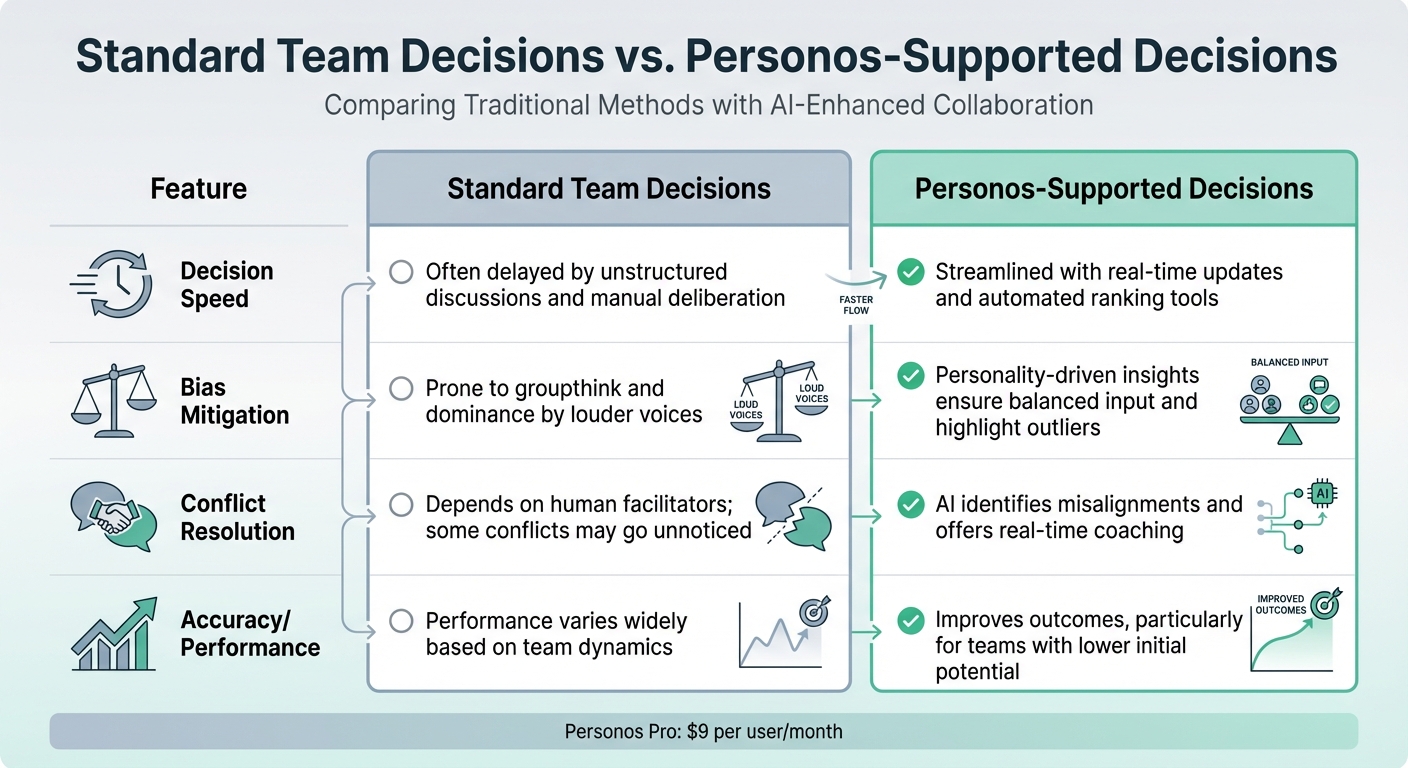
Standard vs AI-Supported Team Decision-Making Comparison
Research has shown that real-time AI can significantly improve team decision-making, and Personos brings this capability to life through an accessible, user-friendly platform. By merging personality psychology with artificial intelligence, Personos tackles common team challenges - like cognitive biases, communication breakdowns, and interpersonal conflicts - that often hinder effective decision-making. The platform translates these AI-driven insights into actionable tools for everyday use.
Core Features of Personos
Personos leverages advanced psychometric tools, including the Big Five Factor model, Sociable Dominance, and Psychological Collectivism, to create detailed personality profiles for team members [12][9]. These profiles provide a deeper understanding of how individuals think, communicate, and interact within a group setting.
The platform’s dynamic personality reports offer tailored insights at individual, relational, and group levels. For instance, studies reveal a notable correlation (0.52) between a team member’s "Agreeableness" score and the gap between their preferences and the final group decision. This suggests that without specific intervention, more agreeable members may struggle to have their voices heard [12].
Proactive communication prompts take this a step further by offering real-time coaching during discussions. The system monitors team interactions to identify misalignments in understanding and intervenes to prevent groupthink while ensuring diverse perspectives are included. A participant from the University of Maryland QUEST Honors Program, which involved 45 students across 9 teams, highlighted the value of this feature:
"The chart was very helpful, because it showed majority perspectives which allowed everyone's perspective to be objectively viewed. In this way, everyone's opinions were incorporated so that one person's opinion couldn't overshadow others." - User U11, QUEST Honors Program Participant [12].
These features enable teams to achieve results that outperform traditional decision-making methods.
Comparison: Standard Team Decisions vs. Personos-Supported Decisions
| Feature | Standard Team Decisions | Personos-Supported Decisions |
|---|---|---|
| Decision Speed | Often delayed by unstructured discussions and manual deliberation [12]. | Streamlined with real-time updates and automated ranking tools [12]. |
| Bias Mitigation | Prone to groupthink and dominance by louder voices [12]. | Personality-driven insights ensure balanced input and highlight outliers [12]. |
| Conflict Resolution | Depends on human facilitators; some conflicts may go unnoticed [12]. | AI identifies misalignments and offers real-time coaching [2]. |
| Accuracy/Performance | Performance varies widely based on team dynamics [9]. | Improves outcomes, particularly for teams with lower initial potential [9]. |
Real-Time Coaching and Conflict Resolution
Expanding on its core capabilities, Personos provides real-time guidance tailored to both the task at hand and the team’s dynamics. For example, during the ASIST Program’s urban search and rescue simulations, AI advisors monitored high-pressure team missions. The results were compelling:
"ASI advisors had a strong positive impact on low potential teams such that they improved the performance of those teams across mission outcome measures." - Nature Scientific Reports [9].
Personos differentiates between taskwork potential (technical skills like spatial navigation) and teamwork potential (social intelligence, collective orientation, and dominance). This dual approach helps the system diagnose whether a team’s struggles stem from technical execution or collaboration issues [9].
For conflict resolution, Personos customizes communication strategies based on individual profiles. Its group dynamics analysis identifies who is leading discussions versus who is handling execution. Interestingly, research indicates that key decision-makers often score higher in extraversion and lower in conscientiousness [12].
For just $9 per seat per month, Personos Pro offers private, user-specific insights. This ensures a judgment-free environment where users can reflect and grow without concerns about external perceptions.
How to Implement Personos for Better Team Decisions
Evaluating Team Needs and Objectives
Start by mapping out the kinds of decisions your team regularly handles - whether they’re simple yes/no choices, prioritizing tasks, or selecting from multiple options [13]. Use an Importance vs. Urgency matrix to analyze recent decisions and identify areas where AI tools like Personos could make the biggest difference [13].
Next, assess your team’s dynamics using measurable data. Break down the work into "taskwork" (the technical tasks) and "teamwork" (collaborative processes such as leadership roles and conflict resolution) [9]. For example, a study revealed that 11 out of 17 team members who physically updated group rankings considered themselves facilitators, uncovering hidden patterns of leadership [12].
Conduct a pre-mortem exercise to identify potential reasons for decision-making failures before they happen [13]. Document your team’s goals, values, and constraints to ensure AI recommendations align with your mission [13].
Once you’ve clarified your team’s objectives, the next step is to set up Personos and train your team to use it effectively.
Setting Up Personos and Training Your Team
Personos is priced at $9 per user per month, making it an affordable option for teams of all sizes. Start by running practice sessions to teach the AI about your team’s decision-making patterns [15]. Assign "AI champions" to oversee the setup process and troubleshoot any workflow challenges [16].
The training process should focus on positioning Personos as a "sensemaking partner" rather than a tool that simply provides answers [1]. By incorporating individual and team profiles, the AI adjusts its communication style based on whether it’s working with a beginner or an expert [9]. As MIT Professor Alex Pentland explains:
"AI without human oversight is prone to bad mistakes, typically because the AI has such a narrow view of the world and can't tell when it is violating norms or when the context has changed" [5].
Adopt a "pause and reflect" method, where Personos steps in to address misalignments in real time [15]. This approach uses Socratic questioning to provide coaching during critical decision moments. Teams should also prepare for "reconciliation costs", which refer to the time needed to process recommendations from the AI that might conflict with their own instincts [14].
After setting up and training, it’s essential to measure how well Personos is working and make adjustments as needed.
Tracking Results and Making Adjustments
Before fully rolling out Personos, establish baseline metrics to measure progress. Track factors like decision speed, error rates, and team alignment to create a clear benchmark for evaluating the tool’s impact [16]. Research shows that organizations with AI-ready cultures outperform their peers by 11.5%, and 70% of successful implementations credit collaboration and knowledge sharing as key factors [8].
Monitor results across these key areas:
- Decision Cycle Time: Aim to cut down the time it takes to resolve inquiries by 40% [18].
- Strategic Alignment: Strive for a 25% improvement in conversion rates for personalized campaigns [18].
- Recommendation Acceptance: Measure how often AI-driven recommendations are adopted compared to human-led decisions [8].
Look for improvements in shared understanding among team members and reductions in bottlenecks during cross-functional projects [17][2]. Build feedback loops so team members can flag whether Personos’ recommendations were helpful, enabling continuous refinement [8][19]. Regularly check for "model drift", where the AI’s accuracy might decline due to changes in data or market conditions [8][18]. Conduct audits to address potential biases, as 70% of consumers express concerns about the ethical use of AI [8].
| Metric Category | Specific Indicator | Goal/Target Example |
|---|---|---|
| Efficiency | Decision Cycle Time | 40% reduction in time to resolve inquiries [18] |
| Quality | Strategic Alignment | 25% increase in conversion for personalized campaigns [18] |
| Cost | Operational Savings | 20% reduction in inventory holding costs [18] |
| Collaboration | Shared Understanding | Detection of misalignments in team behavior [2] |
| Trust | Recommendation Acceptance | Frequency of AI‐led vs. human‐led decisions [8] |
Conclusion: What's Next for AI in Team Decision Support
Real-time AI, like Personos, is reshaping how teams make decisions by offering dynamic, personality-aware support that enhances human judgment. These systems identify misalignments and provide timely coaching, ensuring that teams stay on track when it matters most.
Recent studies highlight this shift. In August 2025, researchers from MIT and Microsoft Research studied 1,475 participants across 281 groups. Their findings? AI facilitators significantly boosted the number of unique facts shared in discussions, with a moderate-to-large effect size (Cohen's d = 0.61) [4]. This aligns with earlier research showing that effective real-time AI uses behavioral data to create more balanced and well-informed team conversations. In this way, AI is evolving into an active participant in making smarter decisions.
As Raunak Jain and Mudita Khurana put it:
"Sensemaking (the ability to co-construct causal explanations, surface uncertainties, and adapt goals) is the key capability that current training pipelines do not explicitly develop or evaluate" [1].
The future of AI won't just involve providing answers - it will guide teams toward understanding the reasoning behind decisions and highlighting crucial uncertainties.
Organizations adopting these systems today are preparing themselves for a major transformation. Real-time AI is set to revolutionize team decision-making. The question is: will your team be ready to take the lead? Those who embrace these advancements will redefine how decisions are made across industries.
FAQs
What decisions benefit most from real-time AI support?
Real-time AI shines brightest in situations that are fast-paced, high-pressure, or demand quick decision-making. For instance, it can help resolve workplace conflicts by analyzing emotional cues and suggesting personalized strategies. Another example is its role in maintaining safety in live environments by enabling immediate, controlled actions. These systems are particularly effective in minimizing risks, improving performance, and offering swift, data-backed responses when time is of the essence.
How does real-time AI reduce bias without steering the outcome?
Real-time AI tackles bias head-on by identifying and addressing it as it happens. Using techniques like dynamic bias detection and targeted interventions, it works to keep decision-making processes both fair and dependable - all without skewing the results.
What should we measure to prove Personos is improving decisions?
To demonstrate how Personos is improving team decision-making, focus on measurable outcomes. For instance, there's been a 43% decrease in conflict escalation, with resolution times dropping significantly - from 6.2 days to just 2.1 days. Formal grievances have also gone down by 34%, highlighting a more harmonious workplace.
Additionally, collaboration metrics show clear progress. Project delays have been reduced by 25%, while team satisfaction has climbed by 30%, reflecting better communication and teamwork. These numbers paint a clear picture of Personos' positive influence on team dynamics.