Personality vs. Culture in Generational Identity Gaps
Generational divides come from both stable personality traits and shared cultural events; combining both eases workplace tension.
Nick Blasi

Personality vs. Culture in Generational Identity Gaps
Generational conflicts in workplaces and families often stem from two key factors: personality traits and shared experiences. Personality traits, such as openness or conscientiousness, are stable over time and explain individual behaviors. Shared experiences, like historical events (e.g., 9/11 or the Great Recession), shape the values and outlooks of entire generations.
- Personality-driven perspective: Focuses on individual traits and interpersonal differences. Tools like Personos use detailed personality profiling to reduce conflicts by tailoring communication strategies for meetings.
- Experience-based perspective: Examines how major events during formative years influence generational identities. For example, Baby Boomers value loyalty due to post-war scarcity, while Millennials prioritize work-life balance after witnessing economic instability.
The tension lies in balancing these approaches. Personality models offer tailored solutions, while shared experiences provide context for generational values. Leaders can also leverage AI for behavioral insights to better understand these dynamics. Overgeneralizing generations can worsen conflicts, but combining both perspectives helps resolve misunderstandings effectively.
Key takeaway: Generational gaps are not just about age - they're about how individual traits and life events interact. Tailored tools that address both factors can bridge these gaps in a meaningful way.
Generational Differences at Work: Truth and Fiction
How Shared Experiences Shape Generational Identities
The experiences we go through during adolescence play a huge role in shaping how we see the world. Researchers describe this as a "generation for itself" - not just a group of people born around the same time, but individuals united by powerful, transformative events they lived through together [4]. These shared moments help explain how different generations respond to changes in culture and the economy.
For instance, Baby Boomers were shaped by post–World War II scarcity, the Civil Rights Movement, and the Vietnam War. These experiences instilled values like competition, social activism, and a strong work ethic [1][3]. Generation X grew up during the fall of the Berlin Wall, the AIDS epidemic, and the rise of the dot-com era, which encouraged independence, skepticism, and a focus on balancing work and life [1][2]. Millennials came of age during 9/11, the internet boom, and the Great Recession, which made them tech-savvy, collaborative, and drawn to meaningful work [1][8]. Generation Z, meanwhile, has been shaped by the climate crisis, the COVID-19 pandemic, and the dominance of social media, creating what researchers call the first "global generation" with a focus on truth, authenticity, and mental health [1][2].
These shared experiences often leave a lasting imprint on values. Hanju Lee from Johns Hopkins University explains:
"The environment in which an individual is brought up in, namely the things that they lack or are deprived of in their childhood, strongly influences their value development throughout adulthood" [1].
For example, Baby Boomers, who grew up with limited resources, developed a "work as hard as you can" mentality. Generation X, having seen their parents' work-focused lives, leaned toward a "work hard, play hard" approach. Millennials and Gen Z, having witnessed economic upheaval, tend to seek jobs that align with their personal values and allow for a sense of playfulness [1].
Major Events and Movements That Define Generations
The impact of shared experiences becomes even clearer when we look at defining historical moments. Events experienced firsthand are remembered as personal memories, while younger generations often encounter these same events as "cultural memory", which can feel more distant or even myth-like [4]. This explains why Baby Boomers, who lived through the Civil Rights Movement, often relate to it differently than Millennials, who mostly learned about it in school.
Technology has also created sharp generational divides. Generation X witnessed the shift from analog to digital, Millennials experienced the rise of the digital age, and Generation Z grew up as true "digital natives." These shifts have dramatically altered how people communicate and interact socially [1][3]. For example, Traditionalists value handwritten notes, Baby Boomers favor phone calls or in-person meetings, while Millennials and Gen Z rely heavily on instant messaging, texting, and social media [2][8].
Economic realities further highlight generational differences. Baby Boomers enjoyed stable job markets and affordable housing, while Millennials face challenges like student debt and delayed homeownership. These disparities create tension, especially as Baby Boomers hold 65% of the U.S. Senate and 48% of the House of Representatives, while Millennials - making up about 35% of the workforce - struggle with what researchers describe as a "bottleneck" in the transfer of wealth and power [7][1]. These contrasting experiences shape differing views on work, success, and fairness.
Why Generational Stereotypes Fall Short
While shared experiences play a big role in shaping generational identities, the stereotypes that often come with these labels can oversimplify reality. Cultural historian Siva Vaidhyanathan from the University of Virginia critiques this mindset:
"Generational thinking is just a benign form of bigotry" [9].
The problem lies in treating generations as "highly entitative" - viewing them as uniform, clearly defined groups with little variation [7]. This approach encourages "us-versus-them" thinking, fueling conflict and ignoring the diversity within each generation.
Take the stereotypes of the "privileged Boomer" or the "coddled Millennial." These narratives often reflect the experiences of white, middle-class individuals and fail to account for those from minority or lower-income backgrounds [4][5][9]. Historian Pierre Nora captures the issue well:
"The generational concept would make a wonderfully precise instrument if only its precision didn't make it impossible to apply to the unclassifiable disorder of reality" [9].
Karl Mannheim also pointed out that even within the same historical period, people’s experiences can differ greatly. For example, 18th-century peasants didn’t share the same generational outlook as their urban, educated peers [9].
Today, a Millennial raised in rural poverty has little in common with one from an affluent suburb, even though they were born in the same era. Research involving 1,714 participants found that challenging the rigid boundaries of generational categories - encouraging people to see generations as less fixed - can reduce intergroup hostility [7]. While shared experiences do shape generational identities, overly strict definitions often do more harm than good. Understanding the complexities behind these shared experiences is key to addressing generational conflicts more effectively.
Personality Traits Across Generations: A Big Five Perspective
Generational labels like "Millennial" or "Gen Z" often oversimplify the diversity within groups of people. The Big Five personality model, also called the Five Factor Model, offers a more precise way to understand individual differences. It measures five key traits: openness, conscientiousness, extraversion, agreeableness, and neuroticism. Unlike fixed generational categories based on birth year, these traits reflect the unique characteristics that make each person distinct [4].
Research suggests that meaningful differences in personality or values are not driven by the year you were born. Instead, they often arise from life stages and the context of the times. For example, a 25-year-old Millennial and a 25-year-old Baby Boomer (when they were that age) likely faced similar challenges, such as starting careers or forming their identities, despite living through different historical moments [7].
Generational stereotypes often paint entire age groups with a broad brush, ignoring the individuality revealed by personality traits [7]. For instance, a conscientious and introverted person from one generation may have more in common with a similarly-minded individual from another generation than with an extroverted peer of the same age group. In fact, nearly half of Britons feel that labels like "Millennial" or "Gen Z" fail to reflect individual personalities [5]. As Son Pham aptly put it:
"Generalisation would only serve to minimise the very experience of what makes us human" [5].
Focusing on personality traits rather than generational stereotypes offers a clearer way to understand and address generational differences. Instead of assuming all Millennials value flexibility or all Boomers prioritize hard work, personality-based insights highlight how genetics and environment shape individual experiences. This more nuanced perspective helps create tailored solutions for addressing generational conflicts and aligns with earlier discussions on shared cultural experiences.
How Personality Traits Stay Stable and Change Over Time
In personality psychology, the "settled dispositions model" explains that core traits remain relatively stable throughout adulthood [4]. For example, someone who is highly conscientious at age 30 is likely to exhibit similar levels of conscientiousness at age 60, even as they encounter new life stages and historical contexts. This stability makes personality-based approaches reliable for long-term interventions.
However, the "active updating model" suggests that cultural and historical shifts can influence behaviors and attitudes, particularly during adolescence and early adulthood [4]. Younger people are more likely to experience lasting changes in perspective, while older adults tend to maintain consistent dispositions. For instance, while technology has influenced behaviors like attention spans and gratification needs in Generation Y and Z, these changes are relatively minor compared to the variation found within each generation [8]. Economic factors can also shape how personality traits are expressed, but the core traits typically remain consistent [4].
How Personality Interacts with Race, Class, and Gender
Personality traits don’t exist in a vacuum - they intersect with factors like race, class, and gender to create diverse experiences, even within the same generation [4][5]. Generational stereotypes often reflect white, middle-class viewpoints and fail to account for these complexities. For example, a Black Millennial raised in an urban setting may face challenges and develop perspectives that differ significantly from those of a white Millennial from a suburban background, even if their Big Five profiles are similar.
These intersections highlight how generational identities can sometimes reflect privileged perspectives. In the UK, for instance, the second wave of Baby Boomers born in the 1960s experienced different economic realities compared to the first wave born after World War II, which shaped their sense of identity [4]. This reinforces the idea that personality, combined with contextual factors, offers a clearer framework for understanding generational dynamics.
Platforms like Personos embrace this complexity by using the Five Factor Model to measure 30 personality traits on an 80-point scale. Unlike generic generational training programs, Personos combines these detailed profiles with contextual factors like race, class, and gender to offer real-time, personalized guidance. For professionals like social workers, counselors, and case managers, this approach allows them to understand not only who someone is but also how to work effectively with them. By focusing on individual traits and relational dynamics, this method avoids overgeneralizations and creates more tailored, effective interventions. Tools like Personos show how personality-driven insights can bridge generational divides and foster better understanding across diverse groups.
Direct Comparison: Personality vs. Shared Experiences in Generational Gaps
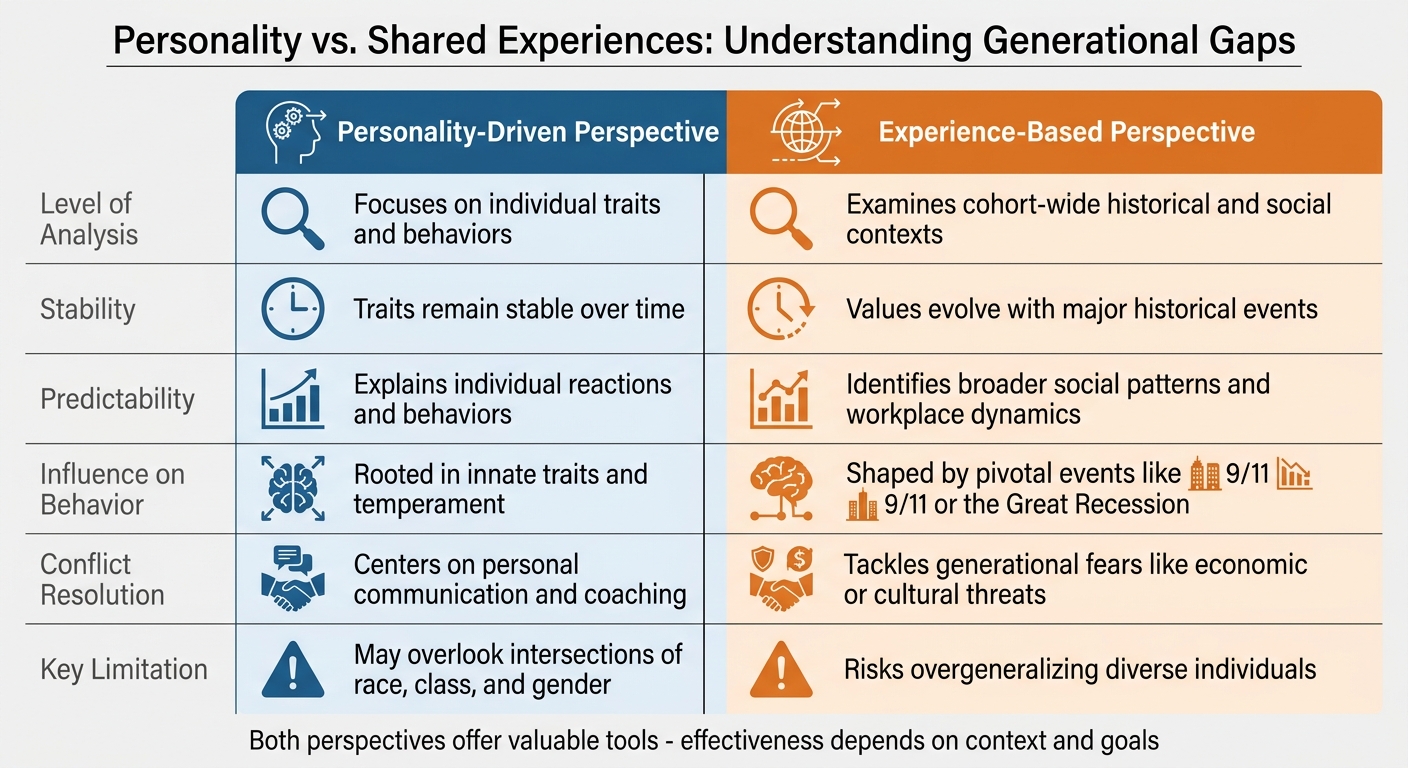
Personality vs Shared Experiences: Two Approaches to Understanding Generational Gaps
This section takes a closer look at two key frameworks for understanding generational differences: one centered on individual personality traits and the other on shared experiences shaped by historical events. Both approaches provide valuable insights into generational conflicts, but they also come with their own challenges.
The personality-based perspective focuses on stable traits like conscientiousness and openness, which tend to remain consistent throughout adulthood. This model is particularly effective for explaining how individuals respond in specific situations, making it useful for addressing conflicts on a personal level through emotional intelligence.
On the other hand, the shared experiences perspective emphasizes how major historical events during formative years - like the Great Recession, 9/11, or the COVID-19 pandemic - shape the values and outlooks of entire generations. This approach is better suited for understanding broad societal trends and generational identities. However, as sociologist Karl Mannheim pointed out, generations emerge when individuals experience "the social and intellectual symptoms of a process of dynamic de-stabilisation" [4]. While insightful, this framework risks oversimplifying and stereotyping diverse groups.
The tension between these approaches becomes particularly apparent in conflict resolution. Personality-focused methods prioritize interpersonal communication and tailored coaching powered by AI, while experience-based strategies aim to address the distinct fears and challenges each generation perceives. For instance, studies suggest Baby Boomers are more concerned about symbolic threats to values and traditions, whereas Millennials are more focused on realistic threats like economic stability [7]. These contrasting concerns fuel generational misunderstandings and highlight the need for nuanced solutions.
Comparison Table: Personality vs. Shared Experiences
Here’s a side-by-side look at how these two perspectives compare:
| Attribute | Personality-Driven Perspective | Experience-Based Perspective |
|---|---|---|
| Level of Analysis | Focuses on individual traits and behaviors | Examines cohort-wide historical and social contexts |
| Stability | Traits remain stable over time | Values evolve with major historical events |
| Predictability | Explains individual reactions and behaviors | Identifies broader social patterns and workplace dynamics |
| Influence on Behavior | Rooted in innate traits and temperament | Shaped by pivotal events like 9/11 or the Great Recession |
| Conflict Resolution | Centers on personal communication and coaching | Tackles generational fears like economic or cultural threats |
| Key Limitation | May overlook intersections of race, class, and gender [4][5] | Risks overgeneralizing diverse individuals [1] |
Both perspectives offer valuable tools for understanding and addressing generational divides, but their effectiveness often depends on the specific context and goals of the analysis.
Practical Interventions for Bridging Generational Gaps
Personality-Driven Interventions
Addressing generational conflicts requires more than the usual sensitivity training. For instance, Baby Boomers often feel their long-held values are under threat, while Millennials grapple with concerns tied to economic instability[7]. A generic, one-size-fits-all approach fails to address these distinct challenges.
This is where targeted tools like Personos come into play. Built on the Big Five personality model, Personos evaluates 30 traits on an 80-point scale to deliver real-time, personalized guidance. Imagine a social worker mediating between a resistant client and a forward-thinking colleague. Personos’ conversational AI analyzes their personality profiles and offers tailored communication strategies. Its Dynamic Reports pinpoint sources of tension and suggest actionable steps, considering traits like openness or conscientiousness.
By focusing on individual differences, tools like Personos challenge the notion of entitativity - the tendency to see generations as rigid, uniform groups. Studies confirm that reducing this perception can significantly ease hostility compared to traditional training methods[7]. This shift encourages professionals to view people as individuals with unique motivations, rather than as representatives of a generational stereotype.
Advantages Over Experience-Based Training
While personality-driven tools provide customized solutions, experience-based training often falls short. Why? Because it can overlook individual concerns and trigger resistance[7]. For example, telling a Millennial to "understand" an older colleague’s loyalty to tradition, or asking a Baby Boomer to embrace Millennials’ preference for flexibility, can leave both feeling dismissed.
Personality-aware tools like Personos avoid these pitfalls by offering precision over generalization. Instead of relying on broad historical references - like the impact of 9/11 or the Great Recession - which may fail to account for factors like race, gender, or class[1][5], personality models consider that traits are only about 40% heritable, with environments playing a larger role[6]. This nuanced approach can reveal, for instance, that someone typically associated with a generational stereotype may actually defy those assumptions. Such insights help align differing work styles and transform conflicts.
The benefits are clear: nearly half of Britons reject generational labels like "Millennial" or "Gen Z", arguing that they don’t capture an individual’s true personality[5]. By focusing on fluid, personal traits instead of fixed generational categories, tools like Personos reduce the "us-versus-them" mindset that often drives workplace tension. At $9 per seat per month, Personos offers professionals - social workers, coaches, and nonprofit staff - practical solutions to address the unique challenges each individual faces, without reinforcing harmful stereotypes.
Conclusion: Personality and Shared Experiences in Balance
Generational identity gaps can't be fully explained by personality traits or shared experiences alone. Events like the 2008 financial crisis or the rise of the internet have shaped the values of entire generations[3][4]. At the same time, personality traits - about 40% inherited, with the rest influenced by environment - play a key role in how individuals respond to these defining moments[6]. While shared experiences create overarching generational values, personality differences lead to distinct, personal reactions.
The real issue arises when we treat generations as fixed, uniform groups. This mindset, known as "entitativity", can fuel an "us-versus-them" dynamic, often worsening workplace tensions[7]. For instance, Baby Boomers might feel their traditional values are being challenged, while Millennials often grapple with economic struggles that feel directly tied to systemic issues. This divide makes it harder for communities to focus on shared experiences that could bring them together.
To tackle these complex conflicts, solutions need to blend historical context with a focus on individual personalities. Understanding the historical backdrop helps clarify the broader concerns of each generation, while tools that focus on personality provide practical ways to address individual differences[3][4]. Platforms like Personos are leading the way by combining these approaches. By analyzing 30 Big Five traits on an 80-point scale, Personos offers professionals a nuanced, stereotype-free method for resolving conflicts. It delivers real-time insights from AI tools that consider both enduring personality traits and current pressures.
FAQs
Are generational gaps mostly personality or culture?
Generational gaps stem from a mix of individual personality traits and broader societal influences, but the latter often has a stronger impact. Each generation's values and behaviors are shaped by the unique social, political, and technological landscapes they grew up in. While personality plays a role in personal relationships, it's the shared historical events and cultural changes that define generational identities. Tools like Personos are useful for navigating individual differences within these larger societal frameworks.
How can I avoid generational stereotypes at work?
Instead of falling into the trap of generational stereotypes, try focusing on what makes each individual unique. Studies suggest that the supposed differences in workplace values across generations are often exaggerated.
What works better? Open communication, highlighting each person’s strengths, and understanding the environmental and social factors that shape their perspectives. Tools like Personos can be a game-changer here. By using personality psychology, these tools help you interact with colleagues based on their unique traits, steering clear of labels tied to their generation.
What’s the best way to bridge a generational conflict fast?
To ease generational conflicts, it's important to focus on clear, open communication. Start by challenging stereotypes and emphasizing shared goals, which can help reduce the differences that often spark tension.
Using techniques like active listening and empathy-building can make a big difference. These approaches encourage understanding and help people see the mutual benefits of working together. By creating opportunities for dialogue that address symbolic threats and highlight common interests, you can build trust and cooperation more effectively.