How Personality Psychology Enhances Intercultural Training
Use personality traits like openness, emotional stability, and social initiative to personalize intercultural training.
Christian Thomas

How Personality Psychology Enhances Intercultural Training
Personality psychology offers a fresh way to improve intercultural training by focusing on traits like openness, emotional stability, and social initiative. These traits influence how individuals handle new environments, communicate, and build relationships across different cultures. Instead of relying on outdated cultural stereotypes, personality-based approaches tailor training to individual strengths and challenges, making it more effective.
Key insights:
- Personality traits like openness and emotional stability are better predictors of success in diverse settings than intelligence.
- Tools like the Multicultural Personality Questionnaire (MPQ) and the Five-Factor Model (FFM) identify traits critical for cross-cultural success.
- AI-driven platforms, such as Personos, provide personalized guidance based on personality assessments.
Quick takeaway: Combining personality insights with targeted training methods helps professionals communicate better, manage stress, and excel in diverse environments.
An introduction to intercultural competence in the workplace (Free Course Trailer)
Two Main Personality Models: MPQ and Five-Factor Model
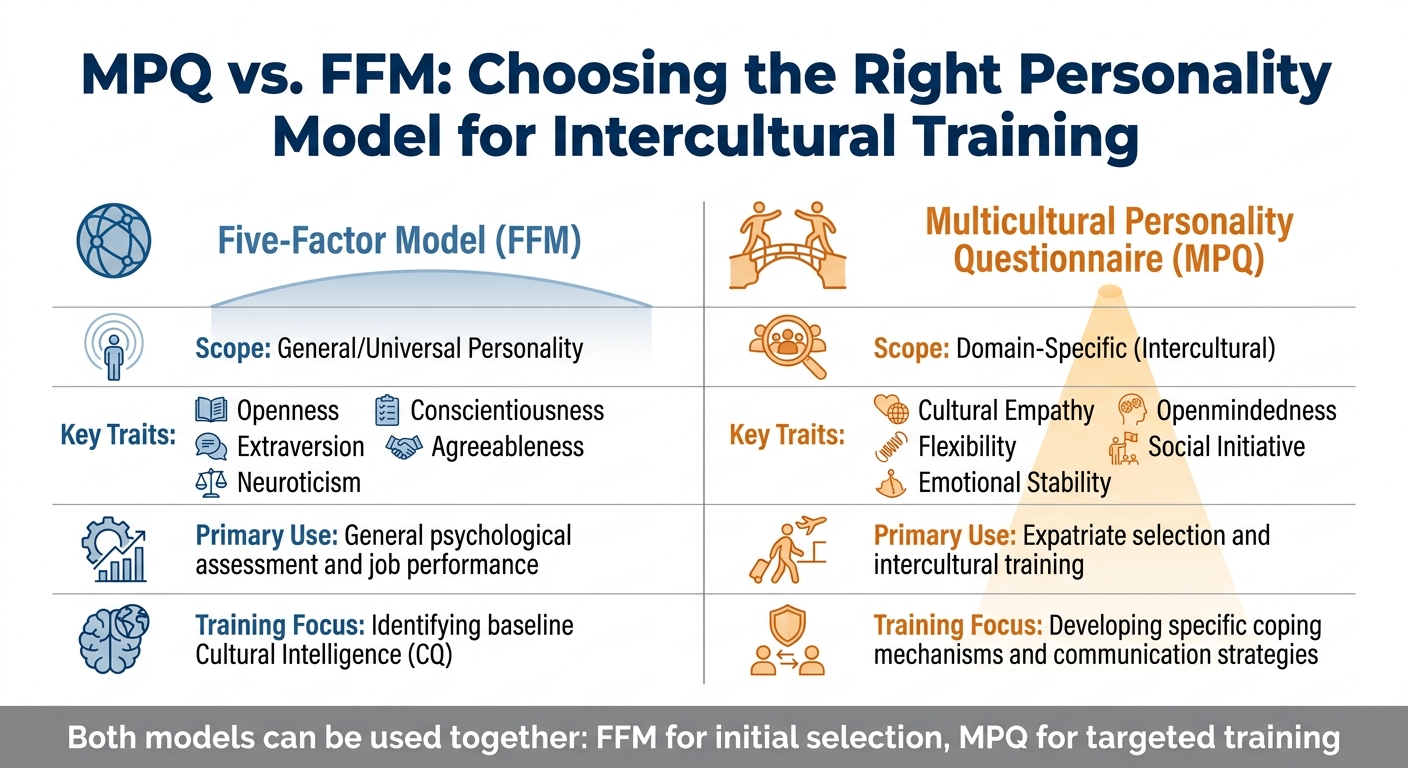
MPQ vs FFM Personality Models for Intercultural Training
Personality plays a critical role in achieving success across cultures. Let’s dive into two influential models that guide modern intercultural training efforts.
The Multicultural Personality Questionnaire (MPQ) Explained
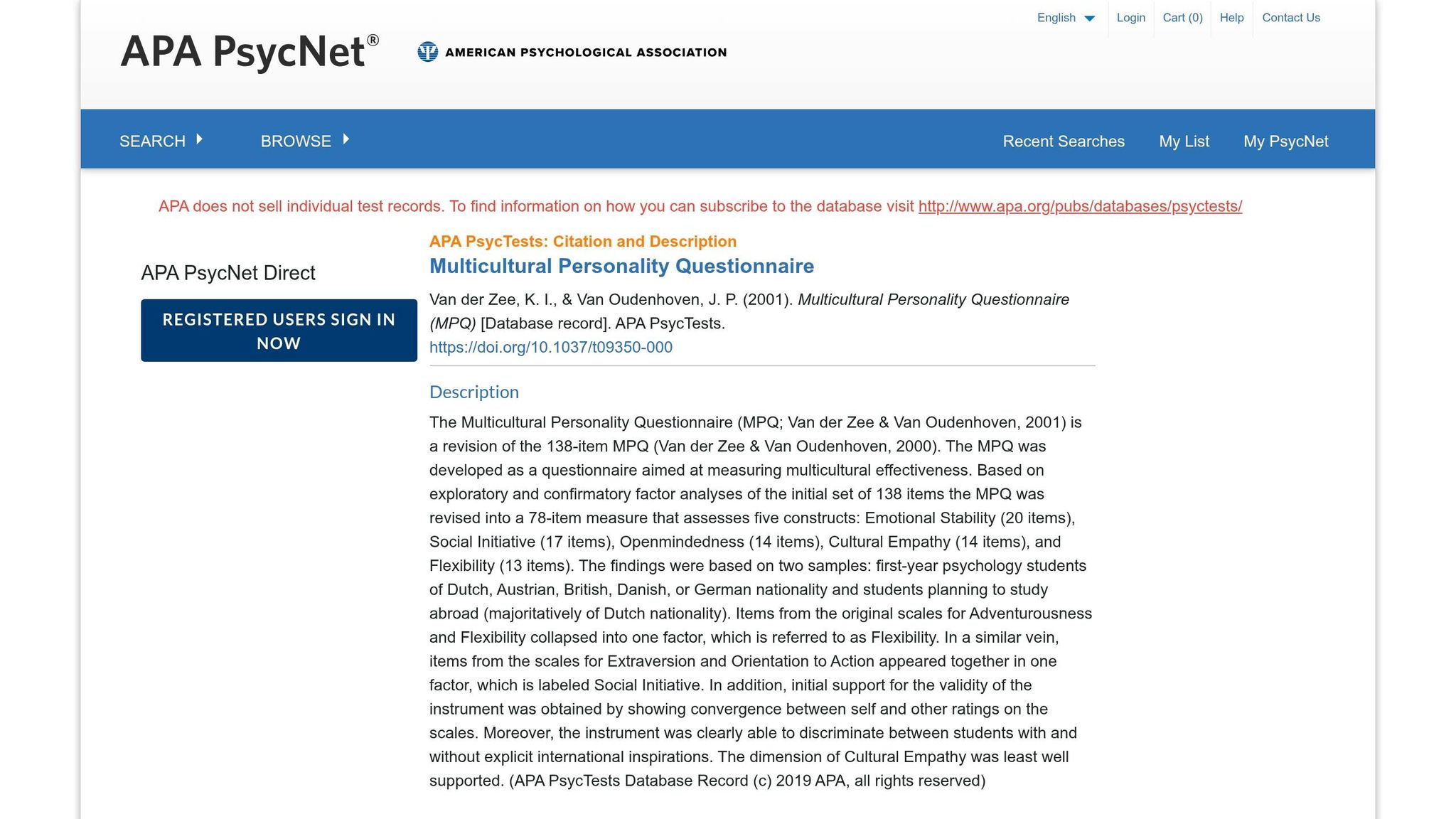
The Multicultural Personality Questionnaire (MPQ) is specifically designed for intercultural contexts. Unlike general personality tests, it evaluates five traits crucial for thriving in cross-cultural environments: Cultural Empathy, Openmindedness, Emotional Stability, Social Initiative, and Flexibility [2].
These traits fall into two groups: stress-related traits (Emotional Stability and Flexibility), which help individuals stay composed in unfamiliar settings, and social-perceptual traits (Cultural Empathy, Openmindedness, and Social Initiative), which foster a positive approach to learning from cultural differences [2]. A 2020 study by Erasmus University Rotterdam using the "Barnga" game demonstrated this in action - Emotional Stability helped reduce stress, while Social Initiative improved peer-rated performance.
Research supports the MPQ’s effectiveness in measuring intercultural competence. For example, one study found that MPQ dimensions accounted for 22%–56% of the variance in intercultural success [2]. Additionally, traits like Cultural Empathy and Social Initiative have been linked to academic achievement in international programs. Students with high scores in these areas achieved an average GPA of 7.20 (on a 10-point scale) after a year of intercultural exposure [7].
The Five-Factor Model (FFM) in Training Settings
The Five-Factor Model (FFM), also known as the Big Five, outlines five universal personality traits: Openness to Experience, Conscientiousness, Extraversion, Agreeableness, and Neuroticism [8]. Its broad applicability makes it a versatile tool across various settings.
In intercultural training, Openness to Experience stands out. A 2006 study led by Soon Ang and Linn Van Dyne at Nanyang Technological University found Openness to be the only Big Five trait linked to all four components of Cultural Intelligence (CQ): metacognitive, cognitive, motivational, and behavioral. Soon Ang explained:
"Openness to experience is a crucial personality characteristic that is related to a person's capability to function effectively in diverse cultural settings (CQ)." [8]
Other traits like Conscientiousness, Extraversion, and Agreeableness also support job performance and adaptability, while Neuroticism often has the opposite effect [4]. These traits provide a foundation for understanding personality in intercultural contexts.
MPQ vs. FFM: How They Differ in Training
Comparing these two models helps trainers choose the right approach to enhance intercultural competence. The key difference lies in their focus: the FFM provides a broad personality framework useful in many contexts, while the MPQ zeroes in on traits specific to intercultural interactions [2]. As Joep Hofhuis noted:
"The MPQ dimensions as a whole... have been specifically tailored to reflect domain-specific constructs that play a role in intercultural interaction." [2]
This focus gives the MPQ an edge in training scenarios since traits like Cultural Empathy often predict intercultural effectiveness better than general traits. However, the FFM is still invaluable for initial candidate selection. For instance, a 2003 study of European managers in a cross-cultural training program in Japan found that Openness predicted training performance, while cognitive ability was more closely tied to language learning [9].
Using both models together can maximize results. The FFM helps identify individuals likely to excel in international roles, while the MPQ provides insights for targeted training. For example, Social Initiative scores could highlight those who might benefit from extra support in proactive communication [2] [4]. Tools like Personos take this a step further by leveraging the FFM to assess 30 traits on an 80-point scale, offering real-time guidance for navigating intercultural challenges.
| Feature | Five-Factor Model (FFM) | Multicultural Personality Questionnaire (MPQ) |
|---|---|---|
| Scope | General/Universal Personality | Domain-Specific (Intercultural) |
| Key Traits | Openness, Conscientiousness, Extraversion, Agreeableness, Neuroticism | Cultural Empathy, Openmindedness, Flexibility, Social Initiative, Emotional Stability |
| Primary Use | General psychological assessment and job performance | Expatriate selection and intercultural training |
| Training Focus | Identifying baseline Cultural Intelligence (CQ) | Developing specific coping mechanisms and communication strategies |
What Research Shows About Personality and Cross-Cultural Success
Years of research have consistently shown that specific personality traits play a key role in thriving across cultures. These traits help people manage stress, adapt to new environments, and build meaningful relationships in diverse settings.
Emotional Stability Reduces Cross-Cultural Stress
Staying calm under pressure is a game-changer when navigating cross-cultural situations. In January 2020, researchers Joep Hofhuis, Marike F. Schilderman, and Arjan Verdooren from Erasmus University Rotterdam studied 116 professionals during intercultural workshops in the Netherlands. They used "Barnga", a game designed to simulate cultural conflict and language barriers, to explore how personality impacts effectiveness. Their findings were clear: Emotional Stability directly improved both self-rated and peer-rated effectiveness. The reason? Reduced stress. Hofhuis explained:
"Emotional stability has a positive effect on mean scores (intercept) of both self-rated and other-rated outcomes, mediated through perceived stress." [2]
This aligns with broader research showing that anxiety can derail cross-cultural adaptation. Emotional stability helps people regulate their emotions, even in tense or ambiguous situations, enabling them to focus on problem-solving rather than stress [2].
While Emotional Stability helps manage stress, another trait - Openness to Experience - is crucial for cultural learning and adaptation.
Openness to Experience Predicts Cultural Adjustment
Curiosity about new experiences significantly boosts cultural adaptation. A meta-analysis spanning 40 years of research (including 137 correlation coefficients from 31 studies across 24 countries and 8,853 participants) found that Openness to Experience had a strong positive correlation (.23) with second language learning achievement [3]. It outperformed other traits like extraversion (.12) and agreeableness (.10).
Why does this matter? Language learning is essential for cultural adaptation. People with high Openness view intercultural challenges as opportunities rather than threats. They are quick to notice cultural differences and approach them with curiosity. Research further shows that Openness and Conscientiousness are positively linked to Intercultural Communication Competence, while Neuroticism tends to hinder it [1]. The MPQ framework refers to this trait as "Openmindedness", emphasizing an unbiased attitude that fosters trust and understanding across cultures [2].
But adapting to new cultures isn't just about staying calm or being curious - it also requires actively building connections, which is where Social Initiative comes into play.
Social Initiative Builds Cross-Cultural Relationships
Taking the lead in social interactions can make all the difference in cross-cultural environments. The same 2020 Barnga study highlighted an intriguing finding: while Emotional Stability predicted initial success, Social Initiative was the only trait linked to improvement over time. Participants who scored high in Social Initiative used proactive, non-verbal communication to bridge cultural gaps during the game. Hofhuis noted:
"Social Initiative has a positive effect on the rate of improvement (slope) in other-rated outcomes during the simulation, mediated through pro-active communication." [2]
This trait encourages people to start conversations, ask questions, and navigate unfamiliar social dynamics - even when language barriers exist. In situations where shared language or norms are absent, proactive communication becomes critical. Research indicates that traits like Cultural Empathy, Openmindedness, and Social Initiative account for 22% to 56% of the variance in intercultural success [2]. Tools like Personos can help professionals identify and develop these traits, offering guidance for tackling complex intercultural challenges.
Together, these findings highlight the value of tailoring intercultural training to individual personality traits, offering a more personalized approach to fostering cross-cultural effectiveness.
How to Use Personality Insights in Training Programs
Understanding personality traits is a great starting point, but applying that knowledge in intercultural training takes it to the next level. Organizations are using well-tested methods to weave personality psychology into their training programs, making each session more tailored and impactful.
Adding Personality Assessments to Training
The first step is to evaluate each trainee's personality traits - identifying both strengths and areas for growth. Tools like the Multicultural Personality Questionnaire (MPQ) and the Five-Factor Model (FFM) are often used for this purpose. For instance, a study conducted at Humboldt University of Berlin involved a 21-hour training program for 29 psychotherapists. By incorporating personality assessments, the program achieved notable improvements in intercultural competence, which were still evident three months later. Ulrike von Lersner, who led the study, shared:
"Intercultural competence can be considered a general therapeutic skill that can be taught in short interventions." [6]
Similarly, the U.S. Army has utilized the TAPAS (a forced-choice assessment) since 2009 to minimize biases like faking or social desirability [4]. Using methods like forced-choice formats or Situational Judgment Tests (SJT) helps gather precise baseline data. These insights can then be grouped into categories like "stress-related traits" (e.g., Emotional Stability, Flexibility) and "social-perceptual traits" (e.g., Cultural Empathy, Social Initiative), allowing for more targeted training modules [2].
AI Tools for Personality-Based Guidance
AI is stepping into the game by offering real-time, personality-driven guidance. One example is Personos, a platform rooted in the Five-Factor Model. It measures 30 personality traits on an 80-point scale and provides situation-specific advice through conversational AI. For example, if a social worker encounters a challenging cross-cultural interaction, Personos Chat can analyze both personalities and the context to suggest tailored communication strategies. The platform’s Dynamic Reports go a step further, offering actionable insights on how to collaborate effectively based on both parties' traits.
Other AI tools are also being used creatively. For instance, standard models like GPT and ERNIE can be strategically prompted to provide culturally nuanced responses. Research from MIT Sloan's Jackson Lu revealed that these models adopt different cultural orientations depending on the language used. When prompted in English, the AI tends to reflect an independent social orientation, but it shifts to an interdependent orientation when prompted in Chinese [11]. According to Lu:
"As generative AI becomes part of everyday decision-making, recognizing these cultural tendencies will be critical for both individuals and organizations worldwide." [11]
Incorporating cultural role-play prompts - such as asking the AI to "act as someone from [Target Country]" - can make intercultural guidance even more accurate [11]. The CRAIF-C framework builds on this by designing AI chatbots that are "culturally responsive" across key areas like Adaptive Interaction and Governance, improving both cultural fit and user trust [10].
Designing Training for Different Professional Roles
Once personality assessments and AI insights are in place, training should be customized to fit specific professional roles. For example, focus on Extraversion and Openness when preparing employees for expatriate roles, while emphasizing Awareness and Knowledge for clinical professionals like psychotherapists [4] [6]. A Dutch study using the Barnga simulation demonstrated this concept: participants with high Social Initiative improved more quickly in intercultural workshops because they relied on proactive, non-verbal communication [2].
To maximize effectiveness, use tools like cultural assimilators, role modeling, and experiential simulations to encourage real-time behavioral changes [4]. In international contexts, particularly outside the U.S., pair awareness training with activities like role-playing, perspective-taking, and mentorship workshops. Awareness training on its own can backfire in cultures with high power distance or collectivist values [5]. With 64% of learning and development professionals globally reporting that diversity and inclusion programs are now a priority [5], there’s a growing demand for training programs that deliver results across diverse cultural settings.
Conclusion: Better Training Through Personality Psychology
Main Lessons from Research and Practice
Research highlights how understanding personality traits can reshape intercultural training and improve outcomes. Studies consistently show that personality traits, like Emotional Stability and Openness, play a larger role in intercultural success than cognitive ability. For example, a 2020 study at Umm Al Qura University in Saudi Arabia analyzed 95 international undergraduates and found that Openness and Conscientiousness were positively linked to Intercultural Communication Competence (ICC). On the other hand, Neuroticism showed a strong negative correlation (t = -5.301, p < .000) [12]. This suggests that individuals with stable emotions and openness adapt more quickly and experience fewer cultural misunderstandings.
Tailoring training to personality traits can also reduce resistance to learning and speed up adaptation. Trainers who understand stress-related traits, like Emotional Stability and Flexibility, can help participants view cultural differences as opportunities rather than threats. Traits such as Cultural Empathy and Social Initiative further encourage stronger communication and relationship-building. As Joep Hofhuis, Marike F. Schilderman, and Arjan Verdooren explain:
"Individuals who score high on the MPQ will be better equipped to deal with the situation, and will learn from their experiences more quickly." [2]
Future Directions in Personality-Based Intercultural Training
The future of intercultural training is moving toward AI-driven personalization. Organizations are shifting away from generic programs to tools that adapt based on individual personality profiles. For instance, Personos uses the Five-Factor Model to assess 30 personality traits on an 80-point scale, providing real-time, tailored guidance through conversational AI.
Recent research underscores the potential of combining personality insights with AI. A 2024 study from Johns Hopkins and MIT examined personality pairing in human-AI collaboration. Involving 1,258 participants, the study found that matching human and AI personality traits improved outcomes. For example, neurotic individuals paired with neurotic AI agents achieved higher click-through rates during a field experiment with nearly 5 million impressions on X (formerly Twitter) [13]. Harang Ju from Johns Hopkins Carey Business School noted:
"Designing [AI agents] with personality traits that complement their human counterparts could enable optimization of performance in real agentic workflows." [13]
FAQs
Which personality traits matter most for intercultural success?
Key traits that support success in intercultural settings include emotional stability, social initiative, openness to experience, conscientiousness, and extraversion. Studies show that emotional stability helps individuals handle stress more effectively, while social initiative encourages proactive communication - both essential for managing the complexities of intercultural interactions.
Should I use the MPQ, the Big Five, or both?
The Multicultural Personality Questionnaire (MPQ) is specifically designed to assess traits tied to intercultural competence. It’s known for its validated reliability across a variety of settings. On the other hand, the Big Five model takes a broader approach, highlighting traits like Openness, which can be useful in predicting success in cross-cultural training. While the MPQ is often the go-to tool for its targeted focus on multicultural traits, combining it with the Big Five can provide extra insights into personality when necessary.
How can AI personalize intercultural training using personality data?
AI brings a new level of personalization to intercultural training by leveraging personality data, such as the Five Factor Model, to fine-tune communication styles, scenarios, and learning paths based on individual traits. By aligning training with characteristics like extraversion or openness, this approach boosts both engagement and effectiveness. Tools like Personos take it a step further, offering real-time guidance tailored to personality, which helps create culturally aware and customized interactions. This leads to stronger understanding and collaboration in diverse settings.