Personality-Based Conflict Frameworks: A Quick Guide
Use DISC profiles and Thomas‑Kilmann conflict modes to resolve workplace disputes, navigate power dynamics, and tailor communication for better outcomes.
Nick Blasi

Personality-Based Conflict Frameworks: A Quick Guide
Workplace conflicts often stem from personality differences and power dynamics. Tools like the DISC model and the Thomas-Kilmann Conflict Modes help managers address these issues by tailoring communication and conflict-handling strategies.
Key Takeaways:
- DISC Framework: Categorizes behavior into Dominance, Influence, Steadiness, and Conscientiousness, showing how personality traits affect decision-making and communication.
- Thomas-Kilmann Modes: Identifies five conflict-handling styles - Competing, Collaborating, Compromising, Avoiding, and Accommodating - based on assertiveness and cooperativeness.
- Personality Insights: For example, Dominance types prefer direct communication, while Steadiness types value harmony.
- Power Dynamics: Understanding authority relationships can prevent conflicts from escalating.
Practical Tools:
- Personos: An AI tool that combines personality analysis with conflict strategies, offering tailored recommendations for workplace disputes.
By using these frameworks, managers can resolve conflicts effectively while maintaining strong relationships.
The 5 Conflict Styles: How Leaders Navigate Tension and Build Stronger Teams
Key Personality-Based Frameworks Explained
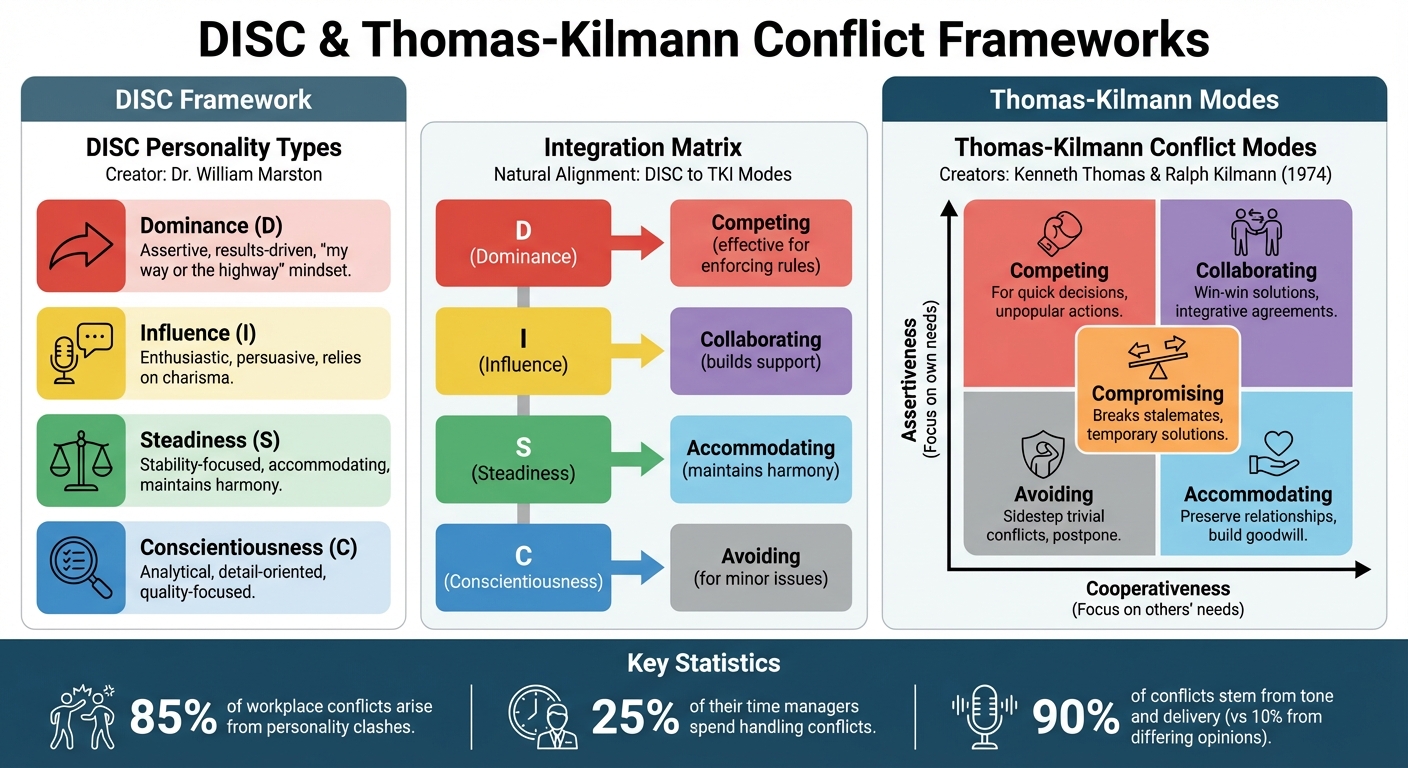
DISC Personality Types vs Thomas-Kilmann Conflict Modes: A Comprehensive Framework Comparison
DISC and the Thomas-Kilmann Conflict Modes provide valuable insights into how individuals navigate conflict. While DISC focuses on understanding communication styles and decision-making tendencies, the Thomas-Kilmann framework examines how people respond when their priorities clash. Together, they offer a deeper understanding of conflict dynamics and help shape effective resolution strategies. Let’s break down what each framework brings to the table.
The DISC Framework
Created by Dr. William Marston, the DISC model categorizes human behavior into four types: Dominance, Influence, Steadiness, and Conscientiousness. Each type reflects distinct traits and approaches to decision-making:
- Dominance: Assertive and results-driven, these individuals act quickly and often adopt a "my way or the highway" mindset.
- Influence: Enthusiastic and persuasive, they rely on charisma to win people over rather than applying pressure.
- Steadiness: Focused on stability and relationships, they tend to accommodate others to maintain harmony.
- Conscientiousness: Analytical and detail-oriented, they prioritize quality and adherence to rules, often avoiding unnecessary risks.
In leadership or high-pressure situations, Dominance types may come across as controlling, while Steadiness types might seem overly accommodating or hesitant to make tough calls. Interestingly, research shows that roughly 85% of workplace conflicts arise from personality clashes [4]. For example, a direct, goal-oriented communication style is effective with Dominance types, while a supportive and affirming approach resonates better with Steadiness types. These insights are crucial for tailoring conflict management strategies.
The Thomas-Kilmann Conflict Modes
The Thomas-Kilmann framework, developed by Kenneth Thomas and Ralph Kilmann in 1974, complements DISC by focusing on how individuals handle conflict. It evaluates responses along two dimensions: Assertiveness (pursuing personal goals) and Cooperativeness (addressing others’ needs). The interplay between these dimensions yields five distinct conflict-handling modes:
- Competing: High assertiveness, low cooperativeness - ideal for situations requiring quick, decisive action, like enforcing unpopular policies or managing crises.
- Collaborating: High assertiveness, high cooperativeness - used to find win-win solutions that satisfy all parties.
- Compromising: Moderate assertiveness and cooperativeness - helps break stalemates, especially between parties with equal power.
- Avoiding: Low assertiveness, low cooperativeness - useful for sidestepping conflicts with significantly stronger opponents or when the issue is trivial.
- Accommodating: Low assertiveness, high cooperativeness - effective when deferring to authority or building goodwill for future interactions.
For example, the Competing mode might be necessary during emergencies, while the Accommodating mode can help preserve relationships when yielding to a higher authority. Managers reportedly dedicate about 25% of their time to handling conflicts [6], making it essential to choose the right approach for each situation. Together, DISC and TKI offer practical tools to navigate these challenges with greater precision.
Managing Power and Authority Dynamics
Power isn’t something you possess in isolation - it’s always tied to relationships. As Avery Harris-Gray aptly states, "Power is always relative. Power is always relational" [7]. This perspective reshapes how conflicts in hierarchical settings are handled. Whether you’re a manager implementing an unpopular policy or an employee challenging a decision, understanding power as relational helps you approach these situations more effectively. Personality frameworks provide valuable tools for navigating these dynamics without damaging relationships or compromising outcomes.
In the U.S., managers spend about 40% of their time resolving workplace conflicts [8]. A significant portion of this involves navigating power dynamics. The real challenge lies not just in resolving disagreements but in doing so while respecting both the hierarchy and the individuals involved. Relying too heavily on formal authority often exacerbates tensions [9]. By using personality-based frameworks, you can shift from exerting control to fostering collaboration [10]. This sets the stage for adapting communication styles to fit different personality profiles.
Communication Strategies for DISC Personality Types
Adapting your communication to align with DISC personality types can make a big difference, especially when authority is involved.
- For Dominance (D) types: These individuals value directness and results-oriented discussions. If you’re addressing a conflict with a D-style subordinate, skip unnecessary details and focus on solutions. As one expert notes, > "D-style personalities... appreciate directness. By addressing issues openly and without hesitation, you'll earn their respect" [11]. If you’re the D-type in a position of authority, it’s crucial to provide clear explanations and listen actively to avoid coming across as overly forceful [7].
- For Influence (I) types: These personalities thrive on positive interactions and are sensitive to rejection. When addressing conflict with an I-style employee, maintain an upbeat tone. Use inclusive language like "we" and balance constructive feedback with acknowledgment of their strengths [11][6].
- For Steadiness (S) types: S-types prioritize harmony and may avoid confrontation by agreeing superficially. To address conflict with them, emphasize partnership and create a safe environment for them to express genuine concerns. Reassure them that the relationship remains stable, even during disagreements [11][3].
- For Conscientiousness (C) types: These individuals are analytical and often take criticism personally. > "Because [C-styles] invest so much time in ensuring their work is flawless, they tend to take criticism personally. Focus on the issue at hand rather than pointing out faults" [11]. When discussing conflicts, stick to objective facts and avoid personal critiques. Acknowledge their attention to detail before pointing out any overlooked elements [11].
Using Conflict Modes in Authority-Based Scenarios
Beyond tailored communication, conflict modes offer additional strategies for resolving authority-based disputes. The Thomas-Kilmann model outlines five modes that can be applied depending on the situation and power dynamics.
- Competing is most effective in emergencies or when enforcing critical but unpopular decisions, such as budget cuts or disciplinary actions. As Kenneth W. Thomas explains, > "Utilizing the competing mode is most appropriate in conflicts over very important issues when collaborating fails... or when a situation requires you to make an unpopular action" [6]. However, this approach should be used sparingly, as overuse can lead to resentment and disengagement [15].
- Accommodating allows leaders to build goodwill by conceding on minor issues or admitting mistakes [6].
- Compromising works well when parties have equal power but conflicting goals. It’s a quick way to find middle ground, especially under time constraints [12][13].
- Collaborating requires leaders to lower the perceived threat level so subordinates feel comfortable sharing honest input [13].
- Avoiding can be useful when the issue is minor or when a subordinate needs time to gather information before addressing a superior [12][14].
The key is to match the conflict mode to the urgency of the situation and the dynamics of authority at play. By doing so, you can resolve disputes in a way that balances respect for hierarchy with the needs of the individuals involved.
sbb-itb-f8fc6bf
Combining DISC and Thomas-Kilmann Frameworks
Bringing together the DISC and Thomas-Kilmann frameworks offers a well-rounded way to understand and manage conflicts. DISC helps uncover personality traits that shape how people naturally respond, while the Thomas-Kilmann model focuses on adaptable strategies for conflict resolution.
The key difference lies in their focus: DISC highlights stable personality traits, while TKI explores flexible conflict-handling behaviors. As Ralph Kilmann, co-creator of the TKI, explains:
"The MBTI [and DISC] instrument assesses personality preferences that are rather stable over a long period... In contrast, the TKI tool assesses conflict-handling behavior, not enduring personality preferences" [17].
This distinction allows you to step outside your natural tendencies and choose conflict responses that fit the situation. Together, these frameworks provide a roadmap for managing conflicts by blending personality insights with situational strategies.
How to Integrate Both Frameworks
To combine DISC and TKI effectively, start with a clear understanding of an individual's DISC profile. For example, Dominance types lean toward assertive, results-driven approaches, while Steadiness types prioritize harmony. Once these tendencies are identified, you can strategically select a Thomas-Kilmann mode that either complements or counterbalances them.
Before choosing a conflict mode, it’s important to assess factors like stress levels, complexity, urgency, trust, and relationship dynamics [19]. Under moderate stress, there’s more room to use modes like Collaborating or Compromising. However, when stress intensifies, people may default to instinctive "Fight, Flight, or Freeze" responses. In TKI terms, this translates to Competing as "Fight", Avoiding as "Flight", and taking a pause as "Freeze" [19].
Most people habitually rely on just one or two conflict modes. By integrating DISC insights with TKI strategies, individuals can intentionally practice less familiar modes. For instance, a Dominance type who naturally gravitates toward Competing might work on Collaborating when long-term relationships are at stake [18][19]. Research also shows that 10% of conflicts stem from differing opinions, while 90% arise from tone and delivery [19], highlighting the importance of mindful communication.
Comparison Table: Conflict Modes and DISC Types
The table below shows how aligning DISC types with TKI modes can improve conflict resolution in authority-driven situations:
| DISC Type | Natural TKI Mode | Effectiveness in Authority Scenarios | When to Switch Modes |
|---|---|---|---|
| Dominance (D) | Competing | High for enforcing unpopular rules and making quick decisions [5][16] | Shift to Collaborating when long-term buy-in is more critical than speed |
| Influence (I) | Collaborating | High for building support and incorporating diverse perspectives [5][19] | Use Competing when time constraints demand immediate action |
| Steadiness (S) | Accommodating | Moderate for maintaining harmony and protecting relationships [5][19] | Try Compromising when your own concerns need attention too |
| Conscientiousness (C) | Avoiding | Low to Moderate for minor issues or when resolution costs outweigh benefits [5][16] | Opt for Collaborating when detailed analysis can enhance outcomes |
For example, Dominance types often excel with the Competing mode in authority-driven scenarios, especially when enforcing tough but necessary decisions [5][16]. A 2007 study involving 8,000 employees found that 57% of men scored high for Competing compared to 44% of women. Conversely, 58% of women scored high for Compromising, compared to 41% of men. Interestingly, 58% of both men and women scored high for Collaborating [16], showing that this mode is effective across genders and personality types when conditions allow.
Using Personos for Conflict Resolution
Real conflicts aren't solved by theory alone - they need practical tools. Personos takes concepts like DISC and Thomas-Kilmann and turns them into actionable solutions. By blending the Five Factor Model with AI-driven insights, Personos provides real-time guidance for handling authority-based conflicts. With its foundation in 30 personality facets scored on an 80-point scale, the platform adapts to the many ways people approach and resolve disagreements [20].
AI-Powered Personality Analysis
Personos Chat acts as a conversational AI, offering personalized advice based on detailed personality profiles and the specific context of a conflict. Whether you're dealing with a Dominance-driven manager or a Conscientiousness-focused colleague, the system delivers tailored recommendations that consider both parties' traits. You can even import relationship profiles using the '@' symbol to incorporate hierarchy and power dynamics, as explained in earlier sections.
The platform combines Dynamic Reports with Nudge-Based Prompts to provide focused strategies and timely suggestions. For instance, if a Steadiness personality type is struggling to communicate effectively with a Dominance-type authority figure, the system offers concrete steps to reduce tension and improve interaction. As Personos puts it:
"By surfacing how the system arrived at the answer... if you choose to take action you can do so with confidence" [20].
These AI-powered insights are designed to lead directly to measurable actions, making them more than just theoretical advice.
Tracking Conflict Outcomes Over Time
The ActionBoard turns AI recommendations into tangible tasks using a Kanban-style interface, bridging the gap between insight and action [20]. For example, if you're advised to shift from a Competing approach to a Compromising one in a specific situation, you can create a task to practice this adjustment during your next team meeting and track the results.
Research indicates that personality differences drive 85% of team conflicts, while 87% of well-managed conflicts build trust through open dialogue [4]. By tracking these strategies over time, Personos helps you identify which methods work best for various personality combinations and authority dynamics. Managers can also use coaching tools to seek advice, explore deeper personality insights, and monitor progress collaboratively through ActionBoards. This approach turns conflict resolution into a skill that can be refined and measured [20].
Conclusion
Conflicts rooted in authority don’t just fade away - they demand a thoughtful approach to understanding how personality influences behavior under stress. Tools like the DISC and Thomas-Kilmann models offer a clear path forward. For example, a Dominance-oriented individual thrives on direct, decisive communication, while someone with a Steadiness profile benefits from a more patient, supportive approach. These insights help guide decisions, such as opting for a Competing strategy in high-pressure situations or choosing Collaborating when maintaining relationships is key [21][22].
Data backs this up: team conflicts often arise from predictable personality clashes [4]. Research highlights that Agreeableness tends to align with a preference for compromise, while Extraversion often leads to more assertive conflict styles [1][4]. These tendencies aren’t random - they follow patterns that can be understood and managed effectively.
The best conflict managers don’t stick to one approach. As Robert Wiedefeld, Owner of Appaloosa Resources LLC, states:
"The most effective conflict managers tend to have a balance of characteristics from each of the four personality types" [3].
Flexibility is key because the dynamics of power, relationships, and stakes can change from one situation to the next. This understanding lays the foundation for practical tools that bring theory into real-world application.
That’s where Personos steps in. This platform translates these frameworks into actionable, AI-driven guidance. Instead of guessing which conflict style to use or how to communicate with a specific DISC type, Personos provides tailored recommendations based on the personalities involved. Its built-in task tracking feature allows you to monitor what works over time, so you’re not starting from scratch with each new conflict. At $9 per seat per month, it’s a cost-effective way to reduce workplace tension and improve team dynamics [4].
Conflict resolution is a skill you can build. Studies show that negotiators who believe in their ability to improve consistently outperform those who think their skills are fixed [2]. With the right tools and frameworks, it’s possible to shift from merely reacting to conflicts to managing them proactively. By leveraging personality differences as opportunities for collaboration, you can turn potential roadblocks into stronger, more cohesive teamwork.
FAQs
How do the DISC and Thomas-Kilmann frameworks work together to resolve conflicts?
The DISC framework breaks personalities into four main types: Dominant (D), Influential (I), Steady (S), and Conscientious (C). This helps explain how people communicate, make decisions, and react under stress. Layered onto this is the Thomas-Kilmann model, which defines five conflict-handling styles: Competing, Collaborating, Compromising, Avoiding, and Accommodating, based on levels of assertiveness and cooperativeness.
When these two models work together, DISC helps identify who you’re dealing with, while Thomas-Kilmann predicts how they might handle conflict. For instance, a goal-oriented D-type often leans toward direct methods like Competing or Collaborating, while an I-type, who values relationships, might prefer Collaborating or Accommodating. S-types, who seek stability, and C-types, who focus on precision, are more likely to favor Compromising or Avoiding approaches.
By understanding how DISC profiles align with conflict-handling styles, you can better predict behaviors, adjust your communication style, and steer interactions toward productive outcomes. Tools like Personos leverage AI to combine DISC insights with the Thomas-Kilmann model, offering real-time advice for resolving conflicts effectively.
How can Personos AI help resolve workplace conflicts more effectively?
Personos AI takes personality insights and turns them into actionable tools for handling workplace conflicts. By examining communication patterns - whether through emails or meeting transcripts - it offers real-time guidance on improving phrasing, tone, and timing. This proactive approach helps employees defuse tense situations and address issues before they grow into bigger problems.
Beyond individual support, the platform provides team-wide insights. It analyzes group dynamics and sends alerts about potential friction points, giving managers the chance to tailor their feedback to fit each team member’s communication style. Features like role-playing simulations and progress tracking further empower teams to develop lasting conflict-resolution skills, creating a more cooperative and productive workplace.
How can managers effectively communicate with different DISC personality types?
The DISC model - Dominance (D), Influence (I), Steadiness (S), and Conscientiousness (C) - provides a framework for managers to adjust their communication styles based on how individuals process information and respond to conflict. By customizing tone, pacing, and messaging for each personality type, leaders can enhance clarity and build stronger relationships.
- D (Dominance): Be straightforward and goal-oriented. Focus on results and provide a clear, actionable plan. Skip unnecessary details and keep the conversation centered on outcomes.
- I (Influence): Maintain an upbeat and engaging tone. Emphasize the broader impact of ideas and encourage brainstorming to keep the discussion dynamic and inclusive.
- S (Steadiness): Approach with patience and a calm demeanor. Show that you’re listening and offer reassurance. Frame changes as collaborative efforts to foster a sense of teamwork.
- C (Conscientiousness): Stick to logical, detailed explanations. Allow time for thorough analysis and avoid overstatements. Data-driven solutions will resonate most with this type.
By applying these tailored strategies, managers can minimize miscommunication and cultivate an environment where individuals feel understood and appreciated. Tools like Personos can further assist by providing real-time insights and personalized prompts, ensuring communication remains clear and effective.