Personality AI vs. Traditional Conflict Tools
AI personality tools speed and scale conflict guidance—best paired with human mediators for empathy in complex cases.
Nick Blasi

Personality AI vs. Traditional Conflict Tools
Workplace conflicts are common, with 85% of employees encountering them. The tools used to manage these situations can make a big difference. Traditional methods like mediation and active listening work well for emotional, face-to-face interactions. However, they're often slow, reactive, and hard to scale.
Enter AI-powered personality tools like Personos. These platforms analyze personality traits and communication patterns in real-time, offering quick, tailored advice to de-escalate conflicts. AI tools are faster, more scalable, and cost-effective, but they lack the empathy and nuanced understanding humans bring to emotionally charged cases.
For the best results, combine AI with human expertise. AI can handle repetitive tasks, provide instant insights, and prevent conflicts, while human mediators focus on building trust and addressing complex emotions. This hybrid approach is especially helpful for professionals like social workers and case managers, balancing heavy workloads and emotional demands.
Key Takeaways:
- Traditional methods are ideal for emotional, face-to-face mediation but are slow and harder to scale.
- AI tools like Personos provide real-time, personality-based conflict guidance, saving time and reducing costs.
- A mix of AI and human expertise offers the best results, addressing both efficiency and emotional depth.
Quick Comparison:
| Feature | AI Tools (e.g., Personos) | Human-Led Methods |
|---|---|---|
| Response Time | Immediate | Slower |
| Personalization | Based on data and traits | Relies on intuition |
| Scalability | High | Limited by availability |
| Cost | Lower ($9/month/seat) | Higher (consultant fees) |
| Empathy | Lacks emotional depth | Strong human connection |
AI tools and human expertise aren't competitors - they're partners in solving workplace conflicts effectively.
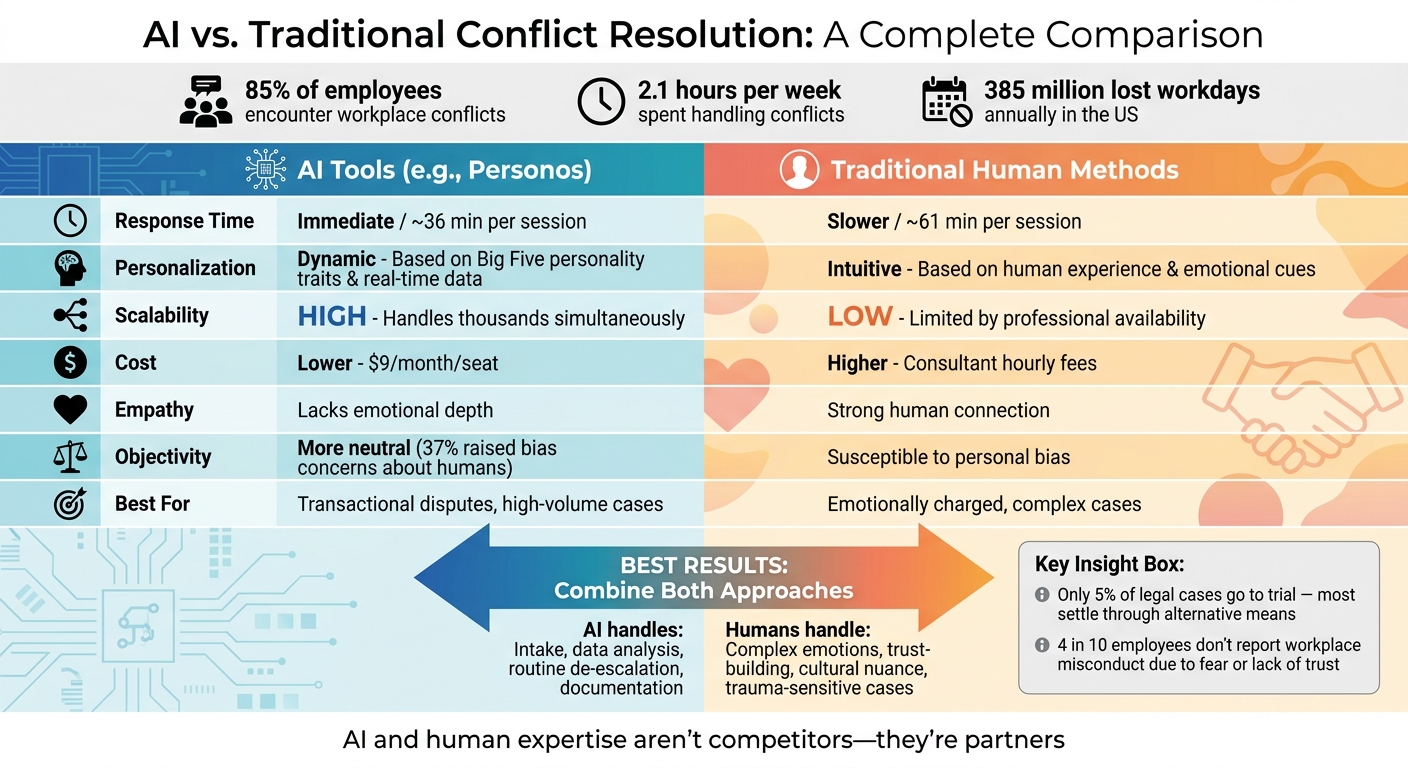
AI vs Traditional Conflict Resolution Methods Comparison
Traditional Conflict Resolution Methods: What Works and What Doesn't
How Traditional Methods Work
Traditional conflict resolution relies on structured, human-driven processes like negotiation, mediation, arbitration, and litigation. These methods involve scheduled meetings and manual tracking systems, such as spreadsheets, digital tables, or even paper-based records [3].
However, they come with a hefty time cost. In the United States, employees spend an average of 2.1 hours per week handling workplace conflicts. This adds up to an astonishing 385 million lost workdays annually [4]. Despite these inefficiencies, many organizations still depend on manual tools. Interestingly, 66% of these organizations plan to upgrade to more modern systems by 2024 [4].
Benefits of Traditional Approaches
While these methods can be time-consuming, they do have their strengths, especially when dealing with complex, emotionally charged disputes.
For example, traditional methods shine in situations that require empathy and personal interaction. Face-to-face mediation allows individuals to express their emotions and build trust in ways that rigid frameworks can’t replicate. A study from the University of Southern California, which analyzed 248 human-to-human dialogues, found that human negotiators create more nuanced outcomes by balancing fact-sharing, interests, and rights [2].
Skilled mediators also adapt their strategies using real-time insights to manage tension. When emotions run high, experienced negotiators often use appeasement techniques to calm volatile situations and keep discussions productive [2].
Drawbacks of Traditional Methods
Despite their strengths, traditional approaches often struggle to keep up with the demands of modern workplaces.
One major issue is scalability and speed. These methods are ill-equipped to handle multiple conflicts at once or to intervene quickly when problems arise. For instance, 4 in 10 employees don’t report workplace misconduct, often due to fear or a lack of trust in human-led systems. Of those who do report issues, 61% approach their manager rather than HR, which slows the resolution process even further [4].
Another drawback is that traditional methods are largely reactive. They focus on resolving conflicts after they’ve escalated, rather than identifying or preventing potential disputes. For context, only 5% of legal cases filed in court ever go to trial, with the majority being settled through alternative means [3].
As Zachary Amos, Features Editor at ReHack, points out:
Conflict is an unfortunate side effect of bringing people of all backgrounds together and throwing demands and deadlines in the mix [4].
The reality is that traditional methods weren’t built to handle the speed or complexity of today’s workplace challenges. These limitations highlight the need for more adaptable, predictive solutions driven by AI. Modern AI tools for conflict resolution address these gaps by offering real-time coaching and personality-driven insights.
AI-Powered Personality Solutions: A Different Approach
How AI Personality Tools Work
AI platforms take a fresh approach by skipping scheduled meetings and lengthy handbooks, instead leveraging validated personality frameworks to offer real-time, tailored conflict guidance.
Take Personos, for example. This platform is built on the Five Factor Model, often called the Big Five Inventory. By focusing on traits like neuroticism, agreeableness, and extraversion, the AI can predict how these characteristics might influence behavior in high-stakes situations. A study conducted in February 2026 by the University of Southern California analyzed 248 human conflict dialogues using the KObe DISpute (KODIS) corpus. The findings revealed that individuals high in neuroticism were less likely to accept negotiation offers (B = -0.26, p = .026), while those with high agreeableness scored lower in final outcomes (B = -2.62 to -3.32, p < .001) [2].
These tools also rely on frameworks like Interests-Rights-Power (IRP) to assess whether someone is acting cooperatively, competitively, or neutrally in real time. As researcher Deuksin Kwon and his team emphasized:
Our work highlights the need for psychological grounding and validation in AI simulations before real-world use. [2]
This combination of psychological insights and real-time adaptability positions AI tools as a strong alternative to traditional conflict resolution methods.
Main Benefits of AI Solutions
AI tools stand out by offering immediate, personalized, and scalable conflict resolution.
One key advantage is their instant availability. Unlike mediation sessions that require scheduling, AI platforms provide 24/7 guidance, addressing conflicts before they escalate into larger problems.
Another standout feature is personality-aware customization. In April 2026, a study of 267 participants compared a theory-driven AI coach named "Trucey" to a traditional negotiation handbook. Results showed that "overcontrolled" workers saw better outcomes with the AI, while "resilient" workers benefited more from the handbook. Researcher Veda Duddu noted:
These patterns suggest personality as a predictor of readiness beyond stage-based tailoring: vulnerable users benefit from targeted rather than comprehensive interventions. [5]
Scalability is another major advantage. While human mediators can only address one conflict at a time, AI platforms can support entire organizations simultaneously. This is especially helpful for professionals managing heavy caseloads.
Finally, AI tools excel at proactive conflict prevention. By analyzing communication patterns and identifying whether interactions are competitive or cooperative, these platforms can flag potential issues before they become serious problems [2].
How Personos Supports Helping Professionals
AI-driven tools like Personos are specifically designed to assist frontline professionals who deal with complex human dynamics daily.
Personos is tailored for social workers, case managers, coaches, counselors, and nonprofit staff. Its Personos Chat feature uses conversational AI to integrate personality profiles and contextual data, providing real-time, tailored advice. For instance, if a social worker faces resistance from a client, the tool offers guidance that considers both the client’s and the practitioner’s profiles, reducing stress and boosting confidence.
The platform also offers Dynamic Reports, which provide evolving insights at three levels: personal self-awareness, relationship dynamics (such as practitioner-to-client or peer-to-peer), and group collaboration. These reports adapt to changing contexts and include role-specific sections addressing trauma responses and coping strategies.
The ActionBoard feature turns insights into measurable outcomes. Practitioners can convert chat recommendations or report sections into actionable items with just one click - an essential tool for professionals juggling heavy workloads while needing to document progress for funders and stakeholders.
At just $9 per seat per month, Personos is an affordable and practical solution for reducing staff burnout and extending the reach of helping professionals without compromising quality. Its mission, "From conflict to collaboration: AI-powered personality psychology that empowers every interaction, extends your reach, and elevates your impact to create lasting change", highlights its role as a tool that complements human expertise. By blending AI-driven insights with human empathy, Personos helps professionals turn difficult interactions into opportunities for meaningful progress.
AI Real-Time Guidance vs. Traditional Interventions: A Direct Comparison
Comparison Table: AI vs. Traditional Methods
When professionals tackle conflict situations, the choice between AI tools and traditional methods hinges on factors like speed, customization, scalability, and resource demands.
Response speed is where AI shines. AI-driven mediation averages about 36 minutes per session, compared to the 61 minutes typically required for human-led sessions [6]. Tools like Personos provide real-time guidance by analyzing historical data and offering immediate suggestions, acting as a silent, data-informed assistant during tense negotiations [1]. On the other hand, traditional methods rely on human intuition, such as interpreting emotional undertones or gauging the mood in the room [1].
Personalization is another area of distinction. AI adapts dynamically, using personality traits and real-time interaction data to tailor its approach. For instance, a study of 267 participants found that "overcontrolled" individuals responded better to AI-driven coaching, while "resilient" individuals benefited more from traditional approaches like handbooks [2][5]. In contrast, traditional methods often follow standardized frameworks or rely on a professional's instinct, which may not adjust as quickly to individual needs [5].
Scalability is where AI stands apart. AI platforms can handle thousands of cases simultaneously. For example, researchers conducted 500 simulations with GPT-4 and 250 each with Claude and Gemini in much less time than it would take to gather similar human data [2]. Traditional methods are constrained by the availability of trained mediators [1].
Resource use also tilts in favor of AI. Traditional methods involve higher costs, such as consultant fees and preparation time [1]. AI tools, by contrast, operate at a lower cost with high availability [2]. As Pollack Peacebuilding Systems noted:
AI's role in streamlining research and document prep saves hours, freeing up time for work that depends on human performance, like facilitating dialogue and making nuanced decisions [1].
This efficiency is crucial for professionals who often work under intense pressure to resolve conflicts quickly.
| Feature | AI-Powered Tools (e.g., Personos) | Traditional Human Interventions |
|---|---|---|
| Response Time | Real-time; sessions average ~36 minutes [6] | Slower; sessions average ~61 minutes [6] |
| Personalization | Dynamic; based on Big Five traits and real-time data by harnessing the Five Factor Model [2] | Intuitive; based on human experience and emotional cues [1] |
| Scalability | High; can handle thousands of disputes simultaneously [2] | Low; limited by the availability of trained professionals [1] |
| Cost | Lower; reduces human resource hours spent on prep work; $9/seat/month [1] | Higher; involves hourly rates for specialized consultants [1] |
| Measurable Results | Highly specific commitments tracked via ActionBoard | Focus on relationship-building and high-level outcomes [6] |
| Objectivity | Perceived as more neutral; 37% of participants raised bias concerns about human mediators [6] | Susceptible to personal bias and framing issues [6] |
These differences highlight how AI and traditional methods bring unique strengths to conflict resolution.
Using Both Together: Combining AI and Human Support
The comparison underscores the potential of blending AI and human expertise. A hybrid approach combines the speed and objectivity of AI with the emotional intelligence and adaptability of human mediators. As Renee Jackson, Founder & CEO of Dyspute.ai, explains:
AI mediation is an exciting advancement... It offers speed, objectivity, and transparency - three things that can make a big difference in the right context [6].
This trend, often called hybrid workflows, is gaining traction. AI can manage tasks like initial data collection, analysis, and immediate conflict de-escalation, while human mediators focus on complex emotional and relational dynamics [1]. For example, AI is well-suited for transactional disputes where quick, transparent documentation is essential [6]. Human facilitators, however, are critical for cases requiring empathy and the ability to interpret subtle cues, such as tone or body language [6].
For professionals with heavy caseloads, this combination is especially practical. Tools like Personos provide real-time, personality-aware guidance during high-pressure scenarios, while human mediators build trust and rapport over time. AI also reduces the time spent on research and preparation, allowing professionals to focus on meaningful conversations and nuanced decisions. This approach helps shift the focus from conflict resolution to fostering collaboration [1].
However, it’s worth noting that AI tools are not without their flaws. They can sometimes "hallucinate" facts or misinterpret legal information, making human oversight essential in high-stakes situations [1]. AI also struggles with interpreting sarcasm or the emotional depth behind nonverbal cues [1]. These limitations highlight the importance of using AI as a complement to, rather than a replacement for, human expertise, particularly when working with vulnerable groups or in trauma-sensitive contexts.
Choosing the Right Approach for Your Organization
What to Consider When Deciding
When deciding between AI tools, traditional methods, or a mix of both, it's essential to weigh factors like conflict complexity, speed requirements, budget constraints, and your team's capacity. Start by identifying the types of conflicts your organization typically encounters. For straightforward, transactional disputes - like property boundaries, pricing disagreements, or routine workplace issues - AI solutions can be highly effective. However, emotionally charged cases that require empathy and the ability to interpret subtle cues, such as silence or body language, still demand the expertise of human mediators [1][6].
Speed and caseload are also key considerations. If your team is overwhelmed by a high volume of cases, AI can assist with tasks like intake, document preparation, and routine de-escalation. For instance, AI mediation averages 36 minutes per session compared to 61 minutes for human-led sessions [6]. That said, AI may require more rounds of communication to finalize structured agreements.
Budget plays a significant role too. AI tools can help cut costs and save time. With pricing as low as $9 per seat per month, AI platforms like ActionBoard offer specific, trackable outcomes, allowing organizations to manage expenses while demonstrating measurable impact [1][6]. However, it’s crucial not to rely exclusively on AI for cases that demand genuine human care. As researchers like Deuksin Kwon from the University of Southern California point out, AI systems cannot fully replicate human behavior without thorough local validation [2].
These considerations are particularly important for helping professionals, whose unique challenges require a customized approach.
Meeting the Needs of Helping Professionals
For professionals like social workers, case managers, and nonprofit staff, the choice of tools often hinges on managing burnout and high caseloads. These roles come with intense emotional demands and a volume of cases that traditional methods cannot always handle efficiently. AI tools like Personos help bridge this gap by offering real-time, personality-aware guidance during crisis situations, which lightens the cognitive load and reduces burnout [1].
The platform’s conversational AI provides tailored, situation-specific advice based on a validated personality model. For example, when dealing with a resistant client, it suggests actionable strategies that align with the dynamics of the interaction.
Another critical need is extending reach without compromising quality. With features like Personos Prompts, practitioners can send quick, actionable nudges to maintain client engagement even outside direct sessions. Meanwhile, the ActionBoard feature translates insights into measurable tasks, offering documentation of progress that supervisors and funders can monitor - an essential tool for nonprofits with strict accountability requirements.
Still, human oversight is indispensable. While AI can handle administrative tasks and provide structured guidance, professionals must bring empathy, cultural awareness, and the ability to navigate emotionally charged situations. A hybrid model - where AI manages intake, data analysis, and initial de-escalation, while humans address complex emotional dynamics - emerges as the most practical solution for organizations working with vulnerable populations [1].
How AI & Mediation Tools Are Transforming HR
Conclusion: Moving from Conflict to Collaboration
Choosing between traditional conflict resolution methods and AI-powered personality tools isn't an either-or decision. Traditional methods shine in offering emotionally nuanced, context-rich support based on human experience. On the other hand, AI solutions like Personos provide real-time, personality-aware guidance that can scale to meet the demands of high-pressure environments, where heavy caseloads and emotional challenges are common.
Research from the University of Southern California highlights an interesting distinction: human negotiators often emphasize facts in conflict resolution, while AI tools focus on structured proposals and concessions, favoring a transactional but efficient approach [2]. As Deuksin Kwon and colleagues explain:
Our work highlights the need for psychological grounding and validation in AI simulations before real-world use [2].
Platforms like Personos utilize the scientifically validated Five Factor Model to combine AI's efficiency with psychological depth, offering a balanced approach.
For professionals like social workers, case managers, and nonprofit staff, these tools can alleviate burnout by handling repetitive tasks and providing structured guidance. By tailoring AI tools to fit individual work styles, organizations can improve outcomes without compromising quality. This approach is especially effective for those who benefit from theory-driven, organized support.
To get started, consider your organization's specific needs: the complexity of conflicts you manage, the capacity of your team, and the personality dynamics of your staff. AI can streamline tasks like intake, routine de-escalation, and administrative work, while human expertise remains essential for cases requiring empathy and nuanced understanding. With pricing starting at $9 per seat per month, solutions like Personos make it possible to deliver measurable results to funders while supporting teams in their mission to assist vulnerable communities.
The real opportunity lies in combining these methods. Success isn't just about resolving conflicts - it's about fostering collaboration. By blending AI's scalability with human empathy, professionals can turn even the most challenging dynamics into opportunities for cooperative solutions.
FAQs
When should we use AI vs. a human mediator?
AI shines when paired with human mediators, especially in tough or complicated scenarios. Hybrid systems, which combine AI with human oversight, tend to deliver better results than either working solo. AI is particularly strong in tasks like identifying conflict types, spotting potential issues early, and suggesting customized strategies. That said, it’s not a substitute for human judgment. Tools such as Personos offer personality-aware insights, helping mediators build trust and navigate difficult interactions more effectively.
How accurate is personality-based conflict advice?
Personality-based conflict advice becomes highly effective when AI systems leverage validated psychological frameworks, such as the Big Five personality traits. Tools like Personos excel at offering customized, situation-specific guidance by analyzing personality profiles and communication styles, leading to better conflict resolution strategies.
That said, the accuracy of these tools hinges on two key factors: the quality of the personality assessments and the AI's ability to understand context. To navigate complex social interactions effectively, blending AI-driven insights with human judgment is essential.
How do we use AI safely in sensitive cases?
Using AI in sensitive situations demands a careful balance of ethical oversight, openness, and human involvement. Regular evaluations are essential to ensure AI systems steer clear of bias or reinforcing harmful stereotypes, particularly when working with vulnerable groups. AI should act as a tool to assist human judgment rather than replace it entirely - leaving final decisions in the hands of professionals. For instance, platforms like Personos provide real-time, personality-based insights, empowering experts to handle complex scenarios with greater care while aiming for better outcomes.