How Personality Shapes Emotion Regulation at Work
Big Five traits predict guarded, reactive, or overwhelmed responses—match your approach to reduce conflict and burnout at work.
Rachel Johnson

How Personality Shapes Emotion Regulation at Work
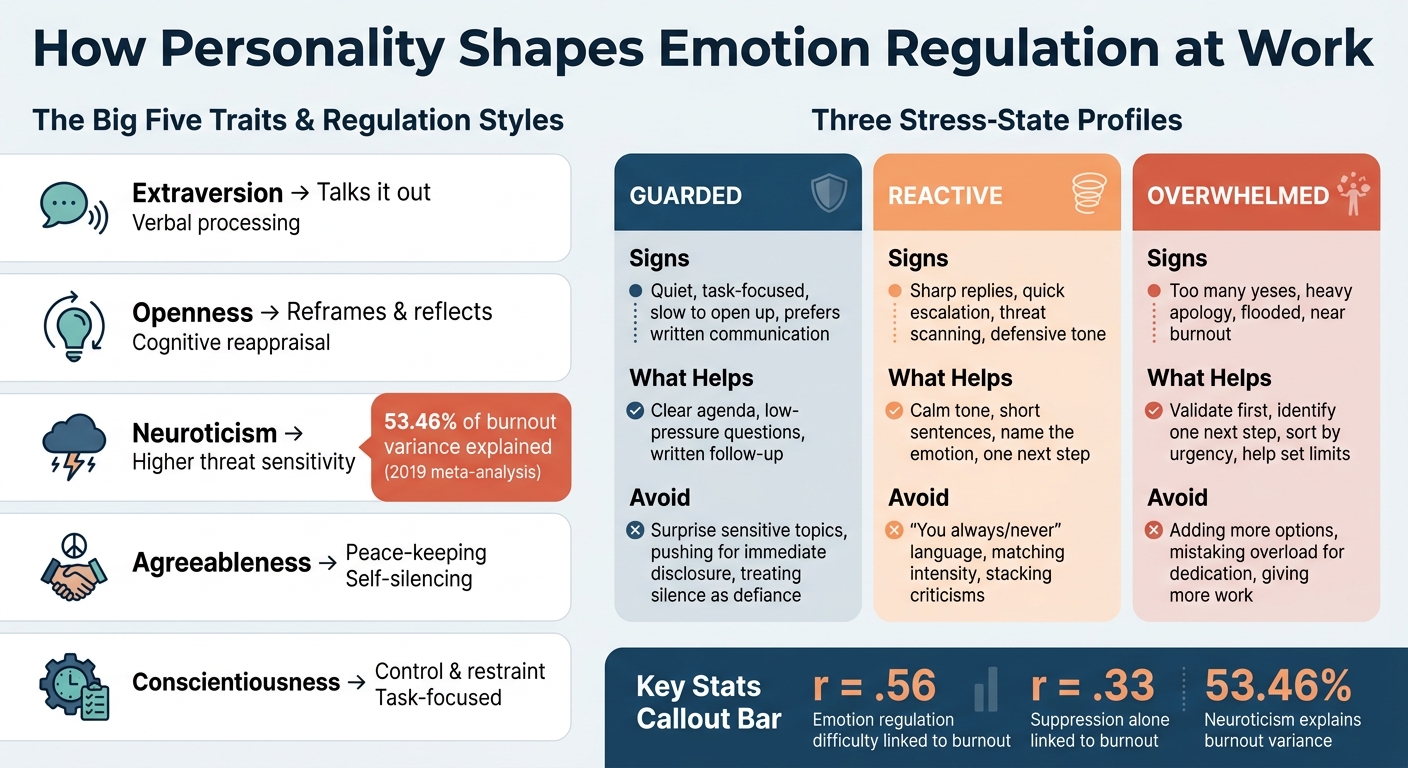
Your personality affects how you handle stress, feedback, conflict, and overload at work. In plain terms, some people talk things out, some pull back, some react fast, and some keep going until they hit a wall. That matters because emotion regulation problems are tied to burnout, with suppression linked at r = .33 and overall emotion regulation difficulty linked at r = .56.
Here’s the short version:
- The Big Five helps explain common work patterns:
- Extraversion often leans toward talking it out
- Openness often leans toward reframing and reflection
- Neuroticism often means higher threat sensitivity
- Agreeableness often means peace-keeping and self-silencing
- Conscientiousness often means control, restraint, and task focus
- Under pressure, I’d watch for three common states:
- Guarded: private, controlled, slow to share
- Reactive: fast escalation, sharp tone, low pause
- Overwhelmed: overloaded, flooded, near burnout
- The response should fit the person:
- With guarded people, I’d lower pressure and add predictability
- With reactive people, I’d calm the interaction before fixing the problem
- With overwhelmed people, I’d validate, simplify, and narrow the next step
One stat stands out: in one 2019 meta-analysis, Neuroticism explained 53.46% of burnout variance. That helps explain why the same hard week can hit two coworkers in very different ways.
| Pattern | What it looks like | What usually helps |
|---|---|---|
| Guarded | quiet, task-focused, slow to open up | clear agenda, low-pressure questions, written follow-up |
| Reactive | sharp replies, quick escalation, threat scanning | calm tone, short sentences, one next step |
| Overwhelmed | too many yeses, heavy apology, overload | validation, task triage, limit-setting |
Bottom line: I wouldn’t treat emotion regulation as just a willpower issue. It’s often a mix of personality and stress load, and the best response is to match your approach to the person, not just the problem, by scaling personalized coaching strategies.
Big Five Personality Traits: Emotion Regulation Patterns & Workplace Responses
Emotion Regulation with James J. Gross, PhD
How the Big Five Traits Shape Emotional Reactions and Communication
Each Big Five trait changes how people read pressure, show emotion, and respond to others. It affects what feels threatening, how fast emotion builds, and whether someone speaks up, shuts down, or clamps down hard on control. Under pressure, these patterns often show up as guarded, reactive, or overwhelmed behavior.
Extraversion and Openness: Expressive vs. Reflective Regulation
Extraversion often shows up at work as verbal processing. When a highly extraverted colleague gets hard news in a team meeting, they may talk through it on the spot. They might name what they feel, ask for instant feedback, or vent for a minute and then move on. For them, social interaction helps them reset.
That can create friction. An extraverted supervisor who thinks out loud may flood a more reserved or detail-focused team member who needs time to process before answering. That difference often gets misread as disengagement or resistance, when it's just a different way of regulating emotion.
Openness tends to work differently. It's linked to reflective regulation. A highly open practitioner dealing with a tough client situation is more likely to reframe the moment than to look for instant social support. They lean on curiosity and reappraisal to handle stress.
Neuroticism and Agreeableness: Threat Sensitivity vs. Harmony Seeking
Neuroticism can make neutral cues feel loaded. Ambiguous instructions may spiral into worst-case thinking. In conflict conversations, people high in neuroticism often circle back to the same grievance again and again, which makes closure harder for everyone in the room.
Agreeableness pulls the other way, but it has its own cost. Highly agreeable staff often protect relationships by holding back anger, giving ground in disputes, and apologizing fast to restore harmony. That can lower visible conflict. But there's a catch: agreeable team members can burn out by overextending themselves. They may take on extra emotional labor, step into conflicts that aren't theirs to manage, and almost never bring up their own needs.
Conscientiousness: Control, Restraint, and Task-Focused Expression
Conscientiousness can act like an emotional buffer, but it cuts both ways. High scorers often regulate by turning to the task. They stabilize the situation, follow the protocol, meet the deadline, and deal with feelings later. In a crisis conversation, that delayed reaction can help. In a supervision session or team debrief, though, the same pattern can come across as cold or dismissive, especially to colleagues who need some human acknowledgment before they can move into problem-solving mode.
Under stress, the downside of conscientiousness is rigidity. If a process changes without warning or a meeting drifts off agenda, high scorers may become visibly impatient or controlling. Clear structure helps. So does making space, on purpose, for emotional processing. That combination can help these individuals stay engaged without feeling like the work is getting pulled off track.
Under stress, these trait patterns often shape whether someone becomes guarded, reactive, or overwhelmed.
Recognizing Guarded, Reactive, and Overwhelmed Profiles
These profiles are momentary patterns, not diagnoses. They are often rooted in the Five Factor Model of personality. They can reflect both personality and current stress load. Once you spot the pattern, the next move is simple: adjust your tone, pace, and pressure.
Guarded: Private, Controlled, and Slow to Disclose
Start by noticing guarded behavior. These people tend to keep things task-focused, lean toward email or clear agendas, and open up slowly. They may also want details in writing before they commit to anything.
This often shows up when social risk feels high and predictability feels low. It’s easy to misread that as coldness or disengagement. But that’s usually not what’s going on.
Reactive: Fast Escalation, Defensive Tone, and Difficulty Pausing
Next, watch for reactive behavior. Criticism can feel threatening, so responses may turn sharp or defensive fast. Ambiguity can register as threat, which means a tense email or meeting pushback may come before anyone stops to clarify.
This pattern points to fast threat detection with weak pause-and-check behavior. The common misread is to label the person toxic or aggressive and leave it there. In many cases, it’s a fast stress response, and de-escalation needs to come first.
Overwhelmed: Overextended, Emotionally Flooded, and Near Burnout
Finally, look for overwhelmed behavior. These people are not closed off. They’re overloaded. They may seem flooded, apologize too much, and have a hard time saying no, even when they’re already at capacity, up against a deadline, or dealing with a packed supervision schedule.
This pattern shows up when stress goes past capacity. A common mistake is to treat overload like dedication and hand them even more work. These are early warning signs of burnout that the person is carrying too much.
How to Adjust Your Approach for Each Profile
Once you spot the pattern, change your approach to reduce friction, not add pressure. The same tone, pace, and way of handling problems won't land the same way with all three.
Working with Guarded People: Lower Pressure, Build Safety
Start with predictability. Sudden, probing, or emotionally loaded interactions often make guarded people pull back even more. In many cases, this style comes from a private, control-oriented way of regulating stress.
Open meetings with a clear, simple agenda. Ask specific, low-stakes questions before moving into anything sensitive. After you ask something, give them a beat instead of rushing to fill the silence. A short written recap after meetings helps too: key points, next steps, and decisions made. That gives them space to process on their own, which is often how they do their best thinking. Treat caution as a communication style, not as resistance.
Do:
- use a clear agenda
- ask low-pressure questions
- send written follow-up
Don't:
- bring up sensitive topics without warning
- push for immediate disclosure
- treat silence like defiance
If guarded people need safety, reactive people need calm before they can think clearly.
Working with Reactive People: De-Escalate First, Solve Second
Lower arousal before you try to solve anything. This style often shows up as fast threat detection with very little pause before a response.
Use short, neutral sentences. A calm voice helps signal safety instead of confrontation. Naming the emotion can help shift the conversation toward reflection without forcing agreement. For example: "It sounds like you're frustrated and worried this won't get resolved." In digital communication, it often helps to wait before replying so the tone can cool off. Or simply acknowledge the message and set up a call instead of letting the conflict grow in writing. Set behavioral limits early and calmly: "I want to keep working through this, but we'll need to bring the volume down to continue."
Do:
- use short sentences
- keep your voice calm
- name the emotion
- give one next step
Don't:
- use absolute language like "you always" or "you never"
- match their intensity
- stack multiple criticisms at once
If reactive people need de-escalation, overwhelmed people need simplification.
Working with Overwhelmed People: Validate, Simplify, and Narrow the Next Step
Overwhelmed people are at capacity. They often can't hold much more. This style points to overload, not disengagement.
Validation comes first. When you acknowledge how heavy the workload feels, you reduce shame and make problem-solving more possible. From there, narrow the focus instead of expanding it. Pick the next required step and set the rest aside for now. If someone can't prioritize, sort tasks by urgency: urgent, important, and can-wait. That creates structure outside their head. You can also help them set limits by co-writing a script to decline a request, adjusting availability, or clarifying what is actually part of their role versus what they've taken on by default.
Do:
- validate
- identify one next step
- sort by urgency
- help set limits
Don't:
- add more options
- mistake overload for dedication
- give them more work
The goal isn't to use one style everywhere. It's to match your response to the person's state.
Using Personality-Aware Tools and Workflows to Reduce Burnout
Knowing the right response is one thing. Using it in a tense moment is something else.
That’s where many people get stuck. The issue usually isn’t a lack of insight into personality. It’s the jump from knowing the trait to choosing the next move. And under pressure, that gap can feed burnout fast.
Where Static Personality Assessments Help and Where They Fall Short
Standard Big Five reports can help people understand themselves and give teams a shared way to talk about behavior. But they usually stop at description.
If a report says someone is high in Neuroticism and low in Agreeableness, that may sound useful on paper. But when that person shuts down in the middle of a session, the report doesn’t tell you what to do next. That missing step is where strain starts to build.
| Feature | Static personality assessments | AI-powered personality guidance systems |
|---|---|---|
| Profile detail | Often summarizes broad traits | Can incorporate detailed trait profiles |
| In-the-moment guidance | Usually limited or generic | Can offer next-step guidance |
| Relationship context | Often individual-only | Can account for both people and their history |
| Use under pressure | Requires interpretation by the user | Can provide direct next-step guidance |
That’s the gap AI-guided workflows are built to close.
How Personos Applies the Five Factor Model in Real Situations
Personos shows what this can look like in practice. It runs on the Five Factor Model, measures 30 traits on an 80-point scale, and turns that data into situation-specific guidance instead of static summaries.
Personos uses the Five Factor Model to turn trait data into real-time guidance through conversational AI, relationship-level Dynamic Reports, session-to-session Prompts, and an ActionBoard for progress tracking.
Its conversational AI chat gives practitioners a way to describe what’s happening as it unfolds. Maybe a client has gone quiet. Maybe a coworker escalated during a team meeting, highlighting how agreeableness shapes workplace conflict outcomes. Instead of leaving the user to interpret a trait report alone, the system offers concrete suggestions tied to the personality profiles involved.
Dynamic Reports look at more than one person in isolation. They analyze the relationship between two people and flag likely friction points before they turn into bigger problems. That can matter a lot when the stress is less about one person’s traits and more about how two people collide.
Prompts add a lighter layer of support between sessions. They deliver short, usable nudges, which helps keep personality-aware guidance workable even when someone’s plate is full.
The ActionBoard then tracks progress in a clear way. That matters because visible signs of progress can help practitioners stay focused and keep long-term goals in view, even when day-to-day work feels messy.
Personos also makes its reasoning plain. Each recommendation shows which traits were considered and why. So users aren’t just following automated instructions. They’re learning how the guidance connects to the underlying profile data.
And because individual scores stay private by default, the platform avoids the labeling problem that can make personality tools feel risky in sensitive professional settings.
Conclusion: Match the Strategy to the Person, Not Just the Problem
When personality insight becomes part of the workflow, professionals can respond faster and with less strain. These are not fixed categories. They’re patterns that shift with context.
Personality-aware workflows help turn trait insight into action, which can cut friction, burnout, and avoidable conflict.
FAQs
Can these patterns change over time?
Yes. Research suggests that, over time, traits like emotional stability, agreeableness, and conscientiousness often grow. That growth can help build stronger emotional resilience.
It’s not just about getting older, though. Resilience and communication skills can also get better through steady effort, honest self-checks, and changing your approach as your work and personal life shift. Personos can help by offering tailored guidance that changes with your feedback and context.
How do I tell stress apart from personality?
Look for consistency over time. Personality is your baseline, the way you usually think, feel, and act. Stress, on the other hand, is often a short-term reaction to pressure from the outside.
Your personality tends to shape how you usually cope and communicate. But stress can change behavior for a while. Tools like Personos can help by looking at both your more stable personality profile and the situation around you, which makes it easier to tell whether a reaction points to a trait or just someone feeling overwhelmed.
What if someone seems both reactive and overwhelmed?
When someone seems reactive and overwhelmed, high neuroticism may be part of the picture. Stress can set off intense anxiety, irritability, or fast mood shifts. In moments like that, the best move is usually to slow things down and listen first.
A simple way to handle it is the PAUSE method:
- Pause: Stop for a beat instead of reacting right away.
- Acknowledge: Show that you hear what they’re feeling.
- Pinpoint: Name the main issue or trigger.
- Select: Choose the calmest, most helpful response.
- Engage: Move forward with care and steady communication.
Personos can help here by offering real-time, personality-tuned guidance. That can make de-escalation, validation, and reframing feel less like guesswork and more like a clear next step.