How Big Five Facets Flag Conflict Early
Spot workplace conflict early by reading Big Five facet patterns, predicting escalation or avoidance, and guiding targeted 1:1 and team moves.
Nick Blasi

How Big Five Facets Flag Conflict Early
Most work conflict starts long before anyone names it. It often shows up first in small behavior shifts like clipped emails, silence in meetings, delayed feedback, or quiet pushback. This article says facet-level Big Five data can help you spot those patterns early, before trust slips and tension turns public.
Here’s the main idea in plain English:
- Broad traits are too vague for early conflict checks
- Facets give better clues about how conflict may show up
- Certain trait pairs matter most, such as:
- High Anger + Low Compliance = open escalation
- High Compliance + High Self-Consciousness = quiet avoidance
- High Anger + High Compliance = late blowup
- High Dutifulness + Low Trust = scorekeeping and delayed pushback
- You can scan a profile in a simple order:
- Reactivity
- Trust
- Response style
- Force
- Change tolerance
- The article also shows how to:
- compare two people without reading too much into score gaps
- spot early warning signs in daily work
- use 1:1 talk tracks and team rules to lower friction
- use tools like Personos to keep this work active between sessions or explore AI tools for conflict resolution for real-time support
A few numbers help explain why this matters. Unresolved conflict is tied to more than $414 billion per year in cost, 77% of employees in repeated conflict become disengaged, and managers may spend up to 42% of their time dealing with people issues.
My takeaway: don’t wait for open conflict. Look for patterns, not single scores. Then test those patterns in conversation, because personality results are only a starting point.
If you want to catch conflict sooner, this article gives you a simple map for what to watch, what it may mean, and what to say next.
The facet patterns that flag conflict early
A 2022 study found facet models explain about 1.5 times more conflict-style variance than broad factors because opposite traits can cancel each other out at the domain level, an averaging-out effect that hides the patterns most predictive of how someone behaves under pressure [3]. So the next move is pretty simple: read facets as interaction patterns, not as stand-alone scores.
The facets to watch first
Watch for these traits in tone, timing, and follow-through, not only in test results.
From Neuroticism: Anger shows up in clipped replies, sarcastic feedback, or clear impatience when someone gets blocked. Anxiety tends to lead to over-explained emails and repeated requests for reassurance. Self-Consciousness often looks like public agreement mixed with private disagreement, plus a reluctance to challenge decisions in a group.
From Agreeableness: Trust is one of the first things to notice. People with low scores often CC more people on emails and want written confirmation before they move ahead. Compliance shows whether a person pushes back or gives way. Low scorers challenge direction in the open, while high scorers may go along on the surface even as resentment builds underneath. Straightforwardness helps separate people who agree in meetings from people who save their criticism for offline conversations.
From Extraversion and Conscientiousness: Assertiveness shapes who drives decisions without input and who never says what’s bothering them. Orderliness and Dutifulness together often create tension around standards. People who score high here tend to point out process gaps, and more flexible coworkers may read that as rigid. Cautiousness can slow decisions, which frustrates fast-moving peers who read careful analysis as obstruction.
Trait combinations that predict escalation, avoidance, or late blowups
Single facets show risk. Combinations show how that risk is likely to play out.
| Facet Combination | Likely Early Behavior | Conflict Pattern |
|---|---|---|
| High Anger + Low Compliance | Sharp pushback, low compromise | Escalation |
| High Assertiveness + Low Straightforwardness | Drives decisions while communicating ambiguously | Escalation |
| High Compliance + High Self-Consciousness | Public yes, private no | Avoidance |
| Low Assertiveness + High Anxiety | Worries intensely, stays silent, uses indirect channels | Avoidance |
| High Anger + High Compliance | Outwardly cooperative until threshold breaks | Late blowup |
| High Dutifulness + Low Trust | Keeps score, then arrives with receipts | Late blowup |
The best way to read facets is in pairs: one part shows the common conflict triggers, and the other shows the response style. From there, you can compare two profiles and turn those patterns into a usable risk map. This data allows executive coaching professionals to plan high-stakes conversations with precision.
How to read a facet profile and build a conflict risk map
Reading a facet profile works best when you follow the same order every time. If you don't, it's easy to latch onto one dramatic score and miss the pattern that tends to drive behavior when pressure hits.
A 5-step scan for individual profiles
Scan in this order: reactivity, trust, response style, force, then change tolerance.
- Neuroticism: Anger, Anxiety, Self-Consciousness
- Agreeableness: Trust, Straightforwardness, Compliance
- Conscientiousness: Order, Dutifulness, Deliberation
- Extraversion: Assertiveness, Activity
- Openness: Ideas, Actions, Feelings
The point isn't to type people. It's to see where conflict is most likely to show up first. From there, you can name likely triggers, likely reactions, and the repair moves that may help.
Once you can read one profile, the next step is to solve team conflicts with personality insights by comparing it with another to spot where friction may keep showing up.
How to compare two profiles without overinterpreting scores
When you compare profiles, look for friction pairs, not overall similarity. A friction pair is a mix of traits that creates repeated tension at work. It does not mean either person is wrong.
Focus on three checks: the type of friction pair, the size of the gap, and the context. For example, high Assertiveness meeting high Compliance can create strain. A small gap may be easy to handle. A large gap can lead to the same misunderstanding again and again. And context matters. The same pairing might work fine in a structured operational role, then fall apart when the work turns vague or moves fast.
Use the mismatch to predict where one person will feel pressure and the other person won't even notice it. Then use that comparison to test your assumptions in conversation. Questions like "What does directness sound like to you?" or "What kind of follow-up helps you trust a decision?" bring the profile back to lived experience. Meta-analytic research confirms that personality traits predict preferred conflict styles, but those are tendencies, not certainties [5][6][4]. Scores are hypotheses. Conversation is how you check them.
Those friction pairs also shape what you should listen for in day-to-day behavior.
What early warning signs look like in real work settings
Watch for changes from baseline, not one-off behavior. In U.S. workplace settings, common signs include delayed feedback, shorter or more formal messages, defensiveness before the issue is raised, missed clarification, over-accommodation, and task disagreements that start to feel personal.
A peer who starts CC'ing more people on routine emails may be signaling low Trust or high Anxiety. A manager who stops asking open-ended questions may be showing high Compliance pulling back from open challenge. A team member who agrees in meetings but brings objections later in Slack is a classic pattern for high Compliance paired with high Self-Consciousness.
Each of these signals echoes the facet patterns named in the previous section. And each one points to a different kind of move in response.
These are the kinds of signals to bring into the next 1:1 or team check-in before the pattern hardens into public conflict. They point straight to the talk tracks and team norms in the next section.
Turn facet patterns into 1:1 talk tracks and team norms
The point of early detection is simple: step in sooner. One conversation and one team norm can prevent the same friction from showing up again and again. Use the risk map from the previous section to match each pattern to escalation, avoidance, or distrust-driven resistance.
1:1 scripts for anger, distrust, and conflict avoidance
In any facet-informed 1:1, call out the behavior, not the trait. Each script below maps to one of the three patterns already flagged: escalation, avoidance, or distrust-driven resistance.
For anger-linked patterns, start with what you saw, ask a direct question, then set a clear limit: "In the last two project reviews, your feedback came across as sharp and the room went quiet. I want us to surface real concerns early without shutting people down. What was driving that reaction?" Then follow with: "Your candor is valuable. I also need us to keep tone constructive so others can engage instead of retreat."
For distrust patterns, don't get pulled into arguing about intent. Ask what would make the decision feel transparent: "When leadership rolls out changes quickly, what would make something feel trustworthy versus like a hidden agenda?" Then build one concrete agreement together, like written rationales for major decisions or a standing check-in on commitments. That way, trust grows through structure, not reassurance.
For avoidance patterns, make it easier to speak up before frustration hardens: "Was there a moment you felt frustrated but didn't say it? Can we unpack one example?" A weekly check-in can help here. Even one small prompt, like "What's one thing bothering you a little?", gives people a lower-pressure way to share early signals.
Team practices that reduce recurring friction
If the same pattern keeps coming back, shift from coaching one person to setting team rules. Use team-wide norms, not corrections aimed at one person.
A conflict charter can help teams high in Assertiveness and low in Modesty. Think rules like: "We criticize ideas, not people", "No interruptions during problem statements," and "If voices rise, we pause for two minutes." Response-time norms can help teams high in Conscientiousness facets, where a vague or delayed reply may feel disrespectful. Agreeing to acknowledge requests within 24 hours, even without a full answer, removes a common trigger. On mixed teams, where some people dominate the floor and others go quiet, rotating facilitators and round-robin input before open discussion give conflict-avoidant members a steady way in. Frame these norms as default team habits, not as a fix for any one person.
Quick-reference table: facet patterns and recommended responses
Use the patterns below to pick the right response faster.
| Facet pattern | Likely early behaviors | Main conflict risk | Best response language |
|---|---|---|---|
| High anger + high competitiveness | Sharp criticism, tense body language | Escalatory confrontations that shut others down | "I value your high standards - let's channel them into concrete improvement steps rather than general judgments." |
| Low trust + high openness (ideas) | Questioning motives, side conversations, slow buy-in | Rumor-driven resistance | "Let's list what would make this decision feel transparent to you so we can address specific gaps, not assumed intent." |
| High compliance + high agreeableness | Quick agreement in meetings, objections raised later | Late blowups or quiet disengagement | "If you're hesitant in the moment, it's fine to say 'I'm not sure yet' - I still need to hear your concerns within a day or two." |
| High assertiveness + low modesty (self-promotion) | Interruptions, airtime hogging | Silencing quieter team members | "Your energy drives our discussions - I need you to help make space by inviting others in before offering your view." |
| High anxiety + high self-consciousness | Slow replies, over-accommodation, late concerns | Chronic avoidance until issues become severe | "I've noticed a shift in your engagement. What pressure points can we address together?" |
These scripts and norms get sharper when they come from live coaching tools instead of a one-time assessment.
Using tools like Personos to make conflict prevention a continuous practice
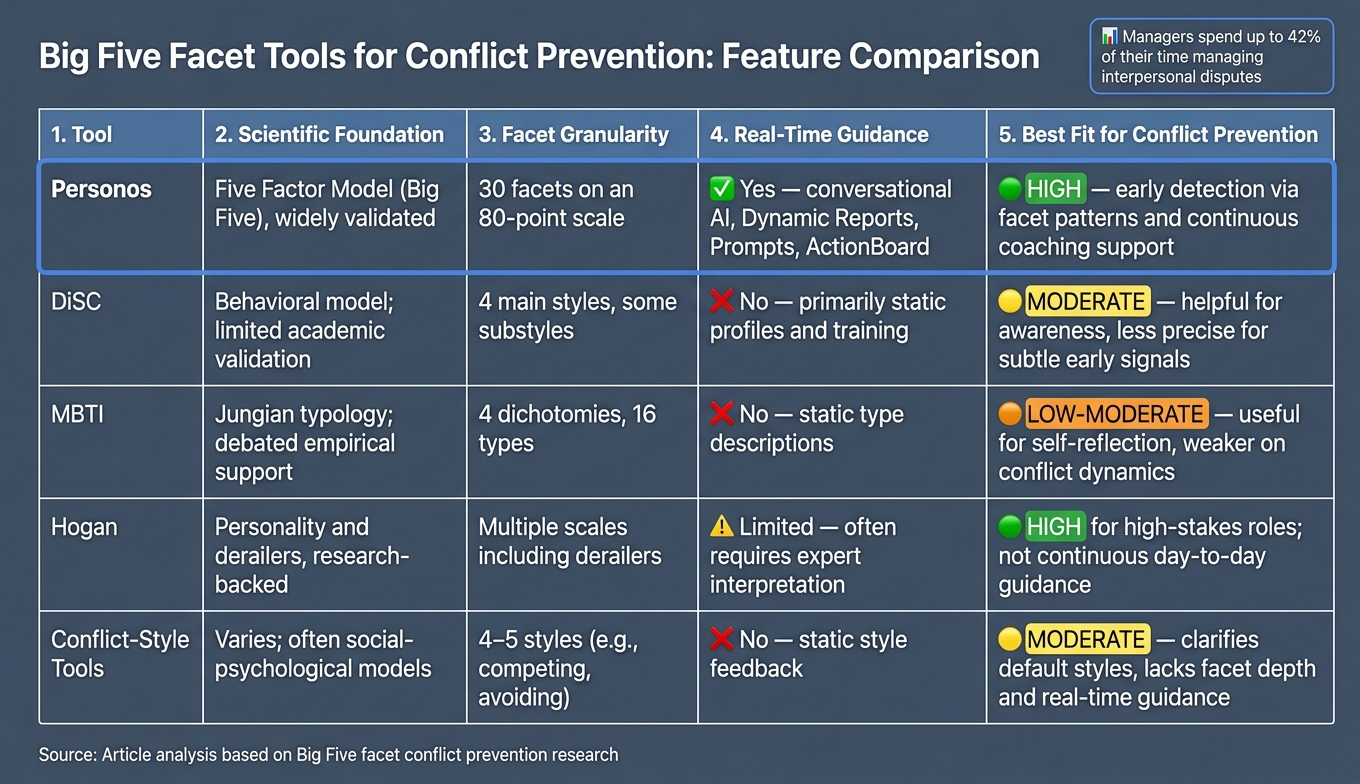
Big Five Facet Tools for Conflict Prevention: Feature Comparison
Personos keeps conflict signals active between sessions instead of trapping them inside a one-time report. That changes how you pick a tool. The main issue isn’t the label it gives someone. It’s whether the platform can help with the next conversation.
Where Personos fits in a conflict-prevention workflow
Personos uses the Five Factor Model and measures 30 facets on an 80-point scale. That gives coaches and HR leaders enough detail to spot conflict risk early. In practice, Personos fits into a five-step workflow: baseline mapping, relationship and team reports, pre-conversation prep, between-session reinforcement, and follow-through.
It also supports the work around the meeting, not just the meeting itself. You can use conversational AI to draft talk tracks and questions, Dynamic Reports to flag friction points, Prompts to reinforce small behavior shifts, and ActionBoard to track follow-through.
There’s one guardrail worth keeping front and center: profile data stays private by default. Relationship and team reports require consent, and detailed facet scores stay limited to trained professionals using them for development, not hiring or discipline.
How Big Five-based platforms compare with DiSC, MBTI, Hogan, and conflict-style tools
The big difference comes down to what happens after the assessment. Does the tool help once the workshop ends, or does it stop there? Research shows participants retain only about 20% of workshop information after one week [1]. Static tools stop at the workshop.
If your goal is daily conflict prevention, the better test is simple: can the tool help before, during, and after the conversation?
| Tool | Scientific foundation | Facet granularity | Real-time guidance | Best fit for conflict prevention |
|---|---|---|---|---|
| Personos | Five Factor Model (Big Five), widely validated | 30 facets on an 80-point scale | Yes - conversational AI, Dynamic Reports, Prompts, ActionBoard | High - early detection via facet patterns and continuous coaching support |
| DiSC | Behavioral model; limited academic validation | 4 main styles, some substyles | No - primarily static profiles and training | Moderate - helpful for awareness, less precise for subtle early signals |
| MBTI | Jungian typology; debated empirical support | 4 dichotomies, 16 types | No - static type descriptions | Low-moderate - useful for self-reflection, weaker on predicting conflict dynamics |
| Hogan | Personality and derailers, research-backed | Multiple scales including derailers | Limited; often requires expert interpretation | High for high-stakes roles; strong on derailers, but not usually continuous day-to-day guidance |
| Conflict-style tools | Varies; often social-psychological models | 4-5 styles (e.g., competing, avoiding) | No - static style feedback | Moderate - clarifies default styles, but lacks facet depth and integrated real-time guidance |
Hogan is strong for executive selection and derailer identification, but it usually depends more on expert interpretation and is less woven into day-to-day coaching workflows. That’s the practical gap a platform like Personos is built to fill. It doesn’t replace a coach’s judgment. It gives that judgment sharper, more timely inputs tied to the escalation, avoidance, and distrust patterns that matter most.
Conclusion: Catch conflict sooner, coach more precisely
That’s why continuous guidance matters more than one-time assessment readouts. Continuous Big Five data moves support earlier, before friction becomes public. The most useful signals almost always come from trait combinations, not one high or low score by itself, but the interaction between, say, high assertiveness and low trust, or high compliance and high anxiety. Single scores can point you in the wrong direction. Patterns tell you more.
Managers may spend up to 42% of their time managing interpersonal disputes [2]. The goal is to catch the kind of conflict that quietly drains teams before it turns into a formal grievance, a resignation, or a team that stops speaking honestly altogether.
FAQs
How are facets different from broad Big Five traits?
The Five Factor Model measures personality through five broad dimensions. Facets take those five dimensions and split them into 30 more specific traits.
The broad traits show the main ways people differ from one another. Facets add a closer, more nuanced view. That extra detail matters.
By using 30 facets instead of broad personality types, tools like Personos can generate more tailored insights based on a person’s exact personality pattern, not a generic label.
Which facet combinations signal conflict risk first?
Conflict risk often shows up first in the way two people’s 30-facet personality profiles interact. Using the Five Factor Model, Personos maps the trait combinations most likely to create friction in communication, decision-making, and collaboration.
From there, it points out likely triggers and suggests tailored language cues that can lower tension before it builds. For coaches and HR leaders, that means clearer talk tracks for 1:1s and smoother team interactions.
Think of it like an early warning system. Instead of waiting for a conversation to go sideways, you can spot where friction may start and adjust how people speak to each other from the start.
How should I use personality data without overinterpreting it?
Put transparency and context first, not fixed labels. Instead of boxing people into rigid types, use the Five Factor Model to assess 30 personality facets on an 80-point scale. That gives you a more detailed view, so the insight stays nuanced and tied to the situation.
It also helps to use systems that show why they made a recommendation. The best ones spell out the traits involved, the situational details, and the psychological principles behind each suggestion.