How AI Supports Emotional Self-Regulation
AI uses wearables, mood tracking, and conversational coaching to detect stress, suggest mindfulness and CBT techniques, and personalize daily emotional routines.
Nick Blasi

How AI Supports Emotional Self-Regulation
AI tools are transforming how we manage emotions, offering real-time support and personalized strategies to improve emotional self-regulation. These tools combine data from wearables, self-reports, and conversational AI to identify emotional triggers and suggest actionable techniques like mindfulness exercises, reframing negative thoughts, and emotion journaling. Here's what you need to know:
- What It Does: Tracks mood, detects stress, and analyzes emotional patterns using heart rate, sleep, activity, and voice data.
- How It Helps: Suggests tailored strategies such as breathing exercises, grounding techniques, and thought reframing in real time.
- Proven Benefits: Studies show AI tools can improve emotional awareness by 40% and enhance well-being by addressing stress triggers effectively.
- Personalization: Platforms like Personos align strategies with your personality traits, offering insights into emotional triggers and behaviors.
- Daily Routine: Regular use - like morning check-ins, midday resets, and evening reflections - helps integrate emotional regulation into everyday life.
These tools act as a bridge between emotional awareness and action, empowering you to manage stress, improve relationships, and navigate challenges with clarity. Whether you're in a high-stakes meeting or decompressing after a long day, AI offers accessible support for building lasting emotional resilience.
What is Emotional Self-Regulation and Why It Matters
Defining Emotional Self-Regulation
Emotional self-regulation is the ability to recognize your emotions, understand what’s causing them, and respond in a way that aligns with your goals and values rather than acting on impulse [4]. It’s about taking a moment to pause, identify what you’re feeling, and choose constructive ways to cope - like deep breathing, reframing your thoughts, or problem-solving [4].
This isn’t about suppressing or avoiding emotions. In fact, research shows that suppression can lead to higher stress levels and negatively impact overall well-being [8]. Healthy self-regulation allows you to fully experience your emotions while managing them effectively [8].
At its core, emotional self-regulation is a key part of emotional intelligence, which also includes self-awareness, social awareness, and the ability to manage relationships [8][5]. Mastering this skill can lead to better stress management, stronger relationships, and improved leadership abilities.
Benefits of Emotional Self-Regulation
The advantages of emotional self-regulation touch nearly every aspect of life. For mental health and stress management, this skill is tied to lower levels of anxiety and depression, reduced stress, and greater resilience [2][8]. A 2023 Stanford study even found that using AI-powered regulation tools boosted emotional awareness by approximately 40% [2]. By recognizing stress early and using strategies like mindful breathing or grounding techniques, you can prevent burnout and emotional exhaustion [1][6].
In terms of productivity and decision-making, self-regulation helps you avoid impulsive, emotion-driven actions - like firing off an angry email or making snap decisions under pressure. Instead, it encourages choices based on long-term goals and sound reasoning [8]. In U.S. workplaces, this translates to sharper focus, fewer conflicts, and more thoughtful responses in high-pressure situations. Techniques like mindful breaks can also ease mental strain, improving the quality of your work [1][2].
When it comes to relationships and communication, emotional self-regulation allows you to pause before reacting, express your feelings clearly (e.g., “I felt hurt when you said that”), and listen empathetically rather than defensively [4][8]. This approach can prevent unnecessary arguments and foster healthier interactions. In professional settings, it supports calm, constructive feedback and helps build a reputation for staying composed under pressure - qualities that are highly valued in collaborative and psychologically safe team environments [7][8].
Next, we’ll explore how AI tools can enhance this process by monitoring and analyzing your emotional patterns.
How AI Supports Self-Regulation
AI takes emotional self-regulation a step further by quickly identifying and responding to your emotional cues. For example, mood trackers use daily check-ins, journaling, and wearable data - like heart rate, sleep, and activity levels - to create a personalized emotional profile [1][2]. Machine learning algorithms analyze this data to detect patterns, such as times of day or situations that trigger stress or irritability, and present these insights in charts or summaries [2]. Some systems achieve up to 95% accuracy in identifying emotions based on biometric and behavioral data [1][2].
Conversational AI acts as a virtual coach, helping you label emotions, unpack triggers, and choose immediate coping strategies [1][2]. Many of these tools incorporate proven techniques from Cognitive Behavioral Therapy (CBT) and Dialectical Behavior Therapy (DBT), guiding you through exercises to challenge negative thoughts or build distress tolerance [1]. In some cases, they analyze text or voice in real time to detect heightened stress or negativity, then suggest interventions - like a quick mindfulness practice or a reminder to take a break - so you can address your emotions right away [2][6].
Mindfulness and regulation apps combine biometric data with self-reports and behavior patterns to recommend tailored strategies. For instance, if your wearable detects an elevated heart rate during the workday, the app might suggest a three-minute breathing exercise [2][6]. Or, if you frequently log irritability after a long commute, it might recommend a simple ritual to help you transition before engaging with family. Personality-based platforms like Personos even customize prompts to fit your unique patterns, offering guidance that feels especially relevant during emotionally charged moments.
How AI Tools Help Identify Emotional Triggers
Tracking Mood and Behavior Patterns with AI
AI-powered mood-tracking apps encourage you to log your emotions alongside details like where you are, what you're doing, and who you're with. By analyzing this information, the system can group similar moods and situations, uncovering trends you might not notice on your own. For instance, it might show that you often feel frustrated during meetings with your manager or that your anxiety spikes on days when you sleep less than 6 hours. Using time-series analysis, these tools map emotional patterns across time, day, and location, presenting them on visual dashboards. The data might reveal, for example, a 40% increase in anxiety on days with insufficient sleep, a 30% rise in stress linked to late-night social media use, or a 25% stress bump on days packed with back-to-back meetings [2]. These insights can guide you in making changes to your daily routines. Wearable devices can take this a step further by monitoring your physical responses.
Using Wearables to Monitor Physical Stress Signals
Wearable devices like smartwatches, fitness trackers, and rings continuously collect data on metrics such as heart rate, heart rate variability (HRV), sleep quality, and even skin conductance or breathing patterns. By comparing this data to your personal baseline, AI models can detect real-time stress signals with impressive accuracy. For example, a sudden drop in HRV or a prolonged spike in heart rate during a weekly meeting might indicate stress. Similarly, wearables might notice heightened stress during traffic-heavy commutes or long stretches of consecutive meetings. In response, the device could suggest a quick breathing exercise or a short stretch break to help you manage stress before it escalates [1][2]. These tools don’t just track physical reactions - they also help you reflect on emotional triggers through conversational AI.
Reflecting on Triggers Through Conversational AI
Conversational AI acts as a kind of digital journaling partner, guiding you through reflective exercises with questions like, "What happened just before you felt this way?" or "What were you thinking at the time?" By analyzing your responses - looking at word choices, emotional tone, and recurring themes - the AI can identify patterns in your thinking, such as tendencies toward catastrophizing or black-and-white thinking. Tools like Personos combine this analysis with personality psychology to offer even deeper insights. By incorporating cognitive behavioral therapy (CBT) techniques, the AI can link specific triggers to thought patterns and emotions. For example, if your journal entries repeatedly show that constructive feedback leaves you feeling "crushed", the AI might point out a connection between criticism and self-judgment. Personos can also highlight how traits like sensitivity to criticism or a need for harmony influence your interactions, offering personalized strategies to manage anxiety before conversations or improve communication in team settings. These tools provide a clearer understanding of emotional triggers, helping you make meaningful changes in how you respond to stress.
#4 Stop Overthinking: How AI Helps You Regain Mental Clarity (EN)
AI-Guided Strategies for Emotional Regulation
Once you’ve pinpointed what triggers your emotions, AI tools can step in to help manage your responses in real time. These platforms draw from proven approaches like Cognitive Behavioral Therapy (CBT), Dialectical Behavior Therapy (DBT), and mindfulness techniques, offering tailored support exactly when it’s needed. Let’s dive into how AI can assist with specific strategies for emotional regulation.
Mindfulness and Breathing Exercises
AI-powered tools can use real-time data - like an elevated heart rate from your smartwatch, a tense tone in your voice, or stressed language in your texts - to suggest mindfulness or breathing exercises. For instance, if your wearable detects a spike in heart rate before a major presentation, the app might guide you through a 5-minute box breathing exercise (inhale for 4 seconds, hold for 4 seconds, exhale for 4 seconds, hold for 4 seconds). Other options could include a 3-minute grounding technique, where you focus on noticing five things you see, four you feel, three you hear, two you smell, and one you taste, or a 10-minute guided body scan to help you relax.
By responding to biometric signals and stress patterns - like pre-commute jitters or tension during a busy day - these exercises help reduce stress consistently. AI tools also learn your habits, sending reminders during your most stressful times. Studies show that people who regularly engage with these features report about a 40% increase in their ability to recognize and manage emotions [2].
But mindfulness isn’t the only tool AI offers. It also helps reframe unhelpful thoughts.
Reframing Negative Thoughts
AI chatbots and coaching apps analyze your language to spot patterns of distorted thinking, such as catastrophizing or all-or-nothing thoughts. For example, if you say, “I always fail at my job,” the AI might flag this as black-and-white thinking and guide you through CBT-style questions like: What evidence supports this belief? What evidence contradicts it? Could there be another explanation? This process can help you reshape your thought into something more balanced, such as, “I made a mistake today, but I’ve also accomplished a lot this week.”
These tools make CBT techniques accessible and practical. A remote worker might receive a late-night prompt to reframe worries about their performance, while a student could get weekly insights encouraging them to work on recurring negative thoughts. Many AI platforms combine this with mindfulness exercises, coping strategies, or journaling tasks tailored to your unique emotional patterns.
And speaking of journaling, AI can take that practice to the next level.
Emotion Journaling and Labeling
AI journaling tools encourage users to write or speak freely about their emotions, then analyze the content to identify emotional tones and recurring themes. This process, known as affect labeling, supports emotional regulation by encouraging thoughtful reflection and reducing the intensity of emotions. Simply naming your emotions can help ease stress.
Prompts might include questions like, “What happened just before you felt this way?”, “Where do you feel this emotion in your body?”, or “What did you need in that moment that you didn’t get?” Over time, the AI can create visual summaries, such as emotion balance scores or stress level trends, to help you spot patterns related to specific days, times, or environments (e.g., work versus home). For instance, if you consistently report stress before Monday meetings, the system might suggest preparing a coping strategy in advance. It can also help you fine-tune your emotional awareness by offering word suggestions to differentiate between similar feelings, like irritation, anger, or resentment, and recommending specific strategies - such as breathing exercises for anxiety, reframing for shame, or boundary-setting for resentment.
Research highlights the benefits of these tools, showing a positive link between AI-based mental health support and improved psychological well-being (β = 0.229, p < 0.001). This relationship is mediated by increased emotional self-efficacy and a sense of autonomy, with the model accounting for 38% of the variance in well-being [3]. By turning emotion detection into actionable steps - like mindfulness exercises or reframing prompts - AI tools provide more than just monitoring; they offer meaningful ways to manage stress and build resilience.
sbb-itb-f8fc6bf
Using Personos for Personality-Based Emotional Regulation
Personos builds on existing AI tracking methods by focusing on personality insights to enhance emotional regulation strategies. Unlike generic approaches, it aligns mood and trigger data with your personality traits, creating strategies that resonate with your unique emotional landscape - not just general solutions.
Identifying Triggers Through Personality Insights
Personos uses dynamic personality reports based on 30 personality traits combined with situational data to uncover patterns you might not notice on your own. For instance, if you're a professional in the U.S. who frequently feels anxious before brainstorming sessions, Personos might link this reaction to a personality trait like a preference for structure and clarity. By identifying such triggers, it provides actionable insights to better manage stress.
Carla Mendoza, LCSW, explains: "Personos anticipates when clients reach a stress threshold, enabling timely adjustments."
The platform also uncovers blind spots - emotional patterns that could take months to recognize without assistance.
Executive coach David Kim, PCC, shares: "It surfaces hidden patterns that typically emerge over months. It's like having a co-pilot who never misses a detail."
By pinpointing why certain situations trigger stronger reactions, you can adopt strategies that align with your personality rather than working against it.
Key Features for Emotional Self-Regulation
Personos offers practical tools to help you manage emotions on a daily basis. Personos Chat and Specialized Chats guide you through tense moments, helping you label emotions accurately and challenge unhelpful thoughts using CBT-style techniques.
Proactive communication prompts are another standout feature. These arrive before meetings or challenging conversations, offering reminders tailored to your personality and the other person’s communication style. For instance, if you tend to rush your words when stressed, you might get a nudge like: "Take a slow breath and count to three before responding." These small adjustments can prevent emotional flare-ups.
The ActionBoard supports habit-building by tracking micro-habits. Whether it’s a 3-minute breathing exercise after client calls or a nightly emotional check-in at 8:00 p.m., the ActionBoard keeps you consistent. If you skip a regulation activity on a high-stress day, it sends reminders to help you stay on track. Over a typical U.S. workweek, this could include Monday morning prompts before meetings, midweek reflections during lunch, and a Friday summary of stress triggers and effective strategies. These tools integrate seamlessly into your routine, making emotional regulation feel manageable and natural.
Managing Emotions in Relationships and Teams
Personos extends its benefits beyond personal habits, helping you navigate relationships and team dynamics effectively. Relationship analysis reports compare personality traits to identify potential friction points. For example, one person might prefer direct feedback, while another may need a softer approach. Knowing these tendencies helps you avoid misinterpretations like assuming someone is upset when they’re simply processing internally.
Group analysis reports provide insights into team dynamics by aggregating personality data. For example, a sales team with high competitiveness and low patience might experience tension during pipeline reviews. Personos can send facilitators prompts to slow the pace and suggest self-regulation cues like "Pause before interrupting" or "Ask clarifying questions before reacting."
Sarah Mitchell, MBA, VP of Operations, shared in 2025: "Personos helped us understand why certain team dynamics weren't working and gave managers the exact words to fix it." Her organization saw a 45% reduction in team turnover within six months thanks to these insights.
Building a Daily Emotional Regulation Routine with AI
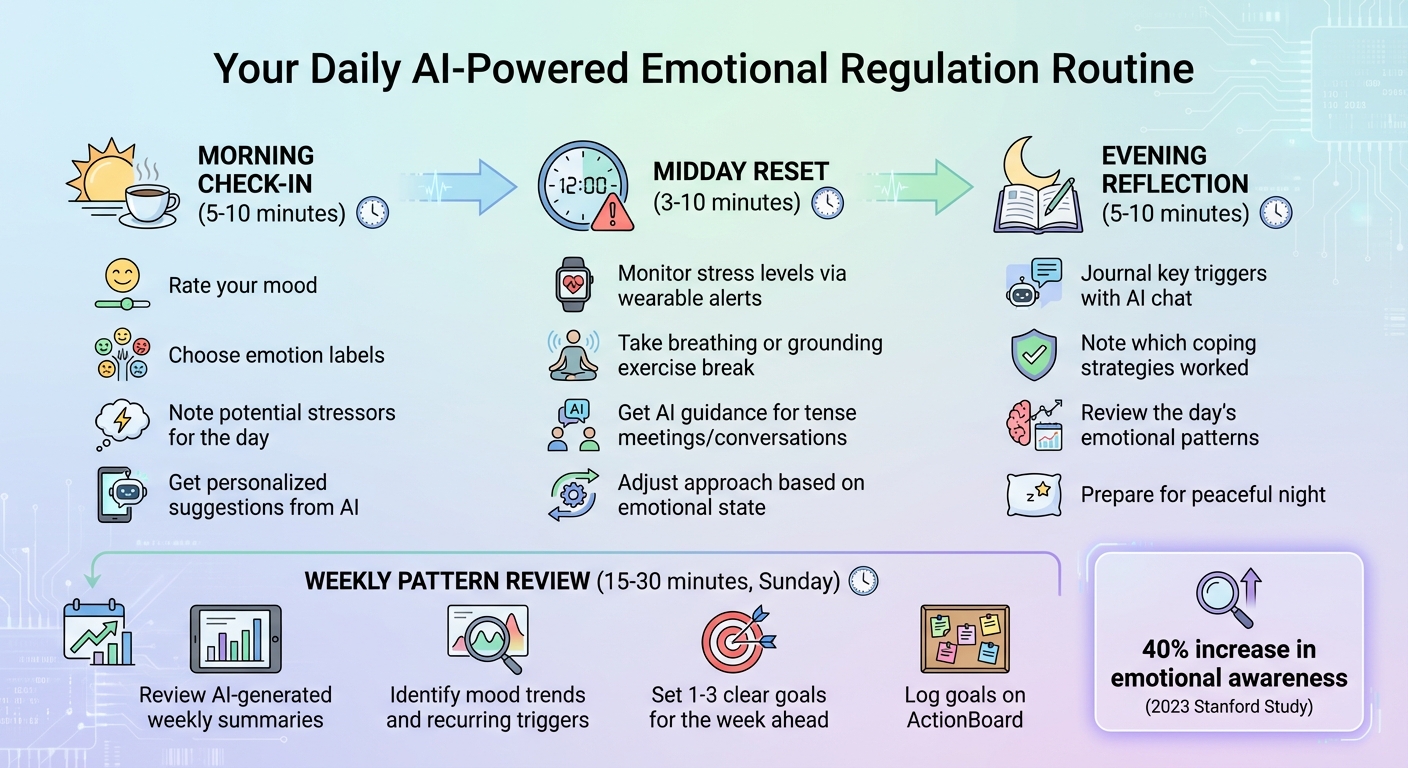
Daily AI-Powered Emotional Regulation Routine: Morning, Midday, and Evening Practices
Emotional regulation isn’t something you master overnight - it’s a skill that grows stronger with consistent practice. AI tools like Personos shine when they’re part of a structured routine that includes morning check-ins, midday resets, and evening reflections. Over time, this routine not only helps the AI adapt to your emotional patterns but also supports you in developing self-regulation habits that feel natural. Once you’ve identified your emotional triggers, sticking to a daily rhythm helps reinforce the strategies you’ve chosen. Incorporating these practices into your day-to-day life strengthens the emotional insights you’ve already gained.
Daily Emotional Check-Ins
Start your morning with a quick 5–10 minute check-in using Personos. During this time, rate your mood, choose emotion labels, and make note of any potential stressors for the day. Midday, if you feel your stress levels rising - or if your wearable device alerts you to changes - take a short 3–10 minute break for a breathing or grounding exercise. Personos uses natural language processing to identify patterns and triggers, offering personalized suggestions based on your personality profile. For instance, it can guide you on how to approach a tense meeting or conversation in a way that aligns with your emotional state and communication style.
At the end of the day, spend 5–10 minutes reflecting with Personos Chat. Use this time to journal key triggers and note which coping strategies worked best. This practice not only reinforces what you’ve learned but also sets you up for a more peaceful night. A 2023 Stanford study revealed that participants using AI-powered emotional regulation tools experienced a 40% boost in emotional awareness, proving that consistent daily use can lead to measurable improvements [2].
Weekly Pattern Review and Goal Adjustment
Your daily check-ins lay the foundation, but a weekly review helps you see the bigger picture. Dedicate 15–30 minutes each Sunday to reviewing Personos’ weekly summaries. Identify mood trends and recurring stress triggers. Then, set 1–3 clear goals for the week ahead - such as, "Take a 3-minute breathing break before every meeting" - and log them on the ActionBoard. The platform’s insights, tailored to your personality, can help you pinpoint which situations or interaction styles are most likely to throw you off balance. With this information, you can create strategies that prepare you for challenging moments.
Privacy and When to Seek Professional Help
It’s important to understand how your data is handled. Review Personos’ privacy policy to learn about its data collection, storage, and sharing practices. The tool processes your data securely on your device. Keep in mind, though, that AI is meant to complement - not replace - professional mental health support. If you notice persistent or worsening symptoms, consult a therapist. You can even share AI-generated mood charts or summaries with your mental health provider to make your sessions more productive and gain deeper insights into your emotional patterns.
Conclusion
This guide has unpacked how AI can identify emotional triggers and guide regulation techniques to support emotional well-being. By helping you spot patterns you might overlook, detect rising stress early through real-time monitoring, and offering tailored coping strategies, AI brings emotional management tools right to your fingertips. While these tools don't replace therapy or coaching, they fill the gaps between sessions, making emotional skills practice accessible anytime.
The key lies in personalization. Tools like Personos use personality psychology to pinpoint triggers specific to your traits - whether you’re sensitive to conflict, prone to perfectionism, or struggle under pressure. This means the advice you receive is customized to your unique way of thinking and interacting, not just generic suggestions. Over time, the AI learns your habits, refines its recommendations, and helps you build emotional skills that truly stick.
Getting started is straightforward. Choose an AI tool like Personos, set aside 10 minutes daily for two weeks, and follow these steps: check in each morning, try one suggested exercise (like a quick breathing session or a reframing prompt), and review your weekly summary to spot recurring patterns. If the tool highlights ongoing distress, consider sharing the data with a therapist to enhance your sessions. A small daily commitment can lead to lasting emotional resilience.
Before diving in, take a moment to review the tool’s privacy policy to understand how your data is managed. Opt for platforms that clearly outline their privacy practices. AI is most effective as a complement to healthy routines, professional care, and human support. If you’re experiencing severe symptoms or thoughts of self-harm, always reach out to a licensed professional or call 988 for immediate mental health support.
With research-backed strategies and personalized insights, the next step is to put these tools into action. AI-assisted emotional regulation isn’t just a passing trend - it’s a fast-evolving field grounded in science and innovation. Try incorporating one AI-supported habit into your routine this week. Pay attention to how you feel, explore the reasons behind those emotions, and practice the strategies that resonate with you. With consistent effort and the right tools, you can transform emotional awareness into meaningful, lasting change.
FAQs
How can AI help me understand and manage my emotions?
AI has the ability to identify what sets off your emotions by examining patterns in your personality, behavior, and the situations you encounter. With this understanding, it offers customized strategies and practical advice to help you spot emotional trends and develop effective ways to regulate your responses.
Through tailored guidance and instant feedback, AI equips you with tools to take control of your emotions and enhance your overall mental well-being.
Can AI tools like Personos help with emotional self-regulation, and do they replace therapy?
AI tools such as Personos can play a helpful role in managing emotional self-regulation. They assist by pinpointing emotional triggers and offering strategies to handle them in everyday situations. However, it's important to note that these tools aren't a replacement for therapy. Therapy provides personalized, clinical support tailored to address deeper emotional and mental health concerns.
Rather than replacing therapy, tools like Personos work alongside it, delivering real-time insights and practical tips for managing daily emotional hurdles. For more thorough mental health care, professional therapy remains a critical component.
How do AI tools protect my personal data and ensure privacy?
AI tools take your personal data seriously, employing robust security measures such as encryption, strict access controls, and adherence to data protection laws. These tools are built to process your information only with your explicit consent, ensuring you’re always aware of how your data is being used.
Moreover, they focus on protecting your privacy by collecting only the information they truly need and storing it securely. This approach ensures your data is managed responsibly, giving you peace of mind about its safety.