How AI Supports Cross-Cultural Crisis Intervention
How AI breaks language barriers, reads emotional signals, and delivers culturally informed, personalized guidance to improve crisis responses across diverse communities.
Christian Thomas

How AI Supports Cross-Cultural Crisis Intervention
AI is transforming how professionals handle crises involving diverse communities. By addressing communication barriers, understanding social norms, and tailoring responses to individual needs, AI tools like Personos improve outcomes for both clients and responders. Key advancements include:
- Real-Time Crisis Communication & Sentiment Analysis: AI ensures accurate translations and detects emotional cues.
- Culturally Informed Guidance: Tools provide context-specific advice, respecting local traditions and behaviors.
- Personalized Support: Platforms like Personos analyze personality and social dynamics to offer tailored recommendations.
These technologies reduce miscommunication, enhance trust, and support responders in managing complex situations effectively. At $9 per seat monthly, Personos is a cost-effective option for organizations.
Main Challenges in Cross-Cultural Crisis Intervention
Language and Communication Barriers
When language differences arise during a crisis, they can disrupt effective communication and delay critical interventions. This applies to both spoken words and non-verbal cues, which often carry different meanings across cultures. AI-powered tools are becoming essential in breaking down these barriers, offering faster, more accessible solutions compared to traditional translation services, which may be too slow to assist someone in immediate distress. For instance, in Jordan's Zaatari refugee camp, Syrian refugees struggled to access healthcare due to language obstacles. AI-driven health assistants stepped in to bridge the gap, providing tailored guidance for healthcare needs[3][4]. Adding to the complexity, professionals must also decode cultural signals, which can vary widely, further complicating communication and increasing the risk of misinterpretation.
Cultural Sensitivities and Misunderstandings
Crisis intervention is not just about communication - it’s also about understanding cultural contexts. Norms around decision-making, emotional expression, and authority differ greatly from one culture to another. What might be seen as supportive in one culture could be viewed as intrusive or even disrespectful in another. Non-verbal cues like eye contact, gestures, or personal space also carry different meanings, leading to unintended offense or miscommunication[3]. Many standard crisis protocols fail to account for these cultural nuances, assuming a one-size-fits-all approach. This oversight can be particularly problematic in settings like multicultural refugee camps or disaster zones, where cultural diversity is the norm[4]. Without a culturally adaptable framework, professionals often struggle to navigate these sensitivities effectively.
Emotional and Psychological Complexity
Cultural differences also shape how individuals respond to trauma, adding another layer of complexity to crisis intervention. For example, behaviors such as withdrawal might be a culturally accepted way of coping rather than a sign of deeper psychological distress. AI technologies are stepping in to address these challenges by tailoring interventions to diverse cultural contexts. Tools like Wysa and Woebot offer multi-language cognitive behavioral therapy and mindfulness exercises, helping both those affected by crises and the professionals supporting them[4]. These tools not only provide culturally aware care but also help alleviate the burnout that responders experience when faced with uncertainty or cultural fatigue. Without such resources, interventions risk being ineffective, leaving underlying issues unaddressed and further straining both survivors and responders[4].
How AI Improves Cross-Cultural Crisis Intervention
Real-Time Translation and Sentiment Analysis
AI is breaking down language barriers and bridging cultural gaps during crises. With advanced natural language processing (NLP) tools, real-time translations ensure critical information - like medical instructions, public health updates, and emergency alerts - reaches diverse communities in their native languages. Platforms like Google's BERT and OpenAI's models excel at processing vast amounts of data, ensuring messages are clear and actionable during emergencies[4].
Beyond translation, machine learning algorithms analyze sentiments across social media and communication channels to catch potential misunderstandings caused by cultural differences. By monitoring emotional expressions in real-time, AI-driven sentiment analysis identifies communities in distress and flags the need for immediate intervention[3][4]. This is crucial because emotional cues can vary widely across cultures - what signals distress in one culture might be a typical response in another.
AI models trained on regional dialects and cultural contexts add another layer of precision. They can pick up on nuanced language, including slang or coded messages, in languages such as Hausa, Somali, or Amharic[5]. This capability allows for a deeper understanding of cultural dynamics, paving the way for more effective crisis interventions.
Culturally Informed Personality Insights
Crisis intervention goes beyond language - it requires understanding the psychological and cultural context of individuals. Tools like Personos provide this by combining the Five Factor Model of personality with cultural insights to offer real-time, culturally sensitive guidance. This approach helps social workers and practitioners de-escalate crises while building trust across cultural divides.
For example, if a refugee appears withdrawn, Personos can help determine whether this behavior is a culturally accepted coping mechanism, an introverted trait, or a sign of deeper distress that needs immediate attention. The platform delivers concise insights into how individuals process information, respond to stress, and prefer to communicate.
What sets Personos apart is its transparent reasoning feature. This allows practitioners to see which personality traits and psychological principles are behind each recommendation. Over time, this builds expertise and reduces dependency on AI, enabling professionals to refine their approach while maintaining confidence in their decisions.
Personalized Guidance for Each Situation
Standardized protocols often overlook cultural nuances, but tools like Personos address this gap by offering tailored guidance for specific situations. Its conversational AI incorporates personality profiles, relationship dynamics, and situational details to provide customized advice for every interaction.
For instance, when a case manager describes a tense scenario involving a client from a different cultural background, Personos generates advice tailored to both the client’s and the practitioner’s profiles. Dynamic Reports offer detailed insights into relationships, while the Prompts feature delivers actionable personality tips on a schedule. This approach helps maintain cultural awareness, even when managing heavy caseloads.
At $9 per seat per month for the Pro version, Personos is an affordable option for nonprofits and social service agencies. It not only improves outcomes for vulnerable populations but also helps reduce staff burnout by streamlining culturally informed crisis intervention.
AI innovations that tackle the global refugee crisis | Global Stage
Comparing AI Platforms for Cross-Cultural Crisis Management
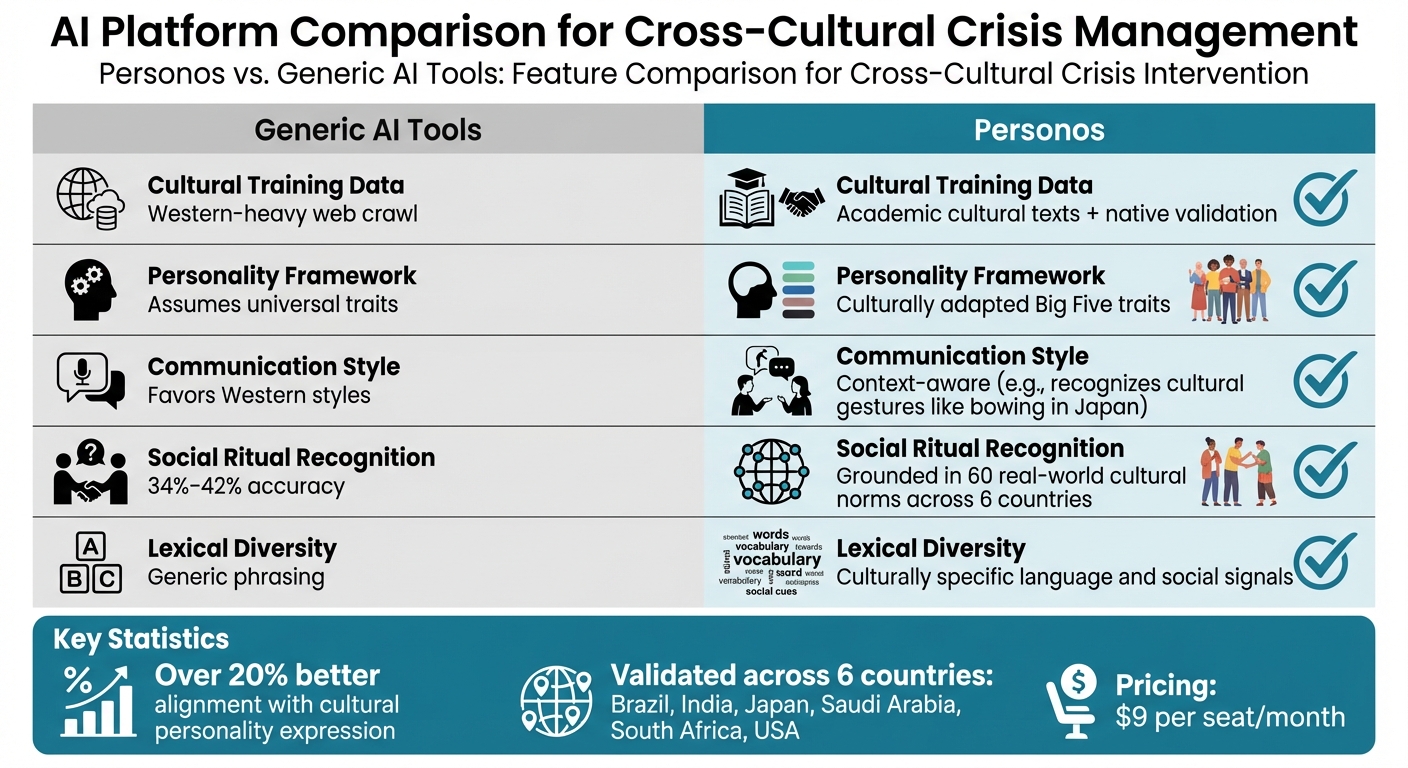
AI Platform Comparison for Cross-Cultural Crisis Management: Personos vs Generic Tools
Feature Comparison: Personos vs. Generic Tools
Generic AI tools often fall short when it comes to cross-cultural crisis management. While platforms like ChatGPT, Claude, and Meta's Llama are undeniably advanced, they tend to operate with a Western-centric perspective. This bias can lead to misunderstandings in culturally sensitive situations, as experts have pointed out[1].
Take, for example, a study conducted in September 2025. Researchers evaluated models from OpenAI, Anthropic, and Meta to see how well they could handle taarof - a Persian social custom centered on politeness and indirect communication. Imagine a social worker in Los Angeles assisting an Iranian refugee family during a crisis. In such a scenario, the inability of these tools to navigate cultural nuances could erode trust at a time when it’s most needed.
Enter Personos, a platform specifically designed to address these gaps. Developed using the CulturalPersonas framework from the University of Southern California in October 2025, it employs a Retrieval-Augmented Generation (RAG) pipeline. This system is built on academic cultural texts and validated by native speakers from countries like Brazil, India, Japan, Saudi Arabia, South Africa, and the United States[2]. The result? Personos achieves over 20% better alignment with how individuals from specific cultures express personality traits and handle stress[2].
| Feature | Generic AI Tools | Personos |
|---|---|---|
| Cultural Training Data | Western-heavy web crawl | Academic cultural texts + native validation |
| Personality Framework | Assumes universal traits | Culturally adapted Big Five traits |
| Communication Style | Favors Western styles | Context-aware (e.g., recognizes cultural gestures like bowing in Japan) |
| Social Ritual Recognition | 34%–42% accuracy | Grounded in 60 real-world cultural norms across 6 countries |
| Lexical Diversity | Generic phrasing | Culturally specific language and social signals |
This comparison highlights why Personos’s culturally informed approach is more effective in real-world scenarios.
Why Personos Works Better
The differences in these platforms aren’t just numbers - they directly impact the quality of responses. Consider a workplace mistake in Japan. Generic tools might suggest a simple apology like, "I am very sorry." In contrast, Personos, leveraging its cultural framework, would recommend a more nuanced response: "bow deeply and express regret." This advice reflects the significance of physical gestures in Japanese culture and conveys sincerity in a way that resonates[2].
Priyanka Dey from USC's Department of Computer Science emphasizes the importance of these distinctions:
Evaluating LLMs without accounting for these distinctions risks reinforcing Western behavioral norms and misrepresenting how personality is interpreted across cultures[2].
For professionals managing diverse caseloads, this level of cultural nuance can make all the difference.
Personos also stands out for its transparent reasoning. It shows users which personality traits and cultural principles inform its recommendations, making it easier for practitioners to understand and trust the guidance. At just $9 per seat per month, the platform is an affordable solution for nonprofits and social service agencies. It reduces staff burnout while improving outcomes for vulnerable populations. Additionally, its privacy-first design ensures individual personality scores remain confidential, fostering the psychological safety essential for effective crisis intervention across cultural boundaries.
Best Practices for Using AI in Cross-Cultural Interventions
Combining AI with Training
AI tools often reflect a Western perspective due to the biases in their training data. Since most large language models are trained on a limited range of global languages, they tend to default to Western-style direct communication, even in situations where indirectness or deference is more appropriate [1]. That's why human cultural expertise is essential to review and refine any AI-generated recommendations.
One practical way to use AI is as an observer during live training sessions. For instance, when practitioners participate in roleplays with cultural insiders - people who deeply understand a specific culture - the AI can provide real-time feedback on communication styles and highlight areas for improvement. However, as conflict resolution experts Ellen Kim and Mo-Yun Lei Fong emphasize:
At the end of the day, there is no replacement for a real life coach who is a cultural insider that has lived the nuance. [1]
Using targeted prompts can also help define the cultural context and assign stakeholder personas. A study from MIT Sloan in June 2025 discovered that prompting ChatGPT in Chinese elicited responses with more interdependent social orientations compared to English prompts. This shows that the language used in the prompt can act as a cultural signal [1]. By explicitly naming the culture and assigning personas, practitioners can guide AI to provide culturally relevant advice instead of defaulting to Western norms [1].
AI's role doesn't have to stop with live training; it can also provide ongoing support to strengthen cultural competence.
Using Personos Prompts for Long-Term Impact
While live training enhances immediate interactions, scheduled AI prompts can help sustain cultural sensitivity over time. Crisis intervention isn’t just about addressing the immediate situation - it requires ongoing attention. Tools like Personos Prompts ensure professionals maintain cultural awareness by delivering regular personality insights tailored to client relationships and cultural contexts. This feature is especially valuable during periods of high caseloads.
Personos also includes a transparent reasoning feature, which explains the personality traits and cultural principles behind each recommendation. By revealing the "why" behind its advice, the tool helps professionals make informed decisions. For social workers managing diverse clients, the affordability of $9 per seat per month makes it an accessible option to reduce burnout while improving outcomes for vulnerable populations. This kind of extended support aligns with the goal of AI-powered crisis intervention: providing culturally aware, real-time solutions.
Conclusion: The Future of AI in Cross-Cultural Crisis Intervention
AI is taking a big leap forward by aligning more closely with genuine cultural expressions, making it better at mirroring real human behavior. Studies reveal that culturally adapted AI boosts behavioral alignment by over 20%, with regions like South Africa seeing improvements as high as 25.9% [2]. Instead of relying solely on static questionnaires, AI now evaluates behavior in context, enabling it to suggest culturally appropriate responses - like a deep bow in Japan versus a verbal apology in the U.S. [2]. These advancements are setting a new standard for effective crisis management.
This progress isn’t just theoretical; it’s helping professionals on the ground through new frameworks for excellence. By reducing burnout and increasing the effectiveness of interventions, tools like Personos are leading the way. These platforms merge personality psychology with cultural insights, offering nuanced guidance. Priyanka Dey from the University of Southern California highlights this shift:
By bridging personality expression and cultural nuance, we envision that CulturalPersonas will pave the way for more socially intelligent and globally adaptive LLMs [2].
Personos stands out by integrating the Five Factor Model with transparent reasoning. It explains why each recommendation aligns with both an individual’s personality and their cultural background. Its Prompts feature ensures that cultural considerations remain front and center, even during high-pressure situations, by providing scheduled reminders to keep professionals on track.
This evolution doesn’t replace human expertise - it enhances it. AI takes on the heavy lifting of interpreting emotional states and cultural norms, giving professionals the freedom to focus on strategic decisions. The result? Broader reach, measurable impact for funders, and better outcomes for vulnerable populations in diverse communities.
FAQs
How does AI avoid cultural bias in crisis advice?
AI reduces cultural bias in crisis advice by relying on diverse training data, recognizing cultural subtleties, and employing bias detection tools. Platforms like Personos take this further by incorporating culturally aware personality insights and adapting in real time to ensure advice aligns with cultural expectations. Additionally, techniques such as tailored prompts and continuous bias monitoring help refine AI responses to reflect a variety of values, minimizing miscommunication and supporting culturally respectful crisis intervention.
What data does AI need to provide culturally accurate guidance?
AI thrives on culturally relevant data, capturing elements like language subtleties, emotional tone, and nonverbal cues such as gestures and facial expressions. It also gains from datasets that mirror a variety of values and social norms, helping to minimize biases. Incorporating human validation and culturally specific scenarios ensures the AI's outputs align with local customs. This approach allows AI to provide thoughtful and accurate guidance, particularly in crisis situations that involve people from diverse cultural backgrounds.
How can teams use AI safely during real emergencies?
Teams can rely on AI during emergencies to handle real-time data, support decision-making, and improve communication - all while keeping humans in charge. AI can sift through massive amounts of information, flag false data, and send personalized alerts to different groups. When paired with human judgment, AI minimizes risks like mistakes, biases, and privacy issues. This approach ensures effective responses by providing early warnings, modeling potential scenarios, and delivering customized messages.