How AI Flags Low Team Engagement Early
AI detects early shifts in communication and participation so managers can check in quickly; privacy and supportive follow-up matter.
Rachel Johnson

How AI Flags Low Team Engagement Early
Low team engagement usually shows up long before burnout or turnover. I’d boil it down to this: AI can spot small behavior shifts early, managers can use those alerts to check in within 24 to 72 hours, and privacy rules matter if you want people to trust the process.
Here’s the article in plain English:
- What changes first: slower replies, shorter messages, fewer updates, and less back-and-forth with coworkers
- What comes next: lower meeting input, skipped check-ins, and less visible participation
- What AI watches: each person’s normal pattern across communication, meetings, collaboration, and tone
- Why this helps: managers often miss gradual changes until they show up in performance issues or resignations
- What good alerts look like: trend-based flags, not reactions to one bad week
- What managers should do: have a private, supportive conversation and build a simple follow-up plan
- What trust depends on: consent, role-based access, and alerts based on patterns instead of raw message review
- How tools differ: manual observation is uneven, surveys are delayed, and AI can spot patterns earlier
One point stands out: the alert itself is not the fix. What matters is whether a manager responds with support, clear next steps, and a plan tied to the person’s workload, role, and team relationships.
If I were summarizing the article in one line, I’d say this: AI is most useful when it helps a manager notice small changes early and respond like a human.
| Method | Main strength | Main limit | Best use |
|---|---|---|---|
| Manual observation | Human judgment | Easy to miss slow changes | Day-to-day team awareness |
| Surveys | Direct employee input | Delayed snapshots | Periodic pulse checks |
| AI detection | Early pattern spotting | Needs clear privacy limits | Early alerts and manager follow-up |
That’s the core idea of the piece: catch quiet signs early, keep the process private, and act before disengagement turns into burnout or exit risk.
AI Employee Monitoring Explained | Productivity Tracking vs Privacy
Early Warning Signs AI Can Detect
AI can track a person’s baseline over time, including communication, meeting participation, collaboration, and tone, then flag steady changes instead of reacting to one busy week [5]. In most cases, the first signal shows up in communication.
Communication Changes: Slower Replies, Shorter Messages, Fewer Updates
Disengagement often starts to show in day-to-day messages. Someone who usually replies fast begins taking longer. Their messages get shorter. Collaboration with peers starts to dip too, with fewer tags, fewer shared items, and fewer feedback loops.
AI looks at these shifts over time, not just on one day. That matters because the goal is to compare changes against each person’s usual style, not some generic team average. When that pattern sticks around, it often starts showing up in meetings next.
Missed Check-Ins and Lower Meeting Participation
After that, missed check-ins and lower meeting participation can start to stand out. A person may still attend meetings but speak less than usual, share fewer updates, or take part less actively. One missed check-in on its own is not a red flag. A repeated pattern is.
AI can spot recurring drop-offs before a manager sees the pattern [1]. If that decline keeps going, the next shift often appears in tone.
Tone and Mood Shifts Across Messages and Feedback
Tone changes matter when they keep happening. Less warmth, less responsiveness, or more friction can point to disengagement, which AI tools for conflict resolution can help identify and address. Changes in tone, response style, or consistency can all be signals.
Some tools compare communication against a person’s usual style and flag when that style changes [4]. Context is the key part here. AI uses situational factors like role, current goals, and existing relationships to judge whether a shift is worth flagging [6].
How AI Turns Weak Signals Into Useful Alerts
AI turns weak signals into alerts by connecting small, repeated shifts in replies, participation, and tone over time. It begins with a personal baseline.
Baseline Tracking and Trend Detection Over Time
AI builds a personal baseline for each person by tracking communication frequency, response times, collaboration activity, and participation. Then it compares new behavior against that person’s past pattern. That baseline helps stop normal work style from being misread as disengagement.
When behavior moves away from that baseline for a sustained period, AI surfaces an alert a manager can act on. That makes it easier to tell the difference between a brief launch crunch and a longer drop in engagement. In plain terms, managers can respond to trends, not noise.
Privacy, Consent, and Boundaries That Keep Trust Intact
Pattern detection only works when employees understand how the data will be used. If people feel watched, they pull back even more. That’s the exact opposite of what engagement support is meant to do.
Well-designed AI engagement tools use privacy controls and role-based visibility so managers see patterns and trend alerts, not raw messages [2][5]. The point is to support people, not audit them. Clear boundaries make alerts easier to trust and make follow-up conversations more likely to happen.
What Managers Should Do After AI Flags a Risk
When AI flags a risk, act fast and start with a private check-in. An alert only helps if it leads to action. If nothing happens after detection, the root issue stays in place.
Start With a Private, Supportive Check-In
Review the alert, then set up a private check-in within 24 to 72 hours [1][4][6]. That timing matters.
Keep the conversation private, curious, and specific. Point to the patterns the AI surfaced, like recent team friction, unclear expectations, or workload strain, without labeling the person as the problem [1][3][6]. Then ask open-ended questions and listen closely.
"I've noticed things seem a bit quieter on your end lately - how are you feeling about your current workload?"
That kind of question opens the door without sounding corrective.
Personos can turn personality data into a tailored conversation plan. If the issue points to workload, expectations, or team friction, the next move is to reset priorities in a way the person can actually work with.
Reconnect the Person to Team Goals With a Workable Plan
After the check-in, the follow-up plan matters more than the exact script. In many cases, the best next step is simple: define clear actions and use a basic follow-up tracker [6]. Support should also fit the person's stress patterns and work style, which makes the plan easier to stick with. Small, specific changes show the manager heard the concern and did something about it.
Reconnect the person to team goals by clarifying expectations, keeping follow-up check-ins predictable, and linking the plan to their role and goals [6]. In practice, a prompt follow-up often matters more than getting every detail perfect.
Choosing AI Tools for Engagement Support
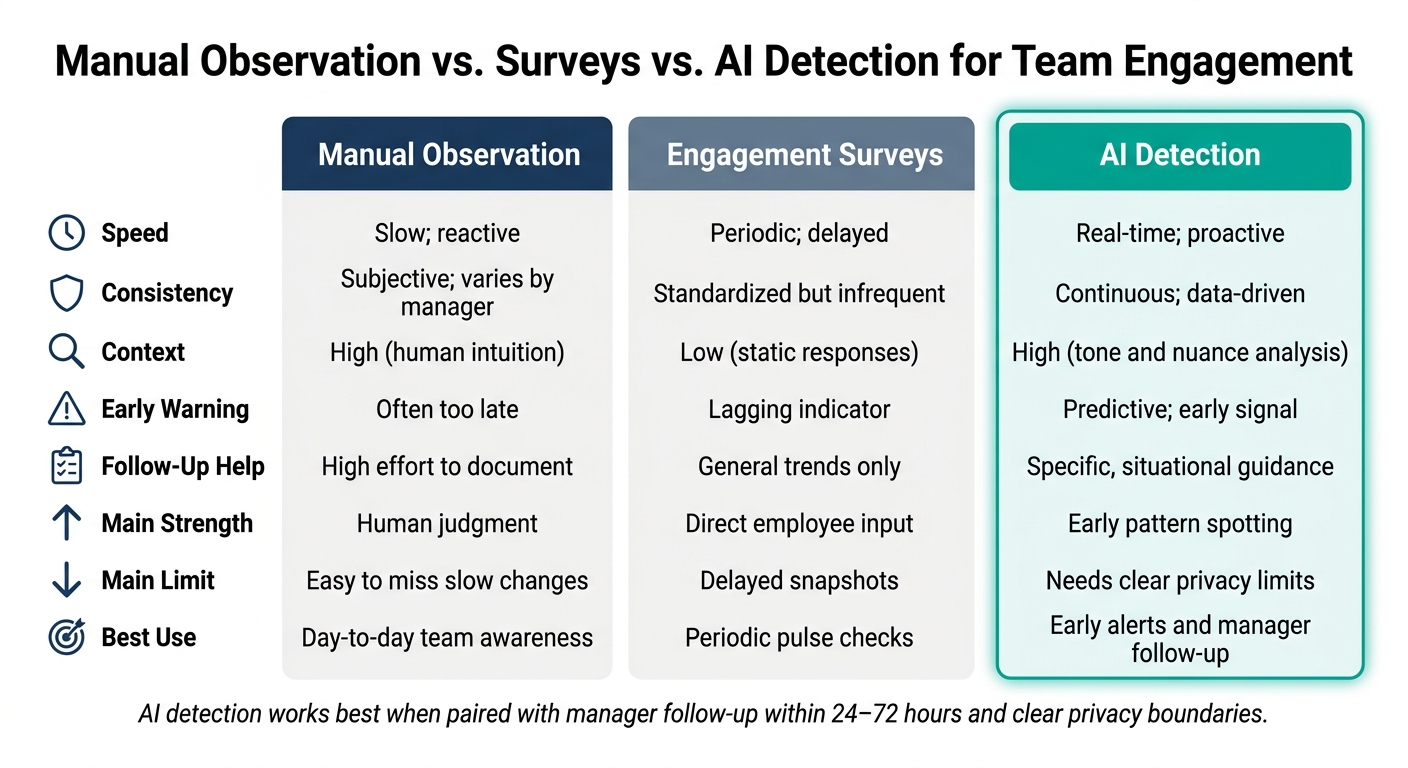
Manual Observation vs. Surveys vs. AI Detection for Team Engagement
For helping professionals, a simple engagement score can miss the human signals that matter most. The better tools go past a number on a dashboard. They look at communication patterns, help managers decide what to do next, and limit access through role-based alerts and trend summaries. So the choice isn't just about charts and dashboards. It's about whether a tool can turn faint signals into guidance a manager can actually use.
Manual Observation vs. Surveys vs. AI Detection
Each option comes with trade-offs. Manual observation depends on a manager's attention and emotional bandwidth, and that can shift from one day to the next. Periodic surveys give you a snapshot, but when the results arrive, the chance to step in may already be gone.
| Feature | Manual Observation | Engagement Surveys | AI Detection |
|---|---|---|---|
| Speed | Slow; reactive | Periodic; delayed | Real-time; proactive |
| Consistency | Subjective; varies by manager | Standardized but infrequent | Continuous; data-driven |
| Context | High (human intuition) | Low (static responses) | High (tone and nuance analysis) |
| Early Warning | Often too late | Lagging indicator | Predictive; early signal |
| Follow-Up Help | High effort to document | General trends only | Specific, situational guidance |
AI gives managers a chance to act before disengagement starts showing up in performance reviews or turnover. Speed matters, of course. But the bigger question is simpler: does the tool help a manager respond well?
Where Personos Fits for Personality-Aware Manager Support
Among tools built for this use case, the strongest options go past activity counts and get into communication nuance. Most general tools track activity. Personos adds personality-aware communication insight. It uses the Five Factor Model, a scientifically validated framework measuring 30 personality traits, to analyze tone, temperament, and communication style in real time [4].
| Feature | General AI Engagement Tools | Personos |
|---|---|---|
| Primary Insight | Engagement and productivity scores | Personality-based collaboration insights |
| Manager Support | Generic alerts and reminders | Tips for specific personality traits |
| Communication Analysis | Basic sentiment analysis | Nuance, tone, and temperament analysis |
| Framework | General algorithms | Five Factor Model (personality science) |
| Workflow Fit | Often standalone | Integrated with communication and CRM tools |
| Privacy Focus | Standard data security | Privacy-first; individual scores stay private |
For helping-professional teams, that gap matters. Personos adds personality-aware guidance through Dynamic Reports, Prompts, and a conversational AI that uses full personality profiles plus context to give tailored guidance for each situation.
Conclusion: Spot Disengagement Early and Respond With Support
Low engagement rarely announces itself. It tends to show up first in quieter messages, skipped check-ins, shorter replies, and slight shifts in tone. Early detection matters only if managers respond fast, keep things private, and lead with support. That's what stops small signs of disengagement from turning into burnout or turnover.
FAQs
How does AI tell the difference between a busy week and real disengagement?
AI spots the difference by looking at long-term patterns, not just one-off moments. One busy week can throw anyone off. But real disengagement tends to show up as a steady change from that person’s usual baseline, like a shift in tone, less collaboration, or missed check-ins.
Tools like Personos add personality context. That gives managers a clearer read on whether the change looks more like burnout or ongoing friction.
What data does AI use to flag low team engagement?
AI can spot low team engagement by looking at behavior and communication data, such as:
- communication patterns like word choice, tone, sentiment, and sentence structure
- response times and meeting participation
- behavior shifts, such as changes in decision-making or signs of frustration
It also compares those signals against a person’s usual baseline. That makes it easier for managers to notice early withdrawal and step in with support before burnout or turnover gets worse.
How should a manager respond after an AI alert?
When AI flags low engagement, managers need to move fast. The goal is simple: coach the employee, reconnect with them, and step in before turnover happens. At the same time, treat alerts as signals, not fixed rules.
A good response usually starts with a supportive check-in. Acknowledge what you've noticed, including the employee's emotions, and open the door for an honest conversation. From there, personality-informed communication can help managers set clear expectations, clear up friction, and avoid talking past the other person.
Tools like Personos can help by giving context-aware prompts, which makes these conversations easier to handle in a human way. Transparency with the team matters too. When people understand what's happening and feel listened to, they're more likely to feel heard and valued.