How AI Enhances Feedback After Conflict
How AI uses personality data and real-time coaching to improve post-conflict feedback, reduce tension, and help teams rebuild trust and communication.
Nick Blasi

How AI Enhances Feedback After Conflict
When emotions run high after a conflict, giving feedback can easily backfire. Misunderstandings often arise because people process emotions and communication differently. AI tools are helping solve this by analyzing personality traits and context to offer tailored feedback strategies. Platforms like Personos use personality data, emotional cues, and conflict history to suggest phrasing and approaches that ease tensions and rebuild trust.
Key Takeaways:
- AI analyzes personality traits on a detailed scale to tailor feedback.
- It provides real-time coaching during conversations, helping adjust tone and phrasing.
- Tools like Personos generate reports highlighting friction points and offer actionable recommendations.
- AI is being used in workplaces and coaching to improve communication and reduce conflicts.
This approach is showing results - like a 45% drop in team turnover - by improving how people interact after conflicts. AI is making feedback more precise and effective, helping relationships recover faster and with less stress.
I Built an AI Conflict Coach – Here’s What Happened
sbb-itb-f8fc6bf
Common Problems with Feedback After Conflict
Highlighting these common feedback challenges helps explain why AI-driven insights are becoming crucial in resolving post-conflict situations. Feedback during conflicts often gets distorted by heightened emotions, which can escalate tensions further. The primary issue? Communication breakdowns. These breakdowns are typically fueled by emotional reactions and personality clashes, making it difficult for individuals to express concerns without bias or further conflict [4].
How Emotions Block Effective Feedback
Intense emotions can act like a filter, distorting the way feedback is both given and received. When emotions run high, objectivity often takes a backseat. Feedback might come across as harsher than intended or be misunderstood entirely. AI can step in here by analyzing communication for signs of emotional shifts, such as a drop in sentiment or a sudden change in tone. It can then suggest structured, neutral language to help keep the conversation productive and balanced [4].
How Personality Affects Feedback Styles
Personality differences play a significant role in how people handle conflict and feedback. For example, someone with a direct communication style might come off as overly blunt, which could feel aggressive to someone with a more sensitive demeanor. AI tools can analyze tone, sentiment, and personality traits to offer real-time advice, helping individuals adjust their feedback delivery to better suit the recipient’s style [3].
Attachment styles - an important aspect of personality psychology - also influence how trust is built and maintained. These styles can shape how feedback is received, especially during conflict recovery. Without understanding these nuances, even well-meaning feedback might fall flat or worsen the situation. AI tools, by recognizing these subtle personality dynamics, can offer immediate suggestions to realign conversations and improve outcomes [3]. This ability to personalize feedback delivery highlights the growing importance of AI in navigating post-conflict communication challenges, as explored further in the next section.
How AI Uses Personality Data to Improve Feedback
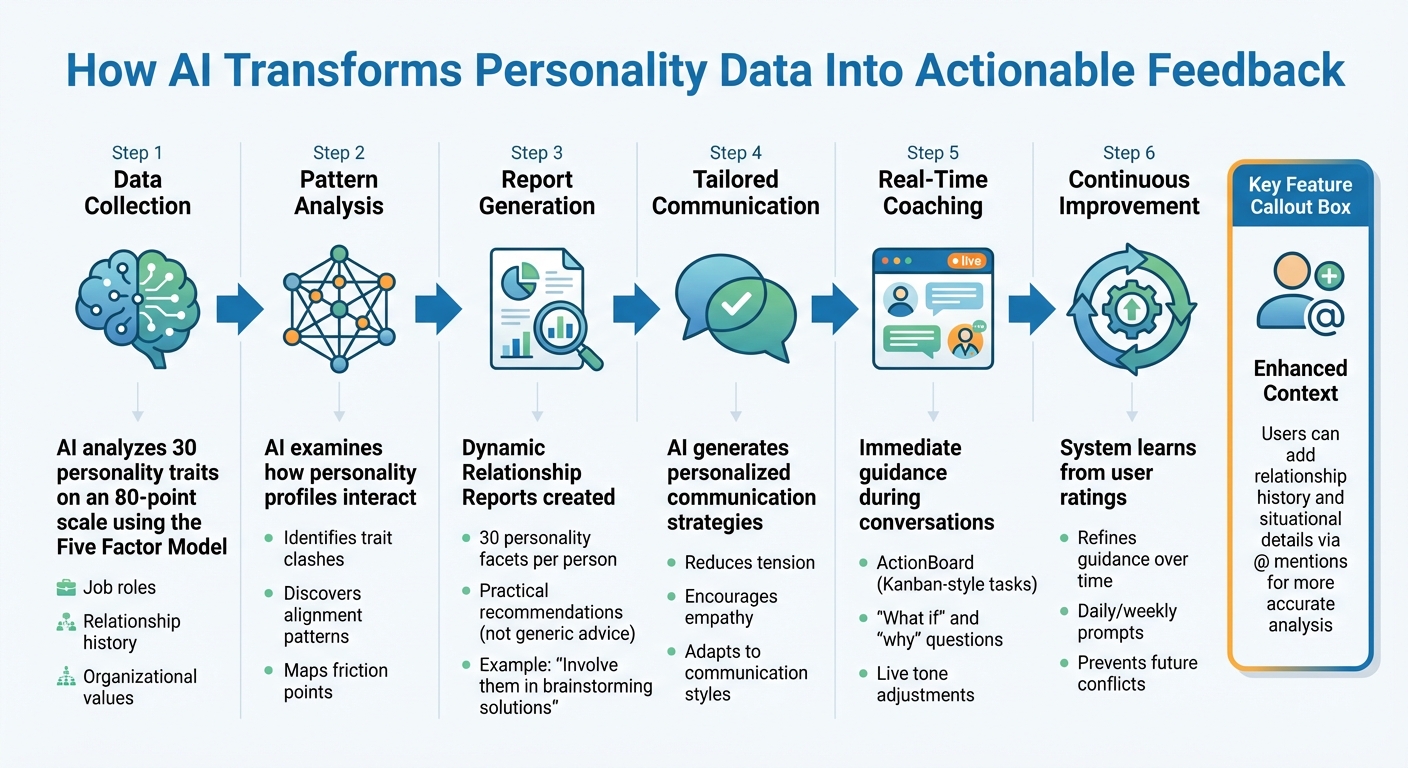
How AI Analyzes Personality Data to Improve Post-Conflict Feedback
AI taps into the Five Factor Model to analyze 30 personality traits on an 80-point scale, while factoring in contextual details like job roles, relationship history, and organizational values. This combination allows AI to offer tailored advice for resolving conflicts[1].
By examining how personality profiles interact, AI uncovers patterns in how traits clash or align. It explains the reasoning behind each suggestion, detailing the traits and principles involved. This analysis results in detailed reports that identify the root causes of conflicts[5].
Using Personality Reports to Understand Conflict
Platforms like Personos create dynamic Relationship Reports that map how two people’s personalities interact during conflicts. These reports highlight friction points by analyzing 30 personality facets for each individual, producing nearly endless combinations of unique insights[1]. Instead of generic advice, the AI provides practical recommendations. For example, instead of saying "this person is highly creative", it might suggest, "involve them in brainstorming solutions to this issue"[1].
Users can enhance these reports by adding specific details through features like "@" mentions. This allows them to incorporate relationship history and situational context directly into the analysis, ensuring the feedback addresses the actual conflict rather than a hypothetical one[5]. These reports also integrate seamlessly into broader recovery strategies, improving communication and understanding.
AI-Generated Communication Suggestions for Recovery
Once AI understands the personalities involved, it generates tailored communication strategies designed to repair relationships. These suggestions take into account how traits like agreeableness shape workplace conflict outcomes and preferred communication styles, offering phrasing that reduces tension and encourages empathy[3].
"By surfacing how the system arrived at the answer, which situational details, which traits of relevant personalities, which relevant psychological or sociological principles, and how they all interact, if you choose to take action you can do so with confidence."
― Personos.ai [5]
AI uses a feedback loop where users rate the effectiveness of its communication prompts. Over time, this helps the system refine its guidance for that specific user[1]. Additionally, users can receive "Prompts" - short, personality-based suggestions delivered daily or weekly - to help manage challenging relationships before conflicts arise[5].
Beyond advice, AI provides immediate coaching to help users turn these insights into meaningful conversations.
Getting Immediate Coaching from AI During Conversations
Real-time coaching is one of AI’s most practical tools for managing conflicts. During tough conversations, the AI analyzes communication metadata and offers live suggestions to adjust tone and phrasing as needed[3].
Through the ActionBoard, users can turn AI recommendations into actionable tasks using a Kanban-style interface[5]. The system also allows users to ask "what if" or "why" questions via chat, helping them understand how to apply personality insights in specific situations[5]. For professional coaches and mediators, specialized "Coaching Reports" provide extra context fields for uploading past notes and environmental details, enhancing their ability to guide clients through recovery[5].
Using AI for Conflict Recovery in Different Settings
AI's potential to deliver tailored feedback extends far beyond individual scenarios, finding applications in various settings. Its ability to adapt and provide real-time, insightful guidance makes it a key player in handling post-conflict feedback and fostering relationship recovery in professional and coaching environments.
Resolving Workplace Conflicts with AI
In workplace settings, HR teams and managers are tapping into AI to address conflicts before they escalate. By analyzing sentiment in emails, chats, and other collaboration tools, AI can detect early warning signs of tension. This allows teams to intervene proactively, avoiding the need for formal complaints and preserving team cohesion and productivity[4][8].
AI mediation tools go a step further by guiding employees through structured conflict resolution processes. These tools analyze conflict history and adjust their strategies based on personality profiles, offering tailored solutions that scale to the needs of the organization[4].
Natural language processing (NLP) tools play a crucial role here, too. They assess tone, sentiment, and bias in both written and spoken communication during mediation sessions. This real-time feedback helps human facilitators identify emotional cues and adjust their approach to keep discussions on track[8]. Many HR teams integrate these tools into popular platforms like Slack or Microsoft Teams, creating automated workflows that flag potential disputes and recommend data-driven solutions[4].
Platforms such as Personos (https://personos.ai) enhance this process by providing personality insights and proactive communication prompts. These tools empower organizations to handle workplace conflicts effectively, ensuring a positive and collaborative environment.
These techniques aren't limited to the workplace - they're just as impactful in coaching scenarios.
How Coaches Use AI for Conflict Mediation
Coaches are also leveraging AI to navigate conflicts and improve mediation practices. AI-driven roleplay simulations allow coaches to practice challenging conversations. These simulations analyze participants' language in real time, identifying interruptions or dismissive tones, and offering immediate feedback on listening skills and emotional responses[6]. This helps participants develop resolution techniques like active listening and empathy-building strategies[6].
AI can also simulate personality-driven behaviors in conflict scenarios. By matching AI responses to specific personality traits, coaches can generate tailored strategies for negotiation and resolution. For instance, when mediating between analytical and creative team members, AI helps create communication frameworks that balance structured and flexible approaches, fostering collaboration and better team dynamics[6][7].
Additionally, coaches use AI to refine their own skills. By providing detailed personality insights and monitoring communication styles, AI helps coaches identify when participants feel unheard or dismissed. It then suggests alternative approaches, such as incorporating empathy exercises, to address these concerns effectively[6].
However, ethical considerations remain critical. Coaches must ensure data privacy, secure proper consent, address potential biases, and maintain human oversight, particularly in sensitive situations[4].
Platforms like Personos (https://personos.ai) also assist coaches by offering tools like conversational AI and dynamic personality reports. These resources support both client training and the coach’s own professional development, making conflict mediation more effective and personalized.
Conclusion
AI is reshaping how we approach post-conflict feedback by combining personality science with real-time guidance. It provides tailored suggestions that align with individual personality traits, directly addressing one of the main drivers of workplace conflict - differences in personality dynamics[2].
A great example of this is Personos (https://personos.ai), which evaluates 30 personality traits on an 80-point scale[5]. It then transforms these insights into actionable recommendations through features like the ActionBoard. This tool helps turn psychological data into concrete, measurable tasks, bridging the gap between understanding a conflict and actively working to repair relationships[5]. Organizations using this method have reported noticeable improvements in team interactions.
The real game-changer here is how AI helps build emotional awareness on a larger scale. It can even predict when someone might emotionally withdraw during a difficult conversation. Addiction recovery counselor Carla Mendoza shared her experience:
"Personos helps me anticipate when a client is on the edge of shutting down and adjust my approach so we stay connected. That kind of in-the-moment support is priceless"[2]
This kind of awareness allows you to stay engaged and responsive, creating opportunities for connection rather than reaction. AI is proving to be a powerful tool in fostering understanding and improving relationships.
FAQs
What data does AI need to tailor post-conflict feedback?
AI leverages personality traits, communication styles, emotional signals, and contextual details to craft tailored and impactful post-conflict feedback. By analyzing these factors, the system gains a clearer understanding of personal dynamics and offers practical suggestions to help mend relationships effectively.
How does real-time AI coaching work in a tough conversation?
Real-time AI coaching takes communication to another level by analyzing emotional signals, personality traits, and conversational cues in the moment. Using tools like natural language processing, it can pick up on subtle emotional shifts, suggest alternative phrasing, and fine-tune tone to help ease tension during difficult discussions. By offering immediate, actionable feedback, AI can help defuse conflicts, encourage mutual understanding, and promote a more cooperative atmosphere, ultimately paving the way for healthier and more effective interactions.
How do you protect privacy when using personality-based AI at work?
When it comes to personality-based AI, safeguarding privacy is non-negotiable. Personos, for instance, takes a firm stance on limiting data collection and ensuring secure handling. Before analyzing any communication or personality data, explicit user consent is required - no exceptions.
These AI tools are designed to provide insights without ever exposing private conversations to employers. This approach helps build trust and fosters a sense of psychological safety among users. Additionally, clear privacy policies and giving users control over their own data reinforce ethical practices and ensure secure usage in workplace settings.