Healthcare Team Conflict: 5 Case Studies
Five healthcare case studies show unclear roles and weak handoffs fuel conflict; fixes include named ownership, thresholds, and huddles.
Rachel Johnson

Healthcare Team Conflict: 5 Case Studies
Most healthcare team conflict is not about bad intent. It usually starts with unclear roles, weak handoffs, and stress. In these 5 case studies, I see the same pattern show up across the ER, inpatient care, behavioral health, care coordination, and discharge planning.
Here’s the short version:
-
Case 1: ER
A doctor and nurse clash over sepsis escalation because one pushes for fast action and the other wants more protocol steps first. -
Case 2: Inpatient care
Nurses, aides, and therapists miss ambulation for a fall-risk patient because no one clearly owns the task. -
Case 3: Behavioral health
A social worker and charge nurse disagree on verbal de-escalation vs. restraint because they read risk differently. -
Case 4: Care coordination
Follow-up tasks fall through because discharge work has no named owner across the hospitalist, case manager, pharmacist, and social worker. -
Case 5: Discharge planning
A hospital team and skilled nursing facility disagree on readiness because the transfer packet is incomplete.
What fixed the problem each time?
- Clear role ownership
- Shared thresholds
- Structured handoffs
- Short debriefs and huddles
- Named task owners in the EHR
The main point: personality affects how people react under pressure, but workflow gaps are often what start the conflict. When teams fix both, repeat friction drops.
A few facts stand out right away:
- The article covers 5 care settings
- Each case uses 4 parts: conflict source, personality factors, action taken, and outcome
- One case includes a 5 to 10 minute re-check plan during prolonged de-escalation
- Personos is described as using 30 traits on an 80-point scale
Education Consult Series | Conflict Management in the Hospital
Quick Comparison
| Case | Main trigger | People involved | Fix used | Result |
|---|---|---|---|---|
| ER | Sepsis escalation disagreement | Attending physician, nurse | SBAR, debrief, written criteria | Faster escalation, fewer heated exchanges |
| Inpatient | Unclear ambulation ownership | Nurses, aides, therapists | Role matrix, EHR field, daily huddles | Fewer missed mobilizations |
| Behavioral health | Different restraint threshold | Social worker, charge nurse | Crisis debrief, agreed markers, 5 to 10 minute re-checks | More consistent restraint decisions |
| Care coordination | Discharge tasks with no owner | Hospitalist, case manager, pharmacist, social worker | Shared checklist, named owners, pre-discharge huddle | Fewer missed follow-up steps |
| Discharge planning | Incomplete SNF transfer details | Hospital team, SNF admissions nurse | Transfer checklist, direct call, named contact | Fewer avoidable delays |
If you want the big takeaway in one line, it’s this: when stress meets ambiguity, conflict grows fast, and teams do better when they use plain structure instead of assumptions.
5 Short Case Studies Across Healthcare Teams
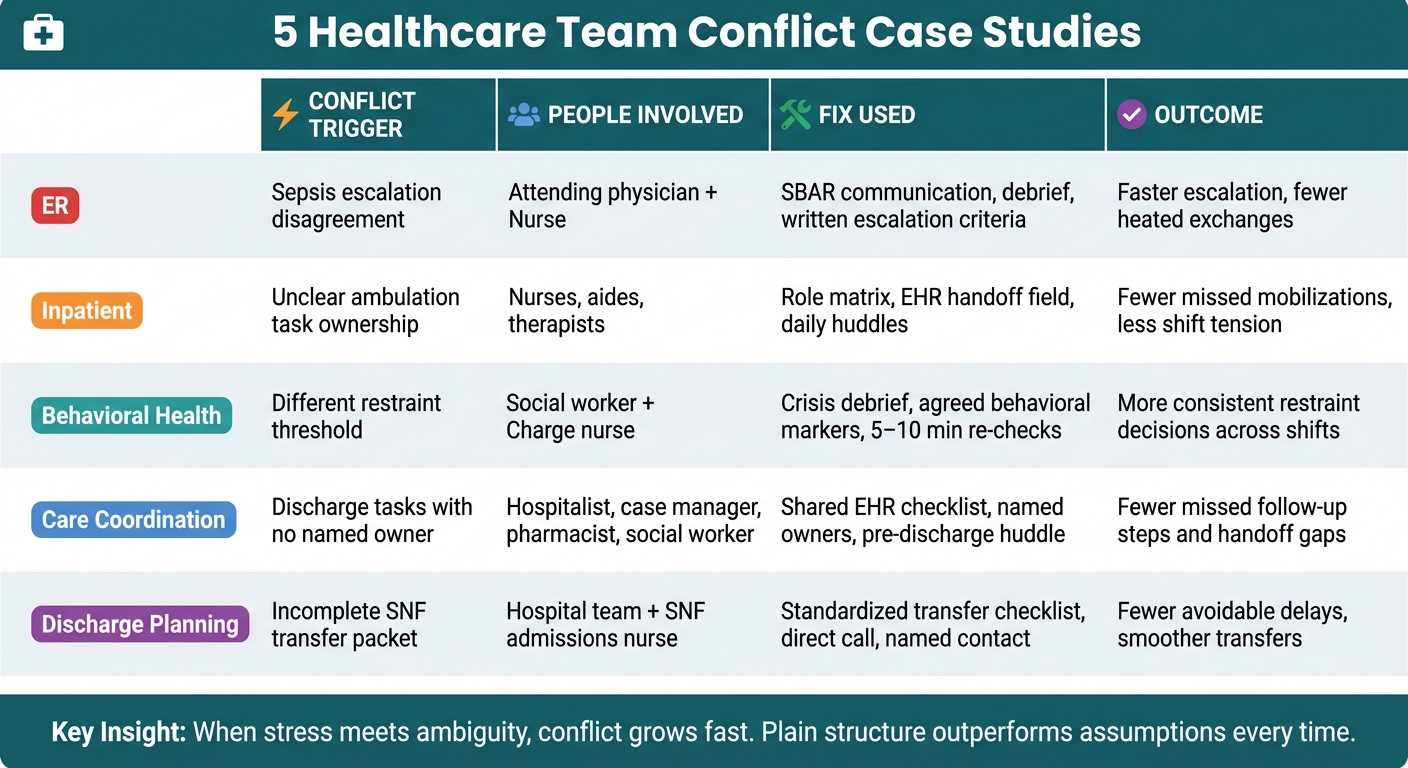
5 Healthcare Team Conflict Case Studies: Triggers, Teams & Fixes
Each case follows the same pattern: a workflow gap, a personality mismatch, a structured fix, and a cleaner outcome.
ER Case: Attending Physician and Nurse Disagree on Escalation
Setting: A busy emergency department. A 68-year-old patient presents with suspected sepsis, dropping mean arterial pressure, and rising lactate.
Conflict source: The attending physician is direct, fast-moving, and low in agreeableness. He pushes for immediate ICU transfer and broad-spectrum antibiotics. The bedside nurse is highly conscientious and protocol-driven, and wants one more blood culture and labs before escalation. The attending reads the delay as resistance. The nurse reads the pressure as dismissal.
Personality factors: The physician's dominant, low agreeableness style leans toward speed and firm action. The nurse's high conscientiousness creates a strong pull to finish the clinical picture before moving.
Action taken: The nurse used SBAR to state the suspected sepsis, the falling MAP, and the request for a second blood culture before transfer. After the shift, the charge nurse led a brief debrief. The team then agreed on written sepsis escalation criteria for future cases.
Outcome: Over the following month, the unit reported faster, more consistent sepsis escalation and fewer heated exchanges between nursing and attending staff.
Inpatient Case: Nurses, Aides, and Therapists Clash Over Role Ownership
Setting: A medical-surgical unit during morning rounds. Nurses, patient care aides, and therapists each assume someone else is handling ambulation for a fall-risk patient.
Conflict source: There is no written protocol saying who starts ambulation outside scheduled therapy sessions. Each discipline assumes the task belongs to someone else, and frustration builds once the gap shows up in patient care.
Personality factors: The charge nurse, who is highly conscientious, expects the task to be assigned and documented. The therapist is more comfortable with informal handoffs and assumes verbal communication from the prior shift was enough. The aide waits for direction that never comes.
Action taken: The unit manager introduced a one-page role matrix that spells out who starts ambulation, who handles assessment, and who owns advanced mobility training. A standardized EHR handoff field was added for last ambulation time and next owner. The unit also started brief daily huddles for high-risk patients.
Outcome: Missed mobilizations dropped, fall-risk patients were ambulated more consistently, and shift-to-shift tension between nursing and therapy decreased because expectations were spelled out.
Behavioral Health Case: Team Disagrees on De-escalation Versus Restraint
Setting: An inpatient psychiatric unit. A patient is pacing, making vague threats, and refusing redirection.
Conflict source: A social worker wants to continue verbal de-escalation because the patient is still engaging. A charge nurse, shaped by a prior assault on the unit, believes the threshold for restraint has already been crossed. The disagreement spills into the hallway in front of other staff.
Personality factors: The social worker's high empathy and lower risk tolerance push toward continued engagement. The charge nurse's higher threat sensitivity and past experience with violence push toward earlier intervention. Under pressure, high stress reactivity can shut down teamwork fast.
Action taken: After the incident, the unit director led a structured crisis debrief with all disciplines present. The team documented specific behavioral markers, such as repeated targeted threats, attempts to strike staff, and inability to follow redirection, as the agreed threshold for moving from verbal de-escalation to physical intervention. Staff also agreed to re-evaluate or hand off every 5–10 minutes during prolonged de-escalation.
Outcome: Restraint use became more consistent across shifts, and restraint decisions became more consistent across shifts.
The next two cases shift from bedside conflict to cross-discipline handoffs.
Care Coordination Case: Follow-Up Tasks Fall Between Disciplines
Setting: A patient with multiple chronic conditions and social needs is preparing for discharge. The hospitalist, case manager, pharmacist, and social worker are all involved.
Conflict source: The hospitalist assumes the case manager will handle transportation and follow-up scheduling. The social worker assumes the case manager owns community referrals. By discharge day, the tasks still have no clear owner.
Personality factors: The hospitalist moves fast, while the pharmacist is detail-focused and high in conscientiousness. That mismatch between quick verbal handoffs and careful, detail-heavy work leaves critical tasks sitting in a gray zone.
Action taken: The team implemented a shared discharge checklist in the EHR with named task owners and status fields for each item. A brief cross-disciplinary huddle was added before discharge dates. The case manager also became the single point of contact to confirm that every checklist item had an owner.
Outcome: Missed follow-up steps, such as transportation gaps and refill lapses, dropped. Handoff-related discharge misses also dropped, and the team reported clearer accountability across disciplines.
The final case extends the same pattern beyond the hospital walls.
Discharge Planning Case: Hospital Team and Community Partner Dispute Patient Readiness
Setting: A medically stable older adult is ready for transfer to a skilled nursing facility. The SNF admissions nurse pushes back because the transfer packet lacks behavioral and functional details.
Conflict source: The hospital team sees the patient as ready based on medical criteria alone. The SNF admissions nurse needs structured information about function and behavior before accepting the transfer. Faxed notes are incomplete and delayed, so both sides are working from different pictures.
Personality factors: The hospitalist's direct, time-pressured style leads to thin documentation and the assumption that the SNF will ask questions if needed. The SNF nurse's cautious, high-detail style needs more complete information before accepting the patient with confidence.
Action taken: The discharge planning team introduced a standardized transfer checklist that requires minimum documentation on functional status, behavioral history, current medications, and pending follow-up needs. For complex cases, the hospital case manager now calls the SNF admissions nurse directly. A named hospital contact is also assigned for each transfer.
Outcome: Avoidable discharge delays dropped, transfers became smoother, and both teams worked from the same transfer criteria.
Patterns Across the 5 Cases
Across all five cases, the same conflict pattern showed up again and again: ambiguity, stress, and communication styles that didn't line up.
The Most Common Conflict Sources
The biggest drivers were unclear role ownership, tension tied to hierarchy, and broken handoffs across shifts and disciplines. The details changed from case to case, but the spark stayed the same: no one was fully sure who owned what, and key details didn't transfer cleanly. Add time pressure, and even small gaps could turn into sharp disagreements fast.
The Personality Factors That Changed the Outcome
Personality didn't create the conflict. But it did shape how people read urgency, responsibility, and disagreement. How assertiveness shapes workplace conflict often pushed tension higher, especially when one person pressed for a decision before the other had time to respond. It also shaped how people interpreted delay. One person might see it as caution. Another might see resistance or dismissal. That difference often decided whether the conflict cooled down or got worse.
What the Effective Responses Had in Common
The fixes that worked all had two things in common: they cut ambiguity and added structure to situations that didn't have enough of it. When teams replaced assumptions with a shared process, it became easier to assign responsibility and settle disagreements. That structure helped lower conflict because it gave different personality styles a common way to work through pressure.
That's exactly the kind of problem personality-aware tools are built to help with.
Using Personality-Aware Tools to Prevent Repeat Conflict
Structure fixed the workflow gaps in these cases. Personality-aware tools deal with something process charts often miss: how people respond when stress hits. That matters when the same conflict keeps showing up.
Where Personos Fits in Team Conflict Workflows
Personos uses the Five Factor Model and measures 30 traits on an 80-point scale [1]. In healthcare, that level of detail matters. The exact same exchange can sound like urgency to one person and pushback to another. You can see that in the conflict patterns already covered here: escalation, role ownership, threshold setting, handoffs, and discharge readiness.
Before conflict starts, Relationship Reports and Group Reports can point to likely areas of friction. During conflict, AI Chat suggests wording shaped to the situation. After the conversation, Prompts and the ActionBoard help teams track commitments and follow-through [1]. That lines up with the same kinds of breakdowns seen in the ER, inpatient, behavioral health, care coordination, and discharge cases.
Personos keeps raw scores private by default. Coworkers see guidance, not labels [1].
Personos vs. Static Personality Tools: A Direct Comparison
MBTI and DISC can give teams a shared language, but they were built for workshops, not live conflict [2][3][4]. The key difference isn't whether a team uses a personality tool. It's whether that tool helps in the moment.
| Dimension | Personos | Static Tools (MBTI, DISC) |
|---|---|---|
| Model depth | 30 traits on an 80-point scale | 4–16 broad types or styles |
| Live conflict use | Real-time AI Chat for specific situations | Workshop reference; not designed for in-the-moment use |
| Context awareness | Factors in roles, history, and team dynamics | General trait descriptions; no situational modeling |
| Privacy approach | Scores private by default; guidance shared, not labels | Type labels are often discussed directly in workshop settings; privacy practices vary |
| Action tracking | ActionBoard tracks commitments and outcomes | No built-in follow-through mechanism |
| Fit for helping professionals | Built for social workers, case managers, counselors, and healthcare teams | Designed primarily for general corporate settings |
Static tools help teams name patterns. Personos helps them respond during the conversation and track follow-through after it.
Conclusion: What These 5 Cases Show About Preventing Healthcare Team Conflict
Across all five cases, escalation disputes, role confusion, threshold disagreements, handoff failures, and readiness conflicts, the same pattern showed up. Conflict began when workflow strain ran into personality differences. Unclear roles and weak handoffs set things off, then familiar reactions made the situation worse when teams didn't have a shared way to respond. That's why these cases matter beyond one unit or one hospital.
The point of the four-part lens isn't just to explain conflict. It's to make the fix repeatable. This lens makes each case usable again and again: identify the trigger, the trait mismatch, the intervention, and the result. When a new conflict comes up, teams can return to those same four questions instead of starting from scratch.
The fixes worked for a simple reason. Someone named the problem, changed how they communicated, and closed the loop. Unresolved conflict wears down performance. Fast resolution, clear ownership, and follow-through that happens the same way each time stop the same dispute from coming back.
When the same friction keeps showing up, teams need tools that track both the relationship side and the workflow side. Personality-aware support like Personos can help teams see friction coming, guide in-the-moment responses, and track follow-through so lessons from one conflict carry into the next.
The goal isn't to eliminate disagreement. It's to stop predictable conflict from getting in the way of care.
FAQs
What usually causes healthcare team conflict?
Healthcare team conflict often starts with personality differences, even when it looks like the issue is about tasks, timing, or priorities. In busy care settings, small misunderstandings can snowball fast, especially when communication styles don't match. One person may want detailed written instructions, while another prefers to talk things through on the spot.
That mismatch can create friction, confusion, and delays that have little to do with the work itself.
Tools like Personos can help teams handle these dynamics with real-time, personality-aware guidance. The goal is simple: reduce friction and help people work together better.
How can teams reduce repeat conflict fast?
Teams can cut repeat conflict when they look past the obvious disagreement and get to the personality-based source of the tension. That shift matters. A debate about tone, timing, or feedback style often isn’t just about the moment itself. It’s about how different people process stress, react to criticism, and communicate under pressure.
Tools like Personos use the Five Factor Model to give teams real-time, tailored communication prompts and de-escalation strategies. In plain English, that means people get guidance they can use right away, not vague advice after the damage is done.
That helps teams spot friction early, adjust how they give feedback, and build shared communication agreements that reduce the odds of small misunderstandings turning into bigger problems.
When do personality-aware tools help most?
They matter most in high-stakes situations like de-escalating conflict, handling crises, or making critical placement decisions, where human dynamics can get messy fast.
They’re also useful for spotting hidden friction points, adjusting communication in real time, and shaping strategies around individual traits. Tools like Personos can help teams work more proactively, cut staff burnout, and improve results in tough interactions.