Dynamic Goals: AI for Employee Engagement
How AI-driven dynamic goals personalize objectives, adjust them in real time, reduce bias, and boost engagement, retention, and performance.
Christian Thomas

Dynamic Goals: AI for Employee Engagement
Static goals don’t work anymore. Businesses change too fast for rigid, annual objectives to stay relevant. Employees feel disconnected, with 70% disengaged from their goals, and outdated systems only make it worse. AI-driven dynamic goal-setting fixes this by using real-time data to adjust goals, align priorities, and personalize objectives for each employee. Companies using AI see a 12% increase in goal attainment, a 30% rise in retention, and a 40% improvement in outcomes.
Key Takeaways:
- Why Static Goals Fail: They’re impersonal, quickly outdated, and lead to burnout.
- How AI Helps: Tracks performance, updates goals in real-time, and personalizes them based on strengths and needs.
- Results: Increased engagement, retention, and fairness in evaluations.
AI tools like Personos and Teamflect make this shift easier by tailoring goals to individual traits or integrating with existing workflows. The result? Employees see their work’s impact, stay motivated, and avoid chasing irrelevant targets. If your business relies on outdated systems, it’s time to rethink how goals are set.
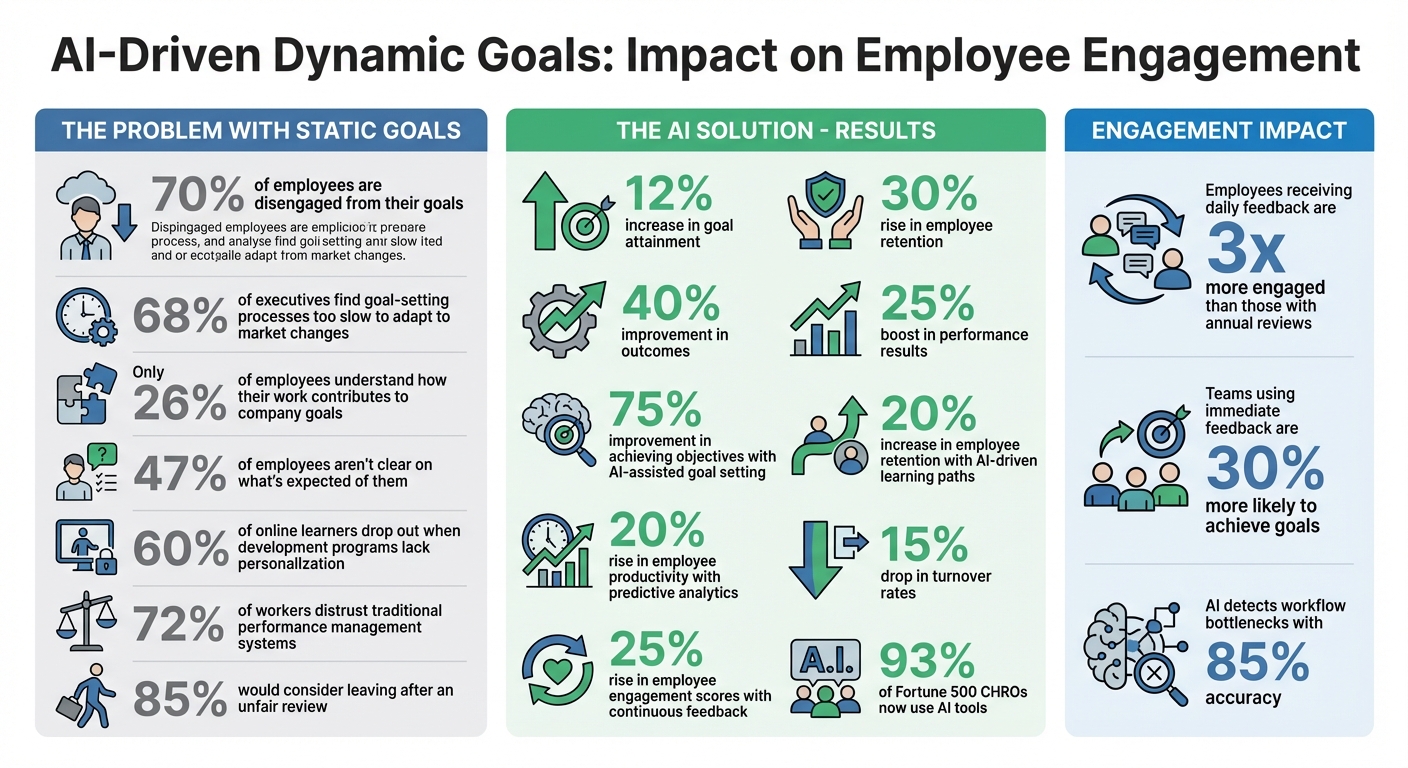
AI-Driven Dynamic Goals: Key Statistics and Benefits
Why Static Goal Setting Fails
Traditional static goals act more like rigid checkpoints than adaptable guides. Imagine setting annual objectives in January, only to find them irrelevant by March. Yet, employees are still evaluated based on those outdated targets months later. Let’s break down why static goals fall short when it comes to personalization, alignment, and motivation.
Missing Personalization
Static goals often ignore the unique qualities and circumstances of individuals. For example, a sales rep who thrives on building client relationships might get the same "increase revenue by 15%" target as a data-driven colleague who struggles with interpersonal skills. These one-size-fits-all objectives fail to account for personal strengths, career goals, or work environments.
This lack of individual focus has tangible effects. Research shows that 60% of online learners drop out when development programs don’t engage them personally [6]. It’s not about a lack of effort - static goals fail to hit that "sweet spot" where personal motivation aligns with company needs [6]. Without considering employees' evolving circumstances and personalities, managers risk setting goals that feel arbitrary, leading to disengagement and missed opportunities to address real-time business priorities.
Disconnected from Real Priorities
Static goals quickly lose relevance when business conditions change. A 2022 Gartner survey revealed that 68% of executives found their goal-setting processes "too slow to adapt to market changes" [5]. When goals are only revisited quarterly or annually, employees may spend weeks chasing objectives that no longer matter.
This disconnect is further compounded by poor communication. Only 26% of employees understand how their work contributes to broader company goals, while 47% aren’t even clear on what’s expected of them [9]. As Xodiac points out:
"The static quarterly OKR becomes a 'distant checkbox rather than a living guide' for daily decision-making."
- Xodiac [9]
When teams work toward outdated or irrelevant objectives, productivity takes a hit [5][4].
Burnout and Lost Motivation
Rigid, unchanging goals often frustrate more than they inspire. Employees may find their objectives either impossible to achieve or irrelevant to their day-to-day work, yet annual review cycles leave no room for adjustments. This rigidity makes it hard for employees to stay connected to their roles.
Feedback delays only add to the problem. Quarterly or annual reviews often highlight issues too late to make a difference [4][2]. Employees are left to struggle in silence, while their efforts go unnoticed. At the same time, managers waste valuable hours on the administrative task of tracking outdated goals instead of providing meaningful support [4][2]. The result? A cycle of burnout and disengagement for both employees and managers, undermining performance on all fronts.
How AI Makes Goal Setting Dynamic
AI transforms the traditional approach to goal setting into a flexible, real-time process. Instead of sticking employees with static objectives that may lose relevance, AI continuously tracks performance data, market trends, and shifting business priorities. This ensures that goals stay aligned with the current landscape. When priorities change or an employee's situation evolves, AI quickly identifies outdated goals and suggests updates to keep progress on track. This shift has caught on: 93% of Fortune 500 CHROs now use AI tools to enhance business outcomes [4], with organizations implementing AI-driven goal alignment seeing a 25% boost in performance results [1].
The technology works by analyzing a wide range of data - everything from CRM activity and project milestones to communication trends and industry standards. This provides a foundation for dynamic goal management. Dr. Dieter Veldsman, Chief Scientist at AIHR, sums it up well:
"AI can be used to enable managers to have more meaningful and fact-based performance conversations, identify and spot trends, and eliminate bias - but only if it is used to augment and complement the human experience of performance." [11]
Real-Time Goal Adjustments
Traditional goal tracking relies heavily on spreadsheets and memory, which often delays the identification of issues. AI eliminates this lag by monitoring employee data in real time. For example, if a sales rep's pipeline slows down or a project team misses a deadline, AI detects these deviations immediately [10][12].
This real-time tracking allows businesses to adapt goals as situations change. Say a company shifts its Q2 strategy - AI can identify which individual objectives no longer align and recommend updates to keep things relevant [4][13]. Tools like Teamflect Agent and Team GPS even predict potential goal failures by analyzing completion patterns, flagging "at-risk" objectives for immediate action. Managers can ask straightforward questions like, "Who on my team is at risk of missing their goals?" and receive instant, data-backed insights [4][13].
The results speak volumes: employees who receive daily feedback are three times more engaged than those limited to annual reviews. Teams using immediate feedback mechanisms are also 30% more likely to achieve their goals [12].
Personalized Goal Recommendations
AI takes things further by tailoring goals to individual strengths and needs. Generic objectives often miss the mark when it comes to recognizing what makes each employee tick. AI solves this by pulling data from various sources - skills assessments, past performance, career goals, 360-degree feedback, and work habits - to suggest goals that feel more personal [3][4]. For instance, an employee skilled in conflict resolution might focus on response times and de-escalation, while a tech-savvy colleague could work on system troubleshooting and knowledge-sharing contributions [4].
AI also refines broad goals into clear, actionable SMART objectives. Instead of a vague aim like "improve sales", AI translates it into a specific target with measurable criteria and deadlines. It also connects individual goals directly to company OKRs, helping employees see how their work supports larger business objectives [4][2].
This personalized approach has tangible benefits: AI-driven learning paths lead to a 20% increase in employee retention, while organizations using AI-assisted goal setting report a 75% improvement in achieving objectives [8]. Emily Helen Arnold, People Strategy Specialist at Teamflect, highlights this advantage:
"AI turns broad aims into precise, measurable objectives, giving leaders unprecedented clarity and control over performance while still preserving the human touch." [4]
Predictive Analytics for Early Intervention
AI's dynamic framework wouldn't be complete without predictive analytics, which help managers intervene early to address potential challenges. Beyond tracking current performance, AI forecasts future hurdles by analyzing progress trends. For example, if a goal is only 20% complete halfway through its timeline, AI can calculate the likelihood of failure and alert managers to step in before it's too late [4].
AI also identifies workflow bottlenecks with an impressive 85% accuracy [1]. By combining data from communication tools and performance metrics, it detects early signs of disengagement or burnout that might otherwise fly under the radar [14]. These predictive insights have led to a 20% rise in employee productivity and, in some cases, a 15% drop in turnover rates [1].
Rather than replacing human judgment, predictive analytics act as a support system for managers. By providing conversation prompts based on detected risks, AI shifts the focus from backward-looking evaluations to forward-thinking coaching [4][14]. This is especially important given that 72% of workers distrust traditional performance management systems, and 85% would consider leaving after receiving what they perceive as an unfair review [14]. By aligning goals with evolving priorities, AI fosters stronger engagement, which lies at the heart of this transformation.
Benefits of AI-Driven Dynamic Goals
AI-powered dynamic goals can lead to measurable improvements in workplace performance. Companies using AI for goal setting have seen about a 25% boost in performance outcomes, which directly impacts employee engagement and alignment within the organization [1][5]. Let’s break down how these benefits enhance employee engagement and create fairer workplaces.
Better Engagement and Retention
When goals are personalized and flexible, employees feel more empowered. AI helps align objectives with individual strengths, career goals, and workloads, giving employees a sense of ownership over their targets. This personalization has tangible results: companies using AI for customized performance goals report a 30% increase in employee retention [1]. Additionally, organizations that implement continuous feedback mechanisms see a 25% rise in employee engagement scores [1].
Trust is another key factor. A significant 72% of employees distrust traditional performance management systems, and 85% say they’d consider quitting after receiving an evaluation they perceive as unfair [14]. AI-driven systems address this by relying on objective data rather than subjective judgments. Employees are more likely to stay motivated when they see their goals adapt in real time to changing business needs, knowing the system is fair and data-driven.
More Transparency and Less Bias
AI helps create fairer evaluations by replacing subjective judgments with objective performance metrics. Traditional reviews often fall victim to biases like recency bias, affinity bias, and gender bias. AI can counteract this by analyzing performance data and identifying patterns, such as discrepancies in how men and women are described in feedback - flagging terms like "aggressive" for women versus "promising" for men [14][2].
Real-time dashboards link individual goals to company-wide strategies, giving employees a clear view of how their daily work contributes to broader objectives [2][5]. As Maria Valero, Editorial Strategist at Workday, explains:
"AI acts as a transparent, objective partner to managers, making sure the rules of success are clear and applied equally to all." [14]
This level of transparency not only builds trust but also ensures employees understand how their goals are set and evaluated. It creates a consistent standard across the organization, paving the way for smoother feedback processes.
Continuous Feedback Loops
AI enables continuous feedback by providing real-time updates on progress and achievements. Automated alerts and goal adjustments ensure that accomplishments and challenges are addressed as they happen [1][2]. Employees receiving daily feedback are three times more engaged than those who only get annual reviews [12].
Top AI Tools for Dynamic Goal Setting
Organizations are increasingly turning to AI tools to bring flexibility to goal setting and boost employee engagement. With 93% of Fortune 500 CHROs now relying on AI tools for business improvement [4], the options have become more diverse. While many platforms emphasize data-driven metrics and performance tracking, their methods for personalizing goals and addressing employee well-being vary significantly. Here's a closer look at some leading tools:
Personos: Personality-Based Goal Setting
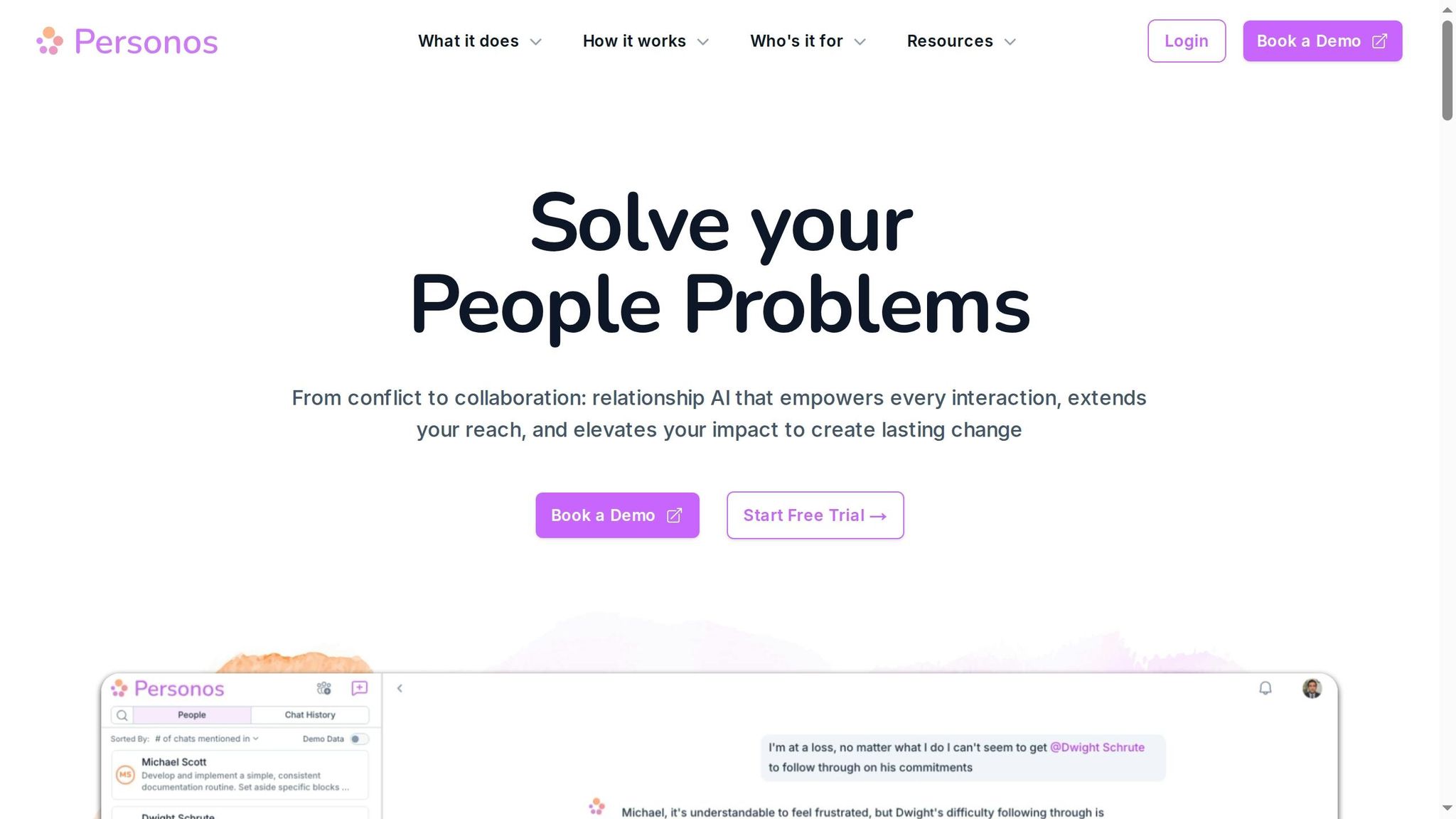
Personos takes a unique approach by tailoring goals to individual personalities using the Five Factor Model. This framework evaluates 30 personality traits on an 80-point scale, moving beyond just performance data and role metrics. By aligning goals with how people think, communicate, and handle stress, Personos creates a more personalized experience.
The platform offers Dynamic Reports, which provide tailored insights for individuals, teams, and relationships. These reports not only suggest what goals to pursue but also explain how to achieve them by leveraging personality strengths. The ActionBoard transforms these insights into actionable tasks, while configurable Prompts deliver small, actionable nudges to keep users engaged between formal reviews.
What makes Personos stand out is its emphasis on reducing burnout through a human-focused approach. Priced at $9 per seat per month, it’s particularly suited for professionals like social workers, coaches, and nonprofit staff who deal with complex interpersonal dynamics and need personality-driven guidance.
PerformYard and Teamflect: Data-Driven Goal Management
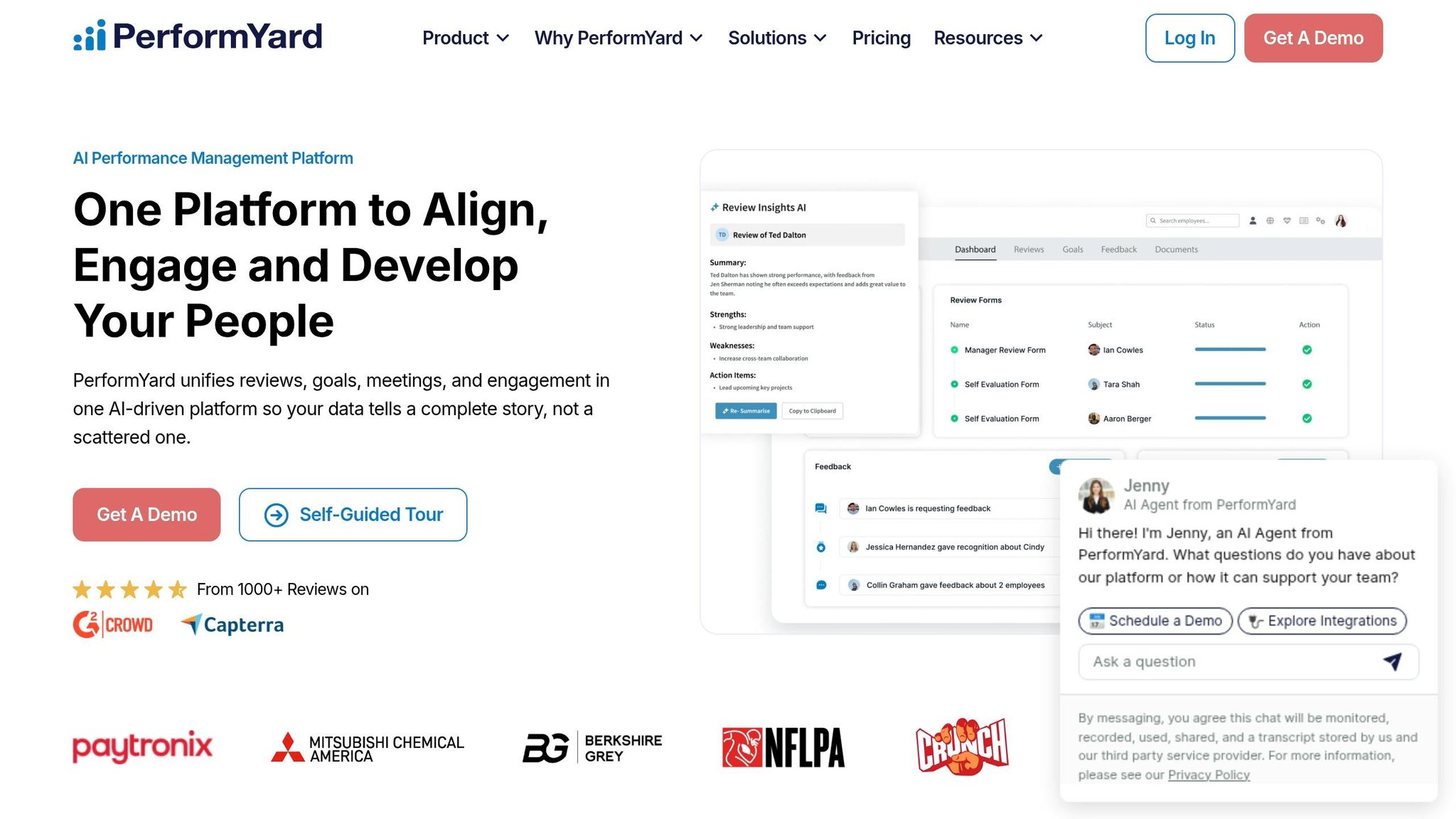
If you're looking for platforms that prioritize data and workflow integration, Teamflect and PerformYard are strong contenders. Teamflect’s Teamflect Agent uses conversational AI to identify at-risk goals by analyzing patterns in task completion and deadlines. Its SMART Goal Generation feature converts simple goal titles into measurable objectives directly within Microsoft Teams [4]. Additionally, it suggests development goals based on 360 feedback and performance reviews.
PerformYard, on the other hand, focuses on aligning goals with broader business strategies. Its AI tools create SMART goals and adjust them dynamically when priorities shift [2]. Both platforms emphasize transparency, with real-time dashboards that link individual goals to company-wide OKRs [2][4].
As Emily Helen Arnold, a People Strategy Specialist at Teamflect, explains:
"AI turns vague intentions into precise, measurable objectives, giving leaders unprecedented clarity and control over performance while still preserving the human touch" [4].
However, while AI-generated goals are 85-90% ready for use, they still require managers to add context - factors like office dynamics, individual circumstances, and team morale that AI can't fully grasp [4]. PerformYard stresses that AI should guide rather than replace managerial judgment, ensuring goals remain relevant and realistic [2].
| Feature | Personos | Teamflect / PerformYard |
|---|---|---|
| Primary Data Source | Five Factor Model (Personality) | Performance data, OKRs, and role metrics |
| Personalization Basis | Psychological traits and behavioral prompts | Past performance signals and industry benchmarks |
| Engagement Focus | Burnout reduction and human-centeredness | Transparency, alignment, and feedback frequency |
| Goal Type | Context-driven, personality-tailored goals | SMART goals and role-based KPIs |
| Integration | ActionBoard and Prompts | Microsoft Teams and workflow tools |
These tools showcase different methods for goal setting, allowing organizations to choose platforms that align with their specific needs and engagement strategies.
How to Implement AI-Driven Dynamic Goals
Adopting AI-driven goal-setting tools isn’t just about installing new software. Without a thoughtful approach, these tools risk becoming underutilized and a wasted investment. A structured implementation ensures the technology delivers real value.
Review Current Goal-Setting Methods
Before diving into AI tools, take a close look at how your organization currently sets and manages goals. Start by auditing your CRM, HRIS, and project management systems to ensure you have accurate, reliable data - AI systems can only work effectively when they’re fed quality inputs [5]. Identify specific challenges, like delays in goal alignment or a lack of connection between individual tasks and company objectives. For example, are employees unclear about how their work supports broader goals? Are managers struggling to provide timely feedback?
Define what success looks like by setting measurable KPIs, such as the percentage of goals achieved, time saved in creating goals, or how quickly targets can be adjusted [5]. Research shows organizations using AI for performance management see a 12% boost in goal attainment compared to traditional methods [5].
Once you’ve pinpointed your challenges and defined success metrics, it’s time to find the right AI tool to address your specific needs.
Choose the Right AI Tool
The right AI tool should directly address your organization’s unique challenges. For instance, if burnout and the need for personalized goals are your biggest hurdles, consider tools like Personos. This platform uses the Five Factor Model to tailor goals based on individual personalities, helping to bridge the gap between rigid frameworks and the dynamic nature of today’s workplaces. On the other hand, if seamless workflow integration and real-time tracking are top priorities, platforms like Teamflect or PerformYard - which integrate with Microsoft Teams and existing HRIS systems - might be a better fit [4][2].
Choose tools that integrate smoothly with your existing tech stack to minimize disruptions. Employees are less likely to adopt tools that require them to juggle multiple systems. Also, look for platforms that offer algorithm transparency so you can understand how recommendations are generated and identify potential biases [2]. Human-in-the-loop functionality is another critical feature, allowing managers to adjust AI recommendations to fit specific contexts [4][2].
Start with a pilot program in a single department or for one OKR cycle. This approach minimizes risk while giving you valuable feedback and measurable results, such as time saved or improved alignment with company culture [5]. Involve your IT team to ensure the tool meets security standards, and let end-users test its usability during the selection process [2].
Once you’ve chosen and piloted the tool, the focus shifts to training your teams to make the most of it.
Train Managers and Employees
Even the most advanced AI tool won’t succeed without proper training. Studies show that 90% of companies that succeed with AI tools have leadership teams that prioritize structured goal-setting frameworks [15]. But effective training isn’t a one-and-done event. As Gabby Davis, Lead Trainer at Engagedly, notes:
"Rolling out without training, communication, and ongoing support guarantees poor adoption. Plan for quarterly reinforcement, not just launch-week training sessions" [15].
Training should go beyond technical how-tos. Show employees how to use AI prompts to transform vague ideas into actionable SMART goals [6][17]. For tools like Personos, teach managers to apply insights from the Five Factor Model to improve communication and adjust their leadership approach to fit individual employee profiles [7]. Managers should also learn how to use AI-generated prompts to guide check-ins and goal discussions effectively [3][16].
Make data security a key part of your training. Provide clear guidelines on what information employees can share with AI tools and emphasize the importance of avoiding sensitive or confidential data in unvetted external systems [6]. For platforms like Personos that keep assessment results private, explain how the confidentiality protocols work to encourage honest employee responses and accurate feedback [7].
Finally, reinforce that AI tools are designed to assist and enhance human decision-making, not replace it. The goal is to empower managers with AI-driven coaching insights and tools that make their roles easier while maintaining the human connection that drives meaningful engagement [5][6].
Conclusion
Static goal-setting frameworks often fall short, leaving employees disengaged and stalling organizational progress. Traditional systems rarely motivate meaningful change or align with real-world demands [3]. The key isn’t to abandon goals but to rethink them - making them dynamic, personalized, and adaptable to the ever-changing landscape.
AI-powered dynamic goals tackle the common pitfalls: lack of personalization, misalignment with company priorities, and the administrative overload that contributes to manager burnout. Organizations leveraging AI for goal alignment report a 25% boost in performance outcomes, while those tailoring objectives with AI see a 30% improvement in employee retention rates [1]. These numbers reflect a real shift in how employees experience their roles and responsibilities.
The choice of AI platform plays a critical role in unlocking these benefits. Tools like Personos go beyond basic goal tracking by using the Five Factor Model to understand how individual personalities influence communication, motivation, and productivity. By offering daily, actionable insights tailored to each person’s unique traits, Personos transforms goals from routine tasks into drivers of sustained performance [7]. Unlike traditional tools that focus solely on skills or data, this approach addresses the psychological factors that determine whether goals feel meaningful or like just another chore.
Expert voices back this approach. As Harvard’s Karim Lakhani explains:
"AI is not going to replace humans, but humans with AI are going to replace humans without AI" [6].
The organizations that succeed will be those that use AI not to monitor employees but to act as a co-pilot - enhancing human decision-making, reducing bias, and fostering meaningful coaching conversations that spark real change.
Moving from static to dynamic goal-setting is no longer optional for organizations aiming to stay relevant. The question is: will your company lead this transformation or fall behind? Embracing dynamic goals can elevate engagement, retain top talent, and position your organization ahead of the competition.
FAQs
How often should dynamic goals change?
Dynamic goals need to be adjusted in real time - or as frequently as necessary - to keep pace with shifting priorities and circumstances. Regular updates ensure these goals stay relevant and effective, aligning seamlessly with the ever-changing demands of the workplace.
What data do AI goal tools need to work well?
AI goal tools depend on objective performance data - like measurable metrics - to establish accurate baselines and set realistic targets. They also incorporate contextual details such as employee roles, skill sets, and historical performance trends to tailor goals to individuals. On top of that, features like natural language inputs and ongoing progress updates enable these tools to adjust goals dynamically and deliver real-time feedback. This helps keep teams aligned and enhances overall performance management.
How do you prevent AI goal setting from feeling like surveillance?
To prevent AI-driven goal setting from feeling intrusive, prioritize transparency, privacy, and empowering employees. Implement methods such as aggregated analytics and pseudonymization to safeguard personal data while still identifying useful trends. Be clear in communicating that AI tools are meant to assist in personal and professional development - not to monitor or scrutinize individuals. Tools like Personos, which use validated psychological models to offer personalized guidance, show how AI can encourage growth without overstepping boundaries.