DISC vs Big Five for Relationship Feedback
Use DISC for fast behavioral feedback and the Big Five for deeper, predictive relationship insight; AI can make depth practical.
Rachel Johnson

DISC vs Big Five for Relationship Feedback
If I need a fast answer, I use DISC. If I need a deeper read for a longer relationship, I use the Big Five.
That is the core point of this topic. DISC is built for observable behavior, communication style, and fast feedback. The Big Five looks at five trait ranges that can help me think through stress, trust, follow-through, engagement, and response to change. In helping work, that choice matters because high-pressure roles often leave little time for long assessment.
Here’s the short version:
- DISC fits short interactions, team check-ins, and quick conflict repair
- Big Five fits longer relationships, higher-stakes work, and more specific feedback
- DISC is simpler to explain
- Big Five usually needs more context
- AI tools can turn Big Five scores into plain next steps
A big reason this matters is volume and pressure. In the U.S., many helping roles deal with packed caseloads, limited time, and emotionally charged conversations. In that kind of setting, even a 5-minute reset can change how a conversation goes.
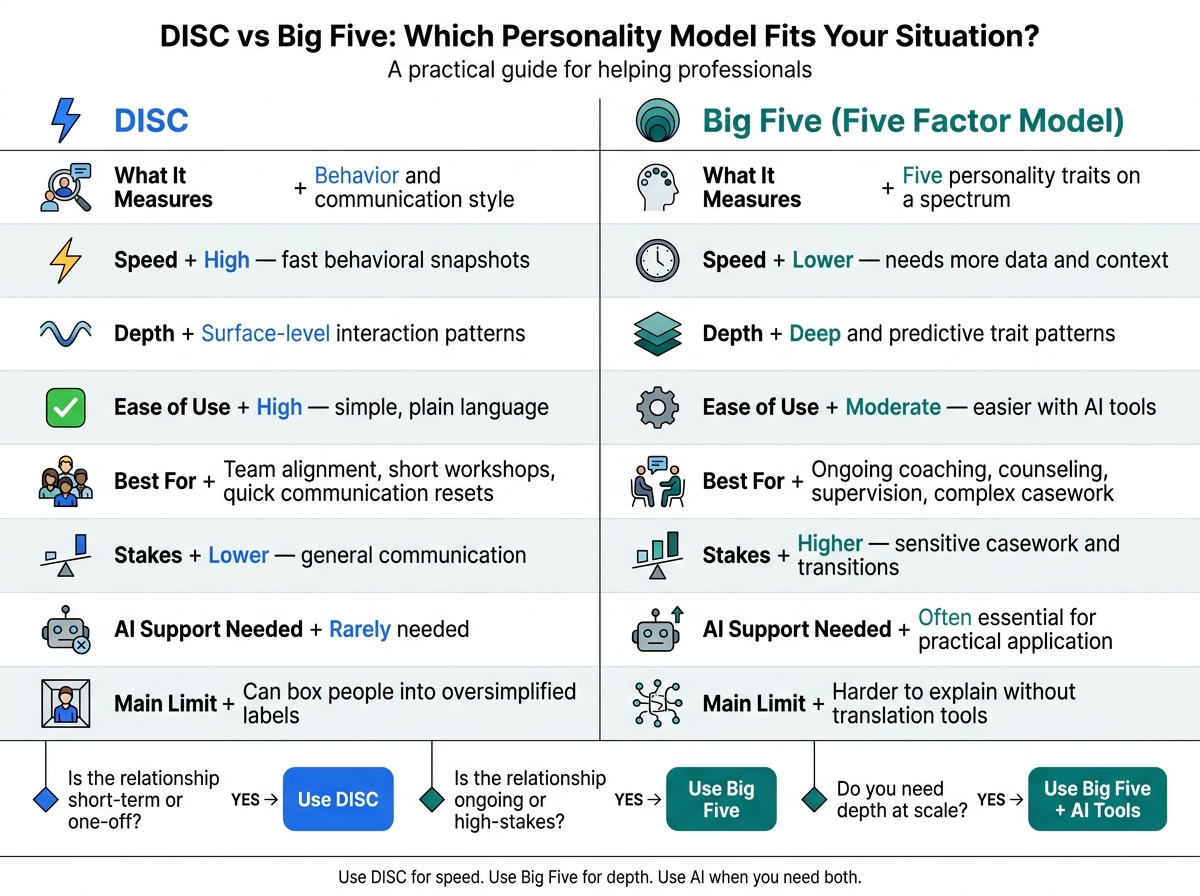
DISC vs Big Five: Which Personality Model Fits Your Situation?
DISC Plus University: DISC Assessments vs Big Five
Quick Comparison
| Criteria | DISC | Big Five |
|---|---|---|
| What it measures | Behavior and communication style | Five personality traits on a range |
| Main use | Fast interaction feedback | Deeper relationship feedback |
| Speed | High | Lower without AI support |
| Depth | Surface-level | More detailed |
| Best for | Team alignment, short client touchpoints, workshop use | Coaching, counseling, supervision, casework (including AI-enhanced executive coaching) |
| Limits | Can box people into simple labels | Can be harder to explain and apply |
| AI fit | Less needed | Often more useful |
My takeaway: use the model that fits the relationship, the pressure level, and the cost of getting it wrong. If I need speed, DISC is often enough. If I need depth, harnessing the Big Five usually gives me more to work with.
DISC for Fast, Behavior-Focused Feedback
DISC gives practitioners a shared language for four behavior styles. That makes it handy for brief, in-the-moment feedback in helping work. In day-to-day practice, DISC can work as a communication tool, not just something used in a workshop.
Where DISC Works Well in Client and Team Relationships
DISC tends to work best for early rapport, team communication, and calming conflict before it grows. It also translates well into plain, everyday language, which can make it easier to use with clients.
That said, its usefulness starts to drop when the situation gets more layered or the stakes get higher.
| Feature | DISC | Big Five |
|---|---|---|
| Speed | Fast; designed for quick behavioral snapshots | Slower; needs more data |
| Plain-Language Fit | High; simple, everyday language | Moderate; often needs AI tools to make insights practical |
Where DISC Falls Short in Complex Helping Situations
DISC’s four-category structure is also its main limit. Human behavior is more fluid than four boxes, so DISC can flatten people into neat labels that don’t always fit. That matters a lot when someone is dealing with serious challenges.
DISC also stays mostly at the surface level of interaction. It doesn’t tell you much about deeper patterns like stress, motivations, or emotional ups and downs [1][2]. So while a quick behavioral snapshot can help in the moment, it usually isn’t enough for long-term relationship feedback. For deeper questions, the Big Five gives a stronger read. Professionals can combine the Five Factor Model with AI to make these deeper insights more actionable.
Big Five for Deeper, More Predictive Relationship Insight
The Big Five gives you a broader view of relationship patterns. Instead of putting someone into a fixed type, it measures five traits on a spectrum. That extra depth matters when a fast read on behavior doesn't tell the whole story.
How Big Five Traits Show Up in Relationship Feedback
Each trait connects to a practical relationship signal. What matters most is not just the score itself, but how that score shapes the next step.
| Big Five Trait | Relationship Feedback Theme | What It Tells You in Practice |
|---|---|---|
| Neuroticism | Emotional Regulation | Stress reactivity, reassurance needs |
| Agreeableness | Conflict Style & Trust | Collaboration tendencies, friction points, empathy levels |
| Conscientiousness | Boundaries & Follow-through | Structure needs, habit-building, consistency in tasks |
| Extraversion | Client Engagement | Communication frequency, interaction preferences, social energy |
| Openness | Adaptability | Receptiveness to feedback, learning style, change readiness |
AI tools like Personos can turn Big Five data into day-to-day guidance, which helps practitioners respond with more precision between sessions.
Where the Big Five Is Harder to Use in Day-to-Day Practice
The tradeoff is time and interpretation. Big Five data usually takes longer to collect, explain, and use well. A trait score doesn't speak for itself. The practitioner still needs enough context—including how personality and culture shape emotional expression—to turn a number into a plain-language action step.
That gets harder when clients are stressed, overloaded, or not ready for deep self-reflection. In busy settings with heavy caseloads, that's often where the model starts to slow things down.
This is why AI tools have become a practical bridge. Platforms like Personos are built to turn raw Five Factor Model data into situation-specific guidance. Without that translation layer, Big Five feedback can stay abstract. With it, the model becomes much easier to use in day-to-day practice.
The real question is when that extra depth is worth the added effort.
When to Use DISC, Big Five, or a Staged Approach
Use DISC for speed, Big Five for depth, and a staged approach when the relationship will change over time. That leads to the practical question: which model fits the situation in front of you?
Matching Each Model to the Right Situation
DISC works best for short, bounded uses like team alignment, workshop resets, and quick communication repair. It’s simple to explain and fast to use.
The Big Five is a better match when the relationship is ongoing, the case is more complex, or the stakes are high enough that you need stronger guidance you can lean on over time. Use Big Five when you need insight that helps with ongoing relationship decisions.
The difference gets easier to see when you look at speed, depth, and fit side by side.
| Feature | DISC | Big Five (Five Factor Model) |
|---|---|---|
| Speed | High; ideal for fast feedback and quick resets | Traditionally slower, though AI tools can speed application |
| Depth | Behavioral surface; focuses on how people act | Deep and predictive; focuses on long-term traits and patterns |
| Ease of Use | High; simple for one-off workshops | Moderate; easier when paired with AI tools |
| Stakes | Lower; best for general communication | Higher; better suited to sensitive casework and transitions |
| Best-Fit Scenarios | Team alignment, short workshops, communication resets | Ongoing coaching, counseling, supervision, complex casework |
A staged approach can also make sense. Start broad with DISC, then shift to Big Five when the relationship becomes ongoing or more complex. As the work gets deeper, AI can help keep Big Five practical without losing nuance.
How AI Tools Can Make Big Five Feedback Easier to Apply
AI helps with the main Big Five challenge: turning trait data into clear next steps.
Personos uses the Five Factor Model to turn personality data into actionable guidance. That matters because the point is not the trait score by itself. The point is the guidance it can produce in real time. Instead of leaving practitioners to sort through raw data on their own, it turns trait profiles into situation-specific guidance for caseload-heavy helping work and client interaction.
For helping professionals, that makes Personos a stronger fit than simple DISC tools when the work is ongoing and context-heavy. It’s better suited to ongoing helping work than a one-time workshop tool.
Conclusion: Choose the Model That Fits the Relationship and the Stakes
Pick the model based on speed, depth, and stakes.
DISC works best for fast, behavior-focused feedback. It’s a good fit for quick team alignment, short client interactions, and early rapport repair. You can use it when the interaction is brief and the goal is to get on the same page fast.
When the relationship lasts longer, or the situation carries more weight, move to the Big Five.
The Big Five fits ongoing, high-stakes relationships because it offers deeper insight and tends to be more predictive over time. The key issue, then, is simple: can you use that depth fast enough in day-to-day work?
Here’s the practical way to think about it:
- Use DISC for short, bounded interactions
- Use the Big Five when the relationship is ongoing and the cost of getting it wrong is high
AI tools can help make Big Five guidance usable in busy settings. That’s where AI support comes in. For helping professionals who want Big Five depth without doing all the manual work, Personos turns personality data into clear, situation-specific guidance.
Choose DISC for speed. Choose Big Five for depth. Use AI when you need depth at scale.
FAQs
How do I choose between DISC and Big Five?
Choose based on your need for speed, depth, and scientific rigor.
DISC works well for quick, surface-level behavioral insight, especially at work. It gives you a fast read on how people tend to act and communicate, which can help in day-to-day team settings.
The Big Five goes deeper. It offers a science-backed view of individual differences and can give you a better sense of longer-term personality development.
If you need actionable, real-time help with more complex client or team dynamics, Personos uses the Five Factor Model to offer more tailored guidance than static models.
Can DISC be enough for client feedback?
DISC can work well when you need fast, practical client feedback. It’s simple, easy to use, and often good enough for a quick read on how someone tends to act.
But that simplicity can also be the catch. With just four broad behavior styles, DISC can flatten client dynamics that are often more layered than they first seem.
The Big Five goes deeper. For example, Personos uses the Five Factor Model to measure 30 traits on an 80-point scale. That gives teams a more detailed, science-based starting point for communication, conflict, and client relationships.
How can AI make Big Five easier to use?
AI makes the Big Five more useful in day-to-day work by turning static test results into guidance people can use in the moment.
Instead of leaning only on one formal assessment, AI can learn from ongoing interactions and suggest communication approaches that fit the situation. That means the Big Five becomes less of a one-time report and more of a live tool for how people talk, work through friction, and respond under pressure.
Platforms like Personos go a step further. They also look at relationship dynamics, job history, and company values to give tailored insights and practical prompts for moments like conflict or resistance.