AI Tools for Adaptive Leadership in Crisis
AI-powered real-time insights, decision support, and team coordination to help leaders act decisively during crises while keeping humans in control.
Rachel Johnson

AI Tools for Adaptive Leadership in Crisis
In high-pressure crises, leaders face incomplete data, conflicting reports, and the need for rapid decisions. AI tools are transforming crisis leadership by helping leaders process data faster, make informed choices, and coordinate teams effectively. Here's how AI supports leaders during crises:
- Real-Time Situational Awareness: Tools like CrisisCommand turn raw data into actionable insights, helping leaders understand unfolding events quickly.
- Decision-Support Systems: AI platforms analyze trends, simulate scenarios, and recommend actions, reducing cognitive bias and improving decision-making accuracy.
- Team Collaboration Tools: These streamline communication and task management, ensuring consistent messaging and reducing response times.
AI doesn't replace human judgment but supports it by cutting through chaos and enabling leaders to focus on strategy and communication. Tools like Personos even integrate personality insights to guide leaders in managing stress and maintaining team trust. The key takeaway: AI helps leaders act decisively and align their teams, even in the most uncertain situations.
Adaptive Leadership in Crisis: What You Need to Know
What is Adaptive Leadership?
Adaptive leadership, introduced by Ronald Heifetz, is a leadership framework that separates problems into two categories: technical problems and adaptive challenges. Technical problems are straightforward - you bring in an expert, follow established protocols, and resolve the issue. Adaptive challenges, on the other hand, are far more complex. They lack clear solutions and require leaders to rethink their strategies, adjust their practices, and embrace new ways of thinking.
Heifetz explains it best:
"Adaptive leadership recognizes that the most complex challenges cannot be solved with existing knowledge alone. They require leaders to navigate ambiguity, regulate their emotional responses, and mobilize collective intelligence." [4]
At its core, adaptive leadership hinges on three key skills: cognitive flexibility, emotional intelligence, and collective intelligence. These are brought to life through the OIRR cycle - Observe, Interpret, Respond, Reflect [5]. This approach lays the groundwork for understanding how adaptive leadership in crises contrasts sharply with traditional management techniques.
How Crisis Leadership Differs from Day-to-Day Management
Crisis leadership, shaped by adaptive principles, demands a completely different mindset than routine management. In stable environments, traditional management relies on established processes, clear hierarchies, and reliable data. But in a crisis, the rules change. Leaders face incomplete information, high stakes, and rapidly shifting circumstances, which require quick thinking and collaborative problem-solving.
Pharma consultant Cristobal Thompson highlights this distinction:
"Decision-making in uncertain environments is not just a technical skill, it is a human discipline influenced by psychological factors, situational context, and interpersonal dynamics." [4]
In high-pressure situations, relying on past experiences or mental shortcuts can lead to poor decisions [4]. The table below highlights the contrasts between everyday management and crisis leadership:
| Feature | Day-to-Day Management | Adaptive Crisis Leadership |
|---|---|---|
| Context | Stable, predictable | Volatile, complex, uncertain |
| Decision Basis | Past experience, linear models | Real-time data, multiple perspectives |
| Authority | Hierarchical, top-down | Orchestration, collective intelligence |
| Primary Goal | Efficiency and execution | Resilience and learning |
| Information | Complete or near-complete | Partial, evolving, and ambiguous |
A great example of adaptive leadership in action is Microsoft’s transformation under CEO Satya Nadella (2014–2023). Nadella led the company through a massive shift, moving from a product licensing model to focusing on AI-powered cloud services. The results? Microsoft’s market value soared from $300 billion to over $3 trillion, employee satisfaction jumped from 63% to 89%, AI-related patent filings surged by 340% since 2015, and the company invested $1 billion annually in reskilling employees [7]. This transformation wasn’t just about adopting new tools - it was about rethinking leadership, fostering collaboration, and embracing uncertainty. This is particularly vital for executive coaching during high-stakes transitions.
Understanding adaptive leadership is essential for leveraging tools like AI to make better decisions and improve team coordination during crises.
The Crisis Isn’t AI. It’s Leadership with Dr. David Bray
Dr. Bray discusses how leaders can navigate uncertainty, a core component of AI for real-time crisis communication and decision support.
Main Categories of AI Tools for Crisis Leaders
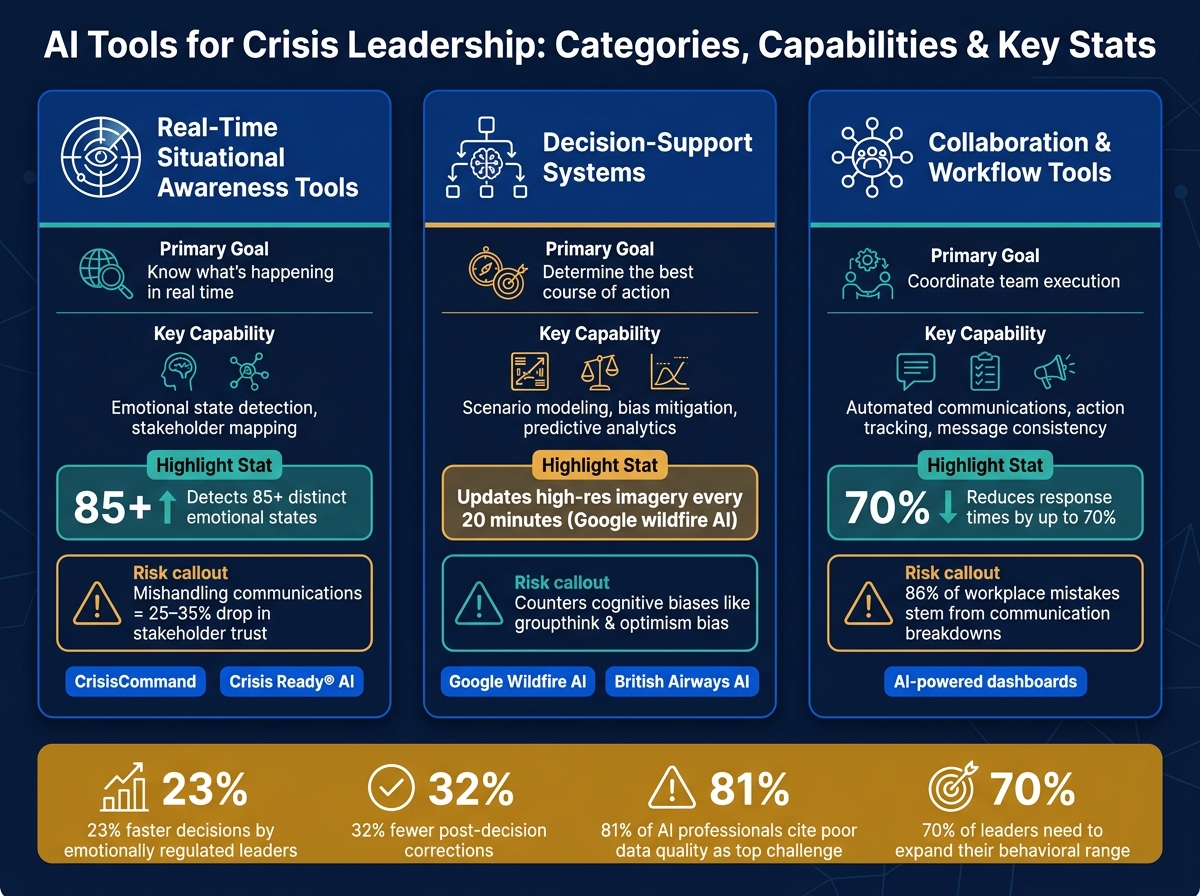
AI Tools for Crisis Leadership: Categories, Capabilities & Key Stats
AI tools are transforming how leaders navigate crises by enhancing their ability to understand situations, make informed decisions, and coordinate teams effectively. When faced with a crisis, instincts alone aren’t enough - leaders need the precision and speed that AI tools provide. These tools generally fall into three main categories, each addressing a critical aspect of crisis management: understanding the situation, deciding on a course of action, and ensuring team alignment.
Real-Time Situational Awareness Tools
These tools turn raw data into actionable information, giving leaders a clear view of unfolding events. Platforms like CrisisCommand can process breaking news and incoming data, organizing it into structured objectives and stakeholder maps in just minutes [9]. Advanced solutions go a step further by analyzing emotional dynamics. For instance, Crisis Ready® AI identifies over 85 distinct emotional states among stakeholders, allowing leaders to craft responses that foster unity rather than division [3].
"The goal is to support you in leading with calm intelligence when everyone else is being reactive. This often involves leveraging AI and personality psychology to maintain emotional stability and team cohesion." - Melissa Agnes, Founder and CEO, Crisis Ready Institute [3]
The stakes are high: mishandling critical communications can lead to a 25–35% drop in stakeholder trust within months [3]. Once the situation is understood, leaders rely on decision-support tools to translate insights into actionable strategies.
Decision-Support Systems
While situational awareness tools focus on understanding what’s happening, decision-support systems help leaders figure out what to do next. These platforms analyze vast datasets to identify trends, simulate scenarios, and recommend actions. This combination of machine precision and human judgment - often referred to as hybrid intelligence - enables more effective decision-making [4].
A standout example is Google’s AI wildfire tracking tool, launched in September 2024. This system updates high-resolution imagery every 20 minutes and uses historical data and weather patterns to predict fire spread, giving authorities a critical advantage in disaster response [6]. Similarly, British Airways uses AI to simultaneously evaluate weather and technical disruptions, allowing the airline to reroute flights and automate passenger rebooking in real time, minimizing customer inconvenience [6].
Another often-overlooked advantage of these systems is their ability to counter cognitive biases. Under stress, leaders can fall into traps like groupthink or optimism bias - assuming outcomes will be better than they realistically might be. AI scenario modeling can challenge these assumptions, preventing poor decisions before they happen [6].
Once decisions are made, implementing them effectively requires seamless team coordination.
Team Collaboration and Workflow Tools
Collaboration and workflow tools streamline essential tasks like note-taking, tracking action items, and managing multi-channel communication. These tools ensure that messaging remains consistent across large organizations [6][9]. By automating processes, AI-powered crisis tools can reduce response times by up to 70%, turning hours of work into minutes [3]. Paired with decision-support systems, they create a feedback loop that keeps strategies aligned with rapidly changing conditions [6].
| Category | Primary Goal | Key Capability |
|---|---|---|
| Situational Awareness Tools | Know what's happening in real time | Emotional state detection, stakeholder mapping |
| Decision-Support Systems | Determine the best course of action | Scenario modeling, bias mitigation, predictive analytics |
| Collaboration & Workflow Tools | Coordinate team execution | Automated communications, action tracking, message consistency |
How AI Tools Work in Crisis Leadership Practice
Using AI to Make Faster, Better Decisions
In times of crisis, the sheer volume of data can paralyze decision-making. Leaders often face a barrage of conflicting reports and incomplete information, all while racing against the clock. AI steps in as a powerful tool to cut through this noise, processing raw data and uncovering actionable insights within minutes.
Research from the Crisis Ready Institute highlights that emotionally regulated leaders make decisions 23% faster and require 32% fewer corrections after the fact [3]. AI tools enhance this process by analyzing over 85 distinct emotional states in stakeholders, enabling leaders to respond with both speed and empathy [3]. Additionally, advanced systems can simulate crisis scenarios by factoring in terrain, weather, and historical data. This allows leaders to shift from merely reacting to proactively managing situations - a critical edge when every second counts [1].
While speed is essential, ensuring everyone on the team is on the same page is just as important.
Improving Team Coordination with AI
Poor communication only amplifies the chaos during a crisis. In fact, 86% of employees attribute workplace mistakes to communication breakdowns [3]. AI can bridge these gaps by automating consistent messaging. It can generate tailored holding statements, talking points, and FAQs in a matter of minutes, ensuring that teams deliver clear and unified messages to all stakeholders.
AI-powered dashboards also provide a shared operational picture, giving everyone involved - from field teams to incident commanders - access to the same real-time information [1]. This common view reduces duplicated efforts and prevents conflicting actions, keeping teams aligned even as the situation evolves rapidly.
"The crisis response penalty (CRP) - the increased damage to people, operations, and revenue due to delayed or misaligned communication - has never been higher." - Melissa Agnes, Founder and CEO, Crisis Ready Institute [3]
How to Choose the Right AI Tools for Crisis Leadership
When it comes to managing high-pressure crises, not all AI tools are created equal. The wrong choice can slow things down, while the right one should simplify decision-making and lighten the mental load. Let’s break down what to look for and how to compare the top options.
Key Features to Look For
AI can be a game-changer for quick decisions and team coordination, but choosing the right tool is essential.
Start by focusing on actionable clarity - the tool should provide outputs that are easy to understand and act on without hesitation. Tools with real-time adaptability are also critical, as they can adjust to new data as situations evolve, much like the unpredictable nature of crises.
Another must-have is uncertainty quantification. The best tools don’t just give you answers - they tell you how confident they are in those answers. This becomes crucial when decisions have to be made with incomplete information [6]. Also, look for interoperability. During large-scale incidents, teams often work across multiple agencies or departments, each with its own systems. A tool that doesn’t integrate seamlessly with these workflows can create unnecessary complications [1].
Lastly, insist on a human-in-the-loop architecture. As Tim Johnson and Kat Bitterli from Deloitte explain:
"Until AI can be trusted to be reliable, accurate and unbiased, all outputs must be reviewed and challenged by humans, potentially reducing efficiency savings." [6]
This ensures that humans remain the ultimate decision-makers, safeguarding against any unreliable or biased outputs. AI should assist decisions, not replace them.
AI Tools Compared
Here’s a quick comparison of different AI tools suited for crisis leadership:
| Tool Type | Key Strengths | Limitations | Best Use Case |
|---|---|---|---|
| Emergency Management AI (e.g., EM1) | Combines satellite, drone, and weather data; predicts resource allocation needs | Effectiveness depends on high-quality data inputs | Wildfires, hurricanes, mass casualty events [1] |
| Contextual AI Platforms (e.g., Glean) | Monitors social media and news in real time; automates response drafts | Can surface irrelevant data if not properly tuned | Crisis communications and reputation management [11] |
| Neuroscience-Based AI (e.g., OMIND) | Tracks cognitive flexibility and emotional responses under stress | Has a narrower focus; works best alongside broader tools | Leader decision-making and risk assessment [4] |
| Generative AI Simulators | Creates evolving, unscripted scenarios based on user input | High setup costs; requires skilled facilitators | Executive training and incident command preparation [8] |
A key takeaway: 81% of AI professionals say poor data quality undermines their tools' effectiveness [11]. Before diving into any AI platform, take a close look at your own data infrastructure. Even the most advanced tool can’t deliver good results if it’s working with bad data.
How Personos Supports Crisis Leadership Training
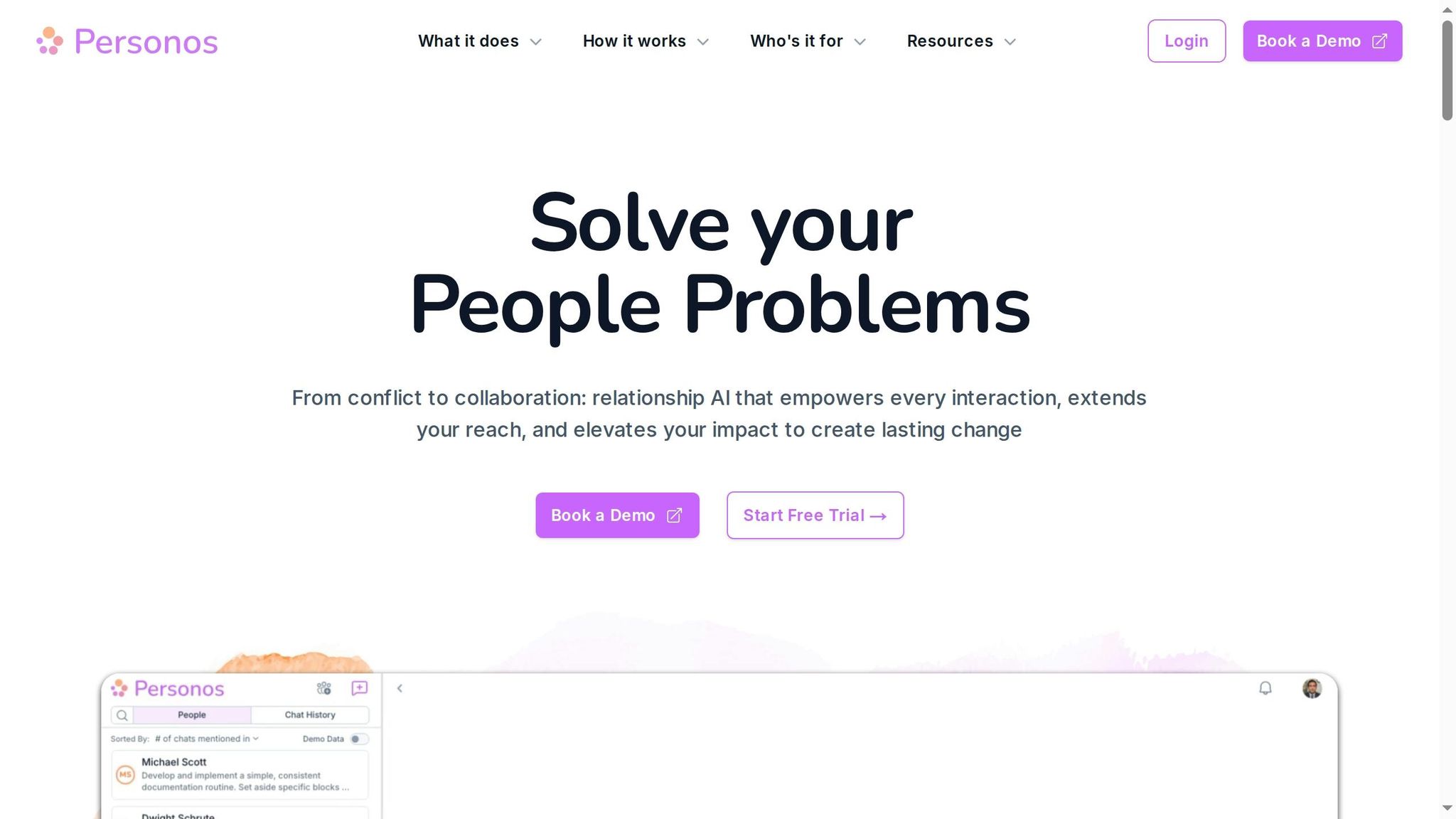
Personos goes beyond just aggregating data and automating workflows - it provides tools that focus on the human aspects of crisis leadership. Specifically, it helps leaders understand how their personality shapes their communication, decision-making, and ability to keep their teams united during intense situations.
Personality-Aware Guidance for Crisis Situations
What sets Personos apart is its use of the Five Factor Model, a scientifically grounded framework that assesses 30 personality traits on an 80-point scale. This isn’t just another personality quiz; it’s a tool built on validated research, offering insights that directly inform its guidance.
Personos Chat uses your unique personality profile and the context of the situation to provide immediate, actionable advice. Whether you’re navigating a tough team conflict, negotiating with stakeholders, or making critical decisions under pressure, the platform delivers guidance tailored to your needs [12]. By incorporating emotional intelligence feedback, it helps leaders address team members’ fears or frustrations in a way that de-escalates tension and fosters collaboration.
Studies show that 70% of leaders need to expand their range of effective behaviors, underscoring the importance of this personalized approach [2]. Personos equips leaders to make better decisions while simultaneously rebuilding trust and addressing burnout within their teams.
Building Trust and Reducing Burnout
In crisis situations, trust can erode quickly, creating further challenges for leaders. Personos tackles this issue with its Stakeholder Trust Building feature, which identifies the motivators and communication preferences of key individuals - whether they’re team members, executives, or board members. This helps leaders approach difficult conversations with greater precision [12]. By improving communication, this approach strengthens trust and reduces the likelihood of burnout.
The platform’s ActionBoard turns insights from coaching sessions into trackable tasks, ensuring leaders stay accountable while working to rebuild trust. To further combat burnout, Personos includes tools for reflective practices and personal value clarification. These features help leaders maintain their composure and resilience during prolonged periods of stress [12].
Measuring the Impact of AI on Crisis Leadership
Using AI tools during a crisis is just the starting point. The real challenge is figuring out if they’re making a difference. Without clear measurements, organizations might end up relying on tools that seem impressive but don’t deliver where it counts.
Key Performance Metrics to Track
Once AI tools improve decision-making and team coordination, it’s essential to measure their real-world impact. Some critical metrics to monitor include:
- Decision Speed: How quickly leaders identify a problem and take action.
- Situational Awareness: Accuracy in detecting threats and identifying misinformation before it spreads.
- Team Coordination: Tracking gaps between agencies, employee engagement, and burnout levels.
- Operational Resilience: Measuring reductions in downtime and the ability to maintain services under pressure.
For example, in July 2025, British Airways leveraged AI to reroute flights and automate rebooking, which significantly improved their ability to maintain operations during disruptions [6].
AI is also reshaping leadership training. Tools designed for incident command training can assess up to 72 behavioral criteria on a 5-point scale, offering detailed, data-driven feedback that human evaluators alone can’t achieve [10].
"AI will transform the way that organisations identify risks, build resilience and respond to complex issues or major incidents. Resilient organisations will utilise AI to not only respond during disruption, but to build a strategic and operational advantage." - Tim Johnson, Lead Partner, Crisis & Resilience, Deloitte UK [6]
Tracking Long-Term Outcomes
While short-term metrics highlight immediate crisis response efficiency, long-term outcomes reveal whether organizations are improving over time. Two critical indicators to watch are:
- Skill Velocity: How quickly leaders develop AI-related skills.
- Innovation Cycle Time: The speed at which organizations move from identifying problems to deploying solutions.
These metrics connect data-driven performance to continuous learning and improvement [7].
This is where tools like Personos' ActionBoard shine. Instead of letting lessons from a crisis fade after the debrief, the ActionBoard turns those insights into actionable tasks and development goals. Leaders can track progress over weeks or months, while organizations compare current performance with past benchmarks to see if training investments are paying off. This kind of feedback loop - where every crisis informs better preparation for the next - sets apart organizations that merely recover from those that evolve. Personos' ActionBoard is a prime example of how structured feedback can drive leadership growth and adaptive crisis management.
Conclusion: Where AI and Crisis Leadership Are Headed
Crisis leadership requires quick thinking, clear communication, and strong team dynamics. Today, AI tools are stepping in to turn overwhelming chaos into clear, actionable insights - helping leaders make precise decisions when time is of the essence.
By integrating AI into their strategies, leaders can enhance their own judgment and decision-making. As Erin Sutton, Partner at McChrystal Group, explains: "Tomorrow's resilience hinges on seamless integration of emergency management expertise and AI capability." [1]
While AI can accelerate decision-making and improve team coordination, it can't replace the human element. Empathy, ethical reasoning, and understanding interpersonal dynamics remain critical. AI might handle the data, but leaders handle the people. Tools like Personos are a great example of this balance, offering personality-aware coaching based on the Five Factor Model, which considers how individuals react under stress.
New developments like generative AI simulations, digital twins for testing decisions ahead of time, and AI actively involved in crisis response are advancing quickly. Organizations that bring these tools together into a unified system - combining lessons from the past, real-time insights, and continuous improvement - will not just weather crises but come out stronger. These technologies are creating opportunities for organizations to grow through adversity.
"AI will transform the way that organisations identify risks, build resilience and respond to complex issues or major incidents. Resilient organisations will utilise AI to not only respond during disruption, but to build a strategic and operational advantage." - Tim Johnson, Lead Partner, Crisis & Resilience, Deloitte UK [6]
The future of crisis management belongs to leaders who can combine human intuition with advanced AI tools. They're not waiting for the perfect solution - they're preparing now, using AI to enhance their judgment, not replace it.
FAQs
How can I tell if a crisis is an adaptive challenge or a technical problem?
A technical problem typically comes with straightforward solutions based on established knowledge or processes. In contrast, an adaptive challenge is far more intricate, often marked by uncertainty, ambiguity, or clashing viewpoints. Tackling these challenges often demands shifts in values, attitudes, or behaviors. To navigate such complexities, leaders can turn to frameworks like VUCA (Volatility, Uncertainty, Complexity, Ambiguity) to differentiate between the two. AI tools, like predictive analytics, can also play a crucial role in evaluating crises, helping determine whether the situation calls for adaptive leadership or a technical solution.
What should I check to trust AI outputs during a fast-moving crisis?
To rely on AI outputs during a crisis, focus on three critical aspects:
- Data quality and reliability: Make sure the data feeding the AI is accurate, up-to-date, and relevant to the situation at hand.
- Model transparency: Understand how the AI generates its recommendations or insights, ensuring there’s clarity in its decision-making process.
- Expert cross-verification: Always pair AI insights with human expertise to validate the findings and ensure they make sense in context.
Remember, AI works best as a decision-support tool, not as the sole decision-maker. Combining its capabilities with human judgment ensures its outputs are aligned with the situation's real-world demands.
How can AI help reduce burnout and keep teams aligned under stress?
AI tools help alleviate burnout and ensure teams stay aligned by offering real-time, tailored guidance for decision-making and coordination. Take platforms like Personos, for instance - they provide personalized support to handle crises, build trust, and enhance communication across teams. Features such as customized prompts and actionable insights reduce emotional and mental strain. Meanwhile, predictive analytics and decision-support tools simplify planning, allowing teams to remain focused and work together effectively, even in high-pressure scenarios.