How AI Resolves Conflicts Across Cultures
AI blends Big Five personality profiling, cultural context, and real-time sentiment analysis to guide mediators through cross-cultural disputes.
Nick Blasi

How AI Resolves Conflicts Across Cultures
AI is transforming conflict resolution by combining personality analysis with cultural context. Tools like Personos use the Five Factor Model to assess personality traits, offering tailored strategies for mediators. By layering this with cultural norms, AI ensures its recommendations align with individual needs and social expectations. Key features include:
- Personality Analysis: Measures 30 traits on an 80-point scale for precise insights.
- Cultural Context: Adjusts suggestions based on societal norms, avoiding one-size-fits-all solutions.
- Real-Time Guidance: Provides actionable prompts and dynamic reports for mediators.
- Emotion Detection: Uses sentiment analysis to identify tensions early.
This approach doesn't replace human expertise but enhances it, helping professionals manage conflicts effectively while respecting individual and social dynamics.
AI and the end of conflict, with Simon Horton
How AI Analyzes Personality and Culture for Conflict Resolution
Resolving conflicts effectively means understanding both the personalities and backgrounds of the people involved. AI tools designed for cross-cultural mediation combine insights into personality traits with cultural awareness to offer tailored recommendations, similar to how AI enhances social work by improving communication and client relationships. Generic advice often falls short, especially when addressing nuanced traits like high Neuroticism or low Agreeableness. AI steps in by blending psychological precision with cultural sensitivity, creating a more effective approach to conflict resolution. Let’s break down how personality frameworks and cultural understanding come together in AI-driven mediation.
Using the Five Factor Model for Personality Analysis
The Five Factor Model (FFM), also known as the Big Five, evaluates personality across five broad dimensions: Extraversion, Agreeableness, Conscientiousness, Neuroticism, and Openness to Experience. Its universal applicability makes it a valuable tool for conflict resolution across diverse groups. As highlighted in research from PubMed, the FFM "should prove useful both for individual assessment and for the elucidation of a number of topics of interest to personality psychologists" [2]. Unlike personality frameworks tied to specific cultures, the FFM works across different contexts, making it a reliable choice for mediation.
Platforms like Personos take this a step further by analyzing not just the five dimensions but also the 30 narrower traits - or facets - that underlie them. A study involving 11,219 participants revealed that these facet-level insights are about 1.5 times more predictive of conflict management styles than the broader factors alone [3]. For example, a high "Agreeableness" score might stem from traits like altruism, compliance, or trust - each of which calls for a different approach during mediation.
Thomas A. O'Neill from the University of Calgary explains this well: "Personality facets better predict conflict management styles than factors... Factors obscure nuanced relations between facets and conflict management styles" [3]. This level of detail is crucial for identifying whether someone might favor an "Integrating" style (collaborative problem-solving) or a "Compromising" strategy (splitting the difference). AI systems like Personos can differentiate between these approaches by examining specific traits, such as straightforwardness or trust.
Personos uses an 80-point scale to measure all 30 traits, offering mediators the detailed insights they need to adapt their strategies. For instance, imagine a mediator working with two clients. The platform might reveal that one client’s high Neuroticism - particularly the anxiety and vulnerability facets - makes them prone to avoiding conflict. Meanwhile, the other client’s high Openness, especially toward values, might incline them to favor collaborative solutions [3]. With this knowledge, the mediator can tailor their approach, perhaps by supporting the first client with anxiety-reduction techniques and engaging the second client in creative problem-solving [4].
Adding Cultural Context to AI Recommendations
Understanding personality is only part of the equation. To truly refine its recommendations, AI tools also incorporate cultural context. By layering cultural norms onto personality insights, these systems ensure that their suggestions are not only psychologically sound but also culturally appropriate. For example, someone from a hierarchical society might express disagreement differently than someone from an egalitarian one.
This dual approach helps avoid culturally insensitive advice. Instead of recommending direct confrontation - which might be unsuitable in some cultures - the AI might suggest alternatives like storytelling or involving respected community figures to address disagreements. Platforms like Personos also include features like Transparent Reasoning, which show mediators how personality traits and cultural factors shaped each recommendation. This not only builds practitioners’ expertise over time but also ensures they don’t become overly dependent on the tool for decision-making.
How AI Detects Emotional and Cultural Tensions in Real Time
Spotting tension early is crucial when resolving conflicts across cultures. AI tools use sentiment analysis and emotional computing to examine tone, word choices, and subtle emotional signals. This helps mediators identify when friction might stem from emotional distress or cultural misunderstandings. On the other hand, large language models (LLMs) act as pattern-matching systems, uncovering cultural norms and social expectations embedded in conversations [1]. Let’s dive into how AI applies sentiment analysis and cultural prompt engineering to make sense of these tensions.
One challenge is that AI doesn’t inherently separate emotional signals from cultural ones. Ellen Kim and Mo-Yun Lei Fong highlight this complexity:
Almost all AI platforms come with a 'cultural accent' that may result in misunderstandings or even conflict [1].
This emphasizes the importance of framing cultural context explicitly. Without it, AI might misread indirect politeness as emotional withdrawal, potentially derailing effective mediation.
Sentiment Analysis for Detecting Emotional Cues
AI tackles misinterpretations by analyzing conversations in real time. Sentiment analysis monitors emotional tones by examining language patterns, pacing, and word choices. For example, when dialogue becomes shorter, defensive, or emotionally charged, the AI flags these changes as signs of potential escalation. This allows mediators to adapt their approach - whether by slowing the conversation, addressing emotions directly, or steering toward less confrontational topics.
Platforms like Personos take this further by incorporating personality insights into sentiment analysis. For instance, if the AI senses frustration in someone with high Neuroticism - especially within the anger-hostility facet - it can suggest specific de-escalation strategies. The platform’s Transparent Reasoning feature explains which personality traits and emotional signals shaped its recommendations, giving mediators a clearer understanding of both the "what" and the "why" behind its guidance.
Identifying Cultural Biases and Misunderstandings
Beyond emotional cues, AI also works to identify cultural nuances that might lead to miscommunication. Understanding cultural misunderstandings requires more than tone analysis - it demands a grasp of how different cultures express meaning. AI models can be programmed to take on specific cultural personas for each participant, helping pinpoint where Western norms might conflict with those of other regions [1]. For instance, the same phrase could carry distinct implications in Shenzhen compared to Stuttgart.
To improve mediation, culture-conscious prompt engineering is key. By explicitly defining the cultures involved and assigning personas to each participant, mediators can guide the AI to retrieve context-specific cultural patterns instead of defaulting to Western-style directness [1]. Additionally, specifying relational factors - like hierarchy, deference norms, and formality - further customizes the AI’s guidance. Even with these measures, a human cultural expert should review the AI’s output to catch subtleties it might miss [1]. This "human-in-the-loop" approach ensures that AI remains a tool to assist, not replace, informed human judgment in resolving cross-cultural conflicts.
Building Mediation Strategies Based on Culture and Personality
Once tensions are identified, AI shifts its focus to crafting mediation strategies that align with both personality traits and cultural norms. By simulating each stakeholder's perspective within their specific cultural framework, AI ensures that its recommendations respect local customs - like favoring indirect communication styles where appropriate.
Conflict resolution experts Ellen Kim and Mo-Yun Lei Fong emphasize this approach:
The practical takeaway is to name the culture(s) and assign personas for each stakeholder so the model retrieves the right patterns rather than relying on Western defaults. [1]
This involves instructing the AI to account for factors such as hierarchy, deference, and preferred communication methods. For example, when a manager in Japan addresses an employee's underperformance, the mediation script should prioritize trust-building and avoid direct confrontation, aligning with local norms. However, AI alone isn't flawless - human reviewers with cultural expertise are essential to refine these strategies and catch subtle nuances the AI might overlook. This collaboration between cultural understanding and personality analysis lays the groundwork for more targeted mediation techniques.
Dynamic Reports and Context-Specific Guidance
AI platforms go beyond identifying tensions by creating dynamic, adaptive reports that guide mediators in real time. Tools like Personos produce these reports, combining personality profiles with cultural and situational insights to offer tailored mediation guidance. Unlike static evaluations, these reports evolve alongside the situation. For instance, a social worker handling a dispute can access a Relationship Report that highlights how personality traits - like high Agreeableness conflicting with low Conscientiousness - affect interactions. Adding layers like generational differences, gender, or socioeconomic factors makes these strategies even more practical and relevant [1].
Actionable Prompts for Guiding Conversations
In addition to detailed reports, AI provides concise, actionable prompts to help mediators navigate critical moments. These prompts act as real-time coaching tools, offering suggestions such as "Acknowledge their concerns before sharing your perspective" or "Use indirect language to maintain harmony in this situation." Platforms like Personos deliver these prompts at configurable intervals, ensuring support extends beyond structured mediation sessions. If a prompt feels off, users can regenerate it with one click, and the system learns from this feedback to improve future guidance. This approach keeps cultural and personality considerations front and center, helping mediators stay effective while avoiding burnout.
As Kim and Fong explain:
Blending human cultural intelligence with AI's capabilities as a thought partner can help resolve conflicts in a way that honors people's identity, emotional needs, and power dynamics. [1]
Tracking Progress and Maintaining Long-Term Resolution
Resolving a conflict once doesn’t mean it’s gone for good. Misunderstandings tied to cultural differences can pop up again as relationships grow, teams shift, or new challenges arise. That’s where AI-powered dashboards come in - they help keep an eye on things, spotting issues early and tweaking strategies before tensions build. The focus here isn’t just on generic satisfaction scores but on ensuring cultural alignment, steering clear of defaulting to Western directness.
Using Dashboards to Monitor and Improve Outcomes
To truly measure progress, it’s crucial to track metrics that reflect cultural alignment rather than broad satisfaction. For example, are AI-generated recommendations honoring local communication norms? Or are they leaning on a direct approach in settings where subtlety and indirectness are the norm? Research [1] highlights a common issue: AI models often default to Western-style directness, overlooking cultural nuances tied to politeness and communication.
Tools like Personos' ActionBoard take this a step further by turning insights into actionable tasks. For instance, when a social worker receives guidance on navigating a cross-cultural dispute, they can create specific tasks - like "Use indirect language when addressing performance concerns with this client" - and track their progress over time. This creates a feedback loop where human expertise refines and validates AI recommendations.
Ellen Kim and Mo-Yun Lei Fong stress the importance of this human role:
Allow the human to be the final QA on what is culturally appropriate for your particular difficult conversation or high-conflict scenario [1].
Dashboards should make it easy for users to flag and adjust advice that misses the cultural mark. This constant monitoring helps strategies evolve alongside shifting cultural contexts.
Supporting Long-Term Collaboration Across Cultures
Beyond real-time tracking, long-term collaboration requires strategies that grow and adapt as situations change. Team dynamics, external pressures, and cultural contexts are always in flux. While AI excels at resolving immediate conflicts, its tools also play a key role in maintaining cultural awareness over time.
AI supports this by monitoring various cultural layers - like national identity, generational differences, gender, and socioeconomic factors [1]. A June 2025 MIT Sloan study published in Nature Human Behavior found that prompting ChatGPT in Chinese versus English triggered distinct social orientations and cognitive approaches, showing how even the language of input can influence cultural framing [1]. This highlights the importance of not just what AI suggests but also how practitioners frame scenarios with cultural sensitivity in mind.
Platforms like Personos' Dynamic Reports ensure that guidance evolves as relationships and contexts shift. For example, a practitioner working with a refugee family might receive updated recommendations as the family grows more familiar with American norms or as new challenges arise. Rather than treating culture as fixed, the system adapts based on ongoing interactions and feedback, steering clear of one-size-fits-all solutions.
Comparing AI Tools for Cross-Cultural Conflict Resolution
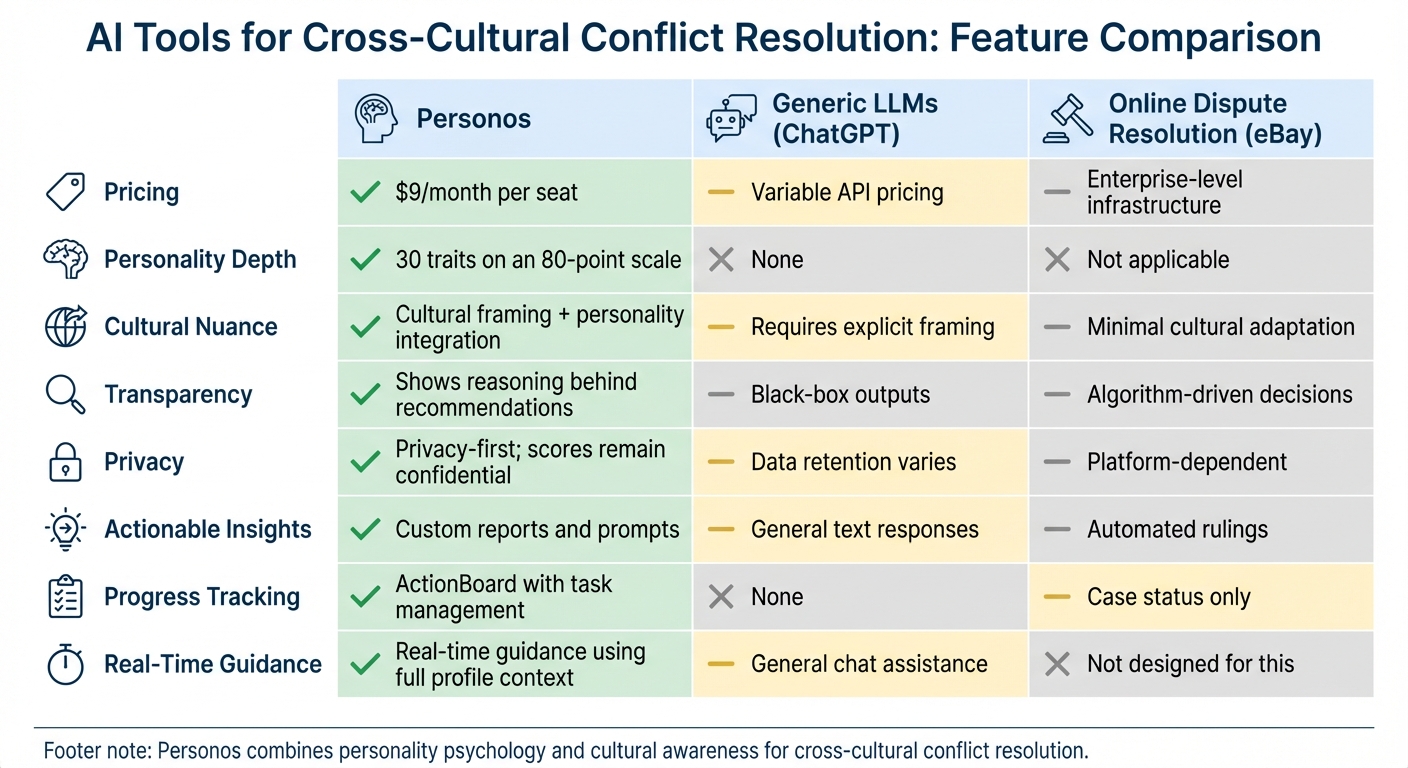
AI Tools for Cross-Cultural Conflict Resolution: Feature Comparison
AI tools come in many forms, each with its own strengths and limitations when it comes to handling cross-cultural conflicts. Some are designed for personality-driven mediation, while others focus on general-purpose assistance or automated dispute resolution. Knowing these differences is critical for practitioners, especially when working with diverse populations where cultural nuances can make or break progress. This section explores how various tools address these challenges, building on earlier discussions about detailed analysis and strategies.
Key distinctions include personality analysis, sensitivity to cultural differences, transparency, and cost. For example, generic models like ChatGPT tend to default to a Western communication style unless explicitly guided by cultural context [1]. On the other hand, platforms like eBay's online dispute resolution system are geared toward resolving high-volume, straightforward disputes, which limits their ability to handle the complexities of interpersonal conflicts rooted in cultural dynamics [5].
Personality-based platforms offer a unique advantage by incorporating detailed trait analysis based on the Five Factor Model. These tools evaluate traits across 30 dimensions using an 80-point scale, providing tailored guidance that accounts for individual psychological profiles [1]. This approach is particularly valuable when personality traits and cultural norms intersect, offering deeper insight into why someone communicates or behaves a certain way.
Feature Comparison Table
Here's a breakdown of how leading AI tools stack up in terms of features, emphasizing their strengths and limitations in personality analysis and cultural awareness.
| Feature | Personos | Generic LLMs (ChatGPT) | Online Dispute Resolution (eBay) |
|---|---|---|---|
| Pricing | $9/month per seat | Variable API pricing | Enterprise-level infrastructure |
| Personality Depth | 30 traits on an 80-point scale | None | Not applicable |
| Cultural Nuance | Cultural framing + personality integration | Requires explicit framing [1] | Minimal cultural adaptation |
| Transparency | Shows reasoning behind recommendations | Black-box outputs | Algorithm-driven decisions |
| Privacy | Privacy-first; scores remain confidential | Data retention varies | Platform-dependent |
| Actionable Insights | Custom reports and prompts | General text responses | Automated rulings |
| Progress Tracking | ActionBoard with task management | None | Case status only |
| Real-Time Guidance | Real-time guidance using full profile context | General chat assistance | Not designed for this |
Personos stands out by combining personality psychology and cultural awareness into a seamless workflow. Unlike generic models that require users to manually craft prompts or interpret vague outputs, Personos delivers fully customized insights that respect both individual traits and cultural contexts [1]. This saves time and allows practitioners to focus on addressing client needs directly. The comparison highlights the value of culturally aware, tailored AI tools in transforming conflict into productive collaboration.
Conclusion: Using AI to Move from Conflict to Collaboration
Turning insights about personality and cultural dynamics, using personality reports for conflict prevention, into meaningful collaboration is the ultimate goal. AI tools that incorporate personality psychology and cultural understanding are reshaping how cross-cultural conflicts are resolved.
The real advantage comes when AI combines cultural context with in-depth personality analysis. This approach doesn’t just reduce friction - it helps transform it into productive teamwork, all while alleviating the stress often felt by practitioners.
Take platforms like Personos, for example. Designed for professionals like social workers, case managers, coaches, and counselors, it offers tools that meet the demands of heavy caseloads and emotionally intense environments. For just $9/month per seat, users get real-time guidance, tailored reports, and tools to track progress. These features not only improve efficiency but also help practitioners stay effective without burning out, ultimately benefiting the vulnerable communities they serve.
Research highlights a common pitfall: generic AI models often lean toward Western communication styles. By prioritizing culturally specific personas and contextual understanding, platforms like this provide the level of nuance needed for resolving complex, high-stakes conflicts.
FAQs
How does AI avoid cultural bias in mediation advice?
AI helps reduce bias in mediation by being trained on diverse datasets that represent a range of cultural norms and communication styles. It employs tools to detect and adjust for content that might be insensitive or biased. At the same time, human oversight ensures that cultural subtleties are respected, making conflict resolution more effective and equitable in various contexts. These measures ensure AI offers guidance that is both inclusive and respectful of different cultural perspectives.
What data does AI need to analyze personality and culture?
AI uses various types of data to evaluate personality and cultural contexts effectively. These include personality traits (like those outlined in the Big Five model), communication styles and decision-making tendencies, emotional signals (such as facial expressions and tone of voice), language use and nonverbal cues, and behavioral trends. By analyzing this data, AI can better grasp cultural nuances and individual personalities, paving the way for respectful conflict resolution and smoother cross-cultural interactions.
How do humans review or override AI recommendations?
Humans play a critical role in reviewing and overriding AI recommendations by applying judgment, oversight, and ethical reasoning. While AI excels at analyzing data and proposing strategies, professionals bring empathy, an understanding of cultural dynamics, and ethical decision-making to the table. This human touch ensures solutions are tailored to the specific context. By interpreting complex situations, human reviewers address the limitations of AI, reduce biases, and uphold ethical standards, ultimately making decisions that align with the unique demands of conflict resolution.