AI-Powered Personality Insights for Teams
AI analyzes team interactions to provide adaptive personality guidance—reducing conflict, improving communication, and boosting productivity.
Christian Thomas

AI-Powered Personality Insights for Teams
AI tools are transforming how teams work by offering real-time insights into personality dynamics. Unlike outdated tests like Myers-Briggs, which provide static labels, these platforms analyze live interactions to deliver actionable advice, such as communication tips and conflict-prevention strategies. Here’s why this matters:
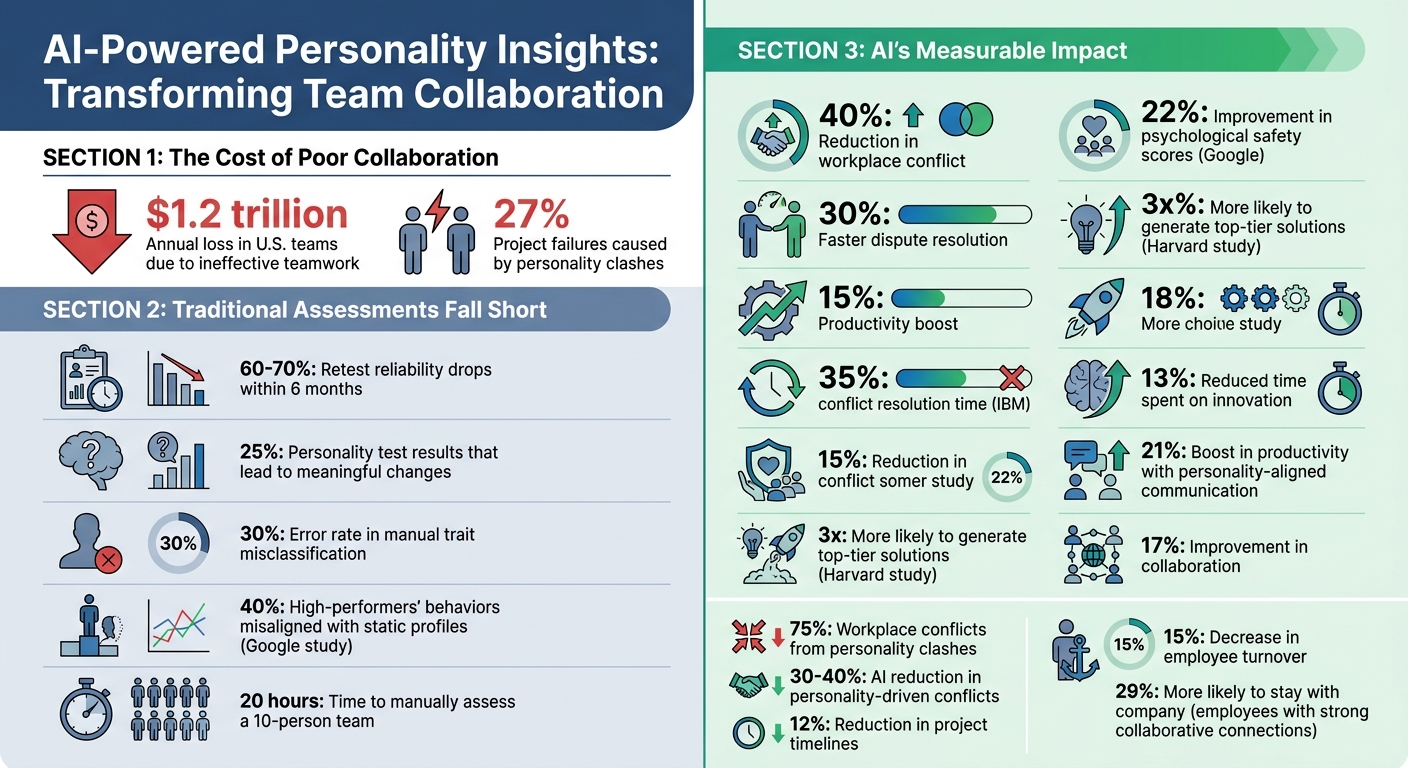
- Cost of Poor Collaboration: U.S. teams lose $1.2 trillion annually due to ineffective teamwork, with personality clashes causing 27% of project failures.
- Shortcomings of Static Assessments: Traditional tests fail to adapt as people grow, leaving managers to rely on outdated or misinterpreted data.
- AI’s Impact: Pilot programs show a 40% reduction in workplace conflict, with teams resolving disputes 30% faster and boosting productivity by 15%.
AI tools like Personos go beyond analysis by embedding insights into daily workflows, offering tailored advice for better communication, faster conflict resolution, and balanced team dynamics. At just $9 per user per month, they’re an affordable way to improve collaboration, especially for industries like social work and counseling.
AI-Powered vs Traditional Personality Assessments: Impact on Team Performance
Using personality insights to strengthen coaching and team performance
Why Traditional Personality Assessments Fall Short
Many organizations still rely on tools like MBTI or DiSC, which provide a one-time snapshot of an employee's personality. These assessments assign fixed labels and leave teams to figure out how to use the information. The problem? They fail to evolve alongside the people they’re meant to describe.
Fixed Results That Don't Adapt Over Time
Traditional assessments lock individuals into static categories, even as they grow and develop. For example, an employee labeled "introverted" could become a confident presenter after months of practice. Similarly, someone tagged as "conflict-avoidant" might learn to handle disagreements effectively after leadership training. These tools don’t account for such changes, leaving managers to base decisions on outdated profiles that no longer represent reality.
The data paints a clear picture: retest reliability for Big Five traits in static assessments drops to 60-70% within six months. IBM recognized this issue in 2021, phasing out MBTI for over 100,000 employees after finding little correlation between test results and actual performance reviews. By switching to behavioral analytics, they reduced conflict resolution time by 35%. These shortcomings highlight the need for tools that provide more actionable, real-time insights.
The Gap Between Data and Action
While personality tests generate plenty of data, turning that information into practical strategies for teamwork remains a challenge. For instance, a company might discover that Team A includes both analytical and creative thinkers - a mix that seems ideal for innovation. However, without clear guidance on how these personalities should collaborate, friction often arises. Analytical team members might dismiss creative ideas as impractical, while creative thinkers may see their analytical colleagues as overly rigid.
A 2023 Gallup Workplace Audit found that only 25% of personality test results lead to meaningful changes in team dynamics. The remaining 75% go unused because companies struggle to move from understanding traits to applying them effectively. Traditional assessments are descriptive, not prescriptive - they tell you what traits exist but offer no roadmap for leveraging them. Even attempts to manually interpret these profiles often add inefficiencies.
Errors and Inefficiency in Manual Analysis
When managers or HR teams manually interpret personality assessments, bias and inconsistency often distort the results. One manager might view "assertiveness" as a sign of leadership potential, while another might see it as a red flag for being "difficult to manage." This subjectivity leads to a 30% error rate in trait misclassification.
Manual analysis also consumes significant time and resources. For a 10-person team, it can take up to 20 hours to assess profiles. Google's Project Aristotle study revealed that static profiles misaligned with 40% of high-performers’ observed behaviors. After adopting data-driven analysis, the company saw a 22% improvement in psychological safety scores across 180 teams and a 15% boost in productivity.
"Static personality tests are like using a 1940s map for GPS navigation - they're outdated relics in dynamic workplaces." - Adam Grant, Wharton psychologist, HBR 2023
The core problem is that traditional assessments fail to provide context-specific guidance. They might suggest generic advice like "appreciate different perspectives", but they don’t consider the specific challenges teams face - whether it’s a looming deadline, a difficult client, or organizational change. These inefficiencies highlight the growing demand for dynamic, AI-driven tools that can adapt to the ever-changing realities of workplace dynamics.
How AI Changes Personality Analysis for Teams
AI-powered personality tools are shaking up the way teams understand and work with personality dynamics. Unlike traditional methods that view personality as fixed, these tools treat it as adaptable, offering insights based on real-time team interactions. This approach ensures personality profiles evolve with individuals and their experiences, making them more relevant and actionable.
Continuous Updates Based on Team Interactions
AI doesn't just take a snapshot of personality - it observes and learns from how team members interact over time. By analyzing behaviors in situations like high-pressure deadlines, conflicts, or shifting priorities, AI adjusts personality profiles to reflect growth and change. For instance, someone who starts as an introvert but develops effective presentation skills or learns to handle disagreements constructively will see their profile evolve to highlight these new strengths.
A field experiment conducted between May and July 2024 by Harvard Business School at Procter & Gamble showcased the power of AI in team settings. Involving 791 professionals, the study used an internal AI tool powered by GPT-4 to generate new product ideas. Teams using AI were three times more likely to create top-tier solutions (ranking in the top 10% of submissions) and reduced the time spent on innovation by 13% [3].
"If you want to be in that top 10% of performers, a full human team plus AI seems like the recipe for success" [3].
Improved Accuracy Through Machine Learning
Machine learning takes personality analysis to another level by uncovering patterns that static tools often miss. For example, research has shown that pairing open-minded individuals with conscientious AI enhances outcomes, while pairing extroverted individuals with the same AI can sometimes hinder performance. This was confirmed in an experiment using the "Pairit" platform, which involved 1,258 participants creating 7,266 ads. A follow-up field test on the X platform generated nearly 5 million impressions, validating these findings [1].
Gallup's AI-powered tools further demonstrate how machine learning accelerates insights:
"What once could take managers months to uncover now happens in minutes. Gallup's AI translates decades of research into instant, actionable insights" [2].
By identifying unique team dynamics and potential areas of conflict in real time, these tools help managers address issues proactively, keeping teams functioning smoothly.
Embedding Personality Insights into Daily Work
AI platforms are now going beyond analysis by weaving personality insights directly into daily workflows. Instead of leaving managers to interpret reports and apply findings on their own, these tools provide real-time guidance tailored to specific situations. For example, they might suggest communication strategies before a tough meeting, flag potential conflicts during project planning, or recommend task assignments that align with team members' strengths.
Platforms like Personos offer situation-specific advice, whether it’s handling a tense client call or mediating a team disagreement. By using comprehensive personality profiles, these tools ensure that recommendations are both practical and personalized. This integration transforms abstract personality data into actionable strategies that improve teamwork.
Data underscores the importance of strong team relationships. Employees with at least one solid collaborative connection are 29% more likely to remain with their company for the next year [2]. AI tools strengthen these bonds by embedding personality-aware insights into every interaction, turning insights into actions that enhance team dynamics and foster collaboration.
How AI-Powered Personality Insights Work in Practice
AI-powered tools take personality data and turn it into actionable strategies for everyday workplace scenarios. Instead of relying on static reports that managers must interpret, these platforms offer real-time, situation-specific guidance. Whether it’s preparing for a challenging meeting, giving constructive feedback, or assigning roles within a project, AI helps reduce misunderstandings, resolve conflicts faster, and unlock team strengths by leveraging individual differences.
Let’s dive into how this technology enhances communication, minimizes conflict, and creates well-balanced teams.
Better Team Communication
AI insights can transform how team members interact on a daily basis. By analyzing traits from the Five Factor Model, these tools adapt communication styles to fit individual preferences. For example, highly conscientious individuals might need detailed updates, while those with lower openness may respond better to concise, action-driven messages. Platforms like Personos take it a step further by suggesting specific phrasing to match each person’s style, ensuring clarity and reducing miscommunication.
These tools don’t stop at analysis - they provide practical tips. Before a critical conversation, AI might advise framing feedback positively for a highly agreeable colleague to build trust or using straightforward, fact-based language for someone who prefers directness. According to a 2023 SHRM study, teams using personality-aligned communication strategies see a 21% boost in productivity and a 17% improvement in collaboration. Personos delivers these insights through bite-sized prompts, such as “Rephrase this email for a high-conscientiousness recipient,” helping users refine their approach and cut down on unnecessary back-and-forth.
Conflict Resolution and Prevention
One of AI’s standout abilities is its knack for identifying potential personality-driven conflicts before they spiral. By examining interaction patterns and scoring traits on an 80-point scale, tools like Personos can flag mismatches - like a dominant team member potentially clashing with a more reserved colleague - and provide tailored strategies to defuse tension. A 2024 Gartner report revealed that 75% of workplace conflicts stem from personality clashes, with AI reducing these issues by 30–40% through targeted interventions.
When conflicts do arise, AI doesn’t just diagnose the problem - it offers solutions. For instance, it might recommend structured brainstorming sessions to bridge the gap between high-openness idea generators and low-openness executors. Dynamic Reports from Personos can analyze real-time interactions to pinpoint friction points and suggest trust-building exercises tailored to individual profiles. One sales team using these interventions resolved conflicts 30% faster, and the platform’s ActionBoard tracks progress to ensure long-term improvements.
But AI’s role doesn’t stop at resolving disputes - it also helps build teams that are less likely to clash in the first place.
Building Balanced Teams
AI simplifies the process of creating effective teams by matching complementary personalities and work styles. Clustering algorithms bring together analytical thinkers with creative visionaries or pair mediators with decisive leaders. Companies using AI for team formation report a 12% reduction in project timelines and a 15% decrease in employee turnover, according to industry benchmarks.
With tools like Personos, managers receive group Dynamic Reports that offer a roadmap for balancing team dynamics. These reports not only highlight individual strengths but also show how different traits interact within team structures, whether someone is contributing, managing, or leading. By aligning roles with natural strengths, AI ensures that team members are set up for success, fostering stronger collaboration and driving better outcomes overall.
Case Study: How Personos Improves Team Collaboration
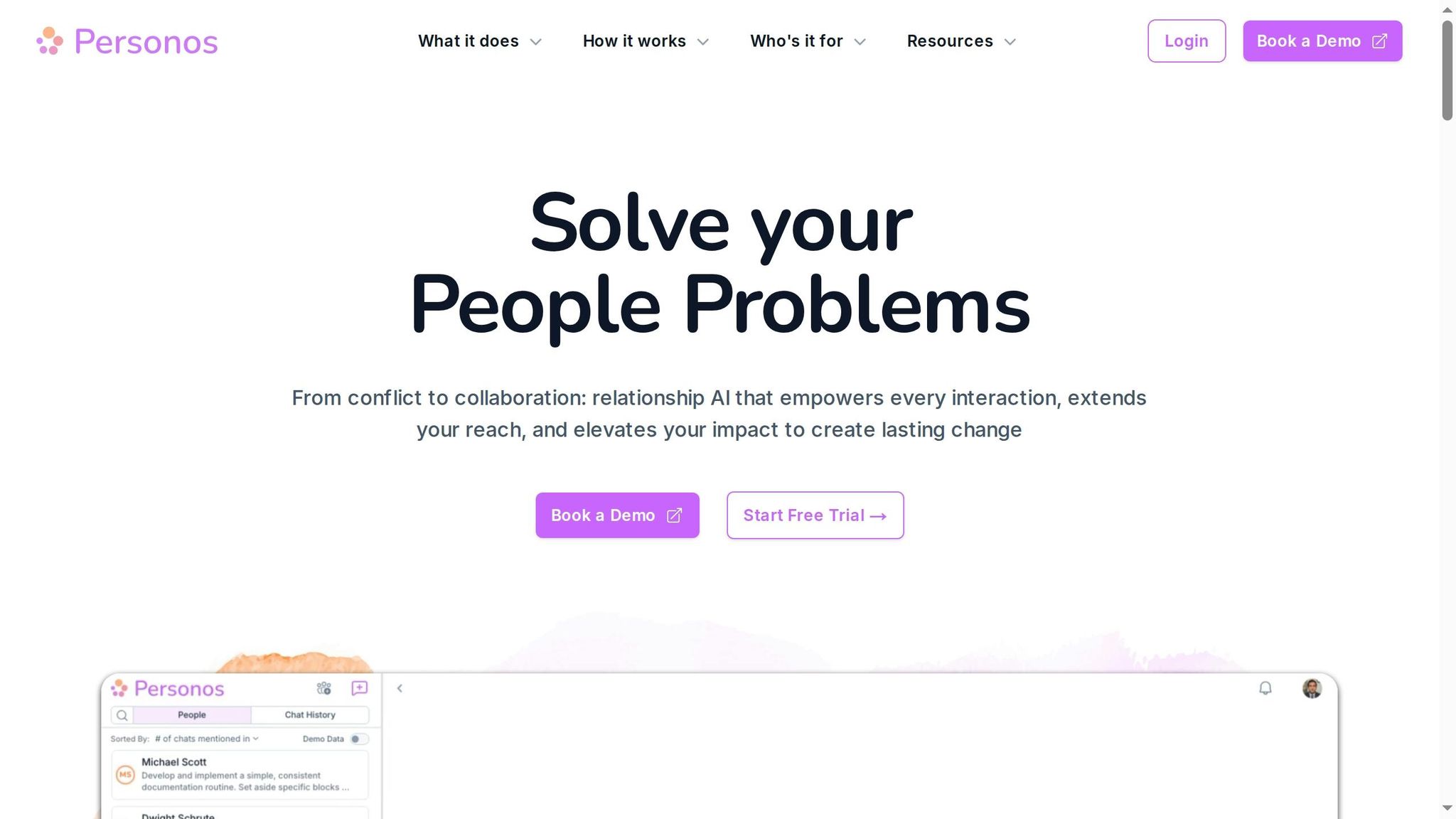
While plenty of platforms provide personality assessments, Personos takes it a step further by addressing the specific needs of helping professionals. Designed with social workers, case managers, coaches, counselors, and nonprofit staff in mind, Personos turns personality data into actionable insights. These insights help reduce burnout, improve client outcomes, and tackle the tough realities of high caseloads, crisis situations, and the emotional demands of working with vulnerable populations.
What sets Personos apart is its ability to provide customized solutions tailored to the unique context of each team. Instead of offering generic personality insights, it focuses on making those insights practical and applicable to real-world challenges. This is especially evident in its dynamic reporting tools.
Dynamic Reports Tailored to Helping Professionals
Personos understands that working with vulnerable populations brings challenges far different from typical workplace dynamics. To meet these needs, the platform offers three levels of customized reports:
- Individual Profiles: Help team members build self-awareness.
- Relationship Reports: Analyze interactions between two people to identify potential friction points and strategies for better communication.
- Group Reports: Provide a big-picture view of team dynamics.
These reports aren’t static - they evolve as team structures or needs change. Whether it’s a new project, a shift in organizational goals, or onboarding new team members, the reports adapt to stay relevant.
For professionals like social workers, relationship reports are a standout feature. For instance, a social worker can use a report to better understand their communication style alongside a resistant client’s personality profile. This can reveal potential areas of conflict and offer strategies for addressing trauma responses or resource needs. The platform even allows organizations to upload their own values, norms, and frameworks, aligning insights with existing practices and communication standards.
Actionable Prompts for Daily Guidance
Personos also supports teams with prompts - bite-sized, actionable reminders delivered on a configurable schedule. For example, a practitioner might get a quick heads-up about a colleague’s preferred communication style before a tough meeting, or a team leader could receive suggestions for phrasing during a performance review.
The ActionBoard ties everything together by turning these prompts, chat messages, or report insights into trackable action items with just one click. This feature helps practitioners monitor client progress and their own professional development goals. It also provides measurable data that funders and stakeholders can rely on, ensuring personality insights lead to real behavior changes rather than staying theoretical.
Privacy and Context-Aware Recommendations
Personos doesn’t just focus on functionality - it also prioritizes privacy. Individual personality scores are only shared with others if the user explicitly consents. This avoids the risk of "labeling", where people are reduced to personality types, and fosters a sense of psychological safety within teams.
The platform’s recommendations are tailored based on a user’s role - whether they’re a contributor, manager, or leader - ensuring advice aligns with specific responsibilities. Users can also add custom context, such as case notes, interaction history, or team objectives. The AI integrates this information seamlessly into its suggestions, making guidance more relevant to actual situations. Plus, every recommendation comes with transparent reasoning, showing how personality traits and psychological principles influenced the advice.
At just $9 per seat per month for Personos Pro, the platform offers an affordable way for organizations to extend their practitioners’ reach without sacrificing quality or adding unnecessary complexity to their workflows.
Conclusion
Traditional personality assessments often offer one-time insights, but AI-powered tools like Personos go further by providing real-time, actionable guidance. Whether it's delivering feedback to a sensitive colleague, calming a heated discussion, or getting everyone on the same page for a major project, these tools offer tailored recommendations that enhance communication and prevent issues from escalating.
And the results? They're hard to ignore. A study from Harvard Business School revealed that teams using AI for collaboration were 3x more likely to generate breakthrough ideas compared to those without AI support [3]. In another study of 1,258 participants working on ad campaigns, human-AI teams with personality-specific pairings saw significantly higher click-through rates, proving that personality-aware AI delivers better results than one-size-fits-all solutions [4].
For helping professionals, these benefits are even more impactful. With features like Dynamic Reports, actionable Prompts, and an ActionBoard, Personos supports high caseloads and crisis situations effectively - all for just $9 per seat per month. The platform enables professionals to extend their reach without compromising quality, while also providing measurable outcomes that resonate with funders and stakeholders.
FAQs
What data does AI use to infer team personalities?
AI uses scientifically-backed models, such as the Five Factor Model, to examine personality data. This model evaluates 30 traits on an 80-point scale. By blending this analysis with contextual data and conversational AI, it delivers real-time insights into both individual personalities and team dynamics.
How do these tools protect privacy and avoid labeling?
AI-driven tools are designed with privacy in mind, using anonymized or aggregated data to create insights while protecting personal information. For example, platforms like Personos incorporate measures such as secure encryption, stringent access controls, and adherence to privacy laws. Rather than assigning rigid labels, these tools offer adaptable, context-aware guidance. This approach supports ethical AI practices, safeguards privacy, and helps avoid reinforcing harmful stereotypes.
How do you roll this out without disrupting workflows?
To introduce AI-powered personality insights effectively, take it step by step. Begin with pilot programs in specific teams. This allows you to showcase its benefits and collect valuable feedback. Make sure to train team members on how to use the AI as a tool to enhance collaboration, rather than viewing it as a replacement for human efforts.
As you move forward, gradually weave the AI into existing workflows - like integrating it with chat tools or team dashboards. Provide continuous support to address questions and refine the process. Clear communication and making adjustments along the way will help ensure a smooth transition while fostering better team interactions.