AI-Powered Mentorship for Career Changes
AI mentorship helps career changers identify transferable skills, build personalized learning plans, access 24/7 coaching, and expand professional networks affordably.
Christian Thomas

AI-Powered Mentorship for Career Changes
Switching careers is hard, but AI tools are making it easier. Here's how:
- Skill Matching: AI identifies transferable skills from your past roles and suggests new career options.
- Personalized Learning: Platforms like MentorcliQ create custom plans to help you close skill gaps with courses and certifications.
- 24/7 Coaching: Tools like CareerVillage offer real-time advice on resumes, interviews, and workplace norms.
- Networking Help: AI connects you with mentors and professionals based on shared goals and experiences.
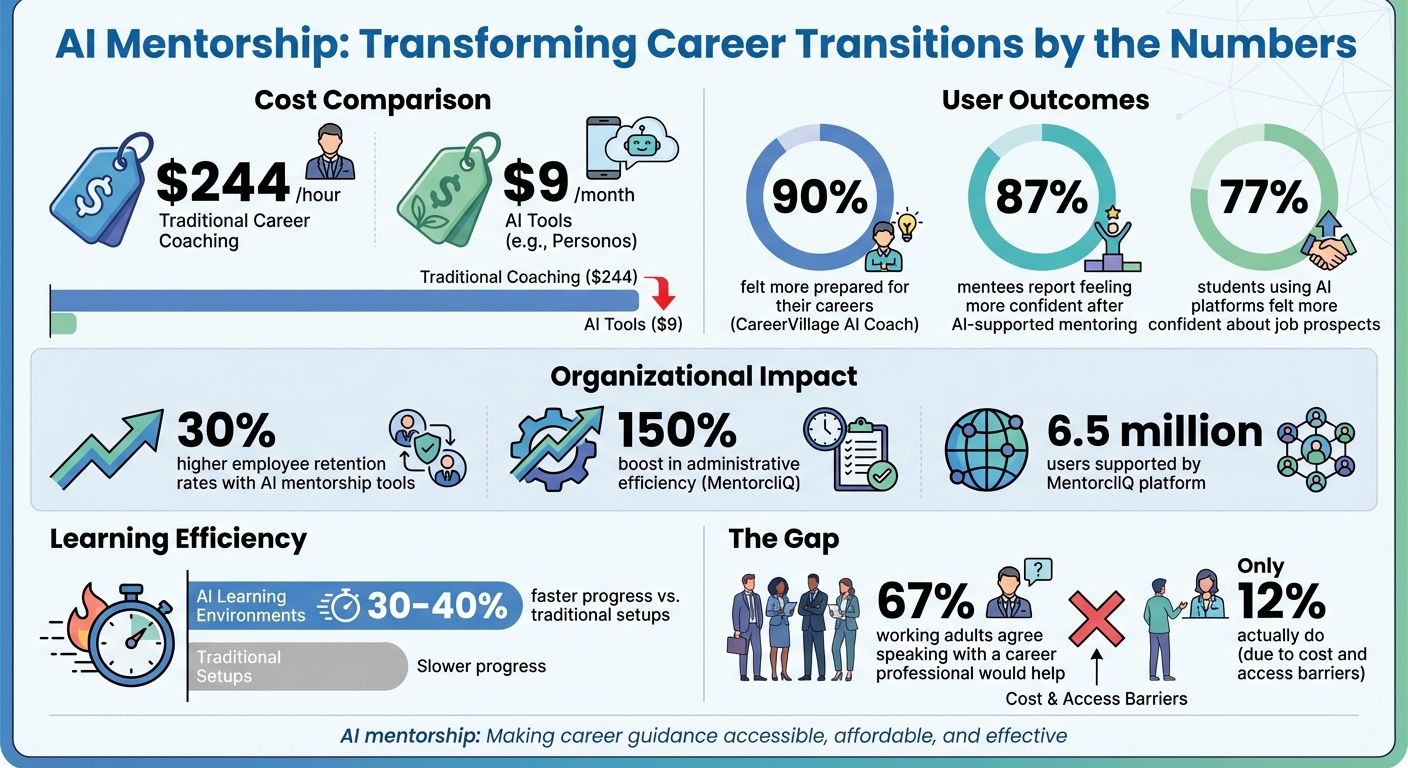
- Affordable Access: With traditional career coaching costing $244/hour, AI tools like Personos provide tailored insights for as little as $9/month.
AI mentorship combines data analysis with personal guidance, giving you the confidence and resources to navigate career changes effectively.
AI Mentorship Impact: Key Statistics for Career Transitions
Common Challenges in Career Transitions
Identifying Transferable Skills and Skill Gaps
One of the biggest hurdles for career changers is figuring out how to communicate their existing skills effectively. Lisa Gevelber, Founder of Grow with Google, explains it well: "Most people either aren't conscious of the skills they have from the jobs they've done, or they don't know how to talk about it" [2]. This "translation barrier" becomes especially tricky when moving between industries. For example, a public health educator might not immediately see how their experience aligns with a role like an employee-wellness coordinator in the corporate world.
The challenge intensifies in competitive job markets. Stephanie Ranno, Former Senior VP of Growth at TorchLight Hire, notes: "In a hiring-hesitant market, you're going to go with the least risky candidate" [2]. Employers often prefer candidates who perfectly match the job description, leaving little room for those with minor skill gaps - even if they’re otherwise highly capable. Traditional career resources, unfortunately, tend to offer outdated advice that doesn’t keep up with today’s fast-changing job landscape [5]. Beyond identifying skills, building meaningful professional connections adds another layer of difficulty.
Finding Mentors and Building Networks
Breaking into a new industry often means starting from scratch when it comes to networking, and that process can be both time-consuming and expensive. For many professionals, the high cost of career coaching puts it out of reach [5]. Even when mentors are available, they’re often juggling their own demanding schedules, making them less accessible or causing commitments to fall through [4][5].
The rise of remote work has made networking even more challenging by cutting out those informal, in-person moments - like chats in the office kitchen or overheard conversations - that used to provide valuable insights [4]. For individuals in underserved areas, geographic isolation adds another barrier, as they lack easy access to industry events or professional networks [1]. Organic mentorship, when it happens, often excludes people from historically disadvantaged groups, leaving them without the guidance they need to navigate new industries [4]. These networking roadblocks, combined with conflicting advice from various sources, only complicate the transition process further.
Managing Information Overload
On top of networking struggles, career changers often face a flood of conflicting information. Search engines, social media, and fragmented online resources bombard them with advice - much of it contradictory - making it difficult to make clear, confident decisions [9]. Industry-specific jargon can also be a stumbling block. Terms like "circle back" or other technical language may seem like a foreign dialect, making it harder to grasp role expectations or communicate effectively in a new field [4].
The problem isn’t just the sheer volume of information but also its quality. Many resources are outdated and fail to reflect the realities of today’s job market [6]. While nearly two-thirds of working adults agree that speaking with a career professional would be helpful, only 12% actually do [8]. Why? Cost and the overwhelming task of sorting through available options often deter them. Together, these challenges highlight the growing need for personalized, dynamic solutions - like AI-driven mentorship - that can adapt to individual needs and help bridge skill gaps while navigating networking obstacles.
Building a GenAI powered mentorship matching tool | Let's Talk About Data
How AI Mentorship Tools Address Career Transition Problems
From bridging skill gaps to expanding networking opportunities, AI tools are reshaping how people navigate career changes.
Data-Driven Career Analysis and Matching
AI platforms analyze resumes, LinkedIn profiles, and work histories to uncover transferable skills and align them with new opportunities. Take Brooke Grant, for example. In March 2025, after a decade in change management at Salesforce, she used the company’s Career Connect AI tool to transition into a sales enablement role. The AI assessed her background in communications and organizational psychology, highlighting its relevance to sales coaching - an area she hadn’t considered before. Armed with this insight, Grant successfully pitched herself for the role and even secured a salary increase [2].
These tools go far beyond simple keyword matching. They assess your skills against live labor-market data and the specific requirements of various roles, often revealing career paths you might never have considered.
David Satterwhite, CEO of Chronus, puts it this way: "We want it to be a systematic process so that you're leveraging mentorship across the company at any size in a very inclusive way" [4].
By addressing blind spots and narrowing down options, these platforms provide a solid analytical base for identifying skill gaps and charting a clear path forward.
Personalized Skill-Gap Analysis and Development Plans
Once AI pinpoints the gaps between your current abilities and the requirements of a target role, it generates tailored learning plans. These plans might include specific courses, certifications, or projects designed to close those gaps. For instance, MentorcliQ, which has integrated 20 years of mentoring expertise into its platform, supports 6.5 million users. Its AI tools, "CliQ AI" and "Admin AI", have improved employee retention by 30% while boosting administrative efficiency by 150% [1].
The technology also helps users set SMART goals - objectives that are Specific, Measurable, Achievable, Relevant, and Time-bound. Instead of vague aspirations, AI breaks them into actionable steps, prioritizing certifications and skills that align with career goals [10].
Real-Time Coaching and Feedback
AI mentorship tools offer round-the-clock support, covering everything from interview prep to navigating workplace dynamics. For example, CareerVillage's "Coach" uses large language models to provide resume reviews and mock interview practice. The result? 90% of users reported feeling more prepared for their careers after engaging with the AI coach [1].
For those stepping into unfamiliar industries, these tools can demystify corporate jargon and workplace norms. They explain terms like "circle back" and even offer advice on professional communication, such as how to politely decline additional tasks when overwhelmed [4].
Erin Clark, Principal at Deloitte U.S., highlights the broader potential: "Democratizing mentorship - but I'd say just democratizing development for people - that is one of the greatest areas of opportunity that I see for AI in general" [4].
This real-time accessibility ensures career changers get immediate answers to pressing questions, eliminating the need to wait for traditional mentoring sessions.
Building Skills with AI Mentorship
Recognizing and Reframing Transferable Skills
Many professionals often underestimate the value of their existing skills. AI tools are changing this by analyzing work histories and translating industry-specific experience into broader, sought-after competencies that appeal to hiring managers across different sectors. For example, in February 2025, Google introduced Career Dreamer, a free AI tool that has already helped hundreds of thousands of users in the U.S. explore new career paths. By leveraging labor-market data, the platform suggests career transitions - such as guiding an accountant toward management consulting or recommending a middle-school teacher shift into corporate training, based on overlapping skills like audience engagement and tailoring learning approaches [2].
This tool examines millions of job postings to uncover the skills that matter most, going beyond surface-level job titles [7]. It highlights connections you might not have noticed, giving you the confidence to pursue roles even if you lack direct experience [2]. Once these transferable skills are clearly defined, AI can identify the new competencies you’ll need to develop for your next step.
Identifying and Prioritizing New Skills
After pinpointing your strengths, AI takes it further by identifying the specific skills required for your target roles. In August 2021, researchers at UTS and UNSW Sydney developed a machine learning system that analyzed 8 million Australian job ads from 2012 to 2020. This system not only predicted job transition probabilities but also provided real-time recommendations for the precise skills needed to switch careers [7]. This shift toward skills-based hiring, where employers focus on competencies rather than traditional job titles, has made career changes more accessible and efficient [7].
AI doesn’t just highlight skill gaps - it provides a step-by-step plan to bridge them. These roadmaps break down learning into manageable steps, organized by complexity and timeline. Often, they recommend micro-credentials or short-term certifications to help you quickly close those gaps [7][11]. Instead of vague goals about "upskilling", you get a clear, actionable path forward.
Personality-Based Coaching with Personos
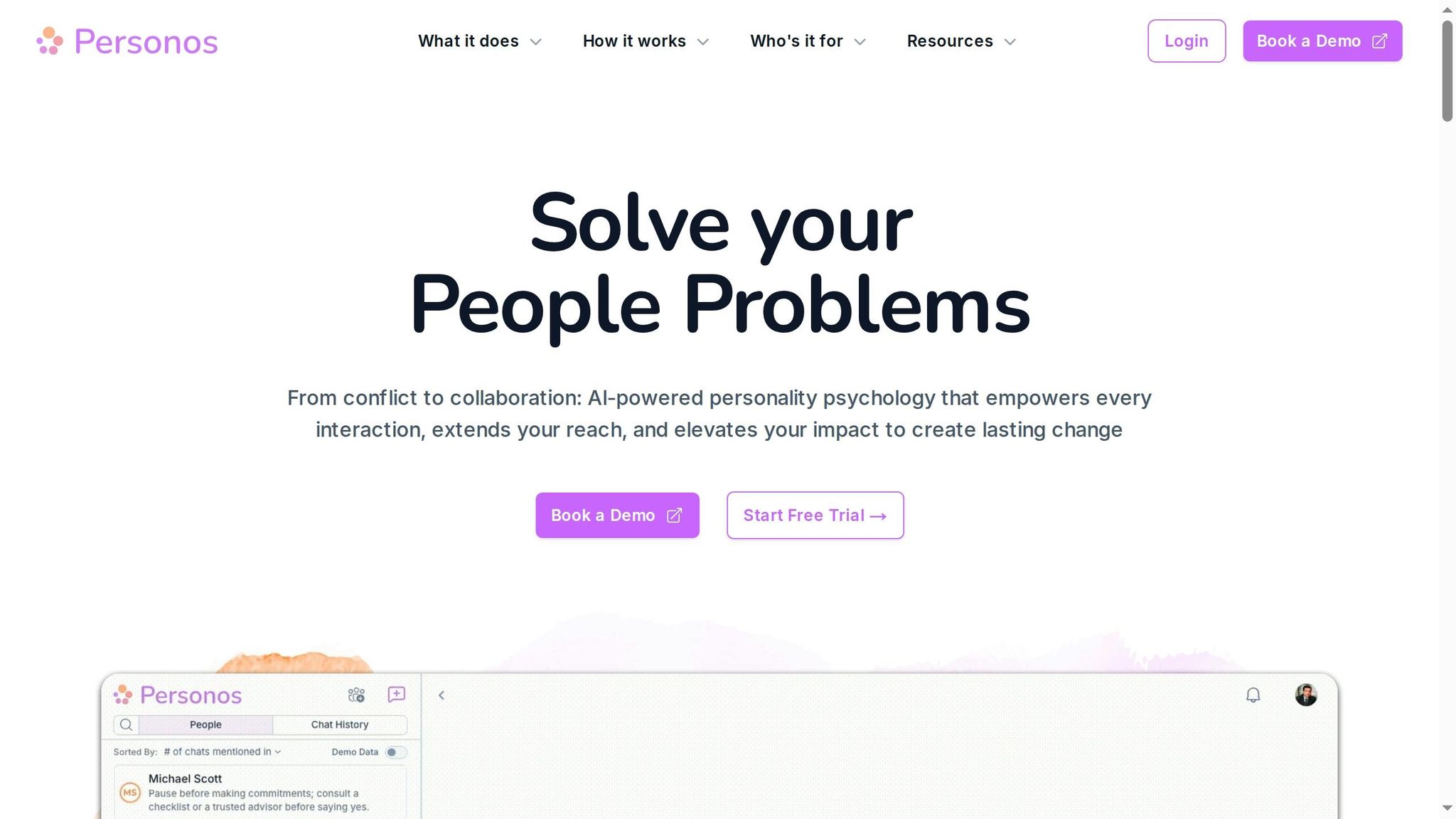
Personos takes skill-building to the next level by incorporating personality psychology into its coaching. This platform evaluates your strengths, communication style, and behavioral patterns to create personalized learning paths that align with your natural work habits [12][14]. This is crucial because developing technical skills is only part of the challenge - adapting to workplace dynamics, building resilience, and communicating effectively in unfamiliar settings can be even tougher [14].
Personos generates dynamic personality reports tailored for individuals, teams, and groups. These reports not only tell you what skills to focus on but also how to apply them in your unique context. For instance, if you’re moving into a collaborative role but thrive in independent work environments, the platform offers strategies for proactive communication and conflict resolution that fit your personality. At $9 per seat per month, Personos makes personality-based coaching accessible to a wider audience.
Research shows that people in customized learning environments progress 30-40% faster than those in traditional setups [13]. By combining AI-driven skill analysis with personality insights, Personos equips career changers with the tools they need to not only learn new skills but also seamlessly integrate them into their professional lives.
Expanding Networks and Adapting to New Industries with AI
Finding the Right Mentors and Connections
In the past, breaking into a new industry often meant relying on cold calls or chance meetings to build a network. But AI has transformed how professionals connect, making the process smarter and faster. Platforms like Chronus, for example, use machine learning algorithms (such as MatchIQ®) to match individuals with mentors based on shared goals, complementary skills, and even personality traits. By analyzing tools like Myers-Briggs or DISC assessments alongside career objectives, these platforms create matches that would have taken months to uncover manually [15].
What makes AI stand out is its ability to uncover rare and meaningful connections.
As Gil Katz, Co-Founder and Director of Operations at MentorEase, puts it: "Artificial intelligence can help find that needle-in-a-haystack type of information that would be impossible to find otherwise, as it requires reading and comparing a lot of text" [15].
Take LinkedIn, for instance. AI can comb through thousands of profiles to identify mentors who share niche interests - like expertise in vertical farming or a shared alma mater - that a manual search might miss. With Natural Language Processing (NLP) tools, resumes and profiles are summarized into detailed, data-driven insights, making it easier to pinpoint the right people to connect with. This level of precision not only saves time but also lays the groundwork for smoother, more personalized communication, which ties directly into the next topic.
Improving Communication for Networking
Reaching out to industry leaders can feel daunting, especially when stepping into unfamiliar professional territory. AI-powered tools are stepping in to make this process less intimidating by offering tailored conversation prompts that help break the ice. Platforms like Together and Mentor Collective use "Spark" prompts - conversation starters based on shared experiences or career goals - to help professionals engage more naturally with potential mentors [15].
A real-world example of this comes from Damaryan Benton, a 22-year-old intern at PR agency Highwire in late 2024. Benton used ChatGPT to navigate the unwritten rules of corporate life, decoding jargon like "circle back" and drafting polished responses to manage his workload. Over six months, this AI-assisted approach not only helped him adapt to the agency’s culture but also boosted his confidence to the point where he relied less on the tool over time [4].
Another platform, Personos, takes networking a step further by offering communication strategies tailored to your personality type. Instead of generic advice, it analyzes how you communicate and suggests outreach techniques that align with your natural strengths. For example, if you're introverted, Personos provides conversation frameworks that feel authentic, helping you connect with others without stepping too far out of your comfort zone. This approach makes networking less stressful and more effective - especially in industries with unfamiliar communication norms. Once those initial connections are made, the next challenge is understanding the ins and outs of the industry itself.
Learning Industry-Specific Information
Getting up to speed on the norms and expectations of a new industry can be a long and confusing process. AI tools are helping to speed up this learning curve by surfacing key information quickly and efficiently. For instance, in early 2025, Rachel Fogleman, an MBA student at the Kelley School of Business, used ChatGPT to help public health workers transition into private-sector roles. The AI suggested equivalent positions like "employee-wellness program coordinator" or "community-relations manager", translating specialized skills into new career paths [2].
AI chatbots, like LinkedIn Learning's assistant, offer real-time insights into industry-specific questions, from workplace norms to career trajectories. Morgan Stanley’s private AI assistant is another example, capable of searching through 100,000 internal reports to provide employees with relevant intelligence [4]. This kind of on-demand access eliminates the need to wait for mentorship sessions to get answers to pressing questions. In fact, 90% of CareerVillage's "Coach" AI users reported feeling more prepared for their careers, while 77% of students using AI-driven platforms like PeopleGrove felt more confident about their job prospects [1].
Ethical and Practical Considerations for AI Mentorship
Protecting Privacy and Data Security
When it comes to sharing personal career details, privacy is a big deal. In fact, 80% to 90% of people opt out of being tracked by third-party apps when given the choice [17]. Leading AI mentorship platforms address these concerns with features like zero-access encryption or local data storage, ensuring that even the service providers can't peek at your information [16][5].
For particularly sensitive topics - like planning a career move - some tools offer a "ghost mode" that deletes conversations immediately after the session ends [16]. Before uploading your resume or career history, it's wise to check the platform's data usage policies. The last thing you want is your professional background showing up in someone else's AI-generated content [16].
As Jason Averbook, Senior Partner and Global Leader of Digital HR Strategy at Mercer, notes: "A lot of mentor and mentee conversations are private conversations, and I don't necessarily want to have private conversations in a public large language model that's tied to my name" [4].
By prioritizing strong security measures, these tools lay the groundwork for ethical AI mentorship.
Reducing Bias and Expanding Access
Traditional mentorship often depends on informal networks, which can leave underrepresented groups out in the cold.
David Satterwhite, CEO of Chronus, explains: "There are certain groups that will pound down the doors to get mentorship, and if you let it happen itself, very often it's people from traditionally disadvantaged groups that don't get included in that process" [4].
AI-powered systems can help level the playing field by matching mentors and mentees based on skills, preferences, and experience, rather than relying on personal connections [4]. That said, AI isn't flawless. While it has the potential to reduce bias by focusing on measurable growth opportunities, it still requires human oversight to catch algorithmic errors and ensure fair access for everyone [18].
Another advantage? AI can demystify industry-specific jargon and those unwritten workplace rules that insiders often take for granted. This makes career transitions smoother, especially for individuals venturing into unfamiliar fields [4]. By addressing these barriers, AI not only widens access but also enhances the quality of mentorship.
Combining AI with Human Mentorship
AI shines when it comes to analyzing data, being available around the clock, and tracking progress. It can handle tasks like scheduling, assessing skills, and retrieving information, leaving human mentors to focus on offering empathy and sharing personal experiences - things machines can't replicate [3][18].
Peter Brown, Global Workforce Leader at PwC, puts it simply: "The use of generative AI in a mentor-mentee relationship is a classic case of where technology can be used to augment but not replace human beings" [3].
Considering that traditional career coaching can cost an average of $244 per hour [5], AI makes mentorship more affordable and accessible. The sweet spot lies in combining both: letting AI handle the groundwork while human mentors step in for those critical, personal moments. Together, they create a mentorship experience that's both efficient and deeply impactful.
Conclusion
Changing careers is about more than just updating your resume - it’s about addressing skill gaps, building new networks, and stepping into unfamiliar industries with confidence. AI mentorship tools tackle these challenges head-on, offering features like data-driven matching, on-demand coaching, and personalized skill-gap analysis that go beyond what traditional methods can achieve. In fact, 87% of mentees report feeling more confident after AI-supported mentoring, and organizations experience up to 30% higher retention rates thanks to these tools [1]. This approach provides a foundation for tailored, actionable guidance.
Platforms like Personos take things a step further by combining personality psychology with AI to offer real-time insights that fit your communication style and interpersonal needs. Whether you’re managing workplace challenges, resolving conflicts, or navigating relationships in a new field, these tools offer guidance that aligns with your personality - not just your professional goals. Erin Clark, Principal in Corporate and Business Unit Strategy at Deloitte U.S., captures this potential perfectly:
"Democratizing mentorship - but I'd say just democratizing development for people - that is one of the greatest areas of opportunity that I see for AI in general" [4].
The future of career transitions doesn’t force a choice between AI and human mentorship. Instead, it blends the strengths of both. AI excels at analyzing skills, tracking progress, and handling administrative tasks, while human mentors bring empathy and the wisdom of experience. Together, they create a mentorship system that’s more accessible, affordable, and effective than ever. If you’re contemplating a career change, AI-powered mentorship tools don’t just offer guidance - they provide a personalized roadmap, backed by data and tailored to your unique strengths and aspirations.
FAQs
How does AI help identify transferable skills during a career change?
AI reviews your resume, work history, and professional background to identify the key skills and abilities you've developed. By using advanced machine learning, it connects these skills to roles in different industries, helping you uncover transferable skills that align with your career aspirations.
It also offers tailored suggestions for role-specific language, making it easier to present your expertise in a way that resonates with potential employers and highlights your unique strengths.
What privacy concerns should I consider when using AI mentorship tools?
AI mentorship tools handle a lot of personal data - think career history, skill evaluations, and even conversation logs. Naturally, this sparks concerns about privacy. The risks? Data breaches, unauthorized access, and a lack of clarity around who has access to your information or how long it’s stored.
To minimize these risks, it’s crucial to opt for platforms that emphasize data security. Look for features like end-to-end encryption, clear consent settings, and options to delete your data. A strong privacy policy and adherence to U.S. regulations can go a long way in safeguarding your sensitive career information while still delivering tailored, helpful insights.
How does AI enhance professional networking during a career transition?
AI makes networking easier and more effective by helping you find the right connections, craft tailored outreach messages, and evaluate communication styles. These tools can sift through public profiles, past collaborations, and industry trends to ensure you're connecting with the right people and growing your network with less effort.
Pair this with AI-driven mentorship, and the opportunities multiply. Platforms like Personos use personality psychology and real-time data to match mentees with mentors who align with their skills and ambitions. This thoughtful pairing not only deepens professional relationships but also accelerates your ability to navigate a new industry by addressing skill gaps and building meaningful connections.