What AI personality tools add to collaboration
Use AI personality tools to prepare conversations, set consent and limits, run a four-week pilot, and keep human judgment central.
Rachel Johnson

What AI personality tools add to collaboration
I’d use AI personality tools to prepare for conversations, not predict people. Start with one communication problem, check the advice against the person’s stated preferences, and agree on a next step with an owner and deadline.
Tools such as Personos can suggest ways to handle meetings, feedback, conflict, and handoffs. But assessment scores and message patterns don’t tell the whole story. Your judgment still matters.
Here’s what I’d check before using them:
- Inputs: Use optional assessments, stated preferences, and only the context the task needs. Let people review and correct suggestions.
- Limits: Keep hiring, performance ratings, diagnosis, eligibility, and crisis decisions outside personality guidance.
- Privacy: Set consent, access, storage, and deletion rules before sharing staff or client information.
- Results: Run a four-week voluntary pilot. Track preparation time, usefulness on a 1-to-5 scale, follow-up, and privacy issues.
My rule: <u>keep the guidance only if it helps and people can reject or revise it.</u>
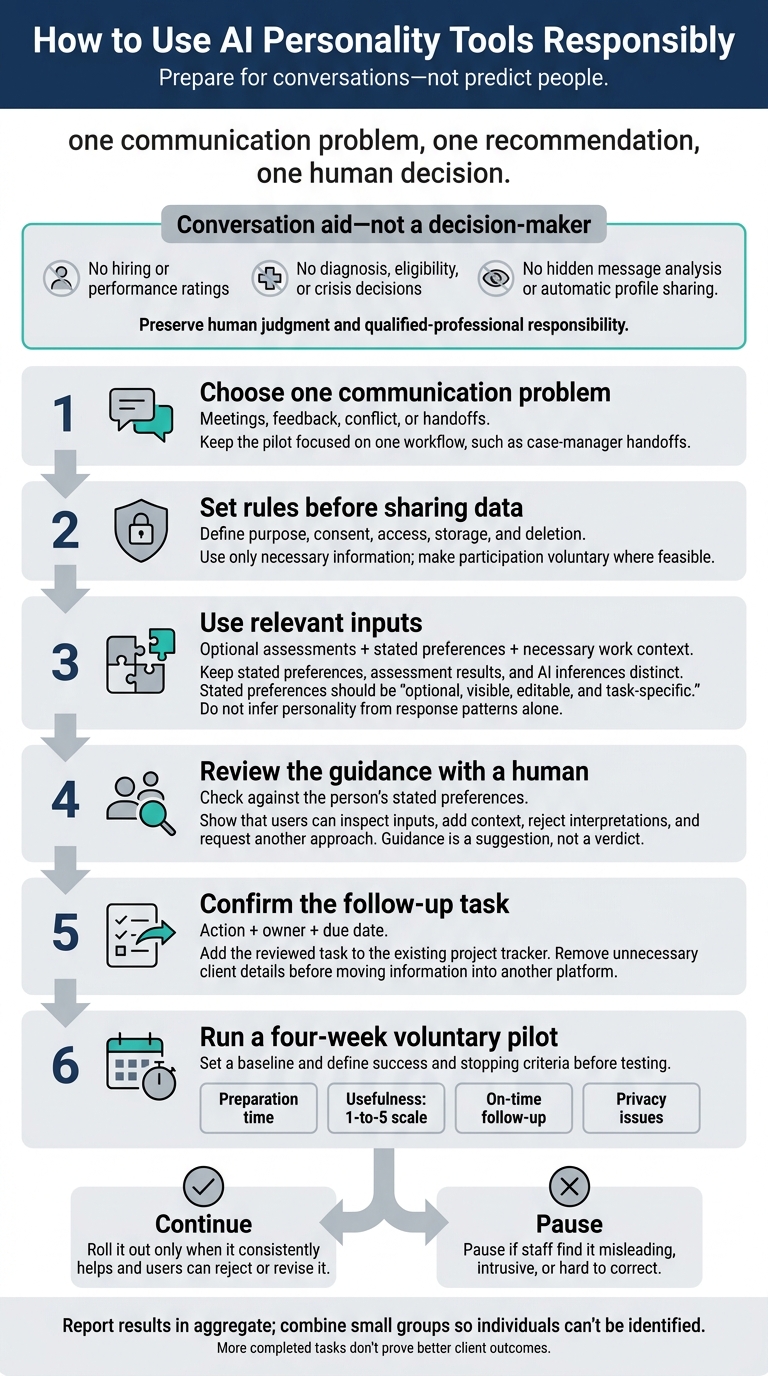
How to Use AI Personality Tools Responsibly
Where personality insights come from
Personality assessments and stated preferences
The Five-Factor Model (Big Five) describes five broad traits: openness, conscientiousness, extraversion, agreeableness, and neuroticism. Scores point to tendencies, not a fixed identity. Each assessment needs evidence of its validity. AI guidance also needs evidence that it improves the intended outcome.[8]
Personos measures 30 traits on an 80-point scale; treat those scores as one input for tailored guidance, not proof that the guidance works.
Voluntary preferences describe how someone wants to receive feedback, communicate, or make decisions. Keep them optional, visible, editable, and task-specific. Don't derive them from a score.
Work context, behavior, and user corrections
Broad traits tell only part of the story. Current work context helps determine which guidance fits now. Roles, goals, deadlines, decision authority, relationship history, and interaction notes can shape advice, but use only what the task requires.
Message or meeting analysis requires tool support, notice, consent, and access controls. This is especially critical when trying to read personality types in meetings or digital threads.[9] Response patterns alone cannot establish personality. Workload, stress, disability, and context can all produce the same behavior.
| Data source | Reasonable indication | What it cannot establish | Origin |
|---|---|---|---|
| Completed personality assessment | Self-reported tendencies | Identity, competence, diagnosis, or behavior across settings | Voluntary |
| Stated preferences | Current communication preferences | Permanent traits or universal preferences | Voluntary |
| Role, goal, deadline, or task status | Current requirements and constraints | Personality, motivation, or intent | User- or system-supplied |
| Relationship history or interaction notes | Prior agreements and friction | A complete account or cause of a reaction | User-supplied or documented |
| Authorized message or meeting analysis | Features of an interaction | Reliable traits, character, or intent | Inferred; requires consent |
| User correction | Fit of guidance to the situation | Universal accuracy | Voluntary |
Confidence should track the evidence, including its quality, relevance, and consistency, not how convincing the AI sounds. A current stated preference offers a better basis for choosing a communication channel than surface writing style. Ask vendors for assessment validation and product-specific outcome evidence. Support for the Big Five does not prove that a particular prompt improves collaboration.[8]
Users should be able to see which inputs shaped a suggestion, add context, reject interpretations, and request another approach without sharing more personal information. Corrections should separate temporary circumstances from lasting preferences. Save them only when the user chooses to, and provide controls to revise or delete stored information.
Turn these inputs into specific guidance that users can review.
How teams and frontline staff use the guidance
Once the guidance reflects the current context, teams can use it to prepare for their next conversation.
Preparing for meetings, feedback, conflict, and handoffs
Build an agenda that names the decision needed, shares questions ahead of time, and gives people written or live ways to contribute. Invite quieter participants to weigh in without assuming why they’re quiet.
Peers can agree on communication channels and response times. Managers can give private feedback tied to behavior. Frontline staff can confirm client preferences.
Keep the focus narrow: one communication problem, one recommendation, one human decision.
| Collaboration problem | Tool insight | Human action | Limitation |
|---|---|---|---|
| A meeting favors the most vocal participants | Suggest written input ahead of time and several ways to contribute | Invite responses, guide turn-taking, and document decisions | Silence may reflect access, comfort, timing, or disagreement |
| Feedback is becoming personal or vague | Focus the issue on observable behavior and its impact | Give private, specific feedback and ask what support is needed | A suggested script may leave out relevant history or context about a person’s background and customs |
| Team members disagree about next steps | Generate neutral questions and different interpretations | Check facts, hear each perspective, and use professional judgment to decide | The tool may gloss over real differences or miss power dynamics |
| A case or project is handed off | Suggest a structured summary and follow-up checklist | Share only necessary information and confirm ownership | Personality information can create privacy, bias, or labeling risks |
In frontline work, this guidance also helps staff prepare for sensitive, rushed, or high-stakes conversations, which can reduce burnout among social workers and other care providers.
Supporting difficult client conversations
Hypothetical nonprofit example: Before discussing missed appointments, a case manager could use Personos Chat to organize the client’s concerns, options, and purpose. The worker could prepare two questions: What made the last appointment difficult to attend? and Which available option would work better for you? Offer phone, video, or another time only if the agency provides them. Explain the conversation’s purpose, listen for barriers, preserve the client’s ability to decline, confirm the next action, and document only what is necessary in the approved case-management system.[1][10]
This can cut prep time, but judgment and care remain human responsibilities. The worker still needs escalation procedures and crisis resources. AI should not determine eligibility, diagnose the client, or create a care plan on its own.[5][10]
Turning Personos guidance into follow-up tasks
After a conversation, turn the guidance into a tracked task rather than leaving it as a loose note.
Personos can turn guidance into a task for human review. Confirm the action, owner, and due date before adding it to the team’s existing project tracker.[1]
Before sharing reports or tasks, check who can see them, how long they’re stored, and what data moves into other tools. Remove unnecessary client details before moving them to another platform.[1][10]
Risks and safeguards for leaders
When personality guidance enters meetings, feedback, and shared trackers, leaders need clear rules for how people use it.
Personality guidance is a conversation aid, not a performance measure, clinical assessment, or replacement for asking someone directly.
Avoid labels and employee surveillance
Use conditional language rather than labels:
may prefer more preparation
Ban hidden message analysis, automatic profile sharing, and work or leadership assignments based on traits. Do not reuse collaboration profiles for hiring, firing, ranking, pay, or promotion. Employment use requires separate, job-related validation and compliance with equal-employment rules.[11][14]
Check for adverse impact, not just average accuracy. Under the EEOC four-fifths rule, a protected group’s selection rate below 80% of the highest group’s rate may signal adverse impact. Passing that threshold does not prove that a process treats groups fairly.[17][18]
Staff must be able to inspect interpretations, add context, request corrections, and get human review without penalty. Designate an HR or privacy contact who can investigate concerns and pause harmful use.
Set consent, data, and review rules
Put the rules in writing before rollout. A written use policy should state the purpose and explain the benefits, risks, and data sources. Get specific informed consent, and make participation voluntary where feasible.
Collect only necessary data. Define who can access it, how long it stays on file, and how it will be securely deleted. Give staff correction rights and reviewers the authority to reject outputs. Clearly separate stated preferences, assessment results, and AI inferences. Do not present them as equally reliable.
Test validity, accessibility, and bias before deployment and after changes to the model or workflow.[15][16]
Before sharing client information or AI guidance across work systems, review each vendor’s encryption, access logs, subcontractors, breach reporting, use of vendor data to train the model, and contractual confidentiality protections.
Marketing to helping professionals does not establish HIPAA compliance. Where HIPAA applies, a cloud provider handling electronic protected health information generally needs an appropriate business associate agreement and must comply with HIPAA Rules.[12][13] Keep clinical and crisis decisions with qualified professionals, not personality-generated risk scores.
Conclusion: When to add personality guidance
Use personality guidance as a collaboration aid, not a prediction tool. Add it when staff need help preparing for conversations, coordinating handoffs, and tracking follow-up. It shouldn’t promise certainty about how someone will behave.
To test it, run a four-week voluntary pilot on one workflow, such as case-manager handoffs. Set a baseline, then track preparation time, usefulness on a 1-to-5 scale, on-time follow-up, and privacy issues. Decide what counts as success and when to stop before testing begins.[19][21][23]
Report results in aggregate and combine small groups so individuals can’t be identified.[20][22] More completed tasks don’t prove better client outcomes. Those claims require a separate evaluation.[19][23]
Roll it out only when it consistently helps and users can reject or revise it. Pause if staff find it misleading, intrusive, or hard to correct.[23]
FAQs
What if AI advice conflicts with someone’s stated preferences?
When AI advice clashes with your stated preferences, tools like Personos explain the reasoning behind it, including the situation, personality traits, and psychological principles involved. You decide whether to follow the advice. Instead of telling you what to do, this transparency lets you assess the reasoning while staying in control of your professional interactions and decisions.
How can frontline staff benefit without sharing sensitive data?
Frontline staff can use platforms like Personos for situation-specific guidance while protecting sensitive data. Before information reaches the AI, rotating placeholders replace real names and contact details. The AI processes only anonymized context [1][3].
Individual personality scores aren't shared with others, and user data isn't used to train AI models. These safeguards keep sensitive interactions and personal profiles confidential [1][4][5].
How do we know personality guidance improves collaboration?
Personality guidance draws on the Five Factor Model, backed by decades of peer-reviewed research on team performance, relationship dynamics, and leadership effectiveness [1][2][3][4].
Tools like Personos put this research into clear, science-backed steps that help reduce misunderstandings and build psychological safety [1][5][6]. Teams that use personality-aware insights consistently communicate better, show higher engagement, and perform better on work that requires collaboration [2][7].