AI Literacy for Social Workers: Guide
Guide to AI literacy for social workers covering core concepts, ethical limits, tools, and practical training for safe use.
Rachel Johnson

AI Literacy for Social Workers: Guide
AI literacy is becoming a must-have skill for social workers. It helps navigate tools like predictive analytics, chatbots, and apps while ensuring ethical use and excellence. Here's what you need to know:
- What is AI literacy? It's understanding AI tools, their strengths, and their risks (like biases or privacy concerns).
- Why does it matter? AI can handle tasks like documentation or crisis support, saving time for client care.
- Key skills: Learn basic AI concepts (e.g., machine learning, natural language processing), ethical evaluation, and practical use in social work.
- Training options: Affordable courses like Walden University’s $25 AI micro-course or NYU Silver’s $1,200 certificate program.
- Best tools: Specialized platforms like Personos offer privacy-focused, personality-aware guidance for $9/month.
Social workers should combine training, hands-on practice, and ethical vigilance to improve outcomes while keeping human connection central.
Ethical AI for Social Workers | Dr. Marina Badillo-Diaz
Core Components of AI Literacy for Social Workers
AI literacy for social workers revolves around three main pillars: understanding basic AI technologies, learning how to use these tools in practice, and evaluating their ethical implications. Together, these components equip social workers to make thoughtful decisions about incorporating AI into their work.
Understanding Basic AI Technologies and Concepts
At the heart of AI literacy is familiarity with key technologies like machine learning, which uses historical data to predict risks, and natural language processing, the backbone of chatbots offering 24/7 crisis support. Predictive analytics helps forecast future scenarios, while generative AI can assist with tasks like drafting notes or grant applications. However, generative AI has a notable downside: it can produce convincing but inaccurate information, often referred to as "hallucinations" [1][2][3]. Other technologies, like computer vision (analyzing facial expressions) and affective computing (detecting emotions in digital interactions), also play a role in social work [1].
Understanding algorithmic bias is equally critical. This occurs when AI systems unintentionally reinforce existing biases, creating ethical challenges [1].
As Eliezer Yudkowsky cautions: "By far, the greatest danger of Artificial Intelligence is that people conclude too early that they understand it" [4].
These foundational insights help social workers use AI tools thoughtfully and responsibly to sustain emotional resilience.
Using AI Tools in Social Work Practice
Once the basics are clear, social workers can explore specific ways AI tools enhance their practice. For instance:
- The Trevor Project collaborated with Google.org to create the Crisis Contact Simulator, an AI tool that helps counselors practice conversations with LGBTQ youth in crisis [1].
- DataKind partnered with food pantries to develop machine learning models predicting client dependency levels, allowing better resource allocation to combat food insecurity [1].
- The Department of Veterans Affairs introduced "Annie", a mobile app that uses automated SMS reminders to help veterans track health metrics and stay motivated. Clinicians can monitor this data remotely [1].
These examples highlight how AI can streamline specific tasks - like training, resource prioritization, or remote monitoring - while leaving critical decision-making in the hands of social workers. Between 2019 and 2022, research on AI in social work surged, with a notable focus on areas like child protection and child welfare [4].
Assessing AI Capabilities and Ethical Limits
Understanding AI's limitations is just as important as recognizing its potential. The European Commission defines AI as "systems that display intelligent behavior by analyzing their environment and taking actions - with some degree of autonomy - to achieve specific goals" [1]. However, current research makes it clear:
"Current AI is still far from effectively recognizing mental disorders and cannot replace clinicians' diagnoses in the near future" [1].
Social workers must critically evaluate AI tools, keeping ethical principles like informed consent, client autonomy, privacy, confidentiality, and transparency at the forefront [1]. The concept of the "moral crumple zone" underscores the risks practitioners face: they may be held accountable for AI failures, even if they lack control over the technology [5].
To mitigate risks, social workers should consider steps like forming digital ethics committees, organizing diverse focus groups, peer-reviewing algorithms, and maintaining detailed test logs. These measures help prevent overreliance on AI while ensuring professional judgment remains central [1].
The National Association of Social Workers last updated its ethical standards for technology in 2017, before the rise of modern generative AI tools. This makes it even more crucial for professionals to verify AI-generated outputs, treat them as drafts requiring human oversight, and remember that AI is a tool to assist - not replace - human expertise [1][3][5].
How to Use AI in Social Work
Using AI for Mediation and Conflict Resolution
AI tools are reshaping how social workers manage challenging client interactions and navigate complex family situations. Predictive analytics, for instance, can analyze historical case data to identify early signs of conflict. These systems can flag potential child neglect patterns, enabling social workers to act proactively rather than waiting for emergencies to arise [6].
During mediation sessions, AI chatbots provide instant access to case details, such as custody agreements or meeting histories. This ensures that social workers can stay focused on the discussion without having to dig through files [6]. The ability to retrieve information on the spot keeps the process smooth and centered on the clients' needs.
AI-powered tools like Abby offer emotional support outside of standard office hours, bridging critical service gaps for clients who may need someone to talk to late at night [6]. Another tool, Personos, incorporates personality psychology into conflict resolution. Using the Five Factor Model, it evaluates 30 personality traits on an 80-point scale to provide tailored, real-time guidance during difficult interactions. If a social worker encounters a resistant client or needs to build trust quickly, Personos adapts its strategies to suit both the practitioner’s and the client’s personality profiles. This personalized approach can help turn potential conflicts into opportunities for collaboration.
"Social workers are uniquely positioned to lead the charge, to ensure that AI remains a tool that supports human connection, not replaces it." – Ja'Bree Harris, MSW and Public Policy and Advocacy Manager for the National Association of Social Workers [6]
Transparency is essential when using AI in social work. Clients should be informed about how these tools are being utilized, and social workers must obtain consent. While AI can suggest interventions, the final decisions always rest with the practitioner [6].
These advancements in mediation naturally contribute to greater efficiency in handling administrative responsibilities and supervision.
Streamlining Case Documentation and Workflow
AI is also revolutionizing case management by taking over time-consuming administrative tasks, allowing social workers to focus more on their clients. Platforms like Binti can record meetings and automatically generate case notes, reducing administrative work by as much as 40% [6]. This means social workers can dedicate their full attention to client interactions instead of worrying about keeping up with documentation.
The adoption of AI in social work has been growing rapidly. In 2025, 30% of social workers reported using AI in their daily routines, up from 21% in 2024 [6]. AI tools can draft treatment plan goals, develop psychoeducation materials, and organize raw data into structured case notes. However, practitioners must always review these outputs to ensure they are accurate and free from bias [6].
AI chatbots also make it easier to retrieve specific records. For example, a social worker could ask, "When was the last custody hearing?" and receive the exact information without sifting through files manually [6].
To protect client confidentiality, social workers should avoid using generic AI tools like ChatGPT for sensitive information. Instead, they should rely on secure, industry-specific platforms that offer encryption and comply with privacy laws [6]. The aim is to automate routine tasks while ensuring that the human connection remains at the heart of social work practice [6].
How to Evaluate AI Tools for Social Work
Personos vs Generic AI Tools: A Comparison
When it comes to using AI in social work, understanding the differences between specialized solutions and generic tools is essential. Generic AI platforms like ChatGPT, Gemini, and Microsoft Copilot can handle tasks like research and administration, but they often fall short in client-facing scenarios. These tools sometimes produce misleading information and rely on broad safety measures that don’t align with the specific ethical standards of social work. This lack of tailored safeguards can make them unsuitable for more nuanced professional applications [2].
On the other hand, specialized platforms such as Personos take a more focused approach. Using the Five Factor Model, a scientifically validated framework, Personos evaluates 30 personality traits on an 80-point scale. This enables it to provide real-time, personality-aware guidance, especially useful in conflict resolution and trust-building. Unlike generic tools, which offer generalized responses, Personos customizes its recommendations based on both the practitioner’s and the client’s personality profiles. Moreover, it incorporates privacy-first principles and ethical safeguards that are specifically designed for social work, addressing the shortcomings of generic AI tools. These features align seamlessly with the ethical considerations that are foundational to the field.
| Feature | Generic AI Tools (e.g., ChatGPT, Copilot) | Personos |
|---|---|---|
| Primary Function | General research and administrative tasks | Personality-aware mediation and conflict resolution |
| Ethical Framework | Broad safety filters with limited relevance to social work | Ethical safeguards tailored to social work |
| Contextual Depth | Often generates generic responses | Delivers customized, context-specific guidance |
| Privacy Design | Basic data protection | Privacy-first design with encryption and strict controls |
This comparison underscores the importance of choosing AI tools specifically designed for the complexities of social work, helping practitioners better meet the needs of their clients.
What to Look for in AI Tools
Given these differences, it’s crucial to focus on specific features when selecting an AI tool for social work. Start by prioritizing privacy and data protection. Any tool you consider should have robust safeguards to prevent unauthorized access to sensitive client information. Look for platforms that offer strong encryption, adhere to HIPAA regulations, and clearly outline how data is stored and used [2].
Transparency and informed consent are equally important. The platform should make it easy to communicate openly with clients and document their consent when AI-generated content is used. As Walden University highlights:
"The need for transparency, informed consent, and consistent monitoring is stressed" [2].
This ensures that social workers can track how AI tools are integrated into their casework.
Another key factor is human-centric design. AI should act as a supportive tool, enhancing - not replacing - professional judgment. Walden University also emphasizes:
"The importance of keeping the focus on the 'human touch' while leveraging the benefits of technology in practice" [2].
The right tool will provide real-time insights while leaving the final decisions in the hands of the practitioner.
Lastly, evaluate the tool’s approach to bias mitigation and accuracy. Ask vendors how they address issues like hallucinations or inaccuracies in AI responses. Reliable platforms will have mechanisms to reduce errors and monitor content for ethical alignment [2].
For social workers managing demanding caseloads, the right AI tool can make a significant difference. By offering personality-aware communication and reducing administrative strain, these tools help improve client outcomes and alleviate practitioner burnout.
How to Build AI Literacy Through Training
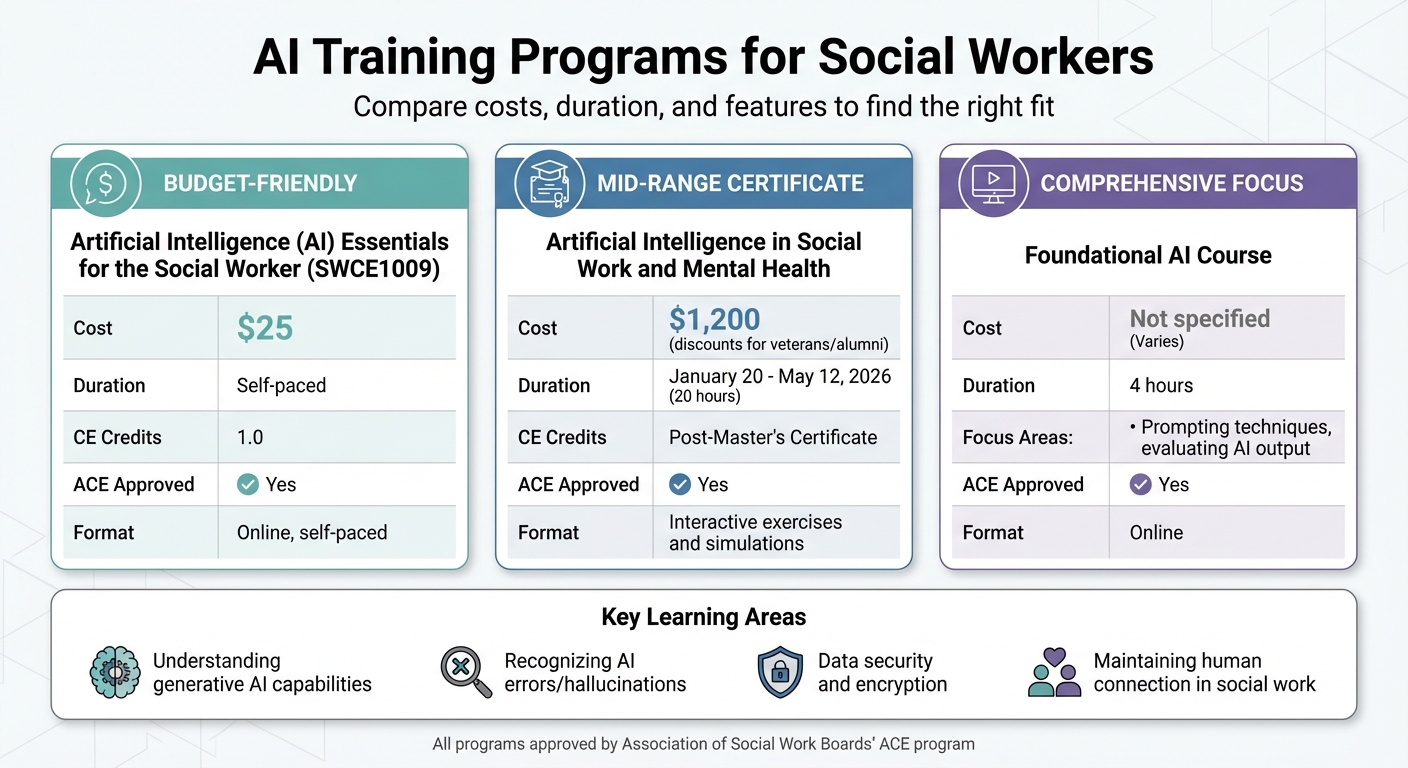
AI Training Programs for Social Workers: Cost and Duration Comparison
Professional Development and Training Programs
To effectively integrate AI into social work, continuous education is essential. Social workers can begin their AI literacy journey through structured professional development programs. Opting for courses approved by the Association of Social Work Boards' Approved Continuing Education (ACE) program ensures that the credits earned count toward licensure renewal [8]. Since the National Association of Social Workers (NASW) last updated its technology standards in 2017 - well before the advent of generative AI - professional development remains a key avenue for staying informed [3].
There’s a range of accredited programs available, catering to different budgets and schedules. For instance, Walden University offers a self-paced micro-course, Artificial Intelligence (AI) Essentials for the Social Worker (SWCE1009), which provides 1.0 CE credit for $25. Meanwhile, NYU Silver’s 20-hour Post-Master’s Certificate in Artificial Intelligence in Social Work and Mental Health costs $1,200 (with discounts for veterans and alumni) and runs from January 20 to May 12, 2026 [2][8]. Another option is the Digital Education Council's 4-hour foundational course, which focuses on prompting techniques and evaluating AI-generated output [9].
Key areas that training should cover include understanding generative AI’s capabilities, recognizing errors or "hallucinations", ensuring data security through encryption, and maintaining the human element in social work [2][3]. Marina Badillo-Diaz, an LCSW and Adjunct Professor at Hunter College, highlights the importance of adapting education to include AI literacy:
"Social work education and training programs will need to evolve to include teaching AI literacy to make sure that future social workers are equipped to use these technologies effectively." [3]
While formal courses lay the groundwork, practical experience is equally important for applying these concepts in real-world scenarios.
Getting Hands-On Practice with AI Tools
Practical experience complements formal training by helping social workers build confidence and proficiency with AI tools. Programs like NYU Silver’s certificate course include interactive exercises and simulations that mirror real-world applications, such as case management, documentation, and supervision [8]. Similarly, workshops like AI for Social Work 101 (available for group purchase at $100) focus on skills like prompt engineering, which tailors AI responses to align with clinical needs [10]. Marina Badillo-Diaz underscores the importance of this skill:
"Learning this skill [prompt engineering] is vital, as it can shape the AI's responses to be more aligned with the nuanced needs of their service." [10]
In addition to formal training, social workers can explore platforms tailored to their field. For example, Personos (https://personos.ai) provides real-time, personality-aware guidance for handling challenging client interactions. At $9 per seat per month, it’s a practical tool for crisis intervention and conflict resolution. The platform’s transparent reasoning feature explains the psychological principles behind its recommendations, allowing professionals to deepen their understanding over time.
When experimenting with AI tools, it’s crucial to safeguard client confidentiality - never input identifiable information into AI systems [3]. Additionally, always verify the accuracy and neutrality of AI-generated content before incorporating it into practice [3]. By combining hands-on practice with formal education, social workers can confidently and ethically integrate AI into their work.
Conclusion: Using AI Literacy to Improve Social Work Practice
Developing AI literacy can transform social work by improving client outcomes, reducing practitioner burnout, and addressing complex challenges. With tools like predictive analytics, social workers can make better decisions, automate routine tasks such as drafting client notes and treatment plans, and tackle larger objectives like community assessments or grant writing [3][7]. These advancements free up time and energy, enabling professionals to focus on meaningful, human-centered interactions.
However, keeping the human element intact is essential when integrating AI into social work. Marina Badillo-Diaz, LCSW and Adjunct Professor at Hunter College, highlights this balance:
"AI should not replace the human aspect of social work practice; instead, our professionals should still promote and practice interpersonal interaction, genuine communication, and empathy" [3].
AI literacy equips social workers to recognize algorithmic bias, identify AI-generated inaccuracies or "hallucinations", and validate outputs using their expertise [3].
Getting started with AI literacy doesn’t require a large investment. For instance, a $25 micro-course can provide a solid introduction [2]. Additionally, tools like Personos (https://personos.ai), priced at $9 per seat per month, offer real-time, personality-aware guidance for handling crises and resolving conflicts [3].
Since the National Association of Social Workers last updated its technology standards in 2017 - before generative AI became widespread - ongoing training and practice are crucial [3]. Social work is evolving rapidly, and collaboration between social workers and technologists is shaping tools that align with the profession’s core values [3].
To start embracing these advancements, consider AI training programs approved by the Association of Social Work Boards' ACE program, adopt specialized tools like Personos, and establish ethical guidelines that reflect social work principles. By doing so, you’ll not only work more efficiently but also extend your impact while keeping empathy and human connection at the heart of your practice [3].
FAQs
How can I use AI without violating client confidentiality?
To use AI while safeguarding client confidentiality, start by ensuring the platform you use meets strict privacy standards and incorporates strong security measures, such as encryption. It's also crucial that data is stored securely. Always be upfront with clients about how AI is integrated into your processes, including what data is collected and how it will be handled. Opt for tools that prioritize ethical practices to protect sensitive information, and stick to professional guidelines to maintain trust and confidentiality.
How can I identify AI bias or 'hallucinations' in my casework?
AI bias happens when the results of an AI system mirror the prejudices or imbalances present in its training data. On the other hand, "hallucinations" refer to instances where the AI generates completely fabricated or incorrect information. Both issues can lead to unreliable outputs, which is why it's crucial to approach AI-generated content with a critical eye.
To identify these problems, cross-check the information against trusted sources and apply your professional judgment. Be on the lookout for red flags like inconsistencies, overly broad statements, or a lack of meaningful context. For tasks involving client-related decisions, it's especially important to double-check AI recommendations to ensure accuracy and fairness.
Finally, staying updated on ethical AI practices is key. This helps you better understand how to use these tools responsibly and minimize potential risks in fields like social work.
When should I use Personos instead of a generic AI tool?
When you need personalized, real-time guidance that takes individual personality traits and complex human interactions into account, Personos is the tool to turn to. Unlike one-size-fits-all AI solutions, Personos is specifically designed for professionals. It offers features like personality-aware insights, dynamic reports, and actionable nudges to help navigate challenging situations.
Personos shines in high-pressure scenarios like trust-building, crisis management, and situations where measurable results are critical. It's especially valuable in demanding social work environments, helping to improve outcomes while easing the strain that can lead to burnout.