AI in Reflective Practice: Research Insights
Studies show AI can make professional reflection more structured, personalized, and actionable while posing ethical, privacy, and bias risks.
Nick Blasi

AI in Reflective Practice: Research Insights
Reflective practice helps professionals analyze experiences to improve decision-making and self-awareness. AI tools are now enhancing this process by guiding users through structured reflection and providing personalized feedback. Tools like Pensée and InnerPond have shown measurable improvements in reflection quality, metacognition, and professional confidence. For example:
- Pensée, tested with 93 participants, improved structured reflection scores from 2.13 to 4.38.
- InnerPond uses AI agents to represent internal perspectives, aiding clarity in complex decisions.
- APIA, used by mental health professionals, boosted perceived competence in therapy tasks (p < 0.01).
These tools reduce cognitive load, offer tailored insights, and support professionals facing heavy workloads and burnout among social workers. However, risks like overreliance, data privacy concerns, and "algorithmic reflectivity" (AI mimicking but not truly understanding reflection) require careful design and ethical considerations. Platforms like Personos, built on psychological models, such as the Five Factor Model for AI-assisted therapy, address these issues by offering context-specific guidance while prioritizing privacy and professional boundaries.
AI can complement - not replace - human judgment, making reflective practice more structured and actionable. However, more research is needed to explore long-term impacts on client outcomes and equity.
Key Research Findings on AI in Reflective Practice
Deeper and More Structured Reflection
AI tools aren't just simplifying the process of reflection - they're transforming its quality. A March 2026 study involving 93 vocational students in Switzerland demonstrated the impact of the Pensée tool. It significantly improved structural quality scores, jumping from 2.13 to 4.38, and boosted metacognition scores from 0.20 to 0.58 based on the Gibbs Reflective Cycle scale [3].
What makes tools like Pensée so effective is their ability to enhance the planning and translation stages of reflection, even before any writing begins. By employing a conversational agent to guide users during the planning phase, Pensée reduced cognitive strain and encouraged deeper, more analytical reflections. This approach shifted writing away from surface-level insights and toward a richer, more structured analysis [3].
These structural improvements are further amplified when tools provide tailored feedback, creating even more opportunities for meaningful reflection.
Personalized and Context-Specific Reflection
When feedback is personalized and tailored to specific contexts, it far outshines generic prompts. Take the CARE system, developed by researchers at Stanford University and Georgia Tech, as an example. This system paired novice counselors with simulated patients and offered structured feedback. The results were noteworthy: participants receiving feedback improved client-centered microskills - like reflections and open-ended questioning - with effect sizes ranging from d = 0.32 to 0.39. In contrast, those who practiced without feedback experienced a decline in empathy scores, with an effect size of d = -0.52 [7].
"Combining simulated practice with structured feedback is critical for meaningful improvement." - Ryan Louie, Lead Researcher, Stanford University [7]
This ability to provide context-aware feedback addresses two major concerns in helping professions: burnout and the quality of client interactions. For instance, platforms like Personos leverage this concept by using individual personality profiles based on the Five Factor Model. These profiles help tailor real-time guidance to specific client scenarios, ensuring reflections are not only structured but also highly relevant. This personalized approach ties directly to improved client outcomes and more meaningful professional development.
Effects on Professional Growth and Client Outcomes
The benefits of AI tools extend beyond reflection quality - they also drive professional growth and enhance client outcomes. A study conducted in March 2026 at Seoul National University introduced InnerPond, a system grounded in Dialogical Self Theory. This tool assigned AI agents to represent different internal "I-positions", helping participants explore their internal conflicts. Among 17 young adults, the system encouraged a meta-cognitive perspective, allowing them to view internal conflicts as interconnected parts of a unified identity. This shift helped participants approach complex decisions with greater clarity [4].
Benefits and Limitations of AI in Reflective Practice
Benefits of AI Tools
AI tools bring several advantages to reflective practice, making them valuable for professionals in various fields. For instance, tools like Pensée help reduce cognitive load by automatically identifying and organizing key concepts from conversations, allowing practitioners to concentrate on deeper reflection instead of administrative tasks [3].
A study conducted in March 2026 at the University of Zurich highlighted another benefit: mental health professionals using the AI agent APIA reported increased task efficiency and a significant boost in their perceived competence (p < 0.01) [1]. Andreas Bucher, the lead researcher, explained:
"GenAI-based digital agents can positively influence mental health professionals' sense of competence and, to a lesser extent, autonomy in asynchronous online psychotherapy settings." [1]
For professionals juggling demanding workloads, such tools can offer much-needed support, enhancing both their confidence and productivity, while helping sustain emotional resilience in high-stress environments.
Risks and Ethical Considerations
Despite these advantages, AI in reflective practice comes with its own set of challenges. A major concern is the risk of overreliance. When practitioners depend too heavily on AI to guide their reflective processes, they may lose the ability to independently analyze and derive insights from their experiences [8]. This issue is particularly concerning for less experienced professionals, who might delegate critical judgment to systems that lack true experiential understanding.
Another challenge is "algorithmic reflectivity." This occurs when AI generates content that mimics deep reflection but lacks genuine emotional or experiential depth, relying solely on linguistic patterns to produce structured outputs [6]. Additional concerns include potential breaches of data confidentiality, biases in training data, and the ethical dilemmas posed by AI's ability to mimic human emotions [2].
Reducing Risks Through Design
Thoughtful design can help minimize these risks and make AI tools safer and more effective for reflective practice. Research suggests that AI systems focused on strategic questioning and reflective summarization are perceived as more secure and professionally appropriate than those that rely on emotional mimicry [2].
"Engagement and safety may not necessarily be mutually exclusive: when grounded in boundary-aware design, therapeutic AI systems can support ethically aligned personalization while reducing risks related to dependency." [2]
- Boyoung Kang, Sungkyunkwan University
An example of this approach is Personos, an AI system that uses structured personality profiles and contextual inquiry instead of attempting to replicate emotional responses. Such tools provide personalized guidance while respecting professional boundaries. Beyond technology design, it’s equally important for practitioners to develop the skills to identify "algorithmic reflectivity." This ensures that AI remains a supportive tool rather than taking over critical decision-making [1][6].
Supporting Reflection With Journaling and Gen AI
Comparing AI Tools for Reflective Practice
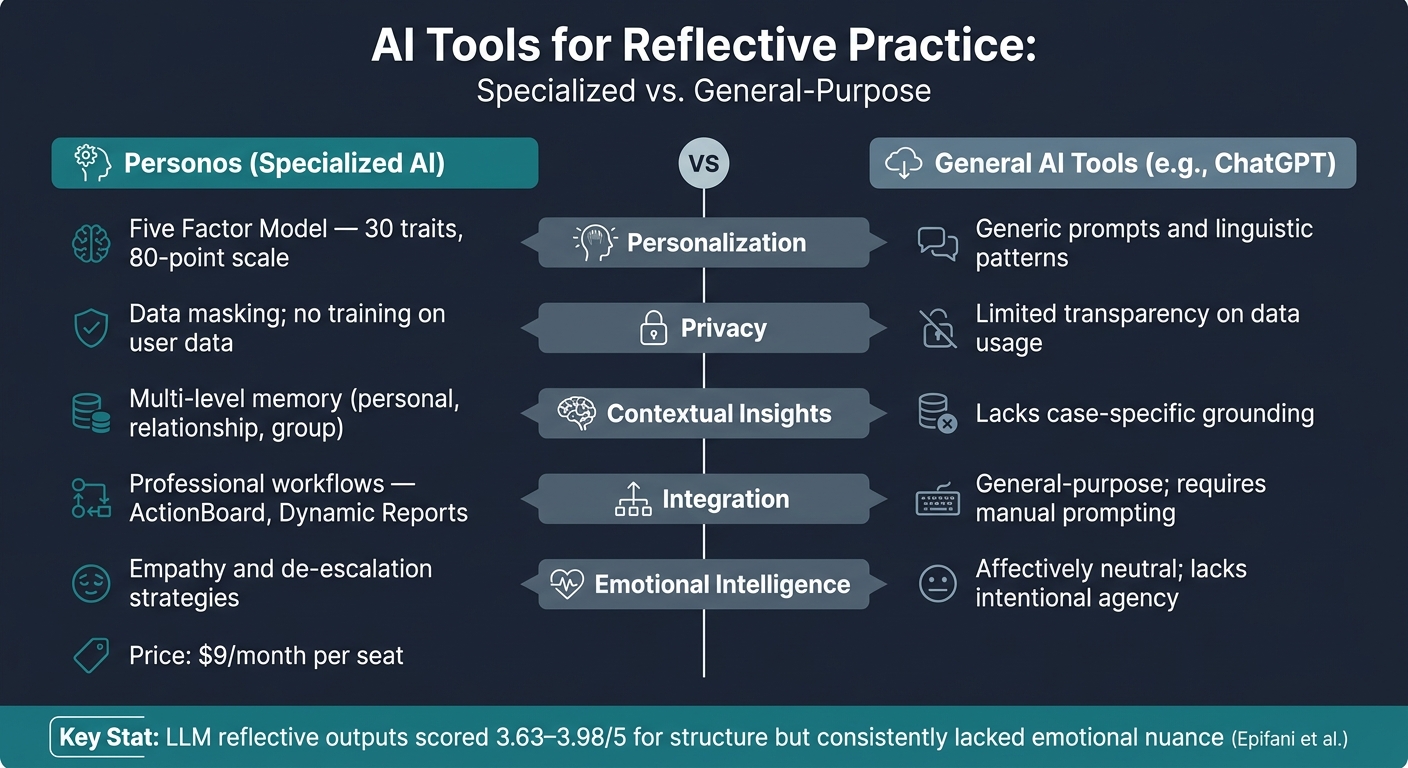
AI Tools for Reflective Practice: Specialized vs. General-Purpose
General-Purpose vs. Specialized AI Tools
AI tools vary widely in their capabilities, and this difference becomes especially important when working with people in sensitive or vulnerable situations. General-purpose large language models (LLMs) like ChatGPT can produce text that appears reflective - structured, coherent, and even insightful. However, as researchers Stefano Epifani et al. observed:
"The findings indicate that LLMs can reliably reproduce the formal linguistic structure associated with mentalization... However, this capacity reflects algorithmic reflectivity rather than psychological mentalization." [6]
In simpler terms, general AI can mimic the structure of reflective thinking but lacks genuine emotional or psychological depth. When clinicians evaluated reflective outputs generated by LLMs, they scored well for structural coherence (3.63 to 3.98 out of 5) but consistently fell short in emotional nuance [6]. This limitation is critical for professionals who need tools capable of supporting meaningful client interactions.
Specialized platforms, on the other hand, go beyond surface-level language patterns. They are built around established psychological frameworks and tailored to professional contexts. This is where tools like Personos stand out, offering domain-specific expertise designed to meet the needs of helping professionals.
What Personos Offers
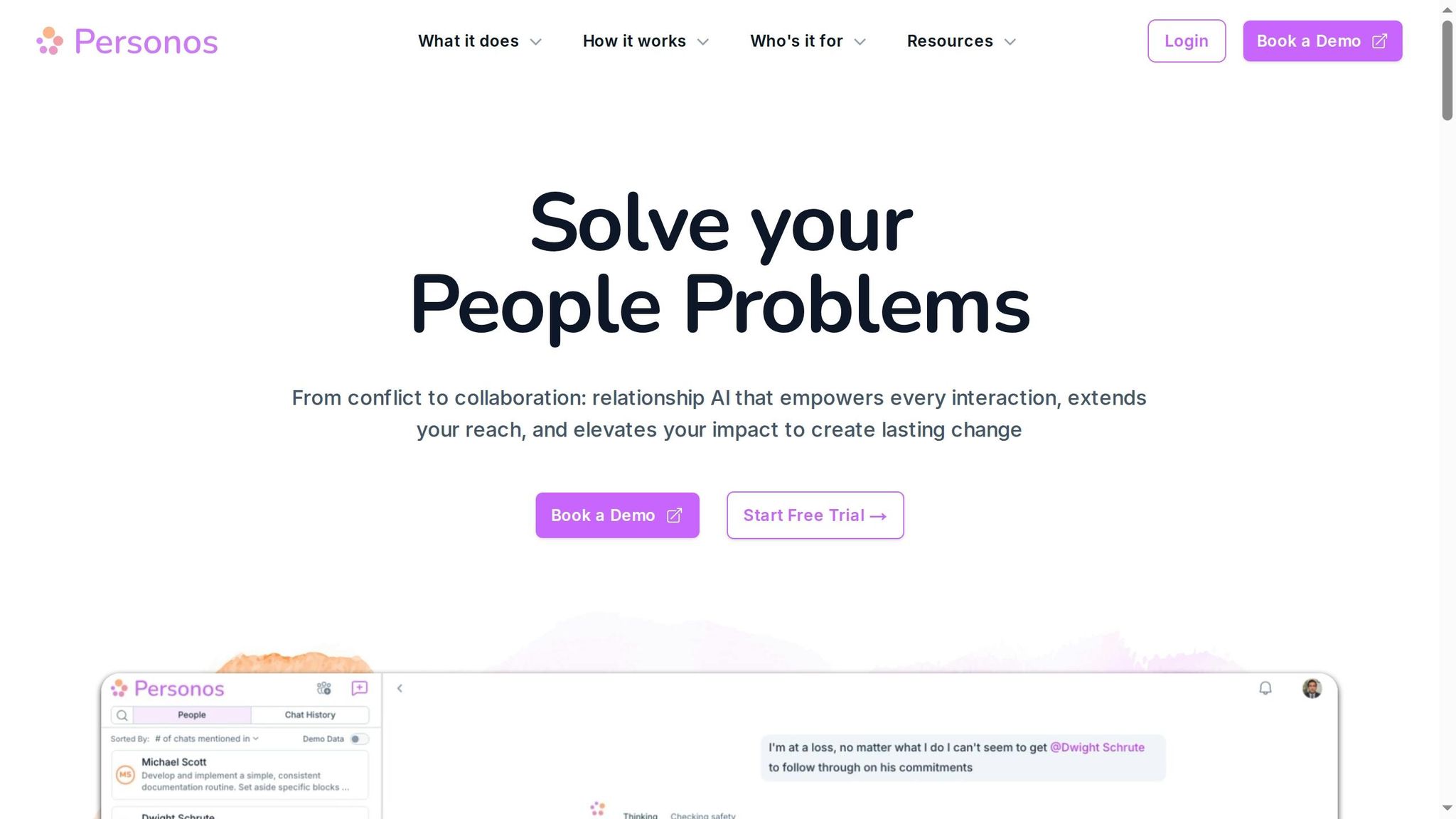
Personos is a prime example of a specialized AI tool developed for professionals like social workers, counselors, coaches, and case managers - people who require more than just a chatbot. Its foundation lies in the Five Factor Model (FFM), which evaluates 30 personality traits on an 80-point scale. This high level of detail ensures that guidance is personalized and never one-size-fits-all.
The platform’s features are designed to work together seamlessly:
- Personos Chat provides real-time, tailored guidance that considers both the practitioner’s and the client’s personality traits.
- Dynamic Reports offer customized insights at individual, relationship, and group levels, addressing dynamics like trauma responses.
- The ActionBoard translates insights into actionable, trackable tasks, making progress measurable and easy to document.
- Personos Prompts deliver timely nudges to keep practitioners aware of personality dynamics between sessions.
Privacy is a top priority. Personos ensures that sensitive information is protected by replacing real names and contact details with placeholders (e.g., "Jane Doe") before data reaches the AI. Additionally, user data is never used to train the model [10][11].
Christian Thomas, CEO and Co-Founder of Personos, captured the platform's mission perfectly:
"AI has made us more efficient in how we work and communicate, but not smarter about how we connect with people. We built Personos to change that." [12]
Comparison Table
When comparing Personos to general AI tools, the differences are clear. Personos is built with depth, professional intent, and practical application in mind:
| Feature | Personos | General AI Tools |
|---|---|---|
| Personalization | Five Factor Model (30 traits, 80-point scale) [10] | Generic prompts and linguistic patterns [6] |
| Privacy | Data masking; no training on user data [11] | Limited transparency on data usage [11] |
| Contextual Insights | Multi-level memory: personal, relationship, group [10] | Lacks case-specific grounding [6] |
| Integration | Designed for professional workflows (ActionBoard, Dynamic Reports) [9] | General-purpose; requires manual prompting [12] |
| Emotional Intelligence | Focuses on empathy and de-escalation strategies [9] | Affectively neutral; lacks intentional agency [6] |
At just $9/month per seat, Personos offers its comprehensive suite of tools - including Chat, ActionBoard, Dynamic Reports, and Transparent Reasoning - at a price point accessible even to nonprofits with limited budgets [11].
Practical Use and Future Directions
Applying AI Tools in Daily Practice
Building on earlier research, integrating AI tools into daily routines can make reflective practices more effective. A simple way to start is with a 3–5 minute post-session review: jot down challenges, successes, and uncertainties, then let the AI generate follow-up questions. Studies in healthcare settings suggest that even brief, guided check-ins like this can improve emotional processing and enhance learning [1] [5].
For more complex situations, pre-session preparation can be equally impactful. For instance, before meeting with a resistant or high-risk client, practitioners can review previous reflections and ask AI tools for personality-based strategies. Tools like Personos, which use personality profiles to tailor communication strategies, exemplify this approach. This aligns with findings that show how Personos supports personalized interventions [1] [3] [5].
AI can also play a role in reducing burnout by identifying recurring patterns, normalizing difficult experiences, and helping practitioners shift from feeling stuck to feeling in control. Platforms like Personos enhance this process by connecting reflections to actionable steps using features like the ActionBoard [3] [4] [5].
Gaps and Future Research Needs
Despite the promise of AI-supported reflective practices, there are still significant gaps in the research. Most studies focus on practitioner experiences rather than client outcomes. To fully understand the impact, longitudinal studies are needed to measure outcomes such as housing stability, reduced hospitalizations, or long-term behavior changes, alongside practitioner well-being and retention over extended periods [1].
Another critical area is equity. In fields like child welfare and justice, predictive tools have sometimes worsened racial and socioeconomic disparities when not carefully monitored [1]. Reflective AI tools could face similar challenges, yet evaluations addressing bias are scarce in current research. Additionally, there’s little direct comparison between general-purpose AI platforms and specialized tools - an important gap, as the choice of platform can significantly impact the quality of reflective practices.
Addressing these research and practical gaps will be essential for advancing the field.
Key Takeaways
AI-supported reflective practices work best when they are structured, goal-oriented, and grounded in psychological principles. Tools that integrate frameworks like the Five Factor Model and link insights to actionable steps offer far more value than generic AI chatbots. Research consistently highlights AI as a thinking partner, complementing clinical judgment rather than replacing it [2] [5].
While the potential is clear, the field still needs more rigorous, equity-focused, and outcome-driven research to keep up with its rapid adoption. For practitioners looking to get started, the advice is simple: begin with small steps, prioritize client privacy, pair AI use with supervision, and choose tools designed for professional use rather than repurposed general platforms.
FAQs
How can I tell if an AI tool is truly helping me reflect or just mimicking reflection?
To figure out if an AI tool truly helps with self-reflection, look at how well it delivers depth and personalization. For example, tools like Personos use behavioral data, communication habits, and context to give tailored and dynamic insights. On the other hand, generic tools often miss the mark because they lack subtlety and flexibility. A good AI tool should adapt to your unique situation and changing needs, offering guidance that boosts self-awareness instead of just mimicking reflective language.
What’s the safest way to use AI for reflection with client-sensitive information?
When working with client-sensitive data, it’s essential to prioritize privacy and security. Start by choosing AI tools that are designed with data protection in mind. Look for platforms that comply with regulations like HIPAA or GDPR and use encryption to safeguard information.
Avoid using public AI platforms that retain user inputs for training purposes, as this can compromise confidentiality. Transparency is also key - clearly explain how data will be used, get explicit client consent, and stick to the principle of data minimization by only collecting what’s absolutely necessary.
For added security, consider tools like Personos, which are built to handle sensitive data responsibly. These tools can mask client information, encrypt conversations, and provide ethical, secure AI support while maintaining confidentiality. By taking these steps, you can ensure your use of AI aligns with both professional standards and client trust.
Should I use a general AI chatbot or a specialized tool like Personos for reflective practice?
Recent studies indicate that specialized tools like Personos outperform general AI chatbots when it comes to reflective practice. While general chatbots often fall short in providing tailored, context-sensitive guidance, Personos combines proven principles of personality psychology with AI to offer real-time, situation-specific insights. Key features like personalized advice and progress tracking empower professionals to handle complex challenges, lower burnout rates, and achieve better results. This makes it a smarter and more ethical option.