AI in Leadership: Tailoring Styles for Success
AI tools analyze personalities, team dynamics, and communications to provide real-time coaching that improves leadership effectiveness and reduces turnover.
Nick Blasi

AI in Leadership: Tailoring Styles for Success
AI is transforming leadership by providing tools to personalize management approaches based on real-time data. Instead of relying solely on instinct, leaders can now use AI to analyze personality traits, team dynamics, and communication patterns. This helps address common workplace challenges like disengagement, miscommunication, and conflict. Tools like Personos offer actionable insights, such as:
- Customized Personality Profiles: Highlight individual strengths, preferences, and areas for improvement.
- Team Dynamics Analysis: Detects friction points and suggests solutions for better collaboration.
- Real-Time Coaching: Provides guidance for feedback, conflict resolution, and communication.
- Leadership Effectiveness Tracking: Monitors metrics like engagement and turnover to refine strategies.
Studies show that AI-driven leadership tools can boost leadership effectiveness by 35% and reduce turnover significantly. By integrating AI, leaders can make data-informed decisions, improve team morale, and create a more productive work environment.
Future Focus | From Tools to Teammates: How AI Is Changing Leadership and Work | September 27, 2025
Evaluating Leadership Styles and Team Dynamics with AI
Start by establishing a clear picture of your current environment. AI tools can sift through workplace data - like emails, meeting transcripts, chats, and feedback - to uncover patterns in leadership and team behavior. By processing thousands of interactions, AI paints an accurate picture of how people actually operate, setting the stage for refining your leadership style and team strategies.
Identifying Your Leadership Style
Platforms like Personos use AI to generate detailed personality profiles that highlight your leadership tendencies in various scenarios. These reports go beyond surface-level observations, identifying your strengths and revealing areas you might not even realize need improvement.
What makes these reports especially useful is their practicality. They don’t just stop at analysis - they provide actionable suggestions tailored to your role. For example, they might recommend asking more open-ended questions or incorporating pauses in conversations to balance assertiveness with a more receptive approach. Plus, the analysis isn’t static. As new data flows in, your profile evolves, offering real-time insights into whether adjustments - like seeking broader input or fine-tuning how you delegate tasks - are actually effective.
Once you’ve got a handle on your leadership style, it’s time to see how it meshes with your team’s dynamics.
Examining Team Dynamics with AI
AI doesn’t just stop at individual insights - it also dives into how teams function as a unit. By analyzing communication patterns, sentiment, participation levels, and interaction trends, these tools can uncover subtle issues that might not be immediately obvious. For instance, they can flag problems like one person dominating meetings, rising frustration levels, or uneven participation.
Personos takes it a step further with reports on relationship and group dynamics. These reports can identify personality clashes that might cause friction. For example, a direct communicator might unintentionally clash with someone who values harmony, leading to misunderstandings - one might feel the other is too blunt, while the other might see a lack of engagement. AI can flag these mismatches early and suggest solutions, like providing more context in conversations, validating emotions, or agreeing on feedback methods that work for both parties. At the team level, it can also uncover personality clusters that may create blind spots in planning or execution, helping you address potential conflicts or oversights before they escalate.
How to Customize Leadership Styles with AI
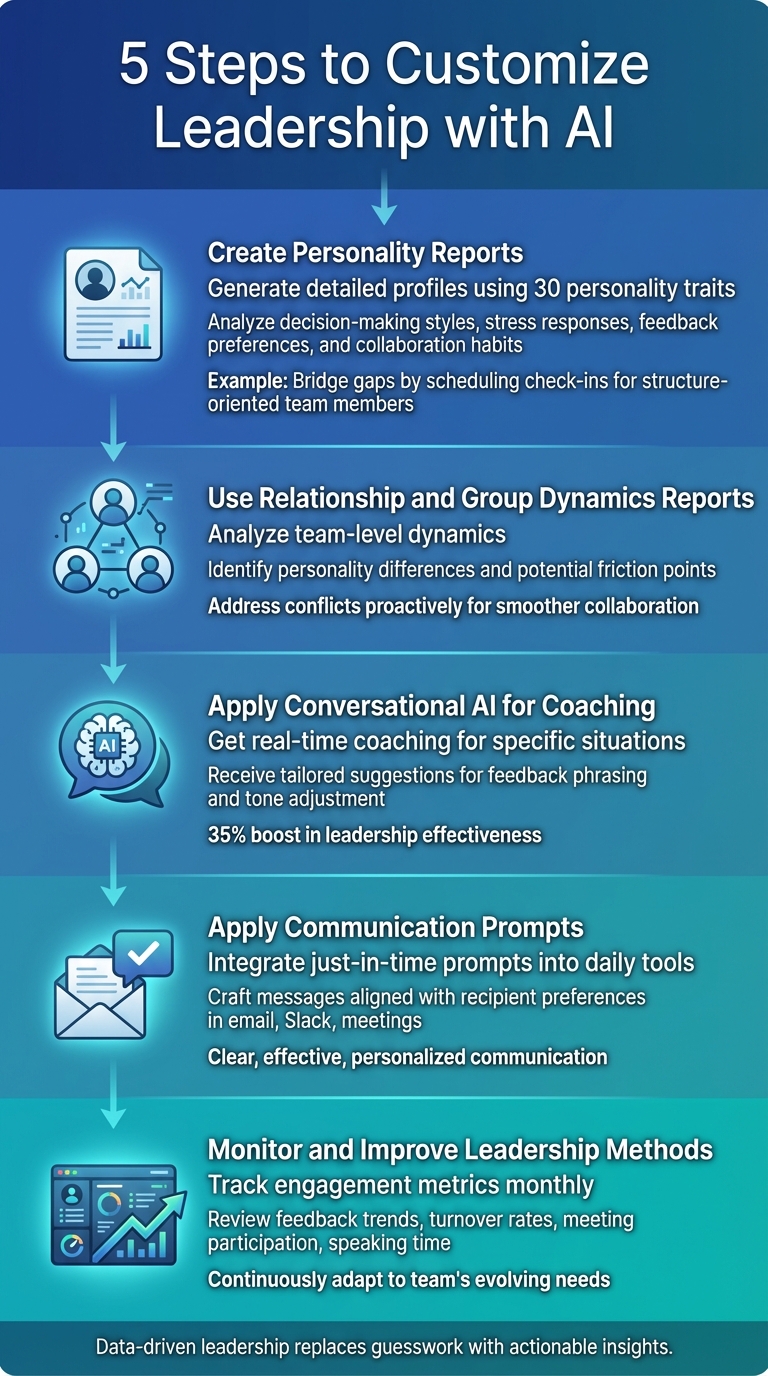
5-Step AI Leadership Customization Workflow
Once you've identified your leadership style and understand your team's dynamics, the next step is putting those insights into action. AI tools like Personos can help you translate these findings into practical changes through a structured workflow that integrates seamlessly into your daily routine. The idea is to rely on data-driven decisions instead of guesswork, keeping the process straightforward and manageable over time. This method provides a solid foundation for tackling leadership challenges with precise, AI-guided solutions.
Step 1: Create Personality Reports
Start by generating detailed personality profiles using data on 30 personality traits, individual backgrounds, situational contexts, and consented information. These reports provide a clear picture of decision-making styles, stress responses, feedback preferences, and collaboration habits. For instance, if your leadership style leans toward a fast-paced approach but a team member thrives on structure, you can bridge the gap by scheduling regular check-ins or providing detailed agendas to support their workflow.
Step 2: Use Relationship and Group Dynamics Reports
Once individual profiles are in place, dive into team-level analysis using relationship and group dynamics reports. These tools highlight areas where personality differences might lead to misunderstandings or friction. By identifying potential conflicts early, you can address them proactively, fostering a smoother and more collaborative team environment.
Step 3: Apply Conversational AI for Coaching
Turn to conversational AI for real-time coaching tailored to specific situations. For example, before heading into a performance review, you can describe the scenario to the AI and receive suggestions on how to phrase feedback with a balance of empathy and directness. This guidance helps set clear improvement goals while adjusting tone and detail to suit different personality types. Companies using AI for leadership development have reported up to a 35% boost in leadership effectiveness, showing the impact of this approach.[1]
Step 4: Apply Communication Prompts
Incorporate just-in-time communication prompts into your daily tools like email, Slack, or one-on-one meetings. The AI can help craft concise subject lines, adjust tone, or structure messages to align with the recipient’s preferences. This ensures your communication is clear, effective, and tailored to resonate with each individual.
Step 5: Monitor and Improve Leadership Methods
Use an AI-powered dashboard to track engagement metrics such as feedback trends, turnover rates, meeting participation, and speaking time. Reviewing these metrics monthly allows you to identify patterns and refine your leadership approach. Adding brief, routine check-ins ensures your style continues to adapt to your team’s evolving needs. Over time, this consistent monitoring helps you stay aligned with your team’s goals and dynamics.
sbb-itb-f8fc6bf
Leadership Challenges and AI-Driven Solutions
Leaders face a variety of challenges that can disrupt team performance. Common hurdles include rigid leadership styles that don’t cater to diverse team needs, poor communication that leads to misunderstandings, and struggles with conflict resolution. In fact, Gallup reports that managers are responsible for at least 70% of the variance in employee engagement, emphasizing how much leadership behavior influences outcomes. Additionally, 82% of employees admit they’d consider leaving their job due to a bad manager, which highlights the steep cost of ineffective leadership and miscommunication.
Personos tackles these challenges head-on with real-time, dynamic feedback. Unlike traditional performance reviews, Personos continuously evaluates communication patterns, such as talk time balance, interruptions, and emotional tone. This provides leaders with a clearer picture of their daily interactions, allowing them to adjust their approach in real time.
The results of AI-driven leadership tools are striking. A Wall Street Journal report reveals that organizations using AI-based programs experience a 35% boost in leadership effectiveness. These tools help managers identify dysfunctional team dynamics and even provide specific wording to address issues, fundamentally changing how leaders manage communication and conflict. Below is a comparison of key leadership challenges and how Personos provides actionable solutions.
Challenges and Solutions Comparison
Here’s a breakdown of common leadership challenges, the features Personos offers, and their expected outcomes for U.S. workplaces:
| Leadership Challenge | Personos Feature | How It Addresses | Expected Outcome |
|---|---|---|---|
| Rigid leadership styles (one-size-fits-all approach) | Dynamic personality reports | Evaluates 30 personality traits, team dynamics, and context to uncover blind spots and recommend tailored leadership approaches (e.g., coaching, directive, or democratic styles). | More adaptive leadership, better alignment between style and team needs, and up to 35% improvement in effectiveness. |
| Poor communication and misalignment | Communication prompts and conversational AI | Identifies unclear messaging, negative tones, or poor listening in real time, offering guidance on rephrasing or asking better questions. | Clearer communication, fewer misunderstandings, more inclusive meetings, and higher team engagement. |
| Conflict resolution struggles | Relationship and group dynamics reports | Highlights friction points (e.g., differences in communication styles) and suggests conflict-resolution strategies, coaching leaders through tough conversations. | Faster conflict resolution, improved team cohesion, and enhanced psychological safety. |
| Low engagement and trust | Dynamic reports and task tracking | Links leadership behaviors (e.g., recognition frequency, feedback consistency) with engagement metrics and nudges leaders to take specific actions like recognizing achievements or clarifying goals. | Improved engagement, stronger trust, lower turnover, and better morale. |
| Bias and inconsistent feedback | Transparent reasoning and dynamic reports | Evaluates behaviors like responsiveness and coaching time using objective criteria, reducing reliance on subjective impressions. | Fairer evaluations, better opportunities for growth, and improved perceptions of fairness. |
| Limited time for 1:1 coaching | Conversational AI and ActionBoard | Summarizes recent interactions, highlights key areas, and suggests focused questions for coaching sessions. | More efficient 1:1s, better use of leadership time, and ongoing development rather than sporadic check-ins. |
Conclusion: AI's Role in Modern Leadership
Leadership today demands flexibility, self-awareness, and the ability to adapt quickly - qualities that AI tools are uniquely equipped to support. Throughout this guide, we've explored how AI empowers leaders to identify their strengths, understand team dynamics through personality and relationship insights, and implement tailored coaching and communication strategies. The era of rigid, one-size-fits-all leadership is fading, replaced by dynamic, personalized approaches that better address the complexities of modern workplaces.
Research shows that AI-driven leadership programs can increase effectiveness by 35% while significantly improving team engagement [1]. These benefits often lead to reduced turnover, stronger team cohesion, and higher productivity - key metrics for any successful organization.
AI doesn't replace human judgment or emotional intelligence; instead, it enhances them. Tools like Personos act as valuable partners, blending human intuition with data-driven insights. They help leaders uncover blind spots, refine their communication, and track progress over time, ensuring leadership evolves in step with the needs of their teams.
As workplaces continue to change, especially with the rise of remote and hybrid work, AI insights into team sentiment, engagement, and communication patterns are becoming indispensable. Leaders who embrace these tools can maintain trust, foster collaboration, and drive performance in even the most complex environments. By leveraging dynamic personality reports, relationship analysis, conversational AI, and proactive communication strategies, leaders can shift from periodic performance reviews to continuous development. This approach not only aligns leadership with team and organizational goals but also nurtures individual growth, creating a culture of ongoing improvement.
In a world where change is constant, leaders who integrate AI into their practices position themselves and their organizations for long-term success in an increasingly fast-paced and interconnected business landscape.
FAQs
How does AI help leaders adapt their leadership style in real-time?
AI provides leaders with personalized insights into their team members' personalities, emotions, and communication styles. This enables leaders to adjust their approach on the fly, resolve potential conflicts before they grow, and build a more harmonious and cooperative workplace.
Using AI-powered tools, leaders can access real-time advice to enhance communication, deepen connections, and tailor their actions to suit each individual's needs. This approach builds trust, increases efficiency, and helps achieve long-term success.
How does AI help leaders improve team dynamics?
AI empowers leaders to better understand their teams by analyzing personality traits, communication habits, and behavioral patterns. It can pinpoint areas where conflicts might arise, suggest ways to enhance collaboration, and offer practical advice to align individual strengths with the broader goals of the organization.
With these insights, leaders can improve communication, address conflicts more efficiently, and cultivate a team environment that is both cohesive and productive.
How can AI help leaders address workplace conflicts effectively?
AI equips leaders with tools to tackle workplace conflicts by providing tailored insights into team dynamics and individual personalities. These insights allow leaders to pinpoint the underlying causes of disagreements and take steps to enhance communication and teamwork.
Platforms like Personos offer detailed personality reports and practical strategies designed for specific scenarios. This information helps leaders address disputes constructively, build stronger relationships, and foster a more unified and efficient team.