AI Feedback for Conflict Resolution: How It Works
Personality-aware AI turns tense conversations into actionable steps that prevent escalation and rebuild trust.
Christian Thomas

AI Feedback for Conflict Resolution: How It Works
AI feedback systems are transforming how conflicts are managed by analyzing communication patterns, emotional cues, and personality traits. These tools provide real-time suggestions to de-escalate tension and guide resolution strategies. They rely on psychological frameworks like the Big Five Inventory (BFI) and advanced technologies such as Natural Language Processing (NLP), emotion detection, and psychometric modeling. Platforms like Personos offer tailored guidance for professionals, helping them manage conflicts more effectively without replacing human judgment. Privacy concerns and biases remain challenges, but ongoing advancements aim to make these systems more ethical and accurate. Key takeaway: AI tools like Personos provide actionable insights, enabling professionals to address conflicts with precision and improve collaboration.
How AI Feedback Systems Work: Core Technologies and Methods
Natural Language Processing and Sentiment Analysis
Natural Language Processing (NLP) allows AI to understand human language and pinpoint potential conflict triggers. In conflict resolution, NLP evaluates communication patterns and suggests alternative phrasing to reduce tension. What makes this especially practical is its ability to adjust language to suit the recipient. As Personos explains, the aim is "language that lands for each personality so tense moments turn into progress" [3]. These systems can also customize their recommendations based on the user’s role - whether they’re a frontline worker, a manager, or a senior leader - since communication styles and emotional cues vary greatly across these positions [3]. Additionally, AI uses emotional insights through affective computing to enhance its guidance.
Emotion Detection and Affective Computing
Affective computing builds on language analysis by tracking emotional changes in real time. These systems identify rising emotional intensity and provide de-escalation prompts as situations unfold [3]. The key advantage here is speed. In high-pressure scenarios, such as those faced by counselors or case managers, analyzing conversations after they occur isn’t practical. Instead, affective computing continuously monitors emotional dynamics, enabling quick interventions to prevent escalation.
Personality and Psychometric Modeling
This method moves AI feedback from being merely reactive to offering more strategic, personalized guidance. By incorporating psychometric tools like the Big Five Inventory (BFI), these systems provide conflict resolution strategies tailored to how individuals are likely to react under stress [1].
A study published in Nature Scientific Reports highlights that agreeableness is the most influential personality trait in promoting cooperative behavior across various AI models, including GPT-3.5-turbo, GPT-4o, and GPT-5 [2]. However, there’s an important limitation to consider:
"Significant divergences in how personality manifests in conflict across different LLMs compared to human data [challenge] the assumption that personality-prompted agents can serve as reliable behavioral proxies." - Gale M. Lucas [1]
Platforms like Personos address this by using a more detailed psychometric framework. Instead of relying solely on broad categories, they employ the Five Factor Model, which measures 30 personality traits on an 80-point scale. This level of detail allows for more precise conflict guidance tailored to individual behaviors. Even so, these tools are designed to provide advice rather than definitive answers.
AI Feedback Across the Conflict Lifecycle
Early Detection and Pre-Conflict Monitoring
Conflicts often stem from subtle tensions that go unnoticed. AI feedback systems excel at picking up on these early warning signs by analyzing communication patterns and tracking collaboration dynamics over time. These systems can flag potential issues before they escalate, tailoring their monitoring based on the roles of individuals - whether they’re frontline staff, managers, or senior leaders [3]. By incorporating an organization's values, norms, and role expectations, the AI can also detect behavior that deviates from the established culture. For instance, a comment perceived as assertive in one team might come across as aggressive in another, depending on the group's communication style.
"Human personality... shapes how individuals navigate social interactions, including strategic choices and behaviors in emotionally charged interactions." - Deuksin Kwon et al., University of Southern California [1]
This proactive approach provides the foundation for timely, personalized interventions when conflicts arise.
Real-Time Guidance During Conflict
When tensions are high, timing is critical. AI systems offer real-time support by suggesting specific language and phrasing that can defuse conflict in the moment, rather than providing advice after the damage is done [3]. The aim isn’t to script conversations but to give individuals actionable alternatives to defensive or escalating responses. These recommendations are tailored, taking into account how the other party processes information and makes decisions - a thoughtful step away from generic advice.
Once the immediate conflict is resolved, the same AI tools can help guide efforts to rebuild trust and improve communication.
Post-Conflict Recovery and Trust Building
After the dust settles, AI systems grounded in psychological research analyze interaction patterns to uncover recurring triggers. This helps both parties understand the root causes of the conflict and how to avoid similar issues in the future [1]. Researchers at the University of Southern California emphasize the importance of psychological validation for AI systems:
"Our work highlights the need for psychological grounding and validation in AI simulations before real-world use." - Deuksin Kwon et al., University of Southern California [1]
While current AI tools still fall short of human intuition in guiding recovery conversations, the most effective systems rely on validated psychological models, like the Five Factor Model. These frameworks go beyond surface-level analysis, offering deeper insights into how agreeableness shapes conflict outcomes and work toward repairing relationships over time.
How to use Al to resolve human conflict | Jonmar | TEDxManhattanBeach
Case Studies and Platforms: Examples in Practice
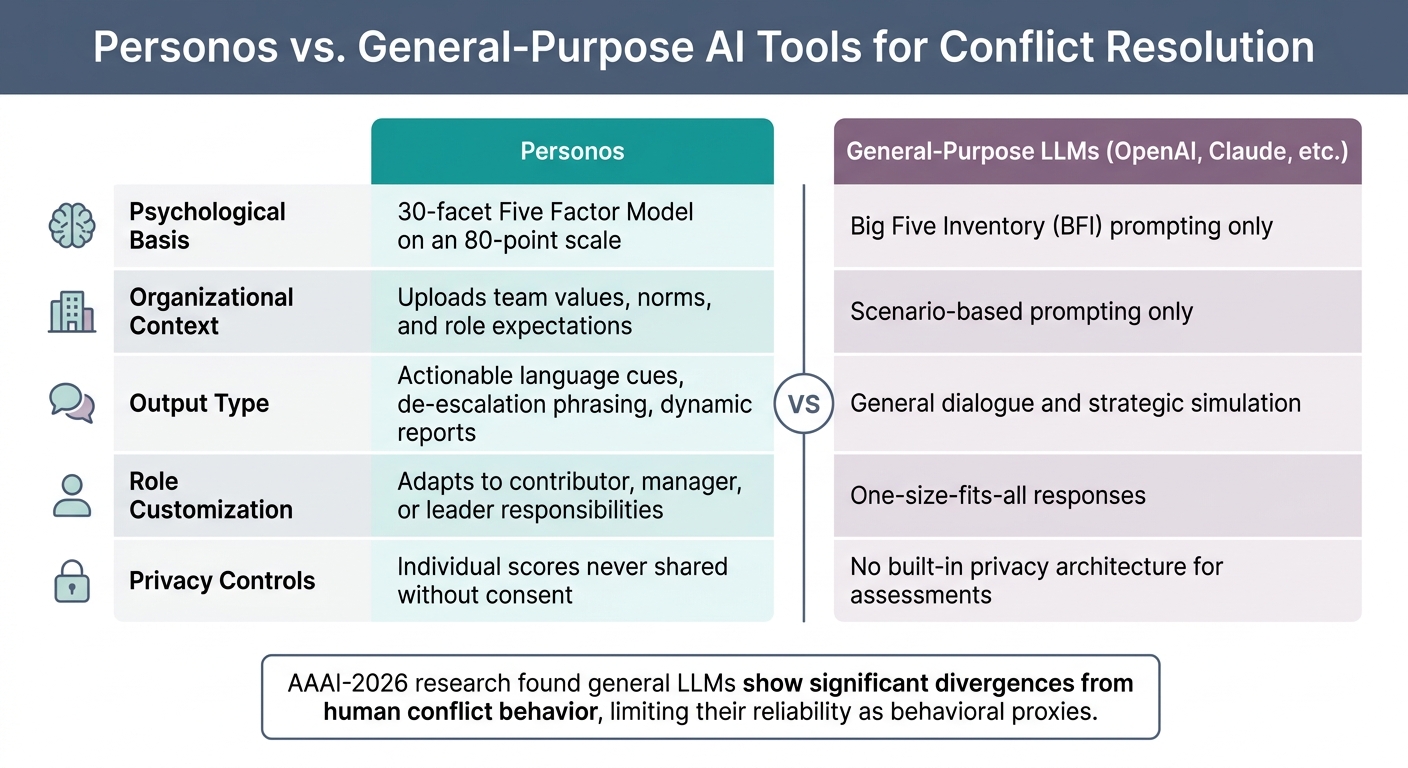
Personos vs. General-Purpose AI Tools for Conflict Resolution
Personos: Personality-Aware Conflict Resolution
Personos uses the Five Factor Model (FFM) to provide conflict resolution guidance. By analyzing 30 personality facets on an 80-point scale, it creates highly detailed profiles. This approach ensures that its advice is tailored to the specific individuals involved, rather than relying on generalized recommendations.
One standout feature is its Scientific Explanation, which breaks down how the system arrives at its suggestions. It explains the personality traits considered, the psychological principles applied, and how these elements interact. For professionals like social workers and case managers, this transparency builds trust in the system by making its reasoning clear.
Another practical tool is the ActionBoard, which turns AI recommendations into actionable tasks. Coaches and practitioners can assign these tasks to clients and track their progress between sessions. This feature makes it easier to demonstrate measurable results, whether to supervisors or funding organizations. By bridging the gap between insights and implementation, Personos sets itself apart from many other AI tools.
How Personos Compares to Other AI Tools
While general-purpose tools like ChatGPT, Claude, and Gemini can handle conflict scenarios, they face limitations in this specialized area. Unlike Personos, these tools rely on broader personality prompts and lack the detailed structure of the Five Factor Model. Additionally, they don’t incorporate organizational context, such as team norms, client histories, or role-specific responsibilities, which are crucial for effective conflict resolution.
According to a 2026 study presented at AAAI-2026, general LLMs often struggle in this domain:
"Significant divergences in how personality manifests in conflict across different LLMs compared to human data, challenging the assumption that personality-prompted agents can serve as reliable behavioral proxies in socially impactful applications." - AAAI-2026: Special Track on Artificial Intelligence for Social Impact [5]
Here’s a quick comparison of Personos and general-purpose LLMs:
| Feature | Personos | General-Purpose LLMs (OpenAI, Claude, etc.) |
|---|---|---|
| Psychological Basis | 30-facet FFM on an 80-point scale [4] | Big Five Inventory (BFI) prompting [5] |
| Organizational Context | Uploads values, norms, and role expectations [3] | Scenario-based prompting only [5] |
| Output Type | Actionable language cues, de-escalation phrasing, dynamic reports [3] | General dialogue and strategic simulation [5] |
| Customized for Role | Adapts to contributor, manager, or leader responsibilities [3] | One-size-fits-all responses |
| Privacy Controls | Individual scores never shared without consent [4] | No built-in privacy architecture for assessments |
Personos also stands out for its multi-level contextual memory, which keeps track of individual, relationship, and group histories. This ensures that the system provides continuity in its guidance, rather than starting from scratch with each session [4].
Research Findings and Measured Outcomes
The AAAI-2026 study used an Interest-Rights-Power (IRP) framework to evaluate AI conflict tools. Metrics like negotiation scores, reciprocity patterns, and "walk away" rates were analyzed [5]. The research highlighted that AI tools grounded in validated psychological models - like Personos - outperform those relying solely on general language capabilities.
On a practical level, Personos offers Dynamic Relationship and Team Reports, which help identify potential conflict triggers and communication friction points before they escalate. The "Conflict Triggers" section is particularly useful for practitioners aiming to prevent disagreements rather than reacting to them. These features demonstrate how scientifically informed, context-aware AI tools can turn conflict into opportunities for better collaboration.
Challenges, Ethics, and What Comes Next
Privacy and Consent in AI Feedback
AI feedback systems handle highly sensitive data, such as personality traits, emotional states, and conflict histories, which raises serious privacy concerns. A study by ETH Zurich revealed that large language models (LLMs) can predict Big Five personality traits from chat logs with an accuracy for extraversion that is 44% higher than random baselines. Additionally, at least half of conversational AI users disclose sensitive information about their jobs, family, and health during interactions [8].
"Personality traits indeed provide particularly sensitive information that can be used by malicious entities for large-scale manipulation." - Derya Cögendez, Researcher, ETH Zurich [8]
To address these concerns, privacy-by-design strategies are becoming more common. These include techniques like data masking (substituting real names with anonymized identifiers), encrypted storage of conversations, and policies that prohibit user data from being used to train models [7].
Reducing Bias and Improving Fairness
Bias in AI systems that model human behavior remains a persistent challenge. Many tools rely on demographic data, such as age, gender, and location, to create user personas. However, studies indicate that demographics account for only 1.5% of response variance and may even amplify perceived differences [9].
"Demographic-only personas are a structural bottleneck... demographics explain only ~1.5% of variance in human response similarity." - Pranav Narayanan Venkit, Researcher, Salesforce Research [9]
New frameworks like SCOPE are moving beyond demographics by focusing on values, motivations, and personality traits to create more accurate personas [9]. Systems based on validated psychometric models, such as the Five Factor Model, are proving to be more effective at understanding how people think and respond. Additionally, there’s a shift away from affective-mirroring, where AI mimics a user’s emotional tone, toward question-led systems. These designs emphasize strategic questioning and reflective summarization, which have been shown to be safer and more professionally appropriate. For instance, research by Boyoung Kang from Sungkyunkwan University found question-led systems reduce the risk of fostering unhealthy dependencies [6]. These innovations are setting the stage for fairer and more effective conflict resolution tools.
Where AI in Conflict Resolution Is Headed
With stronger privacy measures and efforts to reduce bias, the future of AI in conflict resolution looks promising. Current research highlights how LLMs often diverge from human conflict behavior, underscoring the need for tools that integrate deeper personality insights and undergo rigorous validation [5]. Emerging methods aim to combine detailed psychographic profiles with enhanced simulation environments, enabling professionals to practice difficult conversations in safe, controlled settings.
One particularly exciting development is Personality Activation Search (PAS). This training-free technique adjusts AI behavior by modifying activation patterns within the model, allowing for precise personality alignment without requiring extensive sensitive data. This represents a significant step forward in balancing privacy with functionality [10]. These advancements are paving the way for AI tools that offer more accurate, ethical, and practical guidance for navigating complex interpersonal conflicts.
Conclusion: Using AI Feedback to Move From Conflict to Collaboration
Key Takeaways
AI feedback systems are transforming conflict management by replacing subjective decision-making with data-driven, personality-aware insights. Through tools like natural language processing (NLP), real-time emotion analysis, and psychometric modeling, professionals can better anticipate, manage, and resolve conflicts. Research from the University of Southern California highlights the value of validated frameworks, such as the Five Factor Model, in enhancing AI's effectiveness in conflict scenarios [1]. The future of these systems lies in understanding personality-behavior patterns, a game-changer for those handling high-stakes cases, crisis situations, or challenging clients. This evolution opens the door to practical, actionable strategies.
Next Steps for Helping Professionals
To make the most of these advancements, professionals should ask themselves one critical question when evaluating tools: Does this platform have a solid psychological foundation? Armed with this knowledge, they can integrate AI feedback into their daily workflows. While general AI tools may provide broad advice, specialized platforms like Personos are tailored to the complexities of human conflict. Designed for social workers, counselors, coaches, and case managers, these tools offer specific, situation-based guidance instead of generic solutions.
As Personos puts it, their aim is "Language that lands for each personality so tense moments turn into progress." [3] Whether it’s handling a crisis, rebuilding trust with a hesitant client, or addressing team dynamics, AI that understands who you're working with - beyond just their words - can drive better outcomes. By adopting AI feedback, professionals can transform conflict into meaningful collaboration.
FAQs
What data does AI use to detect conflict early?
AI has the ability to identify conflict early by analyzing language, emotions, and behaviors. Through natural language processing and sentiment analysis, it picks up on changes in tone, specific word choices, and patterns such as blame-shifting or the use of provocative language. Beyond just words, it also tracks communication habits - like how quickly people respond, how often they message, or their level of participation in meetings. Tools like Personos even integrate personality psychology, offering context-specific insights into how individual traits and communication styles might be fueling tensions.
How accurate is AI personality modeling in real conflicts?
AI personality modeling has shown impressive results, with studies indicating up to an 80% correlation in predicting traits based on the Big Five personality framework. That said, its effectiveness can depend on the task at hand. One area where AI still faces challenges is interpreting emotional subtleties and navigating strategic decision-making in complex conflicts.
Personos takes this to the next level by utilizing the well-established Five Factor Model. It provides tailored, situation-specific insights, helping professionals overcome the typical limitations of standard AI systems. This makes it a valuable tool for achieving more effective conflict resolution.
How can AI provide real-time help without violating privacy?
AI systems protect privacy by employing encryption, strict data isolation, and secure communication protocols. For instance, platforms like Personos implement data masking to hide personal identifiers, ensuring that only consented information is processed for generating insights. Ethical providers further safeguard user trust by avoiding the storage or reuse of data for AI training. This approach ensures that sensitive conversations stay confidential and are accessible exclusively to the user.