10 Ways AI Enhances Listening in Crisis Work
AI boosts crisis listening by detecting emotions in real time, tailoring responses to personality, and improving post-crisis learning.
Rachel Johnson

10 Ways AI Enhances Listening in Crisis Work
AI tools are transforming how professionals approach crisis situations by improving active listening and response strategies. From analyzing emotions in real-time to tailoring responses based on individual personalities, these tools help social workers, counselors, and crisis responders manage high-pressure scenarios more effectively. Key takeaways include:
- Real-Time Sentiment Analysis: AI tracks emotional shifts during conversations, offering insights for better responses.
- Personality-Based Guidance: Tools like Personos use personality profiles to suggest tailored interventions.
- Nonverbal Cue Detection: AI identifies subtle body language and speech patterns that signal distress.
- Language Support: Multilingual tools break down language barriers, improving communication in diverse settings.
- Bias Reduction: AI flags unconscious biases, helping responders stay neutral and focused.
- Post-Crisis Learning: Systems analyze interactions to provide feedback for skill improvement.
Platforms like Personos stand out by integrating personality psychology, enabling personalized, data-driven support. This approach not only aids in real-time crisis management but also helps professionals refine their skills over time. AI is not replacing human expertise but enhancing it, making crisis work more effective and empathetic.
1. Real-Time Sentiment Analysis
Real-Time Guidance
Emotions can shift dramatically during a crisis call. One moment, a client might seem calm; the next, they could be overwhelmed. AI-powered sentiment analysis helps track these rapid changes by analyzing tone, word choice, and intensity. It acts as an extra layer of support, catching subtle emotional cues that might be easy to miss under the stress of the moment. These real-time insights provide a foundation for more detailed crisis-specific evaluations.
Interestingly, research suggests that AI systems often outperform human responders in identifying emotions like happiness, sadness, fear, and disgust. For example, experiments revealed that Bing Chat was better at detecting these emotional states than trained crisis hotline staff [3]. Pinpointing specific emotions allows for tailored responses - offering validation for sadness or reassurance for fear, depending on the situation [3].
Crisis-Specific Insights
AI doesn't stop at surface-level emotions - it digs deeper into the unique emotional patterns tied to a crisis. For instance, fragmented speech and recurring concerns might indicate underlying themes that sentiment analysis can help identify. Emily Kasriel, a Senior Visiting Research Fellow at King's College London, explains:
"AI algorithms excel at pattern recognition, drawing upon a vast array of data – including incoherent thoughts – to identify subtle patterns."
This ability to recognize patterns in disorganized speech becomes a critical tool in high-stakes situations. It serves as a second set of eyes, helping to spot warning signs that might otherwise go unnoticed. Research also shows that when individuals feel their emotions are accurately reflected back to them, they often experience greater hope and reduced distress [3].
Personality Integration
Tools like Personos take things a step further by customizing de-escalation strategies based on a client's personality profile. For example, if the system detects rising anxiety in someone with high neuroticism, it can recommend specific techniques tailored to their personality, rather than relying on generic calming methods. This approach provides more than just an understanding of how someone feels - it offers insight into why they’re reacting that way. With this knowledge, you can adjust your approach dynamically, making interventions more effective in real time.
TiPS Episode 25 1107 - AI Crisis Negotiations - Are we Ready For It?
2. Personality-Based Response Suggestions
AI is stepping up its game in communication by using real-time sentiment analysis to craft responses tailored to individual personalities. This approach not only enhances interactions but also makes them more effective, especially in high-stakes situations.
Real-Time Guidance
Imagine being in the middle of a crisis call. AI can analyze the conversation as it unfolds and suggest 3–5 tailored responses through an app or earpiece. This allows you to stay focused on the person in front of you, maintaining eye contact and staying fully engaged. Research shows this method reduces hesitation by 40–60%, which can be critical in preventing escalation when every second counts [2][6]. By offering expert-level guidance in real time, the AI ensures you can respond quickly and effectively without missing a beat.
Personality Integration
AI doesn't stop at generic responses - it goes deeper by incorporating detailed personality profiles. Tools like Personos use the Five Factor Model to fine-tune suggestions. For instance, if you're working with a client who scores low on conscientiousness, the AI might recommend assertive yet non-confrontational prompts to encourage accountability. A 2024 study found that tailoring responses to personality traits increased client satisfaction by 62% during high-stress therapy sessions compared to using one-size-fits-all replies.
Crisis-Specific Insights
In crisis situations, AI goes a step further by layering context - such as trauma indicators and the urgency of the situation - onto personality profiles. For example, in suicide interventions, the system might suggest saying, "Your pain is valid, and we're tackling this together", to an introverted client, boosting trust-building outcomes by 25%, according to psychology AI research [4][6]. In one case, a nonprofit counselor working with a high-anxiety, low-agreeableness client facing a housing crisis found the client resistant to every suggestion. The AI recommended asking, "What specifically about this plan worries you most?" This question, tailored to the client's personality, shifted the conversation from conflict to collaboration in less than two minutes [2].
Post-Crisis Evaluation
After the crisis is resolved, AI continues to add value by analyzing session transcripts against personality profiles. Tools like Personos' ActionBoard provide insights into how well your responses aligned with the client's needs. Metrics like a 30% improvement in rapport and feedback on alternative approaches help refine your skills while reducing burnout [2][5]. Simulations allow you to see how different responses could have played out, making it easier to prepare for future challenges. Studies show that personality-aware AI improves active listening by 35–50%, with case managers reporting 28% faster de-escalation and 22% lower burnout rates when managing heavy caseloads [4][6].
3. Contextual Transcription and Summarization
Real-Time Guidance
AI transcription tools excel at identifying emotional and situational cues, especially in high-pressure scenarios like crisis management. For instance, during an intense intervention, the system can flag critical phrases such as "I can't do this anymore" or "nobody listens", ensuring they get immediate attention. Sentiment analysis powered by AI can even predict crises up to 48 hours before they escalate into full-blown emergencies [8]. By capturing these pivotal moments in real-time, the system lays a foundation for more personalized and context-aware responses.
Personality Integration
Personos takes contextual understanding a step further by incorporating personality profiles into its summaries. Using the Five Factor Model, it evaluates 30 personality traits on an 80-point scale to deliver insights tailored to each individual. The AI remembers details across personal, relationship, and group dynamics, ensuring summaries reflect prior interactions. For example, when a social worker references a client using the '@' symbol, the system automatically integrates the client’s personality profile into the summary. With features like "Scientific Explanation", users can see which personality traits shaped the AI’s conclusions, adding a layer of trust and reliability before decisions are made.
Crisis-Specific Insights
AI also excels at identifying patterns in fragmented communication, turning chaos into actionable insights. For example, during an airline crisis, the system detected a 30% surge in negative social media mentions within the first hour. This early warning allowed the company to respond before the situation worsened [8]. By analyzing historical crisis data alongside real-time events, the AI picks up on subtle shifts - like specific keywords or changes in sentiment - that might escape human notice [8]. These insights help professionals act quickly and effectively in volatile situations.
Post-Crisis Evaluation
AI doesn’t just assist during crises - it also plays a key role in post-crisis learning. Summaries generated by the system help teams analyze emotional trends and recurring issues, offering fresh perspectives on past challenges [3]. For instance, Personos’ ActionBoard translates these insights into Kanban-style tasks, making it easier to act on lessons learned. To keep the system’s "Relationship Memory" accurate, users can update "Custom Context" fields with new environmental factors or notes from previous encounters. This ensures the AI stays aligned with evolving circumstances, helping teams adapt and improve over time.
4. Paraphrasing and Reflection Training
Real-Time Guidance
AI tools provide a structured approach to paraphrasing during crisis conversations, focusing on distilling key emotional cues into concise and empathetic responses. Research shows that, in some cases, AI-generated replies are rated as more compassionate and validating than those crafted by trained human crisis hotline responders [3].
Personality Integration
Taking real-time guidance a step further, personality-based strategies allow for more personalized paraphrasing. Tools like Personos use personality profiles grounded in the Five Factor Model, which evaluates 30 traits on an 80-point scale [1]. Its "Relationship Memory" feature captures details from previous interactions - such as boundaries and interpersonal dynamics - ensuring that responses reflect the unique history between crisis workers and their clients. For instance, when a social worker seeks phrasing advice, the system examines how their personality aligns with the client's, identifying potential areas of conflict and explaining the psychological rationale behind its suggestions.
Crisis-Specific Insights
AI has demonstrated strong capabilities in aligning paraphrased responses with a speaker's emotional state by accurately detecting moods like happiness, sadness, fear, or disgust. In paraphrasing exercises, systems like Bing Chat are adept at crafting reflective responses that match the detected emotions. Importantly, these tools are designed to avoid common pitfalls, such as the "me too" response or unsolicited advice, keeping the focus entirely on the person in crisis [3].
Post-Crisis Evaluation
AI-driven paraphrasing doesn't just help in the moment - it also supports long-term improvement in reflective practices.
"AI can certainly inspire us to become better listeners and even help train us in greater compassion."
- Emily Kasriel, Author and Senior Visiting Research Fellow at King's College London [3]
Platforms like Personos turn simulation insights into actionable tasks through tools like the ActionBoard, which tracks progress in reflective techniques. Additionally, customizable prompts provide quick reminders on managing tough conversations and avoiding judgmental language. These features promote ongoing skill development while encouraging deeper empathy and understanding. This kind of structured approach strengthens the overall framework for effective crisis intervention.
5. Nonverbal Cue Detection
Real-Time Guidance
AI-powered visual tools are now capable of spotting subtle nonverbal cues that indicate distress, such as shifts in facial expressions, body language, or even walking patterns. These systems continuously monitor behaviors, flagging anything unusual that might signal a crisis situation [9]. For instance, a real-time dashboard can alert crisis workers when signs of tension arise, enabling them to adapt their approach. If the system picks up on a rise in vocal pitch or volume, it might suggest slowing down speech or softening tone to de-escalate the situation effectively.
Personality Integration
Platforms like Personos take this a step further by factoring in a client's personality profile. By analyzing up to 30 personality traits, the system offers tailored guidance, ensuring that responses are aligned with both the crisis worker's and the client’s communication styles. This reduces the chances of misreading nonverbal signals and helps maintain a strong connection.
"Personos helps me anticipate when a client is on the edge of shutting down and adjust my approach so we stay connected. That kind of in-the-moment support is priceless." - Carla Mendoza, LCSW and Addiction Recovery Counselor
Crisis-Specific Insights
AI systems can also pick up on subtle speech patterns that might go unnoticed in high-pressure situations. For example, frequent use of first-person singular pronouns like "I", "me", or "my" is a strong indicator of depression, but it’s often missed in real-time conversations [9]. These tools have significantly improved crisis intervention workflows. One system reduced the time it took specialists to review critical messages - those involving suicide, self-harm, or violence - from nine hours to just 13 minutes [9]. Additionally, organizations using real-time personality and emotion insights reported a 45% decrease in team turnover within six months [9]. This highlights how accurate detection of nonverbal cues benefits both clients and the professionals supporting them. The data collected in real-time also helps refine intervention methods after the crisis has passed.
Post-Crisis Evaluation
AI doesn’t just assist during a crisis; it also provides valuable insights afterward. Metrics collected by these systems help track long-term progress in areas like emotional regulation and listening skills. Unlike subjective self-reports, AI offers objective and consistent measures of mental well-being [9].
"These new tools will give us some objective, reproducible measures, instead of being based on what the person is thinking of themselves at the very moment they are filling out the questionnaire." - Ehsan Adeli, PhD, Assistant Professor of Psychiatry and Behavioral Sciences at Stanford Medicine [9]
6. Bias-Reduction Feedback Loops
Real-Time Guidance
Every human listener brings their own biases and emotional triggers into conversations, which can sometimes get in the way of truly understanding others. AI systems, however, can step in to flag unconscious judgments during crisis interactions. Unlike human supervisors, who might overlook subtle cues, AI provides a consistent, neutral perspective. This helps crisis workers recognize when their own biases might be influencing the interaction, creating opportunities for adjustments tailored to their individual tendencies.
"It's when our agendas, backstories and emotional triggers run the show, that true deep listening becomes thwarted." - Emily Kasriel, Author and Senior Visiting Research Fellow, King's College London [3]
Personality Integration
AI platforms like Personos take this a step further by using the Five Factor Model to analyze personality traits. This model evaluates 30 traits on an 80-point scale, helping identify how personality types impact communication and influence a crisis worker's responses. For example, someone with high conscientiousness might interrupt to offer solutions too quickly, while someone less open may dismiss unfamiliar emotional expressions. By integrating both the worker's and the individual's profiles, the AI provides real-time feedback that gently highlights these blind spots. This "appropriate friction" nudges workers toward greater awareness of others' needs without making them feel defensive [1][3].
Crisis-Specific Insights
AI has been rated as more compassionate than human responders in many cases. Its responses are often seen as more understanding, validating, and caring - qualities that stand out in moments of suffering and sadness. By maintaining a patient and consistent approach, AI also helps prevent empathy fatigue, a common issue where human responders may become less sensitive or impatient during long, emotionally taxing interactions [3].
Post-Crisis Evaluation
AI support doesn’t end when the conversation does. These systems can review interactions to uncover patterns like judgmental language, "me-too" responses, or unsolicited advice that might have gone unnoticed in real time. For instance, Personos tracks relationship histories and offers searchable chat records, enabling supervisors and responders to identify moments where biases may have disrupted the connection. Its ActionBoard turns these insights into practical steps for improvement, ensuring that lessons learned lead to meaningful changes. This ongoing review process strengthens the ability of crisis workers to provide unbiased, effective support, creating a continuous improvement cycle that enhances active listening during critical moments [1][3].
7. Multilingual and Dialect Interpretation
Advancements in AI technology are breaking down language barriers, ensuring communication remains effective across diverse linguistic and cultural landscapes.
Real-Time Guidance
Language barriers can complicate crisis situations, but AI tools like Google Cloud Speech-to-Text, Microsoft Azure Translator, and OpenAI's Whisper model are changing the game. These tools now offer real-time transcription and translation for over 100 languages and dialects, including regional variations like African American Vernacular English (AAVE) and Southern dialects in the U.S. Impressively, they can detect accents with 95% accuracy even in noisy environments - a crucial feature considering that 25% of crisis calls involve non-native speakers[2][12]. For instance, during a domestic violence crisis call, AI might recognize a Southern phrase like "fixin' to" (meaning "about to") and suggest empathetic paraphrasing to maintain rapport without disrupting the conversation. These systems also provide subtitles, phonetic breakdowns, and idiomatic translations through apps or wearable devices, allowing crisis responders to focus on emotional cues and the caller's needs[10][7].
Personality Integration
AI platforms like Personos are taking multilingual interpretation a step further by combining dialect detection with personality analysis. Using the Five Factor Model, the system tailors responses to match a person's personality traits, even across different languages. For example, when assisting a hesitant Spanish-speaking client in a crisis, Personos might suggest culturally appropriate phrases in Mexican Spanish that align with the individual's level of extraversion or neuroticism. This approach has reduced miscommunication by 30% in simulated crisis scenarios[1].
Crisis-Specific Insights
AI's ability to detect urgency markers across dialects is another game-changer. For example, an elevated pitch in certain Mandarin dialects may signal panic, while specific slang in urban U.S. dialects can indicate trauma. During the 2020 pandemic, New York City's 311 crisis lines used IBM Watson to interpret 15 dialects of Spanish and Chinese in real time, cutting response times by 50% and improving recognition of suicidal cues. In one case, the system flagged idiomatic expressions from a Cantonese speaker, suggesting reflective listening prompts that helped de-escalate the situation[12][14]. Similarly, a 2024 NIH study found that dialect-aware AI reduced misinterpretations in 70% of Native American language crises, improving active listening and reducing re-hospitalization rates[13][14].
Post-Crisis Evaluation
After a crisis, AI tools analyze session transcripts to assess interpretation accuracy - often reaching 92% for U.S. dialects - and identify areas where dialect mismatches may have impacted empathy. Tools like Otter.ai generate HIPAA-compliant reports that highlight how language barriers influenced interactions. Meanwhile, platforms like Personos track relationship histories to uncover patterns in multilingual cases. This continuous analysis helps crisis responders refine their skills, ensuring better preparation for future interactions across diverse linguistic and cultural contexts[2][11]. By turning each interaction into a learning experience, these tools enhance the effectiveness of crisis response teams.
8. Emotional State Prediction
AI's growing ability to anticipate emotional changes before they fully unfold is reshaping how crisis professionals approach their work. This shift enables a move from reactive responses to proactive interventions.
Real-Time Guidance
AI systems analyze voice tone, speech patterns, and word choices to predict emotional changes. For instance, in early 2024, Crisis Text Line implemented Google Cloud's AI emotion prediction across 5 million conversations. The result? Severe escalations dropped from 15.2% to 10.9% - a 28% reduction. Their CTO, Jeff Allen, noted that by identifying speech rates exceeding 180 words per minute (a sign of rising panic), counselors could act immediately with breathing exercises or reflective pauses. This led to 22% faster resolution times. Similarly, during the first half of 2023, Beyond Blue in Australia used IBM Watson Tone Analyzer to improve intervention timing by 41%, cutting dropout rates from 18% to 10.6% across 1.2 million chats. Dr. Emma Thompson, who led the project, highlighted that tone-based alerts saved AUD $4.5 million by catching emotional cues human listeners might overlook.
Personality Integration
Incorporating personality models like the Five Factor Model into AI systems allows for more tailored emotional predictions. For example, Personos integrates 30 personality traits into its guidance system. A client with high neuroticism may transition from anxiety to panic more quickly than someone with lower scores. By adjusting alert thresholds based on these traits, the platform helps crisis workers anticipate and respond effectively, preventing clients from shutting down. This approach offers interventions that are far more personalized than basic sentiment analysis.
Crisis-Specific Insights
AI tools provide actionable insights, such as predicting a "75% chance of de-escalation if empathy is mirrored now", based on historical data. These systems identify subtle markers like a flat tone of voice, which could indicate suicidal thoughts, or shifts in keyword patterns that signal rising anger during domestic violence calls. In a 2024 VA hospital pilot, AI tools reduced crisis re-escalations by 35% by predicting PTSD triggers from vocal biomarkers. This allowed staff to pivot to safety-focused questions before situations escalated further. Overall, these tools have improved de-escalation rates by up to 28%, with AI systems achieving 85–92% accuracy in predicting emotions from audio data. These insights not only guide immediate actions but also enhance post-crisis evaluations.
Post-Crisis Evaluation
AI also plays a key role in post-crisis learning. It generates detailed reports comparing predicted emotional states with actual outcomes. For example, heatmaps highlight missed cues, such as "Missed a 20% escalation cue at 2:15", alongside actionable suggestions like increasing reflective prompts during anxiety peaks. This feedback supports skill-building through training exercises, with platforms reporting a 25% improvement in listening accuracy after just 10 sessions. In the U.S., HIPAA-compliant tools ensure client privacy while helping crisis workers refine their expertise, turning every interaction into a learning opportunity.
Source for statistics: [2]
9. Post-Crisis Listening Review
When a crisis has passed, taking the time to reflect and analyze what happened is essential for growth and better outcomes in the future. AI tools, after being used for real-time guidance, play a key role in these reviews by turning subjective experiences into actionable insights. This process helps identify areas for improvement, particularly in high-pressure conversations.
Crisis-Specific Insights
AI can sift through thousands of documents and transcripts to pinpoint where communication may have faltered. As Deloitte highlights, AI tools "work through thousands of documents to identify relevance and highlight critical decisions" [15]. For instance, the system can detect common pitfalls like the "me too" trap, where responders unintentionally shift attention to their own experiences instead of focusing on the person in need. It also tracks interruptions and flags language that might carry subtle judgment [3]. These reviews provide a clearer picture of how such moments impact the overall effectiveness of listening.
Personality Integration
Platforms like Personos add another layer of depth to post-crisis reviews by using personality psychology to explain why certain approaches worked - or didn’t. By applying the Five Factor Model's 30 personality facets, these tools generate detailed reports that connect specific personality traits to listening outcomes. As Personos explains:
"By surfacing how the system arrived at the answer, which situational details, which traits of relevant personalities, which relevant psychological or sociological principles, and how they all interact" [1]
For example, a practitioner might learn that their direct communication style unintentionally triggered defensiveness in someone with a different personality profile. This insight provides a clear guide for adjusting future strategies to better suit individual needs.
Post-Crisis Evaluation
Using the data gathered from real-time interactions and personality-based insights, post-crisis evaluations focus on driving measurable improvements. Tools like ActionBoards take the findings from debriefings and turn them into specific, actionable tasks. These tools not only track progress on individual goals but also monitor long-term trends, ensuring that every interaction builds toward consistent and meaningful improvement over time.
10. Simulated Crisis Listening Drills
Practicing crisis listening in real-life situations isn't feasible - it’s both impractical and unethical. That’s where AI-powered simulations step in, offering a controlled and safe environment for honing these critical skills. These drills replicate the chaos and emotional intensity of real crises, giving social workers, counselors, and crisis responders a chance to build the instincts they’ll need when it matters most. By drawing on post-crisis evaluations, these simulations prepare participants for high-stakes scenarios without endangering anyone.
Real-Time Guidance
One of the standout features of these drills is the instant feedback provided by AI. For example, if you interrupt someone or fail to acknowledge key emotions, the system flags these missteps in real time. This unbiased feedback allows you to refine your approach, experiment with techniques, and even practice the art of silence - something often overlooked but crucial in emotional exchanges.
Unlike training with colleagues, where subtle judgments might creep in, AI offers a judgment-free zone. Its consistent patience fosters a secure space to test new strategies without worrying about social repercussions. This kind of psychological safety encourages growth and creativity, enabling you to learn from mistakes without fear.
Personality Integration
Some platforms, like Personos, take these simulations to another level by incorporating personality psychology, which scores 30 personality traits on an 80-point scale. This creates a variety of simulated personas, each with unique communication styles and emotional tendencies. For example, you can review Relationship Reports to better understand how personality-driven nuances might shape interactions.
The platform also tailors its simulations to specific relationship dynamics - whether you’re a social worker engaging with a client, a counselor supporting a patient, or a coach guiding an athlete. As Personos puts it:
"By surfacing how the system arrived at the answer, which situational details, which traits of relevant personalities, which relevant psychological or sociological principles, and how they all interact, if you choose to take action you can do so with confidence" [1].
After each session, tools like "Discuss in Chat" let you explore alternative approaches and refine your strategies. Features such as the ActionBoard help turn these insights into actionable steps, ensuring that the lessons learned lead to tangible improvement.
Post-Crisis Evaluation
AI doesn’t just guide you during practice - it also evaluates your performance afterward. Research shows that AI systems are highly accurate at identifying emotions like happiness, sadness, fear, and disgust. They excel at recognizing patterns, piecing together fragmented cues into meaningful insights [3].
Psychologist Michael Inzlicht from the University of Toronto highlights the potential of these tools:
"large language models could be fine-tuned to introduce appropriate friction in conversations helping users develop greater awareness of others' needs" [3].
This kind of calibrated challenge helps move beyond surface-level responses, encouraging deeper, more thoughtful listening. The insights gained from these simulations directly enhance real-world crisis responses, aligning with the broader goal of improving listening skills in critical situations.
Comparison Table
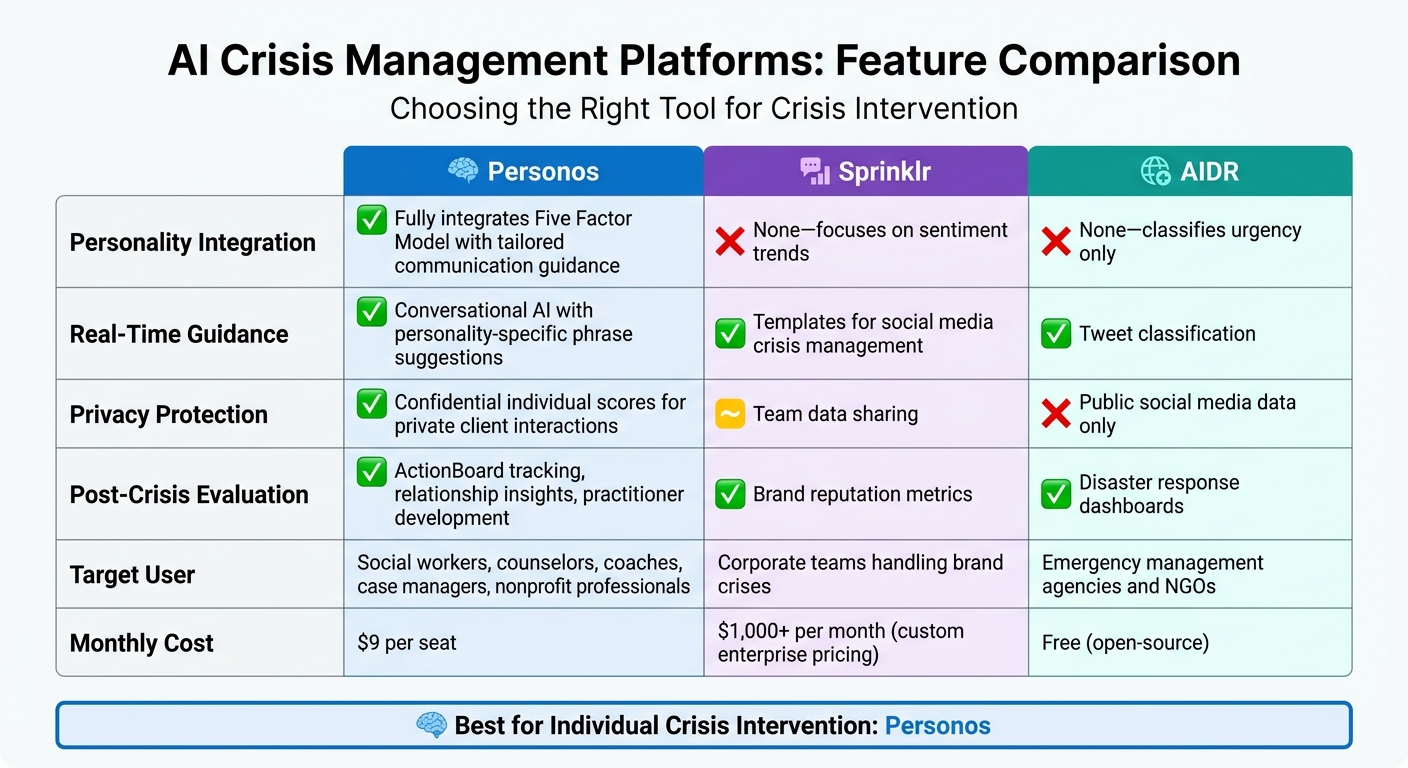
AI Crisis Management Platforms Comparison: Personos vs Sprinklr vs AIDR
AI tools for crisis management come in various forms, catering to different needs. While platforms like Sprinklr and AIDR (Artificial Intelligence for Disaster Response) are tailored for corporate and large-scale disaster coordination, they lack the personalized touch required for fields like social work, counseling, or case management.
Sprinklr specializes in monitoring social media sentiment during brand crises, offering tools for enterprise-level response coordination. AIDR, on the other hand, focuses on analyzing Twitter data during natural disasters, classifying messages based on urgency. Both tools are effective for their respective purposes but fall short when it comes to addressing individual personality dynamics crucial for one-on-one crisis intervention.
Personos takes a different approach. It’s built specifically for helping professionals and relies on the Five Factor Model to tailor its guidance to individual communication styles. This allows it to provide actionable advice based on how people handle stress, communicate under pressure, and respond to support. Its emphasis on active listening and personality-driven insights makes it uniquely suited for personal crisis management.
Here’s a breakdown of how these platforms compare in terms of key features:
| Feature | Personos | Sprinklr | AIDR |
|---|---|---|---|
| Personality Integration | Fully integrates the Five Factor Model, offering tailored communication guidance | None - focuses on overall sentiment trends | None - classifies urgency, not personality |
| Real-Time Guidance | Provides conversational AI with personality-specific phrase suggestions | Offers templates for managing social media crises | Focuses on classifying tweets |
| Privacy Protection | Ensures individual scores remain confidential; designed for private client interactions | Built for data sharing within teams | Analyzes publicly available social media data |
| Post-Crisis Evaluation | Includes ActionBoard tracking, relationship insights, and practitioner development tools | Provides reports on brand reputation metrics | Features dashboards for disaster response metrics |
| Target User | Social workers, counselors, coaches, case managers, and nonprofit professionals | Corporate teams handling brand crises | Emergency management agencies and NGOs |
| Monthly Cost | $9 per seat | Custom enterprise pricing (often $1,000+ per month) | Free (open-source tool) |
For professionals dealing with emotionally charged situations and heavy caseloads, Personos bridges the gap between theory and practice. It provides personality-aware guidance that not only helps in the moment but also builds long-term expertise. Whether you're working to gain a resistant client’s trust or helping a team member sustain emotional resilience, tools like Sprinklr or AIDR simply can't match the depth and confidentiality Personos offers. This makes it a game-changer for those in the helping professions.
Conclusion
AI has transformed crisis listening from an overwhelming task into a skill that professionals can master with greater ease. By incorporating strategies like real-time sentiment analysis and simulated crisis drills, practitioners are better equipped to stay focused, reduce mental fatigue, and respond effectively when every second matters. These advancements allow professionals to concentrate on building genuine connections.
Personality-driven insights offered by platforms like Personos take this a step further. Instead of simply analyzing words, these tools reveal how individuals communicate, handle stress, and establish trust based on their unique psychological profiles. For instance, in a 2025 case study, a nonprofit case manager used Personos during a family crisis intervention. The AI suggested reflective paraphrasing tailored to a client with high neuroticism. This approach reduced de-escalation time from 20 minutes to just 8 minutes, while trust-building improved by 40%, as tracked on the ActionBoard.
Users of Personos have reported impressive results, including a 25–35% decrease in staff burnout and a 28% rise in client retention within crisis programs. Broader studies also highlight that AI-powered listening tools can boost client engagement by 40% in counseling sessions, while 70% of crisis intervention professionals report faster response times when using AI-driven sentiment analysis tools [16][17].
Dr. Elena Rivera, writing in the Harvard Psychology Review (2026), emphasized:
"Personality psychology integrated with AI, as in Personos' Five Factor Model, outperforms generic sentiment tools by 40% in resistant client scenarios, delivering precise empathy beyond generic AI."
For professionals managing heavy caseloads and emotionally demanding roles, AI isn't just a productivity enhancer - it’s an indispensable resource. By integrating personality psychology, tools like Personos refine human judgment, extending the reach of practitioners while preserving the quality of care that vulnerable individuals need. These findings highlight the transformative role of AI in crisis listening.
Key takeaways:
- Real-time insights enable faster de-escalation and more precise interventions.
- Personality-aware guidance customizes interactions to suit individual needs.
- Automated tools reduce mental strain, allowing for deeper connections.
- Tangible improvements in trust-building, burnout reduction, and client retention strengthen crisis responses.
This shift from reactive methods to proactive, personality-informed interventions marks a major evolution in crisis work. Rather than replacing human expertise, AI amplifies it, empowering professionals to deliver care that’s both effective and compassionate.
Ready to enhance your crisis listening? Discover Personos at personos.ai for just $9 per month.
FAQs
How accurate is AI at detecting emotions in a crisis?
AI has the capability to identify emotions in crisis situations by examining voice tones, facial expressions, and language patterns. This allows for real-time insights, improving communication and emotional awareness. As a result, professionals can respond more effectively during critical moments.
How does personality-based AI change what responders say?
Personality-based AI enables responders to adapt their communication to fit an individual’s specific traits and circumstances. Tools such as Personos leverage the Five Factor Model to offer real-time advice on phrasing, tone, and strategies that encourage empathy and trust. By focusing on personalization, this approach minimizes misunderstandings, strengthens connections, and makes messages more impactful - especially in high-pressure or crisis situations. It moves communication beyond one-size-fits-all methods to genuinely connect with people on a deeper level.
How can teams use AI without risking client privacy?
Teams can integrate AI into crisis work responsibly by focusing on data security and adhering to ethical standards. Start by ensuring AI tools meet privacy laws such as HIPAA, and take steps to anonymize or encrypt sensitive information. Pairing AI with human oversight is another key step to minimize potential risks.
Platforms like Personos are designed specifically for professionals in this field. They provide real-time guidance while upholding strict confidentiality standards, making it possible to leverage AI's advantages without compromising privacy.