How AI Enhances Emotion-Based Conflict Resolution
AI uncovers hidden emotions to turn escalating disputes into tailored, empathy-driven resolutions.
Christian Thomas

How AI Enhances Emotion-Based Conflict Resolution
AI tools are transforming how professionals manage emotional conflicts by identifying subtle cues in communication, such as tone, sentiment, and emotional shifts. These systems analyze digital communication, physiological signals, and personality traits to provide real-time insights and tailored strategies for resolving disputes. Tools like Personos integrate personality psychology with AI to suggest personalized approaches, helping professionals address conflicts effectively while maintaining empathy.
Key takeaways:
- AI uses natural language processing, sentiment analysis, and machine learning to predict and detect emotions.
- Tools like Personos analyze personality traits to provide customized conflict resolution strategies.
- AI applications range from workplace disputes to counseling and international peacebuilding.
- Ethical concerns like bias, privacy, and over-reliance on AI require careful management.
AI doesn't replace human judgment but supports professionals in managing conflicts efficiently and empathetically.
How to use Al to resolve human conflict | Jonmar | TEDxManhattanBeach
This presentation highlights how AI tools for conflict resolution can bridge the gap between emotional triggers and constructive dialogue.
How AI Reads and Responds to Emotions
AI-driven emotion detection relies on three main technologies: natural language processing (NLP), sentiment analysis, and machine learning. NLP tools examine written and spoken communication to pick up on tone, sentiment, and emotionally charged language. For example, emails with short, abrupt sentences or words like "always" and "never" can signal heightened emotions. Sentiment analysis takes this a step further by identifying negative patterns in team communications - whether through Slack messages or email threads - so issues can be addressed before frustrations grow.
Machine learning enhances these systems by continuously analyzing patterns in large datasets and improving over time. A fascinating example comes from MIT's EQ-Radio, which demonstrated 87% accuracy in detecting emotions such as anger, happiness, and sadness. It did this by measuring heart and breathing rhythms using wireless signals - even when individuals maintained neutral facial expressions. The device's heartbeat readings were nearly as precise as clinical ECG monitors, showing only a 0.3% margin of error, and it could identify emotions with 70% accuracy for people it had never measured before [3].
"Our work shows that wireless signals can capture information about human behavior that is not always visible to the naked eye."
- Dina Katabi, Professor, MIT [3]
Modern algorithms combine multiple data sources to create a well-rounded emotional profile. This multi-modal integration brings together information from facial expressions, voice tone, text patterns, and physiological signals. Such systems can detect over 130 distinct facial expressions, including micro-expressions that last mere fractions of a second [2]. These tools provide early-warning insights, enabling professionals to intervene in time. By identifying subtle emotional shifts that might go unnoticed during high-stress situations, AI offers a level of precision that supports more effective mediation and decision-making.
Where AI Helps Resolve Conflicts in Professional Settings
AI's ability to interpret emotions is proving to be a game-changer for resolving conflicts in professional environments. From social work and counseling to corporate teams and even international diplomacy, AI-driven tools are reshaping how disputes are managed. With 85% of employees encountering workplace conflict and nearly 33% dealing with it regularly[4], the demand for effective, scalable solutions has never been higher.
Real-Time Emotional Insights
AI tools excel at analyzing digital communication - emails, Slack messages, and chat logs - to identify shifts in tone, urgency, or sentiment that might signal brewing tension. Using Natural Language Processing (NLP), these systems can highlight mismatched expectations or rising frustration before conflicts escalate[4][5]. For example, in Uganda, automated AI systems successfully detected surges in hate speech weeks before civil unrest began, giving peacebuilders valuable time to act[4]. This kind of early warning system is especially valuable for professionals managing heavy caseloads, allowing them to focus on interventions with the most significant impact.
Platforms like Personos take this a step further by incorporating personality psychology into their real-time analysis. Built on the Five Factor Model, Personos doesn’t just evaluate what someone is saying - it also considers how their personality traits influence their communication style and stress responses. Imagine a social worker receiving a curt email from a resistant client. Personos can determine whether the tone is typical for that individual or signals genuine distress, then suggest personalized strategies for de-escalation.
Situation-Specific Mediation and Guidance
General advice rarely works in complex disputes. AI-powered tools now offer recommendations tailored to specific cultural contexts, interaction histories, and situational nuances. For example, platforms used by eBay and PayPal resolve millions of disputes yearly through AI-driven Online Dispute Resolution (ODR), proving that algorithmic mediation can handle high volumes while maintaining consistency[1].
"The future isn't about AI replacing conflict resolution professionals; it's about elevating their work."
- Jeremy Pollack, Founder, Pollack Peacebuilding Systems[1]
For professionals working with vulnerable populations, tools like Personos provide crisis-specific guidance. A case manager preparing for a difficult conversation with a trauma survivor, for instance, can receive not just general tips but advice grounded in the survivor's personality traits and stress patterns. By explaining the psychological principles behind its recommendations, the platform helps practitioners grow their expertise while still prioritizing the human connection essential for meaningful change. This human-in-the-loop approach lets AI handle data analysis while professionals focus on empathy and understanding[4][5].
Improving Team Dynamics
Conflicts within teams often simmer beneath the surface until they explode. AI tools can now analyze team communications to uncover hidden biases, cultural misunderstandings, and communication gaps[4]. By tracking sentiment trends, these systems can alert HR or leadership to growing negativity. Platforms like Personos go a step further, providing insights into how individual team members' personalities might clash or complement one another.
For example, a nonprofit director could use Personos' Dynamic Reports to identify where differing communication styles are causing friction. The platform then offers actionable strategies to bridge those gaps. Its ActionBoard ensures these insights lead to measurable changes, turning awareness into concrete steps. Unlike traditional personality assessments that pigeonhole individuals, Personos keeps personal scores private unless explicitly shared, reducing the risk of stereotyping while fostering collaboration.
Personos: Personality-Driven Conflict Resolution
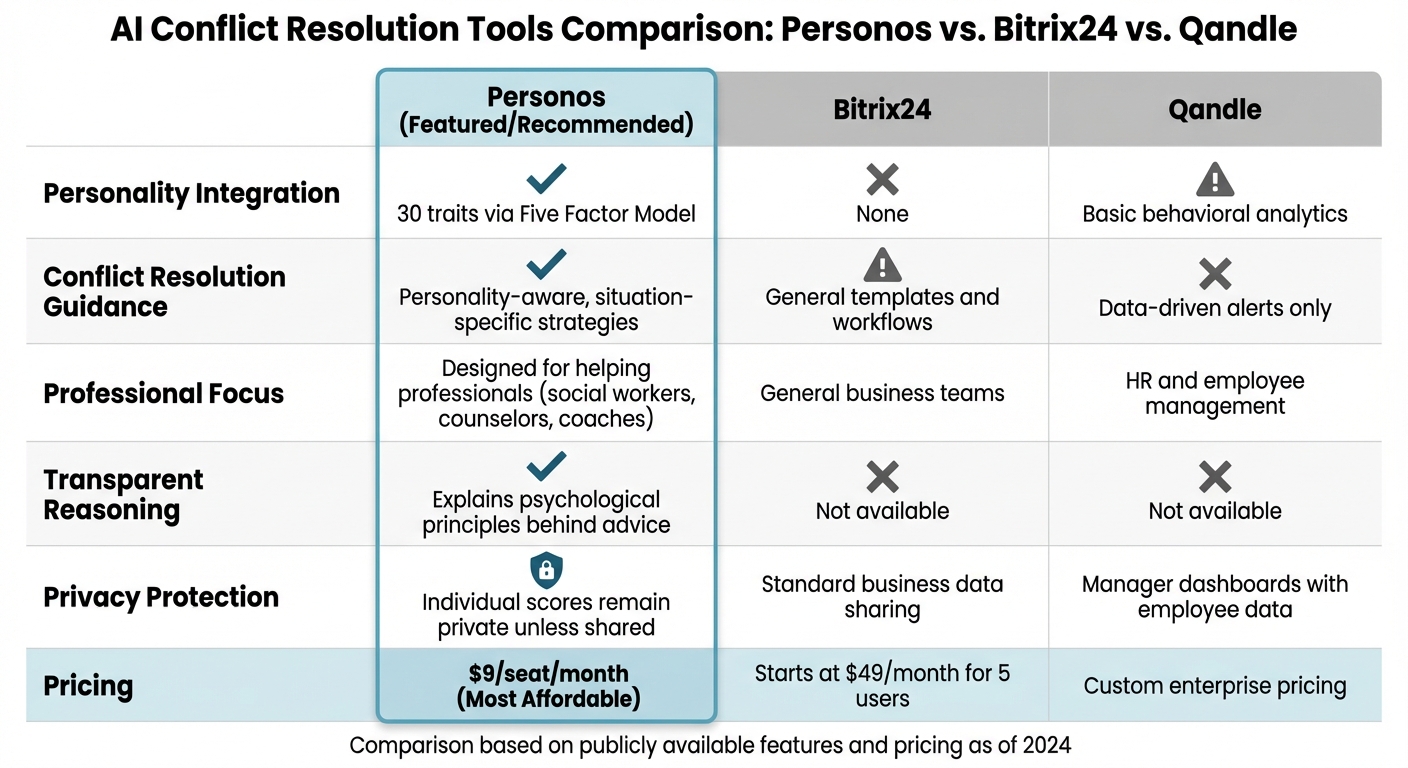
AI Conflict Resolution Tools Comparison: Personos vs Bitrix24 vs Qandle
Personos brings personality psychology into conflict resolution, using the Five Factor Model to evaluate 30 traits on an 80-point scale. It serves as a discreet assistant for professionals like social workers, case managers, counselors, coaches, and nonprofit staff, helping them navigate interpersonal challenges effectively[4].
Unlike tools that merely flag conflict, Personos dives deeper, analyzing how the traits of clients and practitioners interact. This approach enables tailored intervention strategies. For instance, a case manager working with a resistant client gains insights into how the client's openness, stress responses, and communication preferences align - or clash - with their own personality. By integrating psychometric data, Personos offers conflict management advice grounded in the real dynamics of the people involved[1].
A standout feature is its transparent reasoning, which explains the personality traits and psychological principles behind each recommendation. This helps professionals build expertise over time through AI-powered coaching instead of relying solely on AI. For example, a social worker preparing for a challenging family mediation can simulate conversations with Personos to anticipate how each family member might respond to different strategies. These insights are then transformed into practical tools for managing conflicts.
Core Features of Personos
Personos Chat provides tailored advice by blending personality data with context. A counselor managing a conflict between team members can describe the situation, and the chat will incorporate personality traits, interaction history, and workplace dynamics to suggest strategies that align with how each person processes information and handles disagreements.
Dynamic Reports offer insights at three levels: Personal (self-awareness), Relationship (two-person dynamics and friction points), and Group (team dynamics and collective blind spots). Unlike static assessments, these reports evolve with changing contexts. For example, a nonprofit director addressing staff conflict can use a Relationship Report to pinpoint communication gaps between employees and receive actionable strategies that consider everyone’s personality - including their own.
The ActionBoard turns insights into measurable outcomes. Recommendations from chats or reports can be converted into trackable action items with a single click. For professionals needing to demonstrate progress to funders or stakeholders, this feature ensures that personality insights lead to tangible results while documenting outcomes.
Prompts keep personality insights accessible even outside active sessions. These bite-sized, actionable tips are delivered on a schedule tailored to the user. A social worker, for example, might receive daily reminders on managing a specific client’s personality traits or handling their own stress during busy periods. These small nudges help professionals consistently apply conflict resolution strategies in their day-to-day work.
How Personos Stands Out Among AI Tools
Most workplace AI tools focus on task management or basic sentiment analysis, but Personos goes further by integrating personality data into conflict resolution. For example, Bitrix24 monitors communication and tracks conflict but doesn't account for individual personalities - it identifies tension but not the reasons behind it. Similarly, Qandle provides HR analytics and flags potential conflicts through data patterns but lacks personalized guidance.
| Feature | Personos | Bitrix24 | Qandle |
|---|---|---|---|
| Personality Integration | 30 traits via Five Factor Model | None | Basic behavioral analytics |
| Conflict Resolution Guidance | Personality-aware, situation-specific strategies | General templates and workflows | Data-driven alerts only |
| Professional Focus | Designed for helping professionals | General business teams | HR and employee management |
| Transparent Reasoning | Explains psychological principles behind advice | Not available | Not available |
| Privacy Protection | Individual scores remain private unless shared | Standard business data sharing | Manager dashboards with employee data |
| Pricing | $9/seat/month | Starts at $49/month for 5 users | Custom enterprise pricing |
Personos also prioritizes privacy, addressing a key concern in conflict resolution. Personality data is never shared without consent, ensuring individuals feel safe to engage honestly. Unlike traditional assessments that label people into rigid types, Personos maintains a flexible and respectful approach, fostering the trust needed for authentic conflict resolution.
For professionals managing high caseloads and working with vulnerable populations, Personos offers more than just a tool - it’s a resource for anticipating and addressing conflicts before they escalate. At $9 per seat per month, it provides advanced insights that even small practices and nonprofits can afford, delivering enterprise-level value without the hefty price tag.
Challenges and Ethics in AI-Driven Conflict Resolution
AI-powered tools for conflict resolution come with their own set of challenges, starting with algorithmic bias. When systems are trained on limited demographic data, they can misinterpret emotions across different groups. For example, an AI trained predominantly on one ethnicity might fail to accurately read nonverbal cues from others. This could lead to misunderstandings - what might signify stress in one group could be misread as anger in another - potentially escalating conflicts rather than resolving them[6][1]. These issues highlight the importance of embedding ethical safeguards into AI systems to ensure their effectiveness.
Another concern is automation bias, where professionals may overly trust AI-generated outputs, even when they're flawed. By 2019, at least 25% of Fortune 500 companies had adopted emotional AI technologies, and this market is expected to hit $13.8 billion by 2032[6]. With such rapid adoption, the risk of over-reliance grows. Lena Kempe, Principal Attorney at LK Law Firm, cautions:
"Emotional AI, if not operated and supervised properly, can cause severe harm to individuals and subject companies to substantial legal risks"[6].
Privacy issues also loom large. Emotional AI works by transforming deeply personal data - like heart rate, micro-expressions, and brain activity - into analyzable information. This raises significant concerns about consent and the security of such sensitive data, especially when dealing with vulnerable groups. In response, the Federal Trade Commission is cracking down on deceptive practices in AI tools, particularly those designed to manipulate users' emotions or beliefs[6].
The way forward isn’t to abandon AI but to integrate strong safeguards. Steps like reducing bias in AI prompts through diversified training datasets, using tools such as the NIST AI Risk Management Framework to regularly test for bias, and flagging low-confidence outputs for human review can help address these challenges[6][7]. These measures ensure AI tools are not only more accurate but also build trust - a cornerstone for platforms like Personos. Pollack emphasizes that AI should complement human empathy and judgment, not replace them[1]. In emotionally charged situations, AI should act as a research assistant, supporting human decision-making. Tackling these challenges is crucial as systems like Personos evolve to better assist professionals.
Conclusion
AI is reshaping how professionals manage emotion-driven conflicts, shifting the focus from reactive crisis management to proactive, empathy-centered solutions. Research shows that AI interventions can reduce conflict escalation by up to 37% in controlled environments, while personalized strategies boast a 52% higher success rate across 215 teams studied [8]. This evolution highlights tools that not only recognize emotions but also offer tailored strategies to address them effectively.
Take Personos, for example. This tool provides real-time, personalized guidance for specific interactions. Whether a social worker is navigating a crisis intervention or a counselor is working to build trust with a resistant client, Personos delivers strategies that are tailored to the emotional dynamics of the situation. It’s not about generic advice - it’s about communication that adapts to the personalities and emotions involved, fostering collaboration instead of conflict.
AI’s ability to detect emotions adds immense value, especially during high-stakes sessions. Studies reveal that AI can predict common conflict triggers with 67% accuracy and uncover hidden areas of agreement, resolving an average of 3.7 additional contentious points per mediation session [8]. For professionals managing heavy workloads, this technology enhances their capacity to deliver quality outcomes without sacrificing attention to detail.
Looking ahead, it’s essential to address potential challenges like algorithmic bias and privacy concerns. Using diverse training datasets and ensuring transparency in AI recommendations are key to responsible implementation. When handled thoughtfully, AI doesn’t replace the human touch in conflict resolution - it strengthens it. By leveraging these advancements, professionals can turn "conflict into collaboration" on a larger scale, creating meaningful and lasting impact in every interaction.
FAQs
What data does AI use to detect emotions in conflicts?
AI can examine communication patterns, pinpoint different types of conflicts with impressive precision, and recognize early warning signs of disputes. By leveraging tools such as personality analysis and language classification, it can interpret emotions and craft responses that align with the situation.
How can Personos tailor conflict strategies to different personalities?
Personos leverages AI-powered personality analysis rooted in the Five Factor Model, a well-established psychological framework. By assessing 30 distinct traits, it provides real-time, personalized guidance tailored to individual personalities and specific situations. This approach allows professionals to navigate conflicts more effectively, taking into account the unique dynamics of each individual's personality.
How can emotion AI be used without risking privacy or bias?
Using emotion AI responsibly means putting strict safeguards in place. This includes following privacy laws, collecting only the data that's absolutely necessary, anonymizing sensitive information, and always getting explicit consent from users.
To ensure systems are fair and unbiased - especially for minority groups - regular audits are a must. Tools like Personos take this a step further by blending AI-driven insights with human oversight. This approach not only supports ethical decision-making but also helps protect privacy and reduce bias, particularly in areas like conflict resolution.