AI-Driven Personality Insights for Leaders
Use AI-backed personality models (FFM, DISC) to tailor communication, reduce team conflict, and improve negotiation outcomes while protecting privacy.
Nick Blasi

AI-Driven Personality Insights for Leaders
AI tools are changing how leaders manage teams by offering personality-driven insights based on psychological models like the Five Factor Model (FFM) and DISC assessments. These tools analyze traits like Openness and Conscientiousness to help leaders improve communication, resolve conflicts, and guide negotiations. Platforms like Personos stand out by providing real-time, tailored advice, integrating personality data with organizational context.
Key takeaways:
- FFM: Focuses on traits like Agreeableness and Neuroticism to predict behavior and readiness.
- DISC: Provides quick insights into interaction preferences (Dominance, Influence, Steadiness, Conscientiousness).
- Personos: Combines FFM with conversational AI for specific guidance during high-pressure situations.
Studies show AI tools improve outcomes by up to 30%, but their effectiveness depends on individual personality types. Leaders who use these insights can reduce team conflicts, improve retention, and make better decisions in complex scenarios.
AI-Powered Personality Models for Leaders
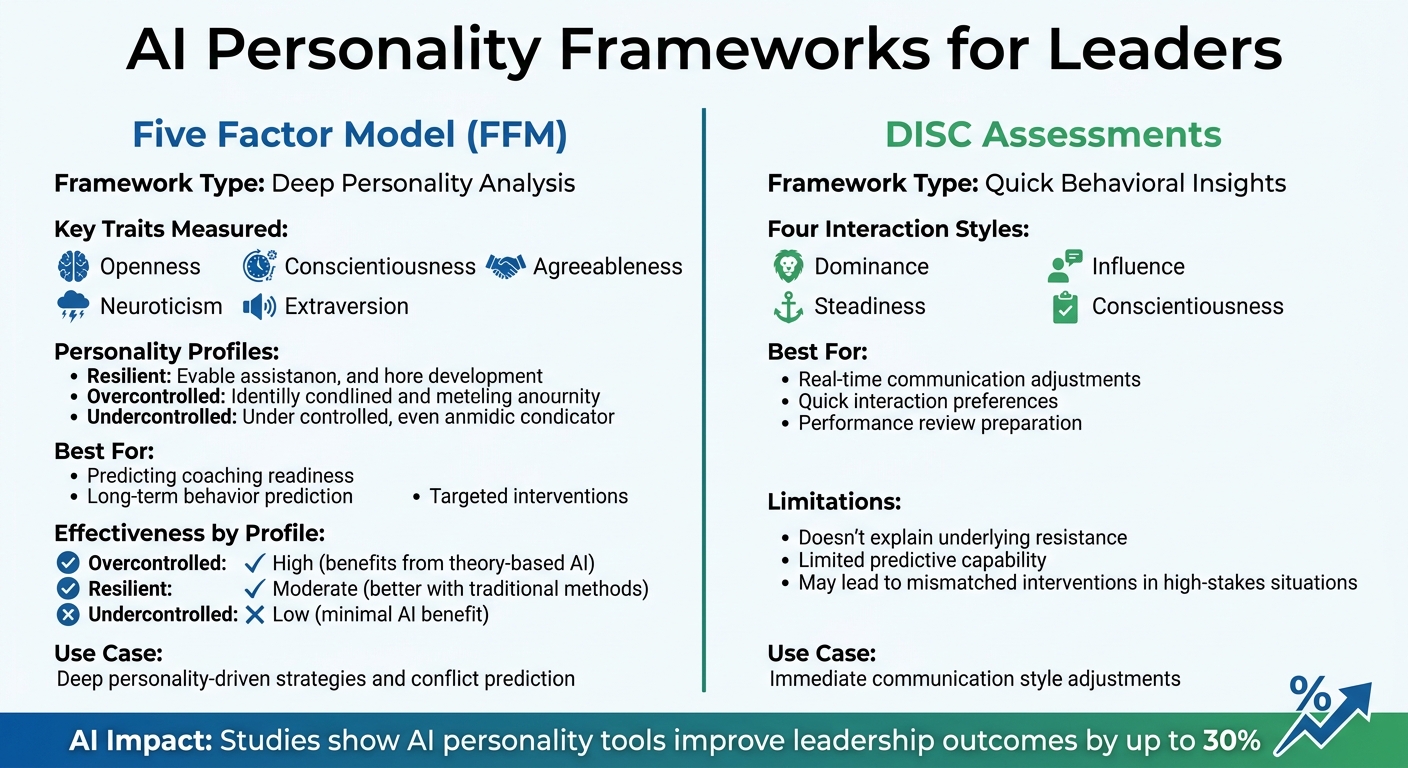
AI Personality Assessment Frameworks for Leaders: FFM vs DISC Comparison
AI platforms often use two main frameworks to understand personality: the Five Factor Model (FFM) and DISC assessments. Both tools bring unique strengths to the table, especially for leaders dealing with conflict or negotiation challenges.
The Five Factor Model in Leadership
The FFM categorizes people into three personality profiles - resilient, overcontrolled, and undercontrolled - to predict how they might respond to coaching or conflict.
A study by Duddu, Parekh, and Mao (April 2026) explored this in depth. Their research highlighted how a theory-driven AI tool, "Trucey", improved negotiation outcomes for overcontrolled workers. However, undercontrolled workers saw minimal benefits, while resilient individuals responded better to traditional handbooks.
"Personality [is] a predictor of readiness beyond stage-based tailoring: vulnerable users benefit from targeted rather than comprehensive interventions." - Duddu et al., Researchers[1]
This finding emphasizes that personality plays a key role in determining whether AI interventions are effective. Leaders cannot assume that a one-size-fits-all AI tool will work for every team member. FFM-based platforms can guide leaders in identifying who will thrive with AI-driven personality feedback and who might perform better with more conventional methods.
AI-Enhanced DISC Assessments
While the FFM dives deep into personality traits, DISC assessments focus on delivering quick, actionable insights. DISC categorizes individuals into four styles: Dominance, Influence, Steadiness, and Conscientiousness. These profiles are particularly helpful for leaders making real-time adjustments to communication. For instance, before a difficult performance review, a leader can use a team member's DISC profile to fine-tune their tone and approach.
However, DISC has its limitations. It provides insight into how someone prefers to interact but doesn’t explain the underlying reasons for resistance or predict how they might respond to coaching. In high-stakes situations, relying solely on DISC could lead to mismatched interventions, wasting resources and failing to deliver the desired results.
AI Tools for Leadership and Negotiation
In high-stakes negotiations, leaders need tools that provide real-time, context-specific guidance rather than one-size-fits-all evaluations. While many AI platforms offer personality insights, their effectiveness can vary based on factors like scientific accuracy, privacy safeguards, and usability. This is where platforms like Personos stand out.
Personos: Real-Time Conflict Negotiation Support
Personos utilizes the validated Five Factor Model, analyzing 30 traits on an 80-point scale, combined with conversational AI. By factoring in organizational values, job history, and relationship dynamics, it delivers highly tailored strategies for leadership challenges.
The platform’s Personos Chat is particularly valuable for navigating tough conversations. Whether preparing for a performance review or salary negotiation, leaders can use the "@" function to input the personalities of all participants. The result? Suggested language that aligns with each individual’s motivators and communication style.
"It surfaces blind spots I would have taken months to uncover. It's like having a co-pilot who never misses a detail." - David Kim, Executive Leadership Coach [2]
Dynamic Reports go beyond static personality profiles, offering actionable insights into communication habits, conflict triggers, and leadership tendencies. These reports, paired with the ActionBoard, ensure that personality insights translate into measurable behavior changes by tracking progress and commitments.
A real-world example: In 2025, VP Sarah Mitchell adopted Personos to address team dysfunctions. Within six months, her team’s turnover rate dropped by 45% [2]. Moreover, Personos prioritizes privacy by masking identifiers and hiding personality scores by default, fostering a safer and more trusting environment [2][3].
Platform Comparison: Personos vs. Competitors
Many AI platforms focus on static personality assessments to predict team compatibility or hiring outcomes. Personos, however, excels by offering real-time conversational guidance enriched with contextual intelligence. Here’s how it compares to other tools:
| Feature | Personos | Competitors |
|---|---|---|
| Framework | Five Factor Model (30 traits, 80-point scale) | Preset types, colors, or letters |
| Guidance | Conversational AI with contextual memory | Static reports or generic chatbots |
| Privacy | Data masking; scores hidden by default | Scores often visible to leadership/teams |
| Contextual Depth | Integrates job history, values, and dynamics | Limited to personality traits only |
While general-purpose AI tools like ChatGPT can simulate negotiation scenarios, they lack the scientific foundation and personality-specific precision that Personos offers.
Additionally, Personos ensures user data is never used to train its AI models and employs FusionAuth for secure authorization hosting. This focus on privacy makes it a trusted choice for managing sensitive personnel matters and high-stakes negotiations. By blending personality psychology with leadership strategies, Personos equips leaders with the insights they need to handle conflicts effectively and make informed decisions.
Applying Personality Insights to Leadership Situations
Adjusting Communication During Conflicts
When leaders understand personality traits, they can fine-tune their communication styles to connect more effectively with others. AI tools help by analyzing patterns like tone and word choice, identifying potential triggers for conflict, and suggesting areas for improvement. This kind of feedback allows leaders to spot when they might be overlooking critical cues or unintentionally using language that could hinder productive dialogue.
"AI training platforms can analyze communication patterns like tone to learn how to detect potential conflict triggers, resolve disagreements and highlight improvements." – Virti [4]
AI simulations also provide a safe space for leaders to practice managing tense situations. These virtual exercises mimic a range of emotional tones, helping leaders develop calm and composed responses during real-world conflicts [4].
Tools like Personos take this a step further by allowing leaders to simulate conversations based on a counterpart's personality profile. By inputting the profile through the "@" function, leaders receive specific language suggestions to avoid common communication pitfalls. Beyond improving individual interactions, AI also helps leaders foresee and address potential team-wide conflicts before they escalate.
Using AI to Predict and Prevent Team Conflicts
AI doesn’t just enhance personal communication - it also offers valuable insights to prevent team-wide conflicts. However, not everyone benefits equally from AI coaching. A 2026 study involving 267 participants revealed that personality types - resilient, overcontrolled, and undercontrolled - play a significant role in how effective AI-driven interventions are during workplace negotiations. For example:
- Overcontrolled individuals, who often struggle with assertiveness, responded well to theory-based AI models.
- Resilient workers showed better results when paired with traditional leadership resources.
- Undercontrolled individuals, prone to impulsivity and emotional reactions, showed minimal improvement even with AI support [1].
These findings highlight the importance of tailoring AI tools to fit individual needs rather than applying a one-size-fits-all method. Segmenting team members by personality type can make AI tools more effective. Platforms like Personos are especially useful for employees requiring targeted guidance, while resilient team members might benefit more from a mix of AI and conventional resources.
Dynamic tools, such as Personos' Dynamic Reports, can also identify potential friction points - like mismatched traits such as conscientiousness - so leaders can adjust workflows, communication styles, or project assignments to minimize tension. By leveraging these insights, leaders can shift from merely reacting to conflicts to creating a proactive environment where team harmony thrives. This approach underscores the growing role of data-driven decision-making in modern leadership.
Conclusion
Today’s leaders are moving beyond intuition and embracing tools grounded in science to guide their decisions. Using the Five Factor Model, which dives deep into personality traits, they’re shifting from reactive approaches to proactive strategies that rely on data-driven insights.
Platforms like Personos are leading this shift. Whether it’s navigating tough negotiations or managing crises, these tools provide instant, tailored recommendations based on detailed personality profiles and real-world context. Features like the ActionBoard take it a step further by turning insights into actionable strategies. Leaders can track metrics like conflict resolution times, team satisfaction, and retention rates - offering clear evidence of impact for stakeholders.
In a world where leaders face diverse teams and growing demands, tools that complement human judgment are no longer optional - they’re essential. By integrating AI-powered personality insights into daily practices, organizations can tackle staff burnout, address conflicts before they escalate, and foster environments where collaboration flourishes. These tools don’t replace leadership; they enhance it.
The challenge now is speed. How quickly can leaders adopt these tools to drive meaningful change? With the blend of personality science, AI, and actionable strategies, leaders have the power to reshape team dynamics and deliver lasting results. For those committed to building stronger, more effective teams, the time to act is now.
FAQs
Which personality model should I use: FFM or DISC?
When deciding between the Five Factor Model (FFM) and DISC, it really comes down to what you're looking for. The FFM, used by tools like Personos, dives deep into 30 traits, offering detailed, research-backed insights. This makes it a great choice for tackling complex situations like leadership challenges or resolving conflicts. On the other hand, DISC simplifies things by focusing on four personality types. It's straightforward but doesn't provide the same level of detail. If you're dealing with high-stakes situations that require precise and thorough guidance, the FFM stands out as the more reliable option.
How can I use AI personality insights in real conversations?
Tools like Personos make it possible to use AI personality insights in conversations. These tools analyze personality traits and provide real-time guidance tailored to specific situations. By using detailed personality profiles and understanding the context, they can suggest customized prompts to improve how you communicate. For instance, they might recommend specific phrases or strategies based on the personality of the person you're engaging with. This approach can help you adjust your style, handle conflicts more effectively, and strengthen trust in your interactions.
How do these tools protect employee privacy?
AI-powered tools for personality insights place a strong emphasis on protecting employee privacy. Platforms such as Personos implement measures like anonymizing or de-identifying data, ensuring that personal information remains secure. They also require informed consent from users and adhere to regulations like GDPR and CCPA. To further safeguard privacy, insights are often presented in an aggregated format or at a group level, avoiding the disclosure of individual details. Clear and open communication about these practices builds trust, allowing organizations to leverage AI responsibly for leadership development and coaching.