AI in Crisis Leadership: Decision Support Tools
AI decision tools speed crisis response with real-time monitoring, simulations, and human-AI collaboration for ethical leadership.
Nick Blasi

AI in Crisis Leadership: Decision Support Tools
In high-pressure crises, quick decisions are critical. AI tools are changing how leaders respond by providing immediate data analysis, risk detection, and actionable plans. These platforms process massive amounts of information in seconds, helping leaders focus on strategy and communication.
Key takeaways:
- Speed: AI cuts response times by up to 70%.
- Cost: AI platforms are far cheaper than traditional crisis consultants, costing $299–$999/month versus $30,000–$50,000 for manual plans.
- Preparedness: Only 49% of organizations have crisis plans, but AI tools act as an "always-on" solution.
- Balance: AI handles data; humans focus on empathy and ethical decisions. This requires leaders to understand potential bias in AI to ensure fair outcomes.
Popular tools like Personos, CrisisCommand, and Striim each address specific needs, from monitoring risks to guiding interpersonal communication. The future of crisis management lies in a partnership between AI and human judgment, ensuring fast, informed, and empathetic responses.
How to Use AI for Crisis Management | Sprinklr
What AI Decision Support Tools Do in Crisis Management
AI tools play a crucial role in crisis management by offering real-time monitoring, predictive modeling, and historical analysis. These functions address key challenges in traditional crisis response, such as the need for speed, anticipation, and data-driven strategies. Together, they provide leaders with the tools to make informed decisions under pressure.
Real-Time Monitoring and Risk Analysis
AI systems excel at scanning social media, news outlets, and internal data streams to detect potential crises early. Instead of waiting for problems to escalate, these tools identify spikes in activity or concerning keyword trends that could signal trouble [5]. For instance, a sudden increase in negative mentions on platforms like Twitter or Reddit might highlight a reputational issue long before it reaches mainstream media.
To cut through the noise, AI ranks and clusters alerts, helping leaders focus on the most critical issues. Using natural language processing (NLP), these tools analyze sentiment in real time, offering insights into whether stakeholders are angry, confused, or supportive [2][5]. As MediaPeachy highlights:
AI-driven crisis management simplifies complex processes by improving detection, prioritization, and coordination [5].
AI also helps map stakeholders by influence, identifying key groups - such as investors, customers, or regulators - and assessing how their reactions might impact the situation. This stakeholder mapping enables leaders to prioritize communication efforts and allocate resources where they’re needed most [1][5].
Predictive Modeling and Scenario Simulations
AI doesn’t just respond to crises - it predicts how they might evolve. By analyzing previous incidents, predictive models identify patterns of escalation and highlight vulnerabilities in specific operations, regions, or stakeholder groups. This allows leaders to prepare for multiple scenarios rather than relying on a single plan [5].
Simulations powered by tools like CrisisCommand test response strategies in dynamic environments, allowing teams to refine their crisis management skills. Unlike static plans that often go unused, these simulations adapt to real-time data, offering updated recommendations as new information becomes available [5]. With only 49% of organizations maintaining formal crisis plans - and even fewer practicing them regularly [1] - AI-driven simulations ensure preparedness becomes an ongoing process rather than a one-time effort.
Recommendations Based on Historical Data
AI uses historical crisis data to recommend effective strategies, helping leaders avoid repeating past mistakes [1]. Security Orchestration, Automation, and Response (SOAR) platforms, for example, can reduce incident response times by up to 80% [6]. These tools generate structured frameworks - like CONTAIN/RESPOND/RECOVER - tailored to the crisis type and severity.
James Neilson of CrisisCompass explains:
AI processes vast amounts of crisis data faster than humans, identifying the most effective response strategies based on past crisis outcomes [6].
Some platforms, like Personos, go a step further by incorporating insights about human behavior and stakeholder psychology, offering more nuanced recommendations for crisis leadership. AI-powered after-action reviews compare current outcomes with historical benchmarks, refining strategies for future incidents and ensuring organizations continually improve their crisis management playbooks [5].
AI Tools for Crisis Leadership: Platform Comparison
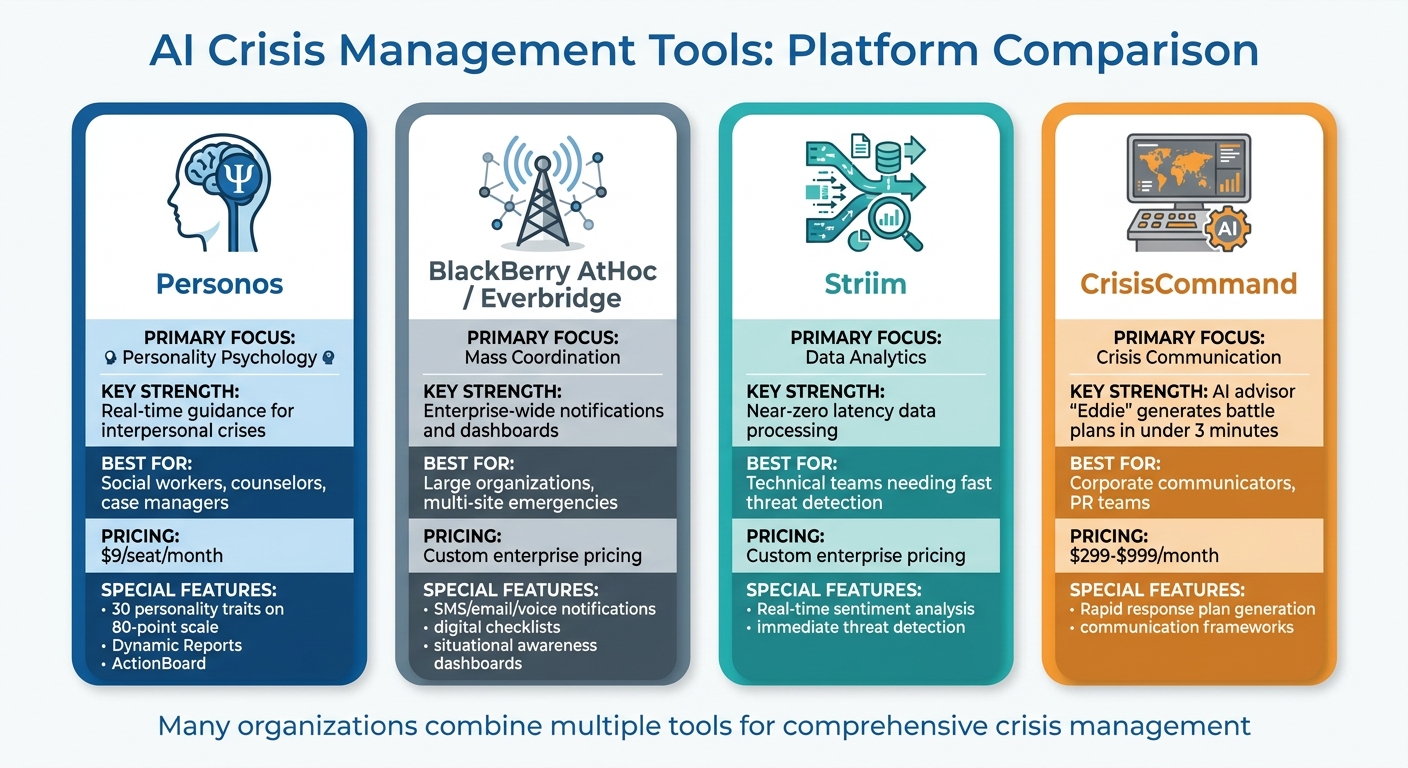
AI Crisis Management Tools Comparison: Features, Pricing and Best Use Cases
AI crisis tools tackle different aspects of leadership challenges - whether it’s coordinating large teams, processing data in real time, or offering guidance tailored to individual personalities. Each tool plays a role in creating a well-rounded crisis management strategy.
Personos: Personality-Based Crisis Guidance
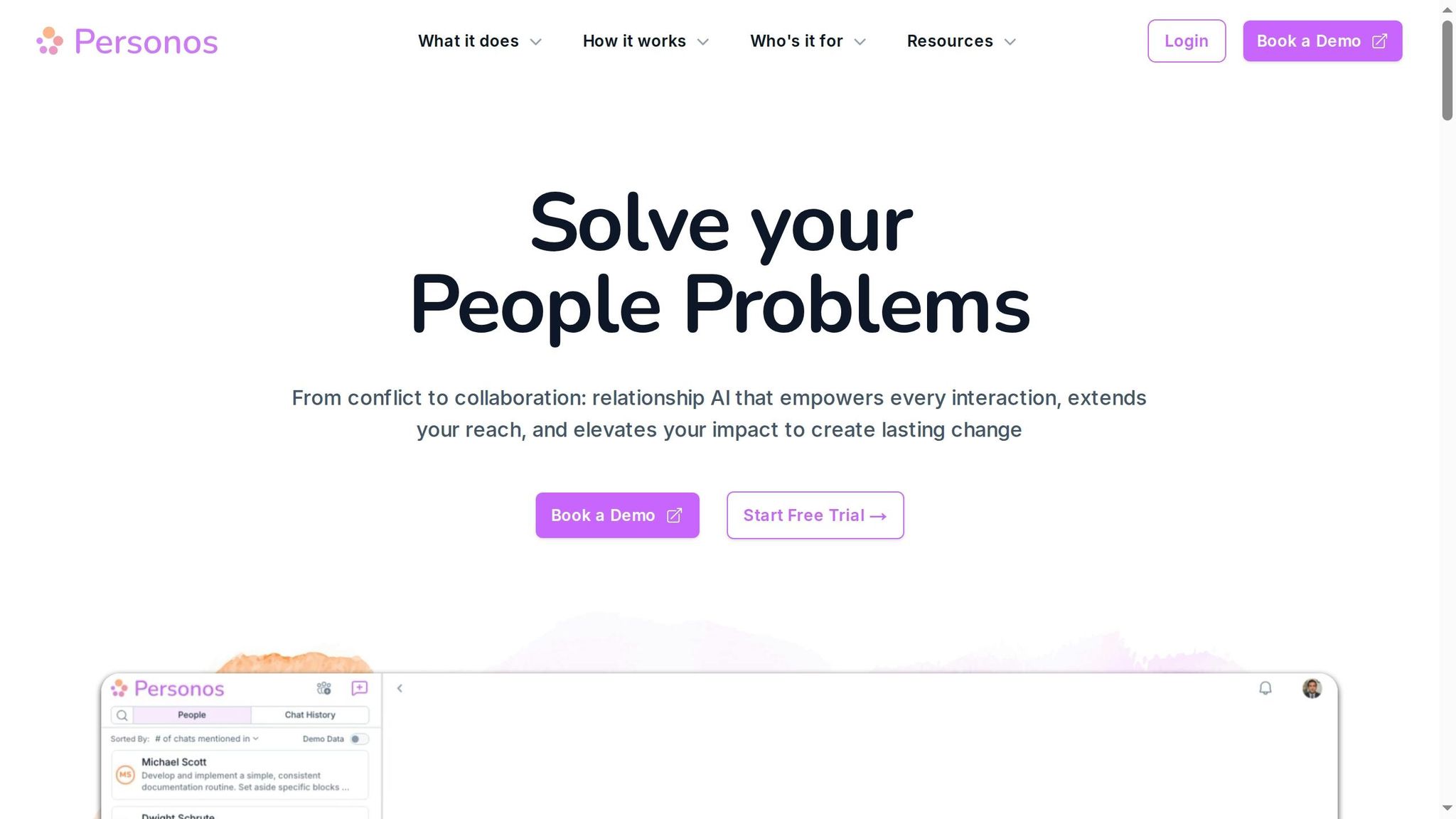
Personos takes a unique approach to crisis management by focusing on the human side of leadership. Built on the Five Factor Model, it evaluates 30 personality traits on an 80-point scale to deliver real-time, personalized guidance for navigating crises and building trust [personos.ai].
This tool’s conversational AI combines personality profiles with specific contexts to offer tailored advice. For example, a social worker might receive guidance that aligns with both their personality and that of their client. The platform’s Dynamic Reports provide fully customized insights, covering individual traits, practitioner-client relationships, and group dynamics. These reports even include sections on trauma responses and coping mechanisms.
Unlike tools that emphasize organizational coordination, Personos zeroes in on interpersonal dynamics, often the deciding factor in whether a crisis is resolved or worsens. Its ActionBoard feature turns insights into actionable steps, ensuring that advice leads to measurable results. At $9 per seat per month, it’s an affordable option for nonprofit staff, counselors, and case managers handling emotionally taxing situations.
BlackBerry AtHoc and Everbridge: Centralized Crisis Management
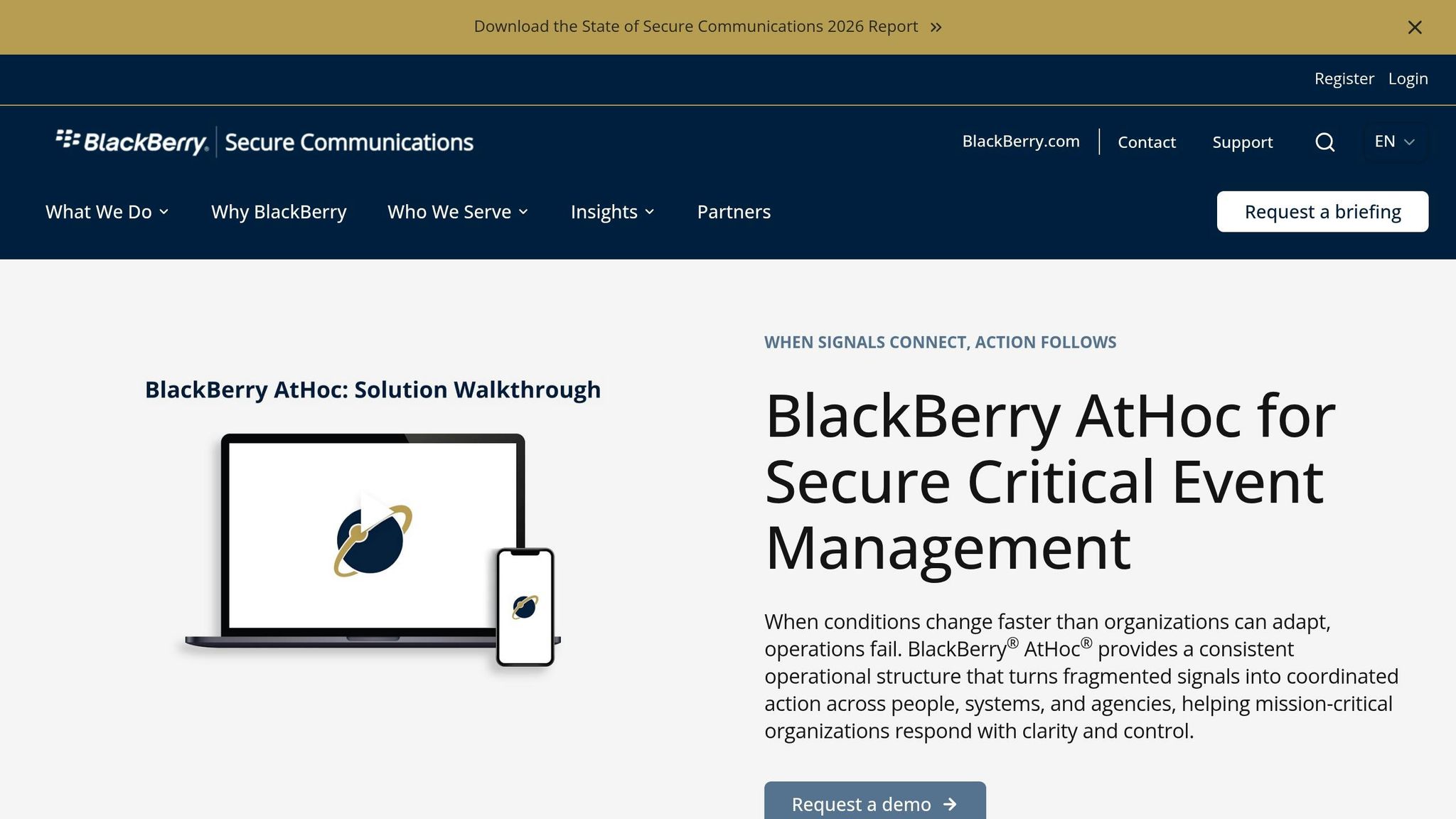
BlackBerry AtHoc and Everbridge excel in mass notification and centralized coordination. These platforms provide tools like SMS, email, and voice notifications, along with dashboards for situational awareness [7]. Crisis teams can use digital checklists to track departmental progress, ensuring that responses stay organized during large-scale emergencies.
While these tools are indispensable for enterprise-level incidents - where reaching thousands of people quickly is critical - they don’t delve into the nuances of individual human behavior or personalized communication strategies.
Striim: Real-Time Data Analytics
Striim specializes in real-time data processing, offering near-zero latency to help detect threats as they occur [7]. The platform even analyzes sentiment in real time, helping leaders gauge stakeholder emotions - whether they’re angry, confused, or supportive - before crafting responses.
Though Striim is a powerhouse for fast data analytics, it doesn’t provide the strategic frameworks or personality-driven insights that tools like Personos or CrisisCommand offer.
Comparison Table of Tools
| Platform | Primary Focus | Key Strength | Best For | Pricing |
|---|---|---|---|---|
| Personos | Personality psychology | Real-time guidance for interpersonal crises | Social workers, counselors, case managers | $9/seat/month |
| BlackBerry AtHoc / Everbridge | Mass coordination | Enterprise-wide notifications and dashboards | Large organizations, multi-site emergencies | Custom enterprise pricing |
| Striim | Data analytics | Near-zero latency data processing | Technical teams needing fast threat detection | Custom enterprise pricing |
| CrisisCommand | Crisis communication | AI advisor "Eddie" generates battle plans in under 3 minutes | Corporate communicators, PR teams | $299-$999/month [2] |
Choosing the right tool depends on whether your challenges involve technical needs (data processing), organizational coordination, or human behavior (trust and interpersonal dynamics). Many organizations combine tools - for example, using Striim for monitoring data, Everbridge for mass notifications, and Personos for addressing human factors. Together, these platforms help create a strong partnership between human leaders and AI in crisis situations.
How to Build a Human-AI Partnership for Crisis Leadership
Successful crisis management combines AI's ability to process data quickly with human strategic thinking and emotional intelligence.
Defining Roles: AI for Data, Humans for Strategy
AI is best suited for tasks that involve handling large volumes of data. It excels at real-time monitoring, filtering out irrelevant information, aggregating data, and performing initial analyses. This allows human leaders to focus on making ethical decisions, crafting strategies, and considering the human impact of their choices.
However, AI's strengths lie in efficiency, not in understanding human needs. For instance, while AI might prioritize metrics like share prices or operational performance, it could miss the importance of caring for employees or customers [3]. Human leaders, therefore, must define success in broader terms, beyond just numbers. Although AI can detect emotional cues, it cannot feel or express genuine empathy, which is often critical in resolving crises [3] [4].
A human-in-the-loop (HITL) model works best for high-stakes decision-making. In this setup, AI provides recommendations, but humans validate and oversee these suggestions [8]. This collaboration minimizes the risk of AI errors, such as misinterpretations or inappropriate responses, that could worsen a crisis. For example, Personos explains the reasoning behind its recommendations, offering insights into the personality factors involved. This transparency helps leaders understand the "why" behind suggestions, allowing for confident decision-making [10]. Additionally, AI can simulate stakeholder reactions using digital twins, enabling leaders to anticipate the potential impact of their decisions [3].
This clear division of responsibilities between data processing and strategic thinking not only improves decision-making accuracy but also builds trust between humans and AI.
Explainable AI (XAI) for Trust and Confidence
Once roles are clearly defined, explainable AI becomes a key factor in fostering trust - something essential for making quick, informed decisions during a crisis. Trust in AI grows when leaders can understand how the system arrives at its conclusions. As TCS observed:
The human mind is not yet comfortable trusting systems that decide without letting us into the logical reasoning behind those decisions [9].
Explainable AI (XAI) addresses this concern by offering clear, easy-to-understand explanations rather than overwhelming users with numbers or complex visuals.
Features that build trust include uncertainty quantification, which highlights data gaps that could affect predictions, and counterfactual explanations, which show what minimal changes could alter an outcome [9]. Poor handling of high-stakes communication can lead to a 25–35% drop in stakeholder trust within months [4]. On the other hand, leaders who trust AI's logic tend to make decisions 23% faster and with 32% fewer corrections after the fact [4]. Shared dashboards that integrate information from legal, operations, and communications teams also help reduce misunderstandings and align teams around AI-supported decisions [5].
Platforms like Personos exemplify how transparent AI can complement human empathy. By detailing the personality insights behind its recommendations, it enables leaders to act with both confidence and compassion. In critical situations, this partnership between AI's analytical capabilities and human judgment ensures timely and well-grounded responses.
How to Implement AI in Crisis Leadership
Bringing AI into crisis leadership isn't just about adopting new technology - it’s about creating a balance between tools, people, and processes. Successful organizations allocate their efforts wisely: 70% on people and processes, 20% on data and technology, and only 10% on algorithms. This approach ensures teams are ready to collaborate with AI, making its rapid insights actionable during high-pressure situations.
Start with Pilot Programs
Launching AI tools through pilot programs helps minimize risks and build trust within the organization. A phased framework is particularly effective:
- Phase 1 (Months 1-3): Assess the readiness of the organization, establish governance structures, and provide AI literacy training for leadership.
- Phase 2 (Months 4-9): Test AI tools in low-stakes scenarios, where errors don’t lead to real-world consequences. Simulations, such as digital twins and tabletop exercises, allow teams to evaluate AI’s performance in realistic conditions.
Simulation-based learning is critical before deploying AI in actual crises. For context, a live crisis plan for a major company can cost between $30,000 and $50,000 [1]. Pilot programs offer a more controlled and less costly way to validate AI’s potential. Once these tools are tested and proven, organizations can focus on implementing operational safeguards.
Focus on Data Privacy and Bias Mitigation
In high-stakes situations, protecting data and addressing bias are essential. Organizations should adopt Privacy by Design principles at every stage, from data collection to model retirement. Practices like data minimization - only collecting what’s necessary - can significantly reduce risks. This is crucial, given that the average cost of a data breach is expected to reach $4.44 million by 2025 [1].
Recent regulatory actions against companies like Clearview AI and Everalbum highlight the importance of robust privacy measures [12]. Regular audits, AI bias detection algorithms, and techniques like tokenization or masking can help safeguard sensitive information. To ensure accountability, it’s vital to establish an internal review body that oversees ethical AI use. Currently, only 6% of organizations report having a solid foundation for responsible AI practices [11]. Beyond technical safeguards, equipping teams with the expertise to manage AI tools effectively is just as important.
Provide Training for Effective Human-AI Collaboration
For AI to make a meaningful impact during crises, leaders and teams need thorough training that covers technical, emotional, and ethical aspects. Key areas of focus include:
- Basics of Machine Learning, NLP, and RPA
- Understanding and addressing over 85 emotional states, such as grief or anger
- Tackling algorithmic bias and ensuring data privacy [13][4]
A phased training approach works best. Start with 60-minute introductory sessions for communications teams to build foundational knowledge. Follow this with comprehensive multi-day courses tailored for strategic leaders [13][4]. Training should go beyond outputs, explaining the reasoning behind AI recommendations to foster trust and understanding.
The Crisis Ready Institute emphasizes the importance of calm, informed leadership during crises:
The goal is to support you in leading with calm intelligence when everyone else is being reactive [4].
Leaders trained in AI decision-making can act 23% faster and require 32% fewer corrections [4]. Post-crisis, AI tools can compile event timelines and analyze response effectiveness, helping organizations identify bottlenecks and improve future strategies [5][1].
Conclusion
AI decision support tools are reshaping how leaders handle crises, turning overwhelming situations into clear strategies and actionable steps within minutes. These tools don’t replace human judgment - they enhance it. By tackling the heavy lifting of data analysis, they allow leaders to focus on what matters most: empathy, ethics, and strategic priorities[6]. The result? Faster and more confident decisions when time is of the essence.
Here’s a quick recap: AI-driven platforms can cut crisis response times by up to 70%, help leaders make decisions 23% faster, and reduce 32% of post-event corrections. On the flip side, mishandling high-stakes communication can cause companies to lose 25–35% of stakeholder trust within just a few months[4].
These advancements are opening doors for specialized tools that address human-centric challenges. Take Personos, for example - a tool designed specifically for professionals managing complex interpersonal dynamics during crises. Powered by the Five Factor Model, it identifies over 85 emotional states and offers real-time, personality-aware guidance. At just $9 per seat per month, it provides a level of support that generic AI solutions simply can’t deliver.
James Neilson of CrisisCompass puts it perfectly:
Human-AI collaboration is the future - AI supports, but does not replace, crisis leaders[6].
The organizations that succeed are those that invest in pilot programs, prioritize data privacy, and provide targeted training to build both technical skills and emotional intelligence. The aim isn’t to automate leadership but to empower it. By combining fast data insights with human empathy and strategic thinking, leaders can turn crisis management into a true competitive edge.
FAQs
What should humans still decide in a crisis vs. AI?
Humans play a key role in making critical decisions during crises, especially when ethical judgment, an understanding of complex human interactions, and context are essential. While AI can assist by analyzing vast amounts of data, spotting patterns, and providing insights, it lacks the ability to replace human judgment.
Tasks such as prioritizing actions, addressing ethical challenges, and communicating with the public require the human touch to ensure responses align with societal values and demonstrate emotional understanding.
How can you pilot an AI crisis tool without real-world risk?
Organizations can test AI crisis tools effectively by using simulation environments, controlled testing, and scenario-based exercises that mimic actual crises. These approaches provide a safe space to assess how the tools perform under pressure and make decisions without real-world consequences. Platforms designed for scenario modeling and decision support enable leaders to fine-tune their strategies, ensuring they’re prepared to handle real emergencies without interrupting daily operations.
How can AI crisis tools protect privacy and reduce bias?
AI tools designed for crisis management strengthen privacy by implementing rigorous data governance policies. They anonymize data and use encryption to safeguard against breaches. For example, platforms like Personos focus on confidentiality by handling sensitive information with a privacy-first approach.
To address bias, these tools use scientifically backed frameworks like the Five Factor Model. They also integrate human oversight to promote fair, objective, and ethical decision-making, especially in critical situations.