Q&A: Using AI for Conflict in High-Stress Teams
AI personality insights and real-time coaching help high-stress teams prevent conflicts, improve communication, and reduce turnover.
Nick Blasi

Q&A: Using AI for Conflict in High-Stress Teams
AI tools are transforming how high-stress teams handle conflict. By analyzing personality traits and monitoring team interactions, these tools offer tailored solutions to prevent and resolve disputes. Platforms like Personos use models like the Five Factor Model to provide real-time insights, actionable advice, and progress tracking at an affordable $9 per user per month. This technology helps managers address issues early, reduce turnover, and improve team dynamics, even in challenging environments like addiction recovery or social services.
Key takeaways:
- AI identifies conflict triggers (e.g., personality clashes, communication styles, decision-making differences).
- Real-time support includes personalized advice and roleplay scenarios to improve communication.
- Affordable solutions like Personos deliver results for teams under pressure, such as a 45% turnover reduction in six months.
AI-driven tools make conflict management more effective, helping teams move from tension to collaboration.
Understanding Personality-Based Conflicts in Teams
Common Sources of Personality-Based Conflict
Personality differences are often at the root of workplace conflicts [1]. In high-stress environments - like behavioral health, domestic violence advocacy, or reentry programs - these differences can become even more pronounced. When stress levels rise, team members tend to react in ways that reflect their individual personalities, which can clash with colleagues who handle stress differently. This is where understanding personality models becomes crucial for decoding team dynamics.
Communication style mismatches are one of the most frequent causes of friction. For instance, some individuals process information analytically, preferring detailed, step-by-step plans, while others rely on intuition, focusing on broader goals and future possibilities [4]. Analytical thinkers may push for thorough reviews, which intuitive thinkers might view as overly cautious. On the flip side, intuitive thinkers’ preference for quick action can come across as impulsive to their more methodical teammates. Without recognizing these differences, both sides can easily misinterpret each other’s intentions.
Decision-making styles are another area where conflicts arise. Some people need time to reflect and gather input before making decisions, while others are comfortable deciding quickly and adapting later. This dynamic can be particularly challenging in fields like domestic violence advocacy or reentry programs, where professionals must balance empathy with maintaining professional boundaries [1]. When these differing approaches go unaddressed, team members may feel undervalued or disconnected. Marcus Lee, JD, Reentry Program Director, shared his insights on the impact of understanding these dynamics:
It predicts behavior in a way that still catches me off guard. But taking that and the advice it gives and applying it to my team, I've never seen results like it [1].
Stress responses further complicate team interactions. Some people become more vocal under pressure, while others withdraw. For example, a high-energy responder might see a quieter colleague’s withdrawal as a lack of interest or commitment, sparking resentment. Conversely, someone who needs quiet reflection could interpret increased communication as overwhelming or intrusive, further straining the relationship.
Using Personality Models to Identify Conflicts
Understanding these conflict triggers is the first step in leveraging AI-powered personality models to address team friction. The Five Factor Model (FFM) is a scientifically grounded tool that measures 30 distinct personality traits on an 80-point scale. This detailed framework helps managers uncover "blind spots" in team dynamics that might otherwise take months to surface [1]. Compared to simpler models, the FFM offers deeper insights into traits like ambiguity tolerance, responses to criticism, and emotional processing - key factors in high-stress workplaces.
Other tools like MBTI and DISC also provide valuable insights. MBTI can indicate whether someone thrives in structured or flexible environments, while DISC identifies whether a person prioritizes results, relationships, stability, or accuracy. AI tools take this further by monitoring hundreds of potential conflict indicators in real time, analyzing emails and chats to detect early signs of tension and reduce conflicts in remote teams [2][5]. These tools can even facilitate roleplay scenarios, allowing team members to practice active listening and empathy. For example, they might simulate conversations between detail-oriented and big-picture thinkers to identify sources of tension and build better communication strategies [4].
Platforms like Personos use the FFM to provide real-time sentiment analysis and actionable feedback. They can flag behaviors like interruptions or dismissive comments and suggest alternatives, such as emphasizing a colleague’s strengths [4]. By offering this level of detail, these tools enable managers to intervene early - before minor conflicts escalate. At just $9 per seat per month, these personality-focused solutions are accessible even for organizations with tight budgets, making conflict prevention a practical option for all teams.
AI Roleplay: Conflict Resolution (Live Example)
How AI Tools Resolve Team Conflicts
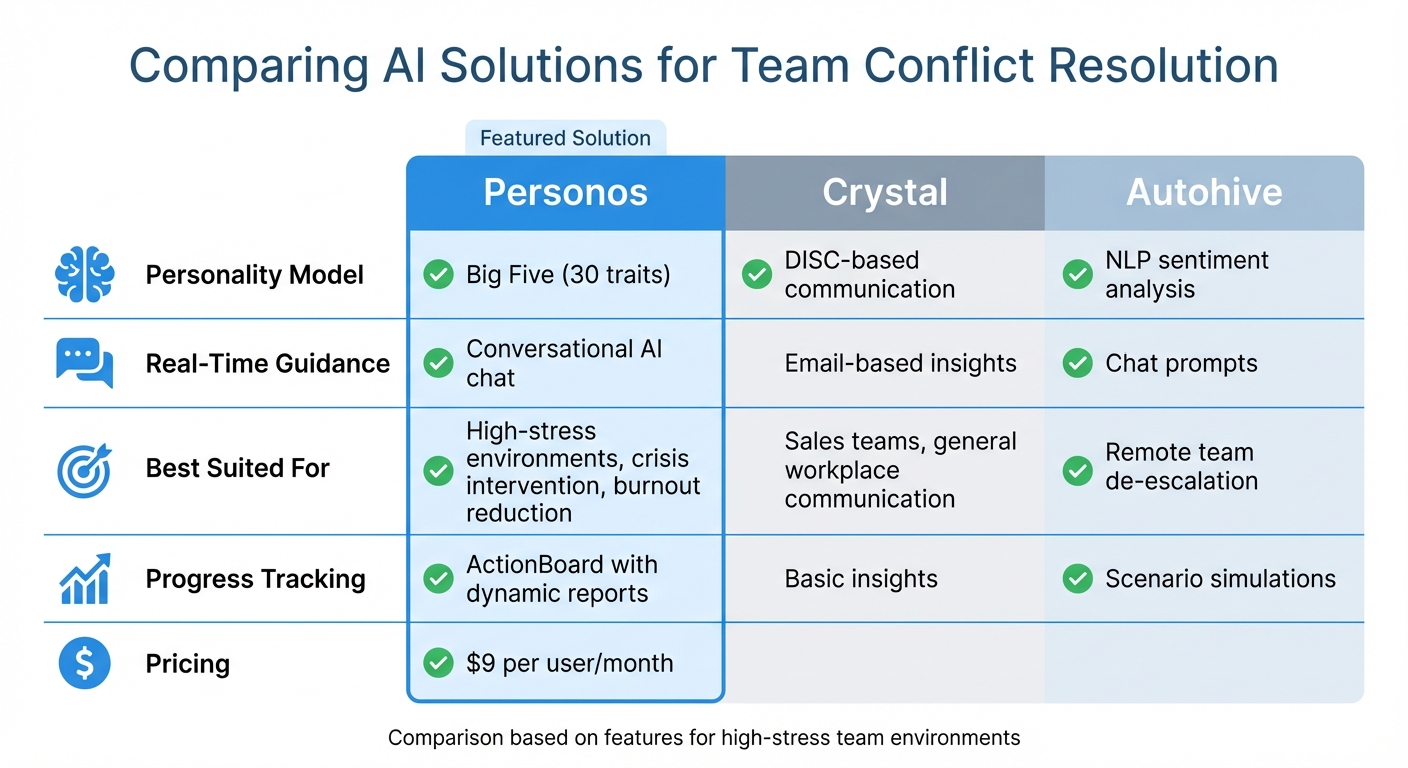
AI Conflict Resolution Tools Comparison: Personos vs Crystal vs Autohive
Key Features of AI-Powered Conflict Resolution Tools
AI-powered tools for conflict resolution go beyond merely identifying personality clashes - they offer real-time, actionable solutions to address issues as they arise. The most effective platforms integrate three main features: dynamic personality reports to uncover the root causes of conflicts, conversational AI for immediate, tailored advice, and progress tracking to help teams develop long-term skills for smoother collaboration.
Dynamic personality reports form the backbone of these tools. Unlike one-time personality assessments, these reports evolve alongside team dynamics. For instance, Personos generates personalized reports across three levels: individual self-awareness, interpersonal relationships, and group-wide patterns. By analyzing friction points based on the Five Factor Model's 30 traits, these reports provide specific communication strategies for various personalities. This approach not only highlights potential conflict areas but also delivers actionable advice for working together effectively.
Conversational AI chat adds immediacy to the mix. Instead of waiting for scheduled meetings or training sessions, team members can describe a conflict in real time and receive context-aware advice instantly. The AI uses detailed profiles, case notes, and team goals to offer recommendations tailored to the situation. It even explains its reasoning by referencing relevant personality traits, allowing users to learn and grow their own conflict resolution skills over time.
Progress tracking ensures the changes stick. Tools like Personos feature an ActionBoard that turns recommendations into trackable tasks. Managers can monitor how well team members apply conflict resolution strategies and celebrate improvements in communication. Predictive analytics flag early signs of tension, enabling teams to address issues before they escalate. At just $9 per seat per month, Personos offers these features at a price point accessible to nonprofits and smaller teams. This blend of affordability and functionality sets it apart in a crowded marketplace.
Comparing AI Solutions for Team Conflict
Now that we’ve covered the key features, let’s look at how different platforms tackle team conflict resolution. Each tool has its unique strengths, so understanding their focus areas is critical for choosing the right fit. For example, Crystal uses DISC-based insights to predict conversational responses, making it a good option for sales teams and general workplace communication [6]. Autohive, on the other hand, specializes in remote teams, using natural language processing to analyze chat sentiment and suggest coaching prompts for de-escalation. Personos is tailored for high-stress environments, offering tools specifically designed for crisis intervention and burnout prevention, which are especially valuable for professionals in demanding roles.
| Feature/Tool | Personos | Crystal | Autohive |
|---|---|---|---|
| Personality Model | Big Five (30 traits) | DISC-based communication | NLP sentiment analysis |
| Real-Time Guidance | Conversational AI chat | Email-based insights | Chat prompts |
| Suitability for High-Stress | Crisis intervention, burnout reduction | Sales/team communication | Remote team de-escalation |
| Progress Tracking | ActionBoard, dynamic reports | Basic insights | Scenario simulations |
The standout differences come down to depth and specialization. Crystal is excellent for quick, actionable communication tips but lacks the nuanced personality analysis needed for more complex conflicts. Autohive’s sentiment monitoring works well for remote teams but doesn’t provide the relationship-specific coaching that high-stress settings demand. Personos, with its scientific Big Five framework, transparent reasoning, and privacy-first design, stands out for teams dealing with sensitive issues like trauma, resistant clients, or high caseloads. Its combination of in-depth analysis, real-time support, and a commitment to privacy makes it an ideal choice for environments where effective conflict resolution is critical.
Preventing Future Conflicts with AI
Building Long-Term Conflict Prevention Protocols
Stopping conflicts before they escalate is all about being proactive. AI tools can analyze communication patterns - like emails and chat messages - using natural language processing to assess tone, sentiment, and even potential bias in real time. These tools act as early warning systems, flagging signs of tension so managers can step in before disagreements spiral out of control. They also provide neutral evaluations of behaviors, which is critical for maintaining fairness in the workplace [2][5]. This kind of early detection has been tied to fewer heated exchanges, faster project progress, and better collaboration, as employees feel safer sharing their thoughts openly [8]. These alerts also set the stage for ongoing coaching to improve team dynamics.
AI-powered coaching platforms take it a step further by offering tailored roleplay scenarios. These simulations allow team members to practice handling tough conversations with AI personas that adapt to their responses. The feedback is immediate and data-driven, making the training highly effective. This is particularly helpful for remote or distributed teams, where traditional in-person coaching might not be an option [4].
How Continuous AI Insights Support Team Success
Once prevention protocols are in place, continuous AI monitoring helps teams build resilience over time. Instead of relying on reactive measures, these AI tools offer ongoing insights that strengthen team dynamics. This doesn’t mean constant surveillance - it’s about providing adaptive support that evolves with the team’s needs. For example, Personos offers a 360° view of team interactions. Its Dynamic Reports analyze 30 personality traits alongside situational context to uncover issues that might otherwise take months to surface.
The platform’s ActionBoard turns these insights into practical, trackable steps. Managers also get role-specific prompts with precise language to address and resolve friction early. Teams using these AI-driven methods report fewer conflicts, stronger communication, and better overall collaboration [7]. Sarah Mitchell, MBA and VP of Operations, shared her experience:
We reduced team turnover by 45% in six months. Personos helped us understand why certain team dynamics weren't working and gave managers the exact words to fix it.
At just $9 per seat per month, tools like Personos are affordable, even for nonprofits or small teams working with limited budgets.
Of course, ethical considerations are crucial. Organizations must prioritize transparency, fairness, and human oversight, ensuring AI enhances rather than replaces human judgment [2]. Personos addresses privacy concerns by masking data and ensuring it isn’t used to train global AI models, helping to maintain the psychological safety that’s so important for genuine team engagement.
Conclusion: Moving from Conflict to Collaboration with AI
High-stress teams don’t have to stay stuck in cycles of conflict. With the help of AI-powered personality psychology, teams can identify potential friction points before they escalate, receive real-time guidance, and develop strategies to prevent future issues. This shift - rooted in established personality science - turns conflict management into a forward-thinking, collaborative process.
Personos offers a practical solution for teams under pressure. Built on the Five Factor Model, it provides insights based on validated psychological research rather than assumptions. The platform's Dynamic Reports delve into 30 personality traits, pinpointing the reasons behind team clashes and offering communication strategies tailored to resolve them. Its ActionBoard translates these insights into actionable, trackable steps, while role-specific prompts equip managers with the right language to address issues effectively. This approach doesn’t just resolve conflicts; it helps teams develop the resilience to handle future challenges.
Personos also prioritizes privacy, ensuring individual scores remain confidential. This fosters collaboration without labeling or unfair judgments, allowing team members to engage openly. Plus, with pricing designed to be accessible, even smaller teams and nonprofits can benefit from tools typically reserved for larger enterprises.
By combining real-time insights with adaptive simulations, teams gain the skills and confidence to navigate conflict proactively. Features like AI role-play simulations and predictive analytics are already becoming workplace staples, helping teams practice mediation and identify potential problems early [2][3]. These tools are available now, and organizations that embrace personality-aware AI are laying the foundation for stronger, more collaborative cultures over time.
The tools to understand the why behind team friction and resolve it systematically are here. The results are clear and measurable. The real question is: will your team take the step to use them?