AI Coaching with Personality Profiles: 7 Use Cases
Personality-driven AI coaching tailors communication, goals, accountability, conflict repair, and burnout detection to fit each client—reducing guesswork.
Christian Thomas

AI Coaching with Personality Profiles: 7 Use Cases
Most coaching misses one simple thing: people do not respond the same way. I’d sum up the article like this: AI paired with Big Five personality data can help me tailor how I communicate, set goals, structure accountability, repair conflict, spot burnout, and keep clients engaged between sessions.
Here’s the short version:
- Communication: match tone, pacing, and format to the client
- Trust: use trait data to read resistance with less guesswork
- Goals: frame goals in ways the client is more likely to follow
- Accountability: build check-ins that fit the person, not just the plan
- Conflict repair: reframe clashes as style mismatches, not character problems
- Burnout support: watch for trait-linked stress patterns early
- Between-session nudges: send the right message at the right time
A few numbers stand out:
- The Five Factor Model explains close to 30% of the variance in work engagement
- Conscientiousness had the strongest link, at ρ = 0.41
- In one cited study, AI support between sessions was tied to 6.57 sessions on average vs. 0.55 with coaching alone
- A timing study found certain message times improved app use by almost 9%
- A 2024 poll cited in the piece says 52% of U.S. employees felt burned out in the past year
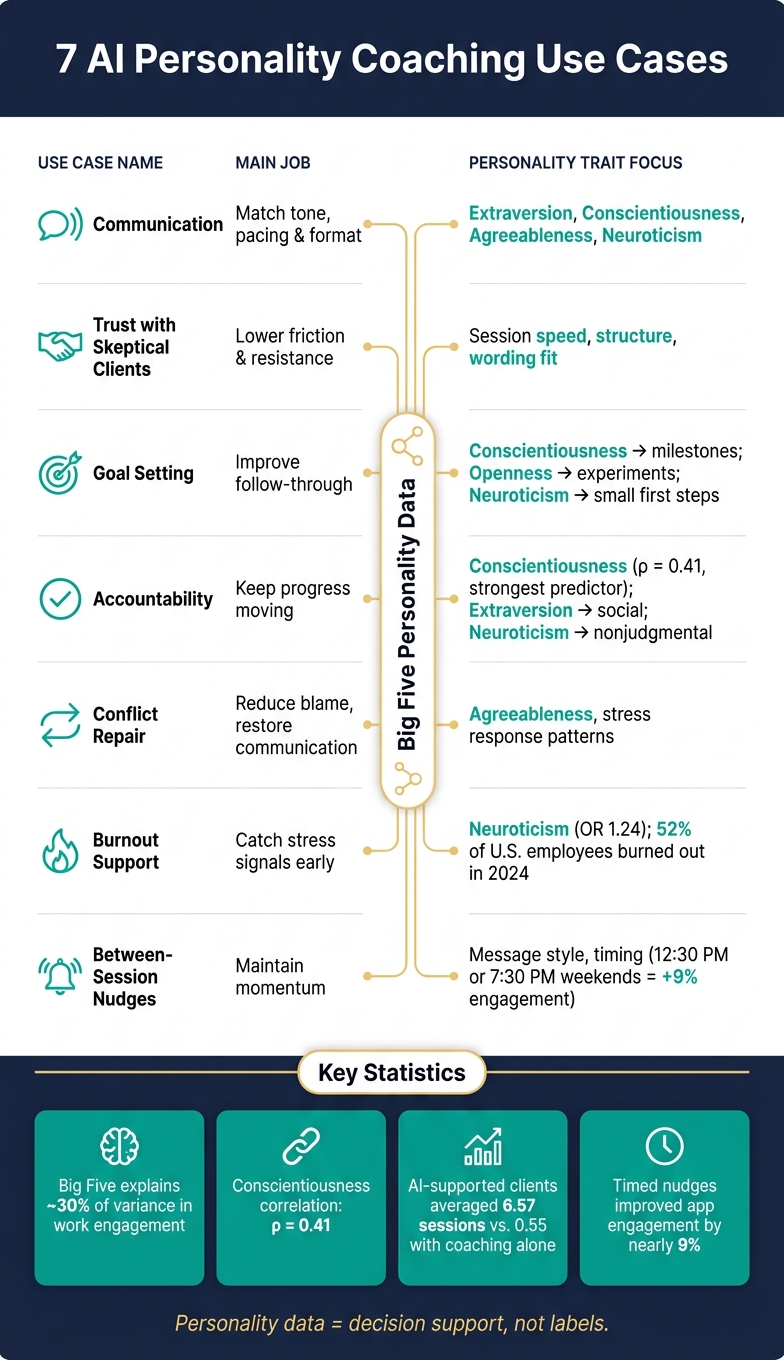
7 AI Personality Coaching Use Cases: Traits, Tools & Outcomes
Quick Comparison
| Use case | Main job | What personality data helps with |
|---|---|---|
| Communication | Match delivery | Tone, pacing, format |
| Trust with skeptical clients | Lower friction | Session speed, structure, wording |
| Goal setting | Improve follow-through | Goal style, first step, framing |
| Accountability | Keep progress moving | Check-in type, frequency, pressure level |
| Conflict repair | Lower blame | Friction points, repair language |
| Burnout support | Catch stress sooner | Risk patterns, recovery fit |
| Between-session nudges | Keep momentum | Message style, timing, frequency |
The core point is simple: personality data is not there to label people. Instead, it represents the intersection of AI, coaching, and personality psychology used to drive better outcomes. I’d use it as decision support so the next conversation, follow-up, or coaching move fits the person better.
Why Personality Profiles Matter in Coaching
Generic coaching advice often treats people like they all react the same way to feedback, structure, and encouragement. In practice, that falls apart fast. A check-in rhythm that helps one client can push another away. If a workplace coach tells a detail-oriented employee with low risk tolerance to simply be more proactive, that can spark anxiety instead of action. The issue isn’t effort. It’s fit. Personality profiles help coaches spot that mismatch before it hurts engagement.
They also make those differences visible before a conversation starts to drift off course. Instead of guessing how to communicate, coaches can see where clients differ on traits like extraversion, agreeableness, conscientiousness, neuroticism, and openness. A client high in neuroticism usually needs validating, steady language and clear reassurance. A client high in conscientiousness may read frequent check-ins as micromanagement, not support. Once a coach can see those patterns, it gets much easier to adjust the way they speak and respond.
The same idea applies to pacing and accountability. High-conscientiousness clients often do well with structured plans and clear deadlines. High-openness clients tend to respond better to exploratory goals and space to test ideas. Accountability only works when the structure fits the client’s trait profile. Tools like Personos turn trait data into real-time guidance on tone, phrasing, pacing, and trust-building for helping professionals. You can see that most clearly in communication, where small shifts can change whether a client leans in or shuts down.
1. Personality-Aware Communication Strategies
Personality profiles help coaches match their tone, pace, and format to the person in front of them. That match can shape whether a client leans in or pulls back. And with skeptical clients, that difference matters a lot.
A few traits tend to shape communication in clear ways. Extraversion affects interaction style. Conscientiousness points to how much structure someone wants. Agreeableness can shape how they handle feedback. Neuroticism affects pacing and emotional load.
Here’s what that can look like in practice:
- With a high-extraversion client, keep the energy up, invite brainstorming, and skip long written follow-ups.
- With a client low in extraversion, slow down, leave space for pauses, and send written notes they can review on their own time.
- With a client low in agreeableness and neuroticism, direct feedback tends to work because they’re less likely to shut down from it.
When tone and pacing fit the client, trust often gets better before the next hard moment even shows up.
Personos measures 30 personality traits on an 80-point scale and gives real-time, context-aware guidance on tone and pacing using full personality profiles. Research on coaching relationships suggests scaling personalized coaching with AI and personality psychology can influence how clients perceive coach trustworthiness[3], which can improve openness and engagement. That shift starts with matching delivery to the client’s profile. That trust-building role leads straight into working with resistant clients.
2. Building Trust with Resistant or Skeptical Clients
Resistance doesn't always mean defiance. A lot of the time, it's a sign that the coach and client are moving at different speeds, using different structures, or processing things in different ways. A fast-moving coach might read a reflective client's silence as disengagement. In many cases, that read is off.
Personality profiles can show why a client seems guarded, which gives the coach a better way to adjust pacing, structure, and tone. AI can take some of the load off by helping with session structure and next-step planning. That makes it easier for the coach and client to get on the same page about the issue and what comes next. Once trust is in place, those same traits can also shape the next conversation in a more useful way.
Executive leadership coach Mike Walker saw this play out with a client dealing with a tense situation around a new athletic director hire. What first looked like a competence problem turned out to be a personality mismatch. One person needed more structure. The other needed more attention. Once she adjusted her communication style to match the hire's profile, the tension eased before it escalated [4].
Personos supports this in a direct way. Its conversational AI chat uses a client's full personality profile and contextual information to give real-time, situation-specific guidance for building trust with resistant individuals. Early service settings report stronger engagement when the guidance matches the client's profile [4]. With trust in place, the next challenge is setting goals the client will actually follow.
3. Goal Setting and Motivation Aligned with Personality
Once trust is in place, the next job is setting goals the client will stick with. The aim isn't to lower the bar. It's to build a plan that fits the client well enough that follow-through gets easier. That matters most when a coach takes insight and turns it into a specific goal.
Personality data should shape both the goal itself and how that goal is presented. Conscientious clients usually do best with clear milestones and firm deadlines. Open clients often lean toward experiment-based goals. Clients high in neuroticism often need a small first step before taking on more. Research on the Five Factor Model shows that these links between traits and motivation can help guide coaching plans [5][2].
Extraversion and agreeableness shape motivation too, and those signals are easy to miss. Extraverted clients often stay engaged when social accountability is part of the plan. Highly agreeable clients often respond better when goals are framed around contribution. AI can help turn those trait patterns into goal language the client is more likely to accept.
Personos can turn a profile into a few goal-framing options, flag likely friction points, and draft language in the right tone, whether that's direct, encouraging, or exploratory. Its relationship insights also show how coach and client traits may shape goal framing.
The payoff is pretty simple: better fit, better follow-through, and less need to rework the plan. Once the goal fits the client, the next step is building accountability that fits too.
4. Accountability Systems That Match Personality Traits
Once a goal is set, accountability is what keeps it moving. But it only works when the setup fits the client. A bad match can make one person pull away, while another may drift because there just isn't enough support. So this isn't only a compliance issue. It's a personality-fit issue.
Conscientiousness is the strongest predictor of follow-through. Meta-analytic research across 99 treatment studies found that higher conscientiousness predicts better session attendance, homework completion, and adherence outcomes [8].
Clients with low conscientiousness often need more support from the coach. If-then plans and social accountability can help make up for weaker self-regulation [10][11]. Extraverted clients often stay on track when other people can see their progress. Introverts may do better with private check-ins and written reflection [9][12]. Clients high in neuroticism tend to need nonjudgmental accountability and very small commitments that rebuild confidence instead of setting off shame [7].
Here’s how three very different trait profiles can map to concrete accountability setups:
| Client Profile | Accountability Format | Tone & Frequency |
|---|---|---|
| High Conscientiousness, Low Extraversion | Private habit tracker, weekly written progress report | Neutral, data-focused; weekly check-ins |
| High Extraversion, High Agreeableness, Low Conscientiousness | Peer accountability buddy, short group check-ins | Energizing, relational; weekly check-ins |
| High Openness, High Neuroticism, Low Conscientiousness | Micro-experiments, reflective end-of-day prompts | Curious, nonjudgmental; daily but lightweight |
Personos can turn a goal and trait profile into an accountability plan, then send between-session nudges and track follow-through over time.
The same trait data also helps when accountability starts turning into tension, blame, or avoidance.
5. Conflict Repair and Mediation Guided by Personality Data
When tension starts to show up as blame or avoidance, personality data can help pull the problem away from the people. In most cases, the argument on the surface isn't the full story. What tends to drive things off the rails is a mismatch in how each person handles stress, shows frustration, or wants others to communicate.
Two people can both care about respect and still clash hard. One may show respect through blunt honesty. The other may show it through emotional attunement. That's a communication mismatch, not a character flaw. And once you name it that way, blame tends to drop. Repair gets a lot more possible.
You can see this in deadline conflicts. A coach working with two colleagues who keep butting heads during project deadlines may hear one person describe the other as careless, while the other describes the first as controlling. With their profiles in hand, the coach can reframe the issue as a mismatch in pacing and standards. From there, both people can name one strength and one friction point in the relationship, then agree on deadlines, update frequency, and a clear signal for overwhelm.
AI can help turn that read into a repair plan for each person. It works best as a two-sided repair brief built from both profiles and the conflict context. A strong tool can map likely friction points, suggest lower-conflict phrasing, and lay out a conversation plan with opening language and de-escalation steps for each person. Personos supports this with Relationship Dynamic Reports that compare both profiles and show likely friction points.
The coach's job is to restore workable communication: identify the mismatch, reframe it, guide the repair conversation, and set concrete next steps. When that sequence holds, the conflict stops acting like a loop and starts becoming something both people can learn from. And that same trait awareness that helps repair conflict can also help catch burnout before it damages the relationship entirely.
6. Spotting and Addressing Burnout Through Personality and Stress Patterns
Burnout often starts quietly. A client may begin canceling sessions, replying with one-line messages, or getting harder to reach. For coaches, the hard part is noticing those shifts before things spiral. In the 2024 NAMI Workplace Mental Health Poll, 52% of U.S. employees said they felt burned out in the past year, and 37% said they felt so overwhelmed that keeping up with work was difficult.[13] Those numbers matter, but the bigger point is this: signals make more sense when you read them through the client’s trait profile.
Personality profiles based on the Five Factor Model can help coaches spot burnout sooner. A client with high Conscientiousness might go from steady and dependable to perfectionistic, overloaded, and stretched thin. A client with high Neuroticism may show more worry, poor sleep, and sharper reactions to feedback. One study found that neuroticism was a risk factor for higher stress, with an odds ratio of 1.24 (95% CI, 1.22–1.26).[14]
The response should fit the person, not just the symptom. For example:
- Use values-based boundary scripts for people-pleasing clients
- Set aside solo recovery blocks for introverted clients who get drained by meetings
- Offer peer support plus firm after-hours limits for extraverted clients
Personos can scan trait scores, session notes, and check-in language to flag burnout risk, then generate tailored recovery guidance. Dynamic Reports map out profile-based recovery strategies, which gives coaches a practical place to start instead of staring at a blank page. Those same patterns can also shape how clients respond to follow-up between sessions.
Burnout is often tied to one role or one main stressor. Depression, by contrast, tends to affect many parts of life at once. Personality patterns can help coaches track scope and duration, and they can also help clarify when distress has moved past situational stress and a referral is the right next step.
7. Keeping Clients Engaged Between Sessions with Personality-Based Nudges
Most coaching happens between sessions. That’s where progress is either built or lost.
And that gap matters. A lot.
This is where trait data starts to do real work. It can shape the message itself, when it gets sent, and how often a client hears from you. If that in-between period is where momentum slips, then the nudge isn’t just a reminder. It becomes part of the coaching intervention.
The practical move is to use trait-based nudges. Match the follow-up to the client’s pattern:
- structured priorities for high conscientiousness
- calm reassurance for high neuroticism
- social accountability for extraversion
That approach isn’t just intuitive. Research supports it. In one study, users who had access to AI support between sessions averaged 6.57 sessions, compared with 0.55 for those using coaching alone.[15]
Timing matters as much as the message. A timing study found that sending tailored health messages at 12:30 p.m. on any day, or at 7:30 p.m. on weekends, made participants almost 9% more likely to use the app.[16] In plain English, even a good message can miss if it lands at the wrong moment.
That’s where AI can help in a more useful way. It can learn when each client is most likely to respond and send prompts during that window. At that point, AI starts to do more than remind. It supports behavior change.
Personos extends support between sessions with Prompts, ActionBoard, and Dynamic Reports, giving coaches a way to send, track, and adjust nudges without adding manual work. To see if those nudges are doing their job, coaches should watch metrics like open rates, response frequency, and self-reported confidence or stress. Those numbers can also show which nudges perform best across a caseload.
From there, the next step is figuring out which AI features can scale that support.
Where AI Personality Coaching Tools Add the Most Value
Across these seven use cases, the best tools tend to do five things well: measure traits at a detailed level, show person-to-person dynamics, adjust guidance to the moment, explain their logic, and track what changes over time.
Fine-grained measurement helps coaches tell apart clients who may seem alike on a broad profile but react in very different ways under pressure. Relationship-level insight helps surface how two specific people may interact, including where tension might show up. Context-aware tools shift their recommendations based on urgency, risk, and recent stress signals instead of relying on a static profile. Transparent reasoning gives coaches a way to use AI suggestions without treating them like black-box outputs [17][19]. And action tracking ties the whole process back to actual change over time.
The setting matters too. Leadership coaching tools fit corporate use cases. Tools for helping professionals need more context, better risk awareness, and stronger relationship insight. Platforms like CoachHub's AIMY and BetterUp pair certified human coaches with AI-driven personalization for workforce coaching in organizations [6][18].
For coaches working with vulnerable groups, such as trauma survivors, justice-involved clients, and people in crisis, Personos is built for that level of complexity. Its conversational AI uses full personality profiles, Dynamic Reports, and an ActionBoard that links insights to outcomes coaches can track.
| Capability | Use Cases It Supports Most |
|---|---|
| High-granularity trait measurement | Communication, goal setting, burnout support |
| Relationship-level insight | Trust-building, conflict repair, mediation |
| Context-aware recommendations | Crisis support, accountability, burnout support |
| Transparent reasoning | All seven use cases (ethical practice) |
| Action tracking | Accountability, between-session engagement |
These same capabilities also bring up questions around privacy, consent, and scope of practice.
Ethical and Practical Considerations
These upsides only matter if you handle the data with care. Personality data should be treated like protected client information. If coaching happens in a HIPAA-covered setting, follow HIPAA. If it does not, follow state privacy, breach-notification, and employer data rules.[23][21][26]
Before you use any assessment or AI tool, spell out what you collect, how you use it, who can see it, and how long you keep it. That also includes how the AI analyzes personality to shape goal setting, accountability, and between-session follow-up. In employer-sponsored programs, be clear about how participation works, who gets access, and how long records stay on file.[27][28]
Data handling needs to be tight from the start. De-identify information before it goes into an AI system. Also document where the data is stored, who can access it, how long it is kept, and how it will be deleted if a client asks.[22][25][26]
A common mistake is reading too much into trait scores. A tendency is not a verdict. Traits should be framed as patterns, not identities, and clients should be invited to say whether a description matches their own experience.[1]
Bias is also a serious risk. AI outputs should be treated as hypotheses, not final answers, especially for clients from underrepresented groups.[22][20] Context matters here. The way traits show up in coaching conversations can shift across communities. Assertiveness or agreeableness, for example, may be expressed and read in different ways, so a score that seems concerning in one setting may be ordinary in another.[20][24]
That is why human review cannot drop out of the process. AI can support coaching decisions, but it should not make them. The coach, not the algorithm, stays accountable. Personos supports this approach with private-by-default scores and explainable recommendations.
Conclusion
Personality profiles matter most when they help with the next conversation, not when they turn a person into a score. Taken together, these use cases point to a simple idea: personality profiles can help you make better calls in the moment. Whether you're adjusting how you communicate, rebuilding trust after a rupture, or sending a check-in message between sessions, the aim stays the same. Respond to the person in front of you with more clarity and less guesswork.
Across the seven use cases, personality-aware coaching improves communication, trust, goal setting, accountability, conflict repair, burnout support, and between-session follow-up.
That’s where a tool like Personos comes in. Tools like Personos turn personality data into real-time, situation-specific guidance instead of generic advice. Use them as decision aids. Compare them with what you hear, what the client says about themselves, and the facts of your setting. Keep ethics, consent, privacy, and context at the center.
Used well, that mix sharpens empathy, cuts guesswork, and extends your reach without replacing judgment. Start with one workflow, such as resistant-client communication or between-session nudges, and test it in practice.
FAQs
How accurate are personality profiles in coaching?
AI personality profiling can be surprisingly accurate. Research points to about an 80% correlation with human Big Five results, and fine-tuned models are preferred 85% of the time over baseline versions.
That said, these profiles aren't perfect. Accuracy can shift depending on the context, and models can show bias or inflate certain traits. So coaches should treat them as data-driven hypotheses that support, not replace, human judgment, empathy, and observation.
Can AI coaching replace human judgment?
No. AI coaching can't replace human judgment.
Tools like Personos can surface data-based insights, point out blind spots, and suggest ways to communicate. But they work best as co-pilots, not as the ones making the call.
Human coaches still need to lead with empathy, intuition, and context. AI output should be the starting point, not the final answer.
How should client personality data be protected?
Coaches should protect client personality data with encryption, secure storage, and informed consent. Clients need to know what data is being collected, how it is analyzed, and how it will be used. They should also be able to review it, update it, or delete it.
Platforms like Personos help by keeping conversations encrypted and personality scores private. Coaches should be open about how they use AI, check their systems for bias, and treat AI insights as one input, not the final word. Good coaching still depends on human judgment and honest communication.