How AI Analyzes Relationships for Coaches
Explains how AI uses NLP, sentiment and personality models to give coaches real-time feedback, conflict insights, and personalized growth plans.
Christian Thomas

How AI Analyzes Relationships for Coaches
AI tools are transforming how coaches understand and improve relationships by analyzing communication patterns, emotions, and personality traits. These systems use advanced techniques like Natural Language Processing (NLP) and sentiment analysis to identify trends and predict outcomes with impressive accuracy. For example:
- Emotion tracking: AI detects shifts in emotions like joy, anger, or fear across interactions.
- Personality insights: Tools predict personality traits with up to 81% accuracy by analyzing language and behavior.
- Real-time feedback: AI provides suggestions to improve communication and resolve conflicts with AI tools.
- Practical applications: Coaches can use AI to simulate conversations, track team dynamics, and offer personalized growth plans.
Platforms like Personos, launched in late 2025, take this further by combining personality psychology with AI. Features include detailed personality reports, communication prompts, and tools for monitoring progress. AI doesn’t replace coaches but acts as a powerful assistant, handling data analysis while coaches focus on human connection. However, ethical concerns like privacy and over-reliance on AI remain key challenges.
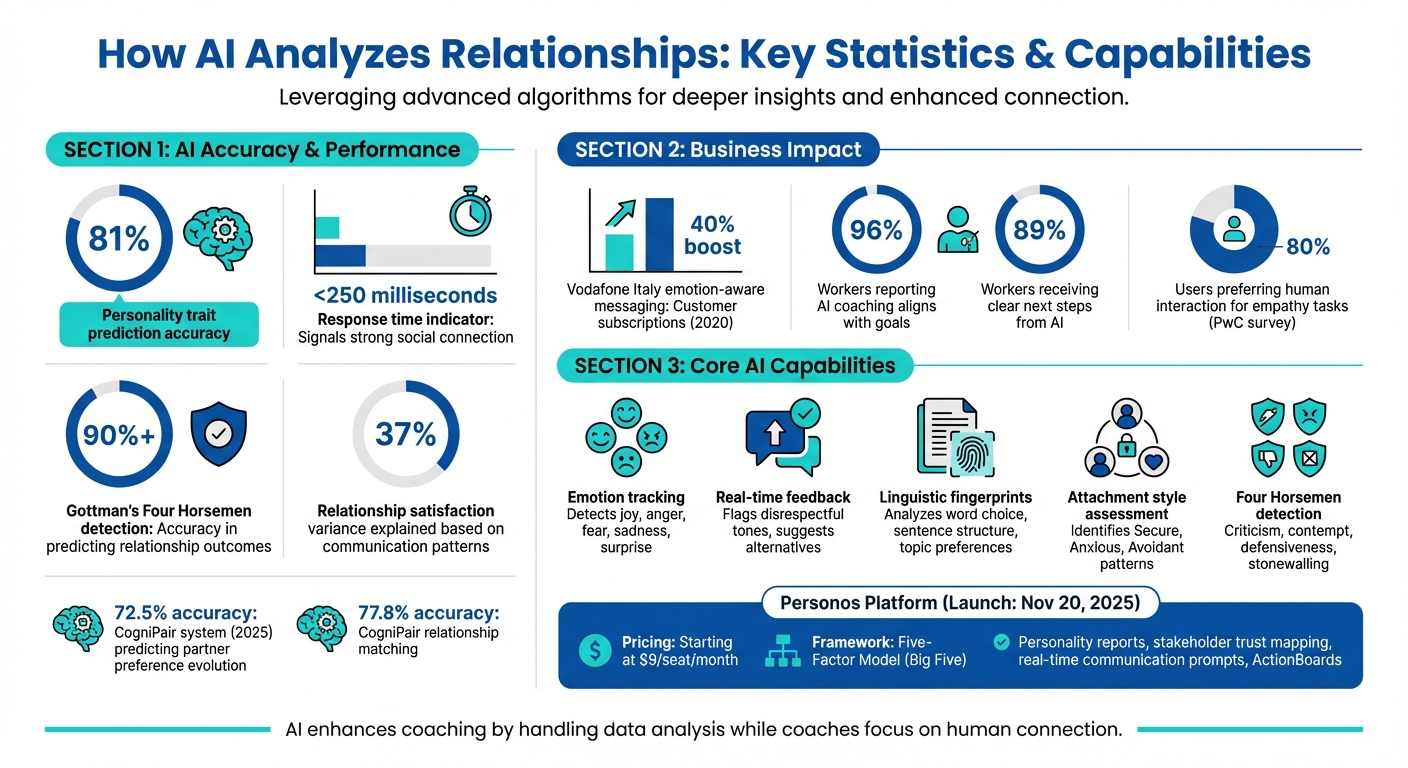
AI Relationship Analysis Statistics and Capabilities for Coaches
Does AI Ruin Our Relationships? (Analysing ChatGPT's Communication Advice)
sbb-itb-f8fc6bf
How AI Analyzes Interpersonal Relationships
AI delves into the dynamics of relationships by combining data extraction, emotion detection, and personality assessment. Together, these tools help coaches better understand how people interact, communicate, and connect.
Using Data for Relationship Insights
AI leverages natural language processing (NLP) techniques - like tokenization, part-of-speech tagging, and dependency parsing - to break down and interpret conversations [1]. Beyond the words themselves, AI examines metadata such as response times, message frequency, and activity patterns to gauge levels of engagement and emotional involvement [1].
For instance, research indicates that response times under 250 milliseconds can signal a strong social connection and mutual rapport [1]. AI also creates "linguistic fingerprints" by identifying patterns in word choices, sentence structures, and topic preferences. These fingerprints can uncover personality traits and emotional tendencies that might not be obvious in a single exchange. For example, frequent use of first-person pronouns may suggest introversion, while heavy use of emotional language might indicate a preference for feeling-driven decision-making. These linguistic patterns pave the way for deeper sentiment and emotional analysis.
Sentiment Analysis and Emotional Patterns
Modern AI sentiment analysis goes far beyond simply categorizing text as positive or negative. It can detect specific emotions like joy, sadness, anger, fear, and surprise [1]. By tracking emotional shifts across multiple interactions, AI can uncover trends that may influence long-term relationship satisfaction. This bridges the gap between raw text analysis and actionable insights.
In 2020, Vodafone Italy used an emotion-aware messaging algorithm that combined customer profile data with emotional tone analysis, leading to a 40% boost in customer subscriptions [2]. Similarly, Humana Pharmacy integrated voice analytics in their call centers to monitor customer engagement in real time, allowing representatives to adapt their responses based on detected emotional states [2].
For relationship coaches, AI can identify communication patterns like Gottman’s Four Horsemen - criticism, contempt, defensiveness, and stonewalling - which are known to predict relationship outcomes with over 90% accuracy [1]. This enables coaches to intervene and adjust strategies proactively. Additionally, AI can provide real-time feedback by flagging disrespectful tones and suggesting more inclusive alternatives, which can be particularly useful for addressing microaggressions [2].
Combining Personality Psychology with AI
AI models trained in personality psychology frameworks can predict personality traits from text with up to 81% accuracy [1]. These models analyze patterns such as messaging frequency, emotional disclosures, and response delays to assess attachment styles - like Secure, Anxious, or Avoidant. For example, behaviors such as reassurance-seeking or avoiding certain topics often correspond to specific attachment tendencies.
A recent study highlighted that specialized AI tools like PersonalityMap and general models like GPT-4o outperformed most individuals, including academic experts, in identifying correlations between personality traits [4][5]. By merging personality psychology with machine learning, AI can explain up to 37% of the variance in relationship satisfaction based on communication patterns and personality factors [3].
IBM’s "Opportunity Team Builder" showcases this integration in action. This AI-driven tool assembles teams by evaluating social skills and predicting interpersonal dynamics. As team members are added, it continuously assesses skill gaps and social interactions to ensure optimal collaboration [2]. These insights allow coaches to develop strategies that improve team and relationship dynamics effectively.
Using AI Insights in Coaching
AI takes relationship data and turns it into clear, practical strategies that coaches can use to drive real, meaningful changes. By analyzing patterns and behaviors, it provides actionable tools for tackling challenges like conflict resolution, improving communication, and fostering personal growth.
Conflict Resolution and Better Communication
AI-generated insights give coaches a detailed view of where communication falters. For example, AI can identify Gottman’s "Four Horsemen" - criticism, contempt, defensiveness, and stonewalling - by analyzing language patterns. If a client frequently says things like "you always" (a sign of criticism) or uses sarcastic tones (a marker of contempt), the coach can step in before these behaviors cause further harm.
AI can also track shifts in response times, which often indicate changes in engagement levels. This data helps clients recognize when they may be pulling away from important relationships, opening the door for deeper conversations about what’s driving the disconnect.
Another advantage of AI is its ability to create a safe space for practicing tough conversations. Clients can rehearse scenarios - like confronting a boss or discussing a sensitive issue with a partner - with an AI bot. Because AI doesn’t judge, people tend to be more open and willing to practice vulnerable conversations they might otherwise avoid. This preparation not only boosts confidence but also improves the outcomes of real-life interactions. Studies even show that a short pre-session chat with an AI bot can increase satisfaction with coaching sessions and lead to more follow-up bookings[7].
Personalized Feedback and Growth Plans
AI makes it easier for coaches to provide tailored, personality-driven feedback. Platforms like Personos, for instance, analyze a leader’s personality and workplace environment to offer insights that quickly move from awareness to actionable steps[8].
Research backs this up - 96% of workers say AI delivers coaching that aligns with their goals, and 89% report that AI-led sessions provide clear, useful next steps[6]. This level of customization is possible because AI processes massive amounts of data, including years of coaching insights and psychological frameworks. It uses this information to recommend strategies based on similar past scenarios[7].
Coaches can also use AI to maintain engagement between sessions. Features like smart messaging allow them to send motivational reminders, session summaries, and assignments, keeping clients accountable and focused on their goals[7]. AI even supports high-stakes conversations, such as performance reviews or salary negotiations, by providing real-time language suggestions tailored to the recipient’s personality. This ensures that communication is not only effective but also resonates on a personal level[8].
Features of Personos for Relationship Analysis
Launched on November 20, 2025, Personos brings psychological insights to the fingertips of coaches everywhere. Rooted in the Five-Factor Model (Big Five) of personality psychology, this platform blends AI with established psychological principles to provide tools that are practical and impactful. As CEO Christian Thomas puts it:
"AI has made us more efficient in how we work and communicate, but not smarter about how we connect with people" [9].
Personos aims to close that gap by prioritizing empathy and understanding over mere productivity, a focus reflected in its standout features for relationship analysis.
Personality and Relationship Reports
Personos begins with a short personality assessment that produces detailed reports on leadership styles, adaptability to change, influence, and risk tendencies. These aren't just surface-level profiles - they offer actionable advice on leading teams, engaging with stakeholders, and managing organizational shifts. One particularly useful tool is stakeholder trust mapping, which helps coaches pinpoint individual motivators within teams or boards. This feature supports trust-building and helps prevent conflicts before they arise. Mike Walker, Executive Leadership Coach and Founder of Dynamic Decisions Coaching, highlights this capability:
"Personos connects the dots between personality and performance" [9].
Real-Time Communication Prompts
Taking insights from its personality reports a step further, Personos Chat turns them into practical communication strategies. This feature provides real-time, personalized language suggestions during important conversations. By aligning with both the speaker's style and the recipient's personality, these prompts help ensure messages are delivered with empathy and clarity. Co-Founder Nick Blasi explains:
"Personos gives people the confidence to communicate with empathy, not just efficiency" [9].
AI Tools for Coaches
Beyond its focus on conversations, Personos offers tools that extend a coach's influence far beyond individual sessions. Coaches can upload their session notes and frameworks into the platform, which then uses tools like Shared ActionBoards and decision-making frameworks to monitor progress and guide decisions. These features make goals and milestones clear, with visual trendlines to track growth. Starting at just $9 per seat per month for Personos Pro, the platform delivers insights that were once only available through expensive consultations.
The Future of AI in Coaching
Advancing AI for Relationship Analysis
AI is taking a giant leap forward, moving well beyond basic chatbots to systems that grasp the nuances of human psychology. A striking example is CogniPair, an advanced AI system developed by researchers at the University of Maryland and tested in November 2025. This system involved 551 GNWT-agents simulating speed dating scenarios. The results? It predicted how partner preferences evolve with an impressive 72.5% accuracy, outperforming older models that achieved only 61.3%. Even better, it matched relationships with 77.8% accuracy, setting a new benchmark in relationship analysis [10].
What makes this system stand out is its innovative design. Unlike traditional AI that views personality as static, these next-gen systems use specialized sub-agents - each dedicated to tasks like emotion, memory, social norms, and planning. These sub-agents work together through a central workspace, mimicking how the human brain processes social interactions. This approach allows the AI to maintain a consistent "personality" while learning and adapting through real-world interactions [10].
For coaches, this evolution in AI could revolutionize their work. Instead of relying on static personality assessments, future tools could dynamically track how relationships shift over time. Another exciting development is network analysis. AI can now map intricate connections between factors like social support and burnout, pinpointing areas where interventions could have the greatest impact [11]. Additionally, immersive role-play simulations are offering coaches and clients a safe environment to practice tough conversations, complete with real-time feedback [12].
While these advancements are promising, they also bring up critical ethical questions.
Ethical Considerations in AI Coaching
As AI technology becomes more sophisticated, ethical concerns grow just as quickly. One major issue is the phenomenon researchers call "social and moral deskilling." This refers to the danger of people relying so heavily on AI for "demand-free" companionship that they lose the ability to navigate complex human relationships [14]. A PwC survey highlights this concern, revealing that 80% of respondents still prefer interacting with humans over AI, particularly for tasks that require empathy [13]. There’s also the concern that AI, no matter how advanced, might lack the creativity and intuition that human coaches bring to fostering deep personal growth [13].
Privacy and data security are another pressing issue. To address these concerns, many platforms are implementing robust measures like ISO 27001 certification, regular penetration testing, and automatic data deletion [12]. Transparency is equally critical - coaches need to clearly communicate when and how AI is being used in their practice. The emerging solution appears to be a hybrid model: AI takes on data-heavy tasks and administrative work, while human coaches focus on delivering empathy, intuition, and the kind of personal connection that drives meaningful change [13].
Conclusion
AI is transforming the way coaches approach and enhance relationships by uncovering subtle communication patterns, shifts in sentiment, and personality traits [1]. These tools don’t replace the human touch - they enhance it, helping coaches guide clients from insights to actionable steps more efficiently while offering support that extends beyond scheduled sessions. A prime example of this evolution is Personos, a platform that merges AI with personality psychology.
Personos leverages personality psychology and AI to provide real-time, tailored guidance based on an individual’s cognitive style and the specific context they’re navigating. Coaches using this platform gain access to dynamic personality reports, relationship insights, proactive communication suggestions, and ActionBoards - tools that track commitments and deliver measurable ROI to stakeholders [8]. Whether it’s preparing for a critical negotiation or managing team dynamics, these personality-driven language cues equip coaches with the right tools at the right time.
The key to success lies in integration, not replacement. As MosaicChats, a prominent industry voice, explains:
"AI should illuminate patterns and provide insights, but the work of building and maintaining relationships remains beautifully, necessarily human" [1].
By blending their own methodologies with AI-driven platforms, coaches create a hybrid approach where technology handles data analysis, leaving them free to focus on building empathy and connection [8].
The future of coaching thrives in this partnership. AI can flag warning signs before conflicts arise, monitor emotional trends, and offer real-time insights, while coaches remain dedicated to fostering authentic growth and transformation. This collaboration equips coaches to harness data-driven insights while nurturing the human connections that remain at the heart of their work.
FAQs
How can AI help coaches understand emotional changes in relationships?
AI brings a fresh dimension to how coaches understand emotional dynamics in relationships by analyzing language, tone, and behavior during conversations. With tools like natural language processing (NLP) and sentiment analysis, it can assess emails, chats, meeting notes, or even voice recordings to uncover mood shifts, stress levels, or signs of conflict. The results are displayed on intuitive dashboards, making it easy to spot patterns - like growing tension or a dip in positivity - so coaches can step in before small issues turn into bigger problems.
It doesn’t stop there. AI continuously updates personality profiles, flagging unusual shifts in communication. For example, if someone known for being collaborative suddenly adopts a defensive tone, the system sends an alert. Coaches are notified of changes, such as a drop in sentiment or a rise in frustration, and receive actionable strategies to address the situation. By turning subtle emotional signals into clear, actionable insights, AI enables coaches to respond with empathy and precision, helping relationships grow stronger.
What ethical considerations should coaches keep in mind when using AI for relationship insights?
When incorporating AI into relationship analysis, coaches should focus on transparency and informed consent. It's important for clients to know exactly how AI is being used, what kind of data it processes, and its limitations. This clarity builds trust and ensures clients feel comfortable with the process. At the same time, coaches must be mindful of potential biases in AI systems. Since these tools can sometimes mirror societal prejudices, it's crucial to address such issues to avoid skewed or unfair insights.
Equally important is safeguarding privacy and data security. AI tools often handle highly sensitive personal information, making it essential to implement strong data protection measures like encryption and clear retention policies. Adhering to regulations such as HIPAA is non-negotiable in this context.
Finally, AI should act as a complement to, not a replacement for, human interaction. While AI can provide valuable insights, the personal connection between coach and client remains central to effective coaching. Platforms like Personos exemplify this balance by offering secure, transparent, and people-focused tools for relationship analysis.
How does AI help coaches better understand and guide their clients?
AI leverages sophisticated analysis of language, behavior patterns, and interaction styles to craft detailed personality profiles. These profiles go beyond the surface, uncovering hidden strengths, areas for development, and potential obstacles. This deeper understanding enables coaches to adapt their strategies to align with each client’s unique communication preferences and motivations.
By pinpointing possible friction points and offering actionable recommendations, AI helps coaches address conflicts, enhance communication, and encourage teamwork. Armed with real-time, data-backed insights rooted in established psychological principles, coaches can provide tailored, impactful guidance that drives personal and team growth while strengthening relationships.