Workplace EQ and AI Feedback: Research Summary
Use AI to improve wording, not replace human judgment: evidence on sincerity, trust, and safeguards for nonprofit teams.
Nick Blasi

Workplace EQ and AI Feedback: Research Summary
My takeaway: use AI to improve wording, not to make judgments about people. Before sending feedback, I’d check the facts, name the behavior and next step, and keep a human responsible for delivery.
Why the caution? In one study, perceived sincerity fell from 83% with minimal AI help to about 40%–52% with extensive help. Clearer writing doesn’t always mean more trust.
Here’s how I’d put the research to work:
- Match the tool to the task. Human-written feedback, AI-edited drafts, fully AI-generated feedback, and AI rehearsal carry different risks.
- Keep care human. Use workplace EQ to guide respectful conversations, with privacy checks and human review for sensitive feedback.
- Test before expanding use. Measure clarity, sincerity, trust, errors, and time saved. Treat personality-based feedback suggestions as prompts, not labels.
- Address workload, too. With 95% of nonprofit leaders reporting concern about staff burnout, I wouldn’t treat better messaging as a substitute for staffing and support.
For nonprofit and social-service teams, my rule is simple: <u>use AI to prepare</u>, while people remain responsible for the judgment and the relationship.
Personalised Feedback at Scale: AI’s Real Superpower
Research on AI-Assisted Messages
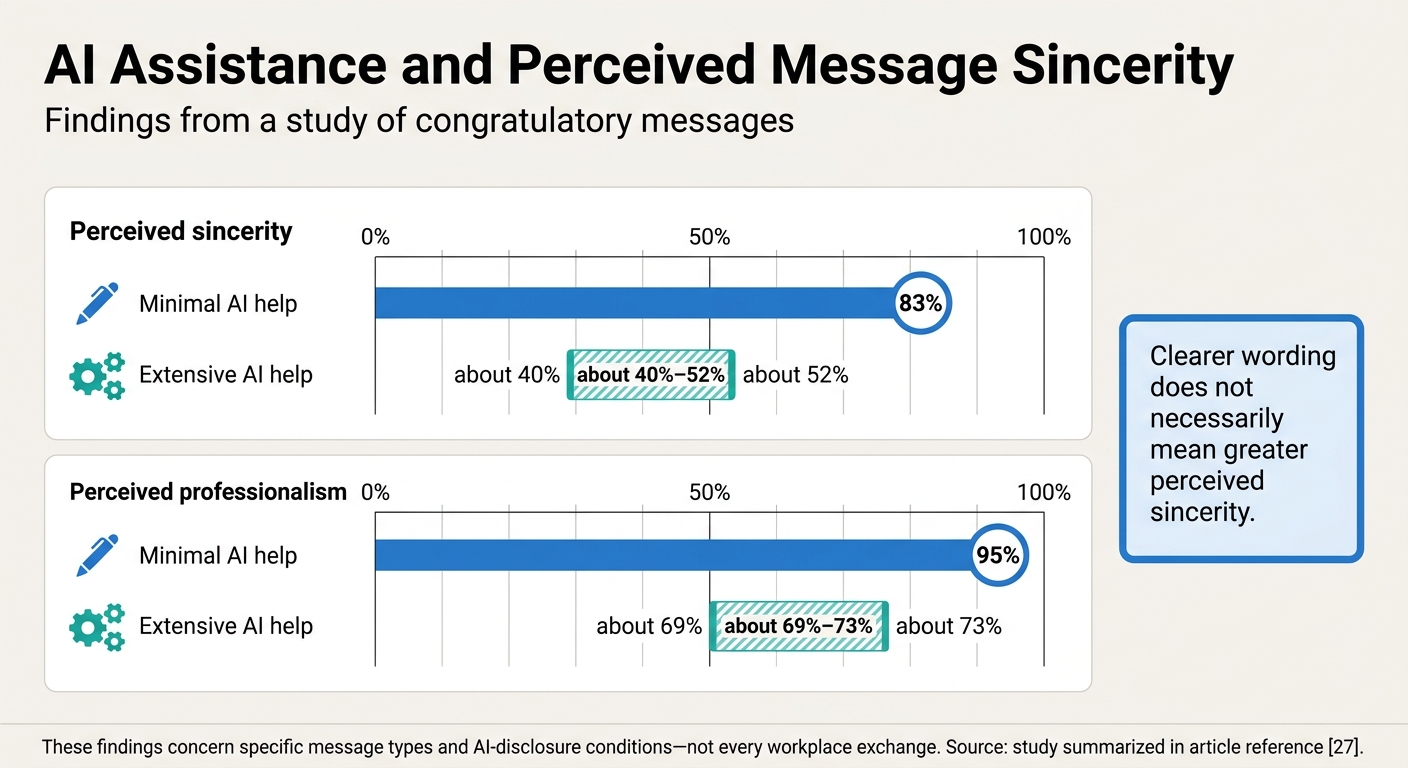
AI Assistance and Perceived Message Sincerity
AI Drafting, Editing, and Communication Coaching
A three-week randomized crossover field experiment involving 121 employees at six companies compared unaided emails with GPT-5 rewrites in playful or professional styles.[9][10] Across 16,880 workplace emails, playful rewrites increased emotional positivity scores (B = +0.068), while professional rewrites decreased them (B = −0.041). Both effects were statistically significant at p < 0.001.[9]
Neither AI condition directly changed email opens, replies, or response times.[9][10] Higher positivity was associated with greater odds of an email being opened (OR = 2.05) and receiving a reply (OR = 3.32), two relevant measures of staff communication.[9] That link was correlational, not causal.
The wording is only part of the picture. AI assistance may also affect how recipients judge the sender.
Managers preferred customized, iterative, context-aware coaching for difficult conversations. But that preference does not prove that coaching leads to better conversations, and evidence from workplace use of AI rehearsal remains limited.[11][13]
For nonprofit teams, test clarity, warmth, and issue resolution separately. Don’t assume playful rewrites suit crisis or disciplinary messages. Disclosure also matters: people often respond to the source, not just the words.
AI Disclosure and Message Sincerity
In congratulatory messages, perceived sincerity fell from 83% with minimal AI help to about 40%–52% with extensive AI help. Perceived professionalism fell from 95% to about 69%–73%.[12] A separate study involving 261 participants and 990 evaluations across six tasks found lower ratings for trustworthiness, caring, competence, and likability, especially in social and interpersonal writing. Greater AI literacy weakened this effect.[15]
These findings apply to specific message types and disclosure conditions, not every workplace exchange. Follow your organization’s disclosure policies, and distinguish help with wording from help forming an assessment. When offering personal praise or correction, the sender should explain the judgment and its basis. AI assistance does not replace that responsibility.
Comparing Human and AI Feedback Methods
These findings matter when leaders use AI and behavioral insights to determine how much automation to include in feedback.
Across two studies and a direct replication, fully AI-generated feedback led to lower performance motivation, acceptance of the source, and intention to seek further feedback than human feedback.[14] A newer comparison placed AI-edited human feedback between human-only and fully AI-generated feedback, with some outcomes comparable to human-only feedback.[8][7]
The findings support separating who makes the judgment from who improves the wording. They do not establish equivalent results in crisis-facing social-service teams.
Match the feedback method to the stakes, whether it’s human-written, fully AI-generated, human feedback edited with AI, or AI-rehearsed.
| Method | Strengths | Main risks | Disclosure needs | Best use | Human review |
|---|---|---|---|---|---|
| Human-written feedback | Context-informed judgment | Bias, unclear wording, emotional reactions, time costs | Follow policy | Sensitive, corrective, developmental, and high-stakes feedback | Sender owns the judgment and delivery |
| Fully AI-generated feedback | Fast structure and wording alternatives | Factual errors, mismatched tone, lower motivation and source acceptance[14] | Follow policy; disclose extensive AI involvement; don’t imply firsthand judgment | Low-stakes drafts or administrative content | Human verifies claims and owns the final assessment |
| Human feedback edited with AI | Clearer wording; some outcomes approach human-only feedback[8][7] | Over-softened correction, altered meaning, loss of the sender’s voice | Follow policy; disclose extensive AI assistance | Routine coaching and developmental feedback; use caution with praise or sensitive correction | Sender retains judgment and approves claims that affect the assessment |
| AI role-play before delivery | Rehearsal for difficult conversations[11] | False confidence; effectiveness in practice remains under-tested[13] | Follow policy, especially for sensitive data or formal processes | Preparation, not a substitute for delivery | Human delivers and adjusts in real time |
The next issue is how these differences in wording and perceived source affect engagement, motivation, and trust in daily work.
AI Feedback, Engagement, and Trust
AI may change more than wording. It may also affect engagement, confidence, and trust.
Engagement and Confidence at Work
A 2025 randomized study of 102 Japanese employees and freelancers found that strength-focused AI-assisted reflection increased engagement in stable work relationships where people had few chances to form new ones. Improvement-focused feedback for coaching did not.[16] For nonprofit and social-service teams, burnout and fixed working relationships make the effects of tone hard to ignore.
A separate 2025 trial found greater confidence in handling work tasks under informational, instrumental, and emotional support conditions. But the summary leaves out the sample size and duration, so we don't know how long those gains last.[17]
For helping teams, track confidence alongside task completion and access to human support. Confidence isn't a substitute for either. Gains matter only if they carry into actual team interactions.
Meeting Feedback and Its Source
A 2025 within-subjects lab study with 28 participants found that AI-mediated feedback led to more balanced speaking time and higher perceived meeting quality than the comparison condition.[6] Teamwork improved (r = 0.44), but Communication quality did not (r = 0.01).[6] Balanced airtime helps only if people still trust the process.
The study suggests AI may lower the social risk of giving feedback. It doesn't prove psychological safety in workplace settings or show which feedback source employees trust most: human, AI, or jointly produced.[6]
In a pilot, pair speaking-time and interruption measures with confidential participant comments and facilitator review. Silence doesn't necessarily mean disengagement, and equal airtime isn't proof of trust.
When feedback shapes how a group works, governance matters as much as delivery.
Safeguards for Sensitive Feedback
High-stakes feedback needs human oversight, not just better phrasing. Require human approval for feedback about performance, client care, conflict, discipline, safety, or employment. Disclose material AI involvement, protect confidentiality, and set controls for access, retention, and security. Leave crisis, abuse, suicide-risk, and safeguarding decisions to qualified humans.
Give recipients a clear way to correct or appeal recommendations. Never use AI to diagnose personality or mental-health conditions, and don't treat inferred intent as fact.
Check for bias tied to culture, disability, language, accent, and power. Watch for surveillance, reduced candor, workload spikes, and harm to client relationships. Encouragement alone doesn't show that burnout has declined.
Uses for Nonprofit and Social-Service Teams
Once safeguards are in place, teams can identify where AI feedback may help with nonprofit and social-service work.
Staff Trust, Workload, and Burnout Risk
A 2024 survey of 70 South Carolina social-work practitioners and leaders found moderate burnout. Respondents most often pointed to organizational factors.[20] High caseloads and secondary trauma make clear communication important. But staffing, supervision, safety, and recovery time matter more.
A 2025 Hungarian study linked emotional intelligence with stronger workplace community and mutual trust, which were also linked with lower burnout.[18][19] The EQ-burnout link was indirect and correlational. It does not show that AI messaging reduces burnout.
Before sending charged feedback, separate what you observed from what you assume about someone’s intent. Name the required action, deadline, and owner. Then check whether the employee has the time, information, and authority to act.
After crisis exposure, arrange a private supervisor check-in focused on safety, priorities, and workload. Measure whether coordination and access to support improve, not just whether messages sound friendlier. Use AI to improve communication, not as a burnout fix.
Personos: Personality-Aware Communication Tools
Personos is a personality-aware option built for helping professionals who need guidance for specific situations. It uses the Five Factor Model, with 30 traits measured on an 80-point scale.
The vendor describes tools such as contextual chat, customized reports, actionable prompts, an ActionBoard, and explanations for recommendations. These may help staff adjust tone, structure, and directness. But a validated personality framework does not establish product effectiveness. The available evidence does not independently show better staff relationships, better client outcomes, or reduced burnout.
Treat personality-aware guidance as a suggestion, not a label or decision. Before use, review the vendor’s privacy design and contractual terms. Obtain informed consent for profiles, limit access by role, and document how data is retained and deleted.
Keep private personality scores out of team reports. Do not use them to classify employees, determine discipline, or make high-stakes employment decisions. Keep identifiable client information out of unapproved tools. Require recommendations that staff can understand and challenge, and keep professional supervision involved. Ask the vendor about implementation costs, nonprofit discounts, and data handling before committing resources.
How to Measure a Communication Pilot
Measure the tool against specific communication goals, not vague impressions.
Run a small, voluntary, time-limited pilot using approved, low-risk messages. Compare usual drafts with AI-assisted revisions. Record:
- Clarity, feedback specificity, recipient-rated sincerity, support and trust, drafting time, and revisions needed before sending.
- Errors, privacy concerns, discomfort, and whether recipients find messages less genuine or useful.
Track caseloads, vacancies, overtime, and access to supervision alongside these communication measures. Use validated burnout measures only with suitable consent and confidentiality protections. A before-and-after pilot shows feasibility, not causation.
Conclusion: Evidence, Limits, and Human Oversight
The evidence supports AI as a writing aid, not a substitute for judgment. Clear feedback isn’t always trusted feedback. Tone affects trust, and trust affects whether people act on feedback. AI should help with that process without taking over human judgment.
AI’s usefulness depends on the task. Editing routine information differs from generating praise or performance criticism. In one workplace-message experiment, about 40%–52% of participants saw supervisors as sincere when AI assistance was high, compared with about 83% when assistance was low.[21] These results apply to that study. Human review doesn’t fully restore trust: people may still trust human-in-the-loop feedback less than feedback written entirely by a person.[22] The safest role is limited help with drafting, editing, and reflection. Humans remain responsible for both the message and the relationship.
Human oversight means using judgment, not approving by default. Explain whether AI edited the wording or helped generate the substance. Use direct conversation when feedback could affect trust, employment, safety, or care. For nonprofit and social-service teams, preventing burnout takes staffing, workload, and recovery support, not just better EQ.[23][24] Claims that AI can show empathy, interpret personality, reduce burnout, or improve social-service outcomes need direct testing in those settings.
Low-risk, limited assistance has the strongest support. Use AI to prepare, not to outsource care or accountability.
FAQs
How can I disclose AI editing without undermining trust?
Be clear about AI assistance. Explain how the system arrived at its guidance [1][2]. Show the situational details, personality traits, and psychological principles that shaped the output, rather than asking people to trust it blindly [3][4].
Platforms like Personos help by showing the reasoning behind prompts and reports [1][5]. This keeps AI in its role as a tool for informed decision-making and supports accountability and clear professional communication [1][2].
How can I spot bias in AI-assisted feedback?
Choose platforms that explain why they recommend a course of action, including the situational factors, personality traits, and psychological principles behind their guidance [1][2][3]. Avoid relying on “black box” systems.
Personos, for example, makes this reasoning visible so you can assess the logic before acting [1][4]. Check whether the advice fits your specific context or rests on assumptions or generic, unvalidated data [1][2].
When should our team stop an AI communication pilot?
Stop an AI communication pilot if it doesn’t produce measurable outcomes [1][2]. Reevaluate it if it fails to improve team dynamics, client engagement, or practitioner development, or doesn’t show a clear impact for stakeholders [1][4].
AI’s value comes from turning insights into action [1][3]. Personos focuses on actionable, science-backed results and measurable progress. A pilot that stays theoretical without driving change in practice should be discontinued [1][2][5].