What Studies Show About Personality and Team Conflict
Personality shapes conflict tendencies but doesn't decide outcomes: relationship conflict hurts teams; norms and leaders prevent escalation.
Nick Blasi

What Studies Show About Personality and Team Conflict
Team conflict is less about personality alone and more about how traits show up under stress. From what I see in the research, three points stand out fast: relationship conflict hurts team performance, task conflict only helps in a narrow set of conditions, and personality traits shape a person’s default conflict style but do not lock in behavior.
If I put the article into plain English, here’s the short version:
- Agreeableness often links with cooperation, but it can also mean staying quiet to keep the peace.
- Low emotional stability often links with withdrawal, rumination, or sharp reactions under stress.
- Conscientiousness can support problem-solving, but it can also turn into control when standards feel threatened.
- Extraversion can help people speak up, but with low agreeableness it can push conflict into a win-lose pattern.
- Openness tends to help people stay curious and consider other options during disagreement.
The conflict type matters just as much as the person:
- Task conflict is about the work
- Process conflict is about how work gets done
- Status conflict is about influence and respect
- Relationship conflict is personal friction, and it tends to do the most harm
A few numbers make the point clear:
- Big Five traits and conflict styles tend to show small-to-moderate links, with correlations around .05 to .36
- Relationship conflict links with lower team performance at about ρ = -0.14
- Process conflict shows a more negative link with performance at about ρ = -0.25 to -0.27
- Higher neuroticism has been linked to burnout in ranges from r = 0.10 to 0.64
- Teams higher in emotional stability have shown better conflict resolution, around r = 0.32
Here’s the simplest way I’d use this at work: watch for silent resentment, standards-based friction, and stress reactions early. Then set team rules that keep idea debate separate from personal attacks, clarify roles before meetings, and make space to name what kind of conflict is happening.
Bottom line: personality gives you a map, not a verdict. Modern tools can help apply the Five Factor Model to these dynamics in real-time. When you pair trait awareness with clear norms, role clarity, and early supervisor action, teams are less likely to let normal disagreement turn personal.
The Basics: Personality Traits, Conflict Types, and Conflict Styles
The Big Five in Plain Language
Personality researchers describe the Big Five as continuous dimensions. [8] In plain English, that means these traits are ranges, not boxes. People land somewhere between low and high on each one, and that spot can shape how they act under pressure, including during conflict. [8]
It helps to describe these traits as patterns instead of labels. So instead of saying someone is rigid or is emotional, it's better to say they tend to prefer structure or often react strongly in tense moments. That keeps the focus on behavior, not identity.
Here's what each trait can look like in a social service or nonprofit workplace:
| Trait | What It Looks Like at Work |
|---|---|
| Openness | Comfort with new approaches, piloting different intake methods, curiosity about clients' perspectives |
| Conscientiousness | Reliable documentation, meeting deadlines, following protocols carefully |
| Extraversion | Speaking up in meetings, building rapport quickly, feeling energized by community events |
| Agreeableness | Pitching in to help colleagues, softening tone to avoid hurt feelings, negotiating to keep relationships smooth |
| Neuroticism (lower emotional stability) | Worrying intensely after difficult client encounters, feeling easily overwhelmed during crises, strong emotional reactions to criticism |
These traits matter because they shape how people react to disagreement and which conflict style they drift toward first.
Task, Relationship, Process, and Status Conflict
Not all conflict is the same. Research splits it into four types: task, relationship, process, and status conflict. [11]
Task conflict is disagreement about the work itself. Maybe the team disagrees on which intervention model to use, how to rank a waitlist, or which outreach plan makes the most sense. At moderate levels, respectful task conflict can lead to better decisions because it brings more information into the conversation. [11]
Relationship conflict is personal friction. This is the resentment, irritation, or dislike that grows between people and isn't mainly about the work. It consistently predicts lower satisfaction, weaker performance, and more burnout. [11]
Process conflict is about how the work gets done. Who handles walk-in triage? How many home visits should each staff member carry? Which documentation system should the team use? This type can help sort out roles if people handle it well, but it can turn personal fast. [11]
Status conflict is tension around influence and respect. Whose voice carries weight in treatment planning? Who gets heard in meetings? Whose expertise gets taken seriously? [11] This kind of conflict can quietly chip away at trust and psychological safety, leaving staff less willing to speak up about risks or client needs.
A simple question can help sort out what kind of conflict a team is dealing with:
Are we fighting about what we should do, how we should do it, who's in charge, or each other?
That question helps put the disagreement in the right bucket and points to a better response.
These four conflict types explain what people are fighting about. Conflict styles explain how they respond.
Rahim and Thomas-Kilmann Conflict Styles
Two major frameworks are often used to study how people respond when conflict shows up: Rahim's Organizational Conflict Inventory (ROCI-II) and the Thomas-Kilmann Conflict Mode Instrument (TKI). Both place conflict styles on two dimensions: how much a person pushes for their own needs, or assertiveness, and how much they try to meet other people's needs, or cooperativeness. [10] [9]
From that grid, five styles emerge:
- Integrating (Collaborating) - High assertiveness, high cooperativeness. People talk openly, work through the problem together, and look for a solution that works for everyone.
- Obliging (Accommodating) - Low assertiveness, high cooperativeness. A person goes along with others' preferences to keep the relationship steady.
- Dominating (Competing) - High assertiveness, low cooperativeness. A person pushes hard for their own answer, often leaning on authority or expertise.
- Avoiding - Low assertiveness, low cooperativeness. The issue gets sidestepped, delayed, or dropped for the moment.
- Compromising - Moderate on both dimensions. Each side gives up something to reach a middle ground.
In teams, each style can affect trust, morale, and performance in different ways depending on the type of conflict and the situation around it. Organizations can resolve conflict and strengthen teams by applying these personality-based insights to improve collaboration. The point isn't to pick one "best" style and stick with it. It's to know your default, then shift when the moment calls for something else.
Those defaults also shape stress reactions, which is where the next layer of research matters.
Masterclass: Strategies for Handling Personality Differences at Work
This masterclass builds on core principles for solving team conflicts with personality insights to create more cohesive work environments.
What Studies Show About Personality, Conflict Style, and Stress Reactions
Research suggests personality shapes the first draft of how people deal with conflict, but it doesn't trap anyone in one fixed pattern. A meta-analysis of 20 studies with 5,337 participants found small-to-moderate links between Big Five traits and conflict style, with correlations of about .05 to .36. So personality matters, but training, team culture, and the situation still have plenty of influence over what someone does next.[20][22] The clearest effects tend to show up in how people respond in the moment.
Which Traits Predict Collaborating, Avoiding, Competing, and Accommodating
Across studies, the patterns are steady enough to use in practice. Collaborating shows up more often in people who score higher on agreeableness, extraversion, openness, and conscientiousness, and lower on neuroticism. Avoiding tends to cluster around higher neuroticism and agreeableness, along with lower extraversion, openness, and conscientiousness. Competing is more likely when extraversion and conscientiousness are high and agreeableness is low. Accommodating is linked to high agreeableness and sometimes lower extraversion.[14][22]
| Conflict Style | Traits That Predict It |
|---|---|
| Collaborating | High agreeableness, extraversion, openness, conscientiousness; low neuroticism |
| Avoiding | High neuroticism and agreeableness; low extraversion, openness, conscientiousness |
| Competing | High extraversion and conscientiousness; low agreeableness |
| Accommodating | High agreeableness; sometimes low extraversion |
| Compromising | Mixed links to the same traits; findings are weaker and less consistent |
A conscientious staff member who usually leans into problem-solving can still shut down when pressure gets high enough. And a highly agreeable person can learn to hold their ground when it counts.
Why Agreeableness and Emotional Stability Matter Most in Conflict
Agreeableness is one of the most central traits in conflict research.[13][21] Some of its facets, especially trust, compliance, and altruism, show meaningful links to conflict style. In day-to-day work, more agreeable staff tend to use less direct power, prefer negotiation, and try to protect relationships. In social service settings, that can be a big plus. Understanding these traits allows for personalized support based on personality data to improve client outcomes.
But there's a catch. High agreeableness also predicts avoiding in some studies, especially when anxiety is part of the picture. In plain terms, agreeable staff may take on extra work without saying much, stay quiet in meetings, or avoid hard feedback just to keep things calm.
Emotional stability, which is the opposite of neuroticism, matters because it shapes how threatening conflict feels from the start. A 2023 review linked higher neuroticism to burnout among social workers, with correlations ranging from r = 0.10 to 0.64.[17] Under stress, this often shows up in two familiar ways: quiet burnout, like disengagement, rumination, and saying everything is fine while feeling resentful, or visible escalation, where minor disagreements spark oversized reactions. Neither pattern means someone is flawed. They are predictable responses, and leaders can plan for them.
The rest of the Big Five helps shape whether that default reaction moves in a helpful direction or starts to wear the team down.
What Openness, Conscientiousness, and Extraversion Add
Openness helps people handle disagreement in a more constructive way. Staff higher in openness are more willing to question routines, consider other options, and stay curious during tense conversations. That helps explain why higher team openness makes people more willing to test alternatives and stay curious under pressure.[16][18]
Conscientiousness supports follow-through. In conflict, conscientious people often focus on solving the problem and then carrying out the fix. They are linked to lower burnout and stronger team coordination.[17][19] The risk shows up when coworkers seem disorganized. That frustration can push conscientious staff toward more controlling behavior if they aren't also coached to stay flexible and empathetic.
Extraversion makes people more willing to speak up. That's useful on teams where safety concerns or policy gaps need to come out into the open. But when extraversion comes with low agreeableness, the risk of dominating the discussion goes up.[12][15] In multidisciplinary meetings or supervision, extraverted staff may crowd out quieter voices without meaning to. Structured turn-taking and direct prompts can help make sure quieter people still get heard.
Those patterns help explain why the same conflict can sharpen a team's thinking in one case and drain it in another.
How Conflict Affects Team Performance, Satisfaction, and Burnout
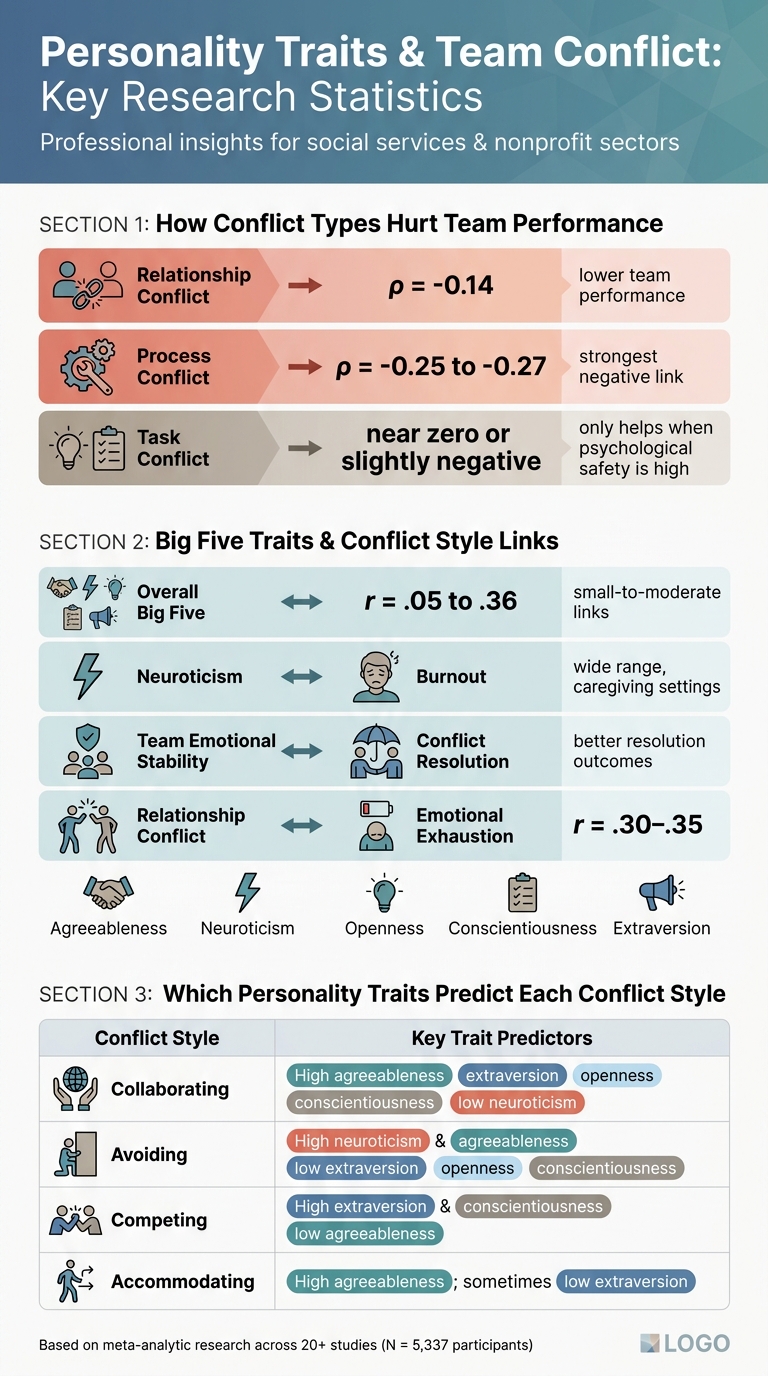
Personality Traits & Team Conflict: Key Research Statistics
Personality shapes how people react in tense moments. But the biggest price usually shows up at the team level: lower performance, less satisfaction, and a higher chance that people start thinking about leaving. That’s the link between individual traits and what happens across the group.
Why Relationship Conflict Is Usually the Most Damaging
When a disagreement stops being about the work and starts feeling personal, things can go downhill fast. Meta-analytic data show that relationship conflict, rooted in distrust and interpersonal tension, is linked to lower team performance (ρ ≈ -0.14) and lower member satisfaction.[2][4] Employees dealing with ongoing interpersonal friction also report more burnout, with correlations around r = .30–.35 for emotional exhaustion.[25][27]
In social service settings, that cost hits even harder. People are already doing demanding work, so relationship conflict piles internal stress on top of an already heavy load. Workers may replay tense interactions in their heads, which drains energy they need for client care.[25][27] The ripple effects reach supervision quality, retention, and the psychological safety teams need for honest case consultation and ethical decision-making.[23][26] Even mild friction can be an early warning sign.
When Task Conflict Helps and When It Backfires
Task conflict helps only in a narrow set of conditions. On average, it is not reliably helpful and is usually near zero or slightly negative for performance.[4]
Psychological safety changes that picture. In one study of 117 project teams, task conflict was positively associated with performance when psychological safety was high, but not when it was low.[28] That makes intuitive sense. A team can argue over ideas and still stay on the same side. But if people don’t feel safe, even a fair debate can start to feel like a personal attack.
The main danger is spillover. Early task conflict can turn into relationship conflict, especially in larger or loosely connected teams.[30] What matters most is whether people can challenge ideas without turning on each other.
How Team Personality Mix Changes Conflict Outcomes
This is why the team’s trait mix matters, not just each person’s style. It shapes whether conflict stays useful or becomes corrosive. Teams higher in emotional stability resolve conflict more effectively (r ≈ 0.32, p < .01),[32] and when team-level openness and emotional stability are both high, task conflict can be positively related to performance.[31][33][34]
The flip side is harder to ignore. Teams with more neuroticism, less agreeableness, or less openness are more likely to let normal disagreement slide into mistrust, burnout, and turnover risk.[11][25][27] Process conflict adds another layer of trouble. Meta-analytic data place its negative association with performance at ρ ≈ -0.25 to -0.27,[4][11] largely because repeated disputes over roles and procedures leave people feeling busy, frustrated, and stuck.
Those patterns point straight to the norms and leader actions that come next.
What Leaders and Practitioners Can Do With This Research
These patterns point to two practical levers: early detection and team norms.
Use Personality Insight to Spot Conflict Patterns Early
These patterns can help leaders catch conflict early, before it turns into burnout, turnover, or poor client care.
In social service teams, the aim is not to label people. It is to notice friction before it starts affecting clients, supervision, and retention. In day-to-day work, pay attention to three patterns: agreeable staff who stay silent, conscientious staff who clash over standards, and lower-emotional-stability staff who escalate or withdraw under stress.[7][6][3]
When supervisors see these tendencies early, they can respond in a more precise way. They can invite agreeable staff into private conversations, where it may feel easier to disagree. They can frame disagreements from conscientious staff as quality checks instead of personal criticism. And they can build in briefing and debrief time for emotionally reactive staff before and after tense conversations.
Build Team Norms That Reduce Escalation
The next step is to shape meetings and supervision so conflict stays productive.
Set up systems that help task disagreement stay about the work instead of becoming personal.[35][29][36][24][23] Research-backed norms include separating idea critique from personal critique, making it clear who has final say on which decisions before meetings begin, and reviewing workflows on a regular basis so process frustrations come up before they get personal.[29][36][23]
During supervision, one simple standing question can help: "What was one tense moment this week, and what type of conflict was it?" That small prompt helps staff and supervisors sort task friction from relationship friction early, before either becomes chronic.
How Tools Like Personos Can Help Teams Apply the Evidence
Tools matter most when they turn personality insight into action in the moment.
Personos turns personality results into situation-specific guidance for helping professionals dealing with tense client and team interactions. Its conversational AI uses full personality profiles and context to tailor guidance to the actual relationship and tension at hand. Dynamic Reports can be generated at the individual, relationship, or group level, which gives supervisors targeted insight instead of a one-size-fits-all summary. Prompts deliver bite-sized, actionable nudges that extend support beyond direct sessions, and an ActionBoard lets supervisors turn insight into trackable tasks.
Just as important, scores stay private unless the individual chooses to share them. That helps avoid the labeling problem that can come with type-based tools and keeps the focus on behavioral tendencies people can work with, not fixed identities they can't.
Conclusion: The Clearest Takeaways From the Research
Personality shapes how people tend to react in conflict, but it doesn't decide the ending. Context matters just as much as traits do. So the main issue isn't simply who people are. It's the patterns they bring with them when stress hits.
The biggest team risk isn't disagreement on its own. The trouble starts when disagreement turns personal. Relationship conflict has a clear negative link with team performance.[1][4] Task, process, and status conflict also tend to hurt teams when they become intense or are handled poorly.[29][4][37][5] Low emotional stability can make this worse, with a higher risk of burnout in caregiving settings.
Some traits can help steady the team in different ways. Agreeableness supports cooperation. Conscientiousness helps people follow through. Openness makes perspective-taking easier. Extraversion helps bring issues into the open. In social service teams, the aim isn't to get rid of conflict. It's to keep conflict useful and safe.
Leaders get better conflict outcomes when they mix personality awareness with clear norms, defined roles, and early intervention, instead of leaning on just one approach. Tools that turn these patterns into real-time guidance make the research easier to use at work. Personos can help teams apply personality insight in actual conversations and cut down conflict before it escalates.
The research keeps pointing in the same direction: people do better when personality insight is paired with clear norms, role clarity, and early intervention. Use personality as a guide, not a label.
FAQs
Can personality tests predict team conflict?
Research suggests they can help. Personality differences are a major source of workplace conflict, and studies show that personality traits can predict relationship dynamics, job performance, and leadership effectiveness.
That matters because when people understand how teammates tend to think, communicate, and react, it gets easier to work through friction before it turns into a bigger problem. This is especially useful on interdependent tasks, where one person’s work directly affects someone else’s.
Personos puts that research to work through the scientifically validated Five Factor Model. It gives teams real-time, personality-aware guidance for conflict, communication, and team dynamics.
Why is relationship conflict more harmful than task conflict?
Relationship conflict does more damage because it pulls people away from solving the issue and into personal friction. Once that happens, trust starts to slip, and psychological safety can take a hit.
Task conflict can, at times, help teams come up with new ideas. Relationship conflict works differently. It adds emotional tension, makes teamwork harder, and can drag down performance.
Personos helps ease that strain with real-time, personality-aware communication guidance, so people can keep conversations professional and productive.
How can managers stop conflict from turning personal?
Managers can stop conflict from turning personal by using personality-aware communication. The idea is simple: reduce friction and make expectations clear.
When leaders know how each team member takes in information and responds under stress, they can choose language that cools things down. That works much better than using the same script with everyone.
Tools like Personos can help. It gives managers real-time, science-backed guidance for tough conversations, so people are more likely to feel heard and respected.