Using Personality Insights to Build Habits
Align habit strategies with your Big Five traits, customize cues/routines/rewards, track automaticity, and use tailored prompts to make habits stick.
Nick Blasi

Using Personality Insights to Build Habits
Building habits that last isn’t just about willpower - it’s about aligning strategies with your personality. Research shows that 45% of daily actions are habitual, and traits like conscientiousness or neuroticism play a big role in habit formation. Here’s how you can create habits that work for you:
- Understand Your Personality: Use tools like the Big Five model (Openness, Conscientiousness, Extraversion, Agreeableness, Neuroticism) to identify your traits.
- Match Strategies to Traits:
- High in Conscientiousness? Use structure and tracking.
- High in Openness? Add variety with habit stacking.
- High in Extraversion? Rely on social accountability.
- Fine-Tune the Habit Loop: Adjust cues, responses, and rewards to fit your natural tendencies.
- Track Progress: Use metrics like automaticity (how effortless a habit feels) to measure success, and refine based on feedback.
Tailoring habits to your personality makes them easier to stick to and more effective. Tools like Personos can help personalize strategies, track progress, and provide timely prompts, ensuring your habits align with who you are.
S05-018: Discusses Personality Styles and Atomic Habits @jamesclear9823
Why Building Habits Is Hard
How Personality Traits Affect Habit Formation Strategies
Building habits is no walk in the park. It often feels like early progress gets derailed as life’s competing demands take over. But here’s the thing: the struggle isn’t about lacking discipline or willpower. The real issue lies in how most habit-building strategies are designed - they treat everyone the same, overlooking the unique differences that make us tick.
Why One-Size-Fits-All Strategies Don't Work
Most generic habit advice assumes that a single approach works for everyone. But in reality, our personalities play a huge role in how we respond to cues and form behaviors. When strategies don’t match who we are, they’re bound to fall short.
For instance, if you’re someone who thrives on structure and clear goals (high in conscientiousness), a vague plan like “exercise more” won’t get you far. You need specific targets and a system to track your progress. On the flip side, if you’re naturally drawn to variety and new experiences, a rigid system might feel suffocating. Studies even back this up, showing a negative correlation between conscientiousness and neuroticism (r = -0.41) [4].
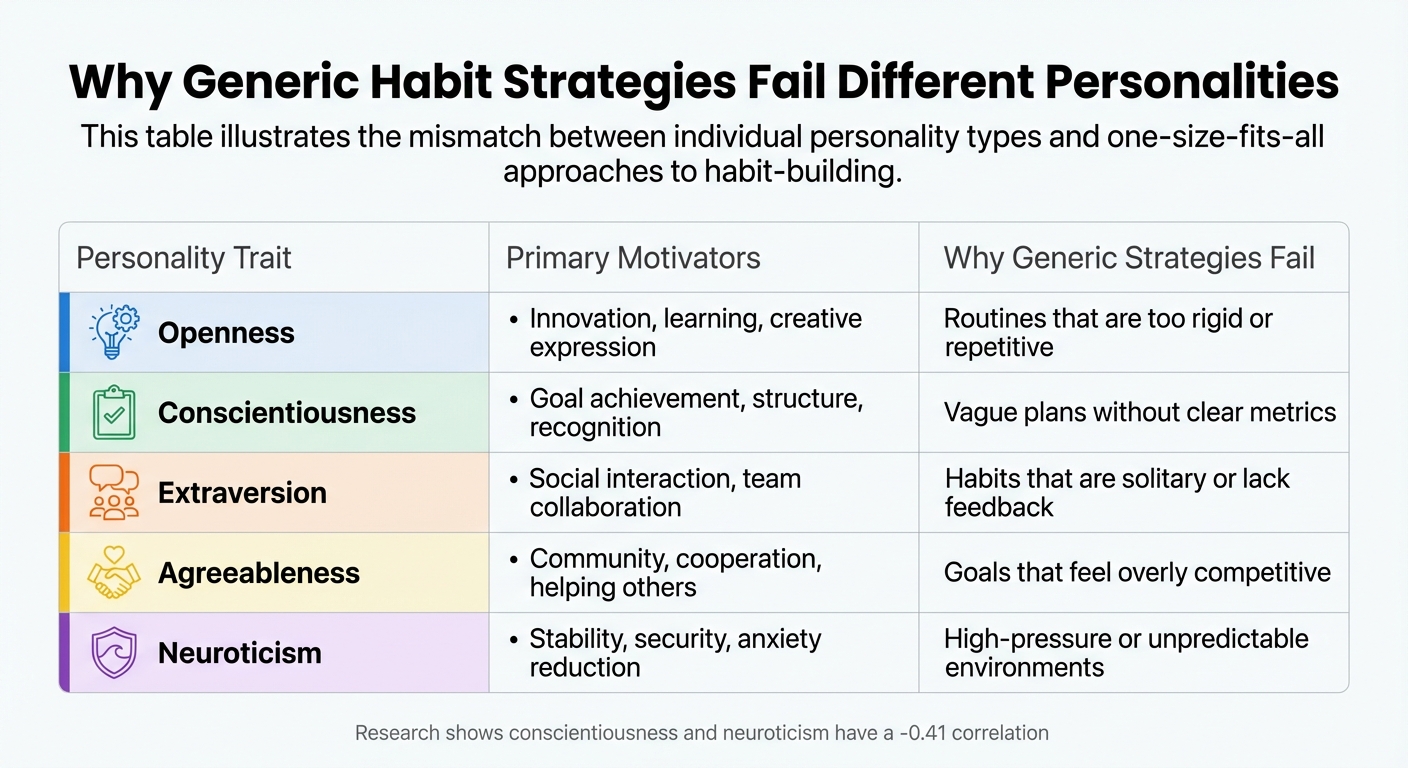
Here’s a quick breakdown of how different personality traits can clash with generic habit strategies:
| Personality Trait | Primary Motivators | Why Generic Strategies Fail |
|---|---|---|
| Openness | Innovation, learning, creative expression | Routines that are too rigid or repetitive |
| Conscientiousness | Goal achievement, structure, recognition | Vague plans without clear metrics |
| Extraversion | Social interaction, team collaboration | Habits that are solitary or lack feedback |
| Agreeableness | Community, cooperation, helping others | Goals that feel overly competitive |
| Neuroticism | Stability, security, anxiety reduction | High-pressure or unpredictable environments |
James Clear, in his book Atomic Habits, sums this up perfectly:
"Your current behaviors are simply a reflection of your current identity. What you do now is a mirror image of the type of person you believe that you are." [3]
When you ignore your personality, you set yourself up for frustration and failure. These mismatches explain why personality traits have such a strong influence on habit formation.
How Personality Traits Affect Habit Formation
The failures of one-size-fits-all strategies underscore the importance of personality in shaping habits. Our traits don’t just influence which habits stick - they also affect how behaviors become automatic.
Research shows that conscientiousness acts as a safeguard against unhealthy automatic behaviors, while neuroticism makes people more prone to them [1][4]. For example, if you’re high in neuroticism, stress might push you toward unhealthy habits - not because you lack self-control, but because your brain is wired to seek relief through familiar behaviors.
Kiran McCloskey, a researcher at the University of Connecticut, explains it well:
"Conscientiousness tends to protect against automaticity for health risk behaviors, whereas neuroticism predicts greater automaticity for health risk behaviors as well as other behaviors." [1]
In practical terms, conscientious individuals are more likely to succeed with measurable, task-oriented habits. Meanwhile, those high in openness or extraversion need habits that offer creative or social rewards [1][4].
The takeaway? Aligning your habit-building approach with your personality isn’t just helpful - it’s essential. By working with your natural tendencies instead of fighting against them, you can set yourself up for lasting success.
Tailoring Habits to Your Personality
Now that you know how personality influences habit formation, it's time to put that insight into action. You don't need a psychology degree to start creating habits that align with who you are. The key is identifying your core traits and tweaking your methods to suit them.
Identifying Your Personality Traits
A great starting point is the Big Five personality model, also known as OCEAN: Openness, Conscientiousness, Extraversion, Agreeableness, and Neuroticism [7]. These traits exist on a spectrum - you’re not strictly “extraverted” or “introverted” but fall somewhere in between.
To pinpoint where you land, consider taking assessments like the Mini-IPIP, a quick tool for evaluating your position on each trait [4][8]. If you’re looking for more detail, the Big Five Aspect Scales (BFAS) break these traits into 10 subcategories, providing a more in-depth understanding [4][8]. Research suggests that 30% to 50% of personality variation is genetic [7], so even small tweaks in your habit-building approach can make a noticeable difference.
Once you’ve identified your traits, you can align your habit-building strategies with your personality for better results.
Adjusting the Habit Loop for Different Personalities
With your personality traits mapped out, you can customize the classic habit loop - Cue, Craving, Response, and Reward - to fit your natural tendencies [11]. Each phase can be fine-tuned to play to your strengths.
Cue Phase: Think about how you respond to different triggers. If you lean toward extraversion, social cues might work best - try scheduling a workout with a friend or joining a group class [5]. On the other hand, if you're more neurotic and sensitive to internal signals like stress, practice "Curiosity Mindfulness" by pausing to observe your physical sensations instead of reacting impulsively [12].
Response Phase: Adjust the difficulty of your actions based on your level of conscientiousness. If you’re less conscientious, reduce friction with the "Two-Minute Rule" - start small, like simply putting on your running shoes, to lower the willpower barrier [11]. Habit stacking can also help; for instance, link a new behavior to an existing routine, such as writing one sentence in a journal right after pouring your morning coffee [10].
Reward Phase: Choose rewards that resonate with your personality. Conscientious individuals might find satisfaction in checking off a task on a to-do list [1], while those high in neuroticism may benefit from stress-relieving rewards [12]. If you're high in openness, try "Temptation Bundling" - pair a necessary task with something you enjoy, like listening to your favorite podcast only while exercising [11].
Habit Strategies for Different Personality Types
Building habits that stick often requires tailoring strategies to align with your personality traits. Here’s how you can design habits that work for three key personality dimensions.
Extraversion: Relying on Social Accountability
If you thrive in social environments, use your natural extraversion to your advantage. Instead of working out solo, consider joining a class or group where you can connect with like-minded individuals. Sharing your goals publicly or partnering with an accountability buddy can significantly boost your success. In fact, research highlights that having an accountability partner can double the likelihood of sticking to your goals [6].
You can also use social triggers to build habits. For instance, try an "if-then" plan like, "If I see a cashier, then I’ll ask how their day is going." These small actions help you cultivate identity-based habits, such as becoming someone who values connection. As James Clear wisely puts it:
"If you do not actively choose a better way, then society, culture, and the general inertia of life will push you into a worse way. The default is distraction, not improvement" [5].
By aligning your habits with social engagement, you can turn your extraverted tendencies into a powerful tool for lasting change. While extraverts benefit from social interactions, those who are conscientious thrive on structure.
Conscientiousness: Embracing Structure and Tracking
Conscientious individuals excel when their habits are tied to clear routines and measurable progress. For example, you could set a specific plan like, "At 8:00 AM, I’ll write for 20 minutes." Visual tools like habit trackers can also be incredibly motivating, helping you stay focused and committed [5][2]. Studies even show that self-monitoring can double success rates for goals like weight loss or quitting smoking [6].
Building a habit takes time - on average, about 66 days - but this varies depending on the complexity of the behavior [6]. Techniques like mental contrasting, where you reflect on both the benefits of your goals and the challenges ahead, can help turn your natural planning abilities into action. Preparing your environment is another effective strategy. For instance, laying out workout clothes the night before removes unnecessary decisions and makes it easier to follow through. Aristotle’s timeless insight captures this well:
"Excellence, then, is not an act, but a habit" [9].
By leaning into structure and preparation, conscientious individuals can create habits that are both effective and sustainable. For those with high openness, however, variety is key.
Openness: Adding Creativity to Habit Stacking
If you score high on openness, you likely crave novelty and intellectual stimulation to stay engaged. Habit stacking - a method where you pair a new habit with an existing one - works particularly well when you incorporate creativity and variety [13][16]. For example, you could listen to your favorite podcast while cleaning, making the task more enjoyable and memorable [14][18]. As Christopher S. Reina, Ph.D., explains:
"Your mind is more likely to remember and reinforce a habit when it's associated with something novel or unique" [15].
To keep things interesting, rotate your rewards or activities. For instance, after your morning coffee, spend ten minutes on a creative hobby [17]. Use specific and novel cues to trigger habits, such as, "When I close my laptop for lunch, I’ll do ten push-ups" [13]. Even rearranging your physical space - like placing a meditation cushion where you’ll see it - can provide fresh prompts to reinforce your routines [15][17].
sbb-itb-f8fc6bf
How Personos Helps Build Personality-Based Habits
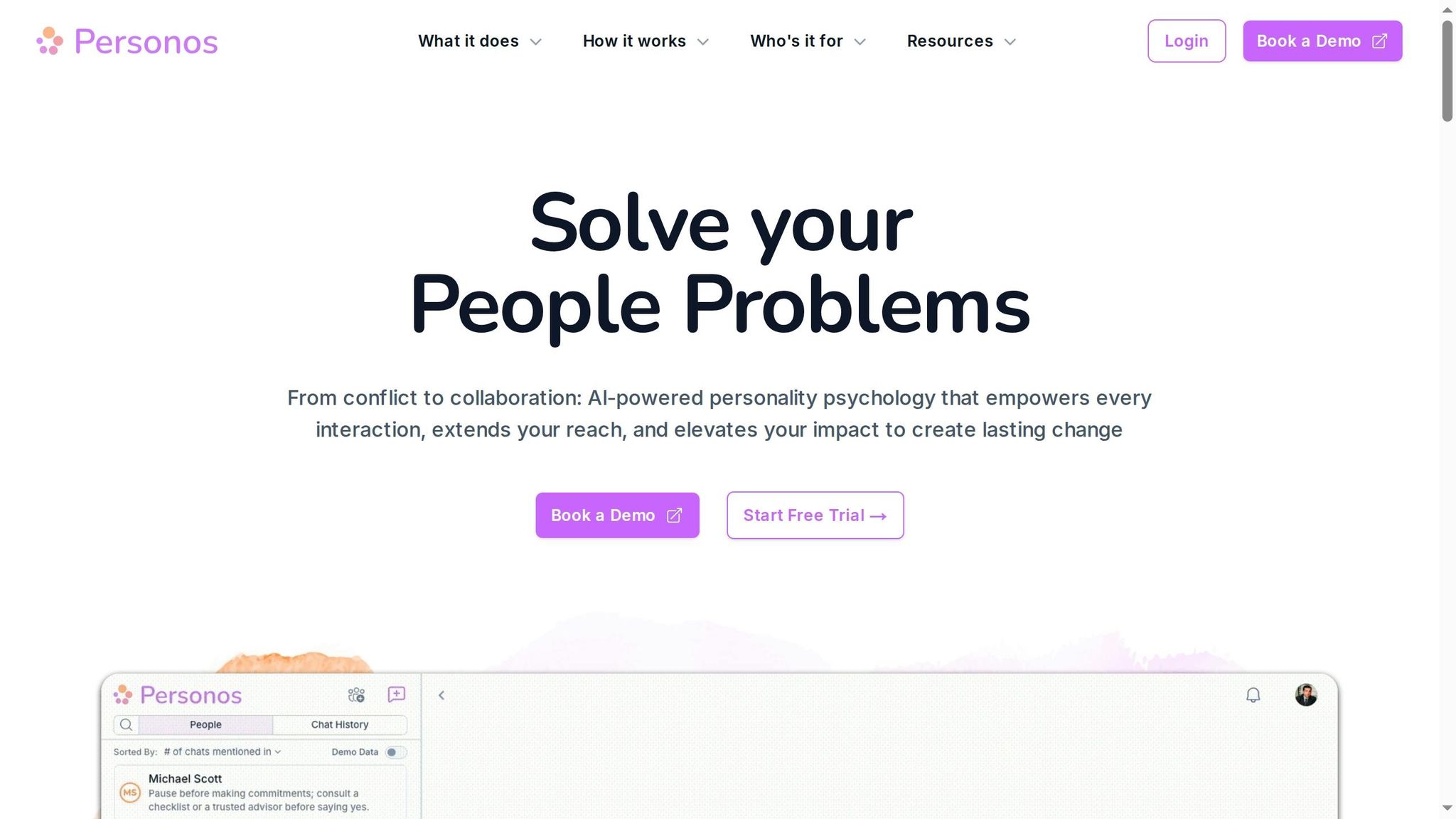
Personos takes your personality insights and turns them into practical, daily habits. Knowing your personality is just the first step - making that knowledge work for you is where the magic happens. By blending AI-driven insights with hands-on tools, Personos creates a clear path from understanding your personality to forming habits that stick. Drawing on 30 different personality traits, it crafts a comprehensive profile to guide you [19].
Using Dynamic Personality Reports to Align Habits
Personos focuses on turning personality insights into real-world actions. Its dynamic personality reports dive into your traits, background, and current situation, offering a customized "Put into Action" section. This section translates psychological research into practical steps you can start using right away. For instance, if your report highlights high neuroticism and low conscientiousness, you’ll get targeted strategies to manage stress-related habits instead of generic relaxation advice. What’s more, Personos explains why these strategies work for your personality, giving you a clearer understanding of your thought processes [19].
This thorough analysis sets the stage for ongoing support through tools designed to keep you moving forward.
Staying on Track with Prompts and Task Tracking
Consistency is the backbone of habit formation, and Personos helps you stay consistent with tools like the ActionBoard and Personos Prompts. The ActionBoard uses a Kanban-style system to turn personality insights into actionable, trackable tasks. You can take any suggestion from your personality report or an AI chat and transform it into a measurable goal [20].
Personos Prompts provide timely nudges throughout your day, tailored to your unique personality traits. These prompts are designed to arrive when they’re most likely to make an impact. Addiction recovery counselor Carla Mendoza, LCSW, highlights the value of this feature:
"In recovery, timing is everything. Personos helps me anticipate when a client is on the edge of shutting down and adjust my approach so we stay connected. That kind of in-the-moment support is priceless" [19].
You can even rate each prompt, helping the system fine-tune future suggestions to better fit your needs [20].
Another powerful tool is Personos Chat, a conversational AI that acts as your go-to guide for habit building. When challenges arise, you can discuss any task or prompt with the AI to get step-by-step advice tailored to your situation. This ensures your strategies stay flexible and effective, even when life throws you a curveball [20].
Tracking Progress and Adjusting Your Habits
Once you've crafted habit strategies tailored to your personality, the next step is tracking your progress. Why? Because habits don’t form overnight, and your personality plays a big role in shaping how you build and maintain them. Standard tracking methods often fall short - they don’t account for what truly drives you or how you respond to rewards. By aligning your tracking methods with your personality, you can make adjustments that actually stick.
Measuring Success with Personality Metrics
The best way to track your progress is by using metrics that resonate with your personality traits. Forget one-size-fits-all approaches. Instead, focus on what matters to you. For example, if you're naturally outgoing (high in Extraversion), you might track how often you engage in social challenges, like starting conversations with strangers. On the other hand, if you're highly organized (high in Conscientiousness), you might find more value in tracking how consistently you complete small, structured tasks.
One of the most insightful metrics to track is automaticity - how natural or effortless a habit feels over time. The Self-Reported Behavioral Automaticity Index (SRBAI) is a tool that helps you measure this. It asks questions like, “Do I do this without thinking?” or “Does this feel second nature now?” Research shows it typically takes about 66 days to form a habit, though depending on the habit’s complexity and individual differences, this can range from 18 to 254 days [6].
Here’s how personality traits can guide your tracking and adjustments:
| Personality Trait | Recommended Metric | Adjustment Strategy if Progress Stalls |
|---|---|---|
| Extraversion | Number of social challenges completed (e.g., greeting strangers) | Join group-based programs or increase social accountability |
| Conscientiousness | Consistency with small organizational wins | Simplify routines to make them more automatic |
| Neuroticism | Frequency of using stress-management techniques (e.g., the "STOP" method) | Reduce triggers in your environment and focus on mindfulness |
| Openness | Variety of new behaviors attempted | Link creative tasks to existing habits using "habit stacking" |
| Agreeableness | Frequency of prosocial actions (e.g., expressing gratitude) | Tie habits to relationship-building or community goals |
By focusing on personality-specific metrics, you’re far more likely to stay motivated and achieve lasting change [6].
Refining Habits Based on Feedback
Tracking progress is just the first step - you also need to act on what you learn. If a habit isn’t sticking, figure out where the breakdown is happening. Is the problem the cue, the routine, or the reward? Your personality plays a big role in how you perceive rewards, which can determine whether a habit becomes permanent.
Intrinsic rewards - like the immediate satisfaction of doing something enjoyable - tend to be more effective for long-term habit formation than external rewards like money or recognition [1][4]. That said, this can vary. For example, people high in Conscientiousness often find satisfaction in simply completing a task, while those high in Neuroticism may feel more motivated by habits that reduce stress or tension [1].
To make adjustments easier, create a tight feedback loop. As Eric Ries, author of The Lean Startup, wisely points out:
"You can't change what you can't measure" [22].
The quicker you get feedback, the faster you can adapt. Use implementation intentions - those “if-then” plans - to make adjustments automatic. For instance, you might say, “If I miss my workout in the morning, then I’ll do a shorter session in the evening” [5][23].
Tools like Personos can make this process even more seamless. Its rating system and conversational AI provide real-time, personality-aligned suggestions to help you overcome obstacles. Plus, its task tracking feature keeps your adjustments visible and measurable, helping you spot patterns in what works and what doesn’t.
It’s also worth noting that your personality isn’t set in stone. As Ying (Lena) Wang, Ph.D., Associate Professor at RMIT University, explains:
"Personality is not fixed and instead can change across someone's lifespan" [21].
In other words, your habits can shape your personality just as much as your personality shapes your habits. That’s why regular refinement is so important - it’s not just about building habits; it’s about evolving as a person.
Conclusion
When your habits align with your personality - your natural rhythms, motivations, and strengths - they feel easier and less draining. Many habit strategies fail because they overlook this simple truth: they don't take into account who you are. For instance, forcing a night owl to wake up at 5 AM or expecting someone who thrives on spontaneity to stick to rigid schedules often leads to frustration instead of progress [24].
Studies reveal that habits tailored to your identity and tracked consistently are far more effective than generic approaches. In fact, success rates can increase by as much as 37% when habits are designed to fit your unique traits [25][26]. Using personality-specific metrics and feedback loops that resonate with your natural tendencies can make all the difference.
Tools like Personos make this process even smoother. By analyzing 30 distinct personality traits, it generates tailored reports and provides real-time prompts through its ActionBoard. This helps you uncover blind spots, maintain consistency, and tweak your approach when needed. As David Kim, a seasoned executive coach, puts it:
"I've coached C-suite executives for 15 years, and Personos changed my practice overnight. It surfaces blind spots I would have taken months to uncover." [19]
By embracing these strategies, your habits naturally sync with your personality. And as your habits evolve, so does your personality. Building routines that match who you are today - and tracking them with personalized insights - goes beyond forming habits. It's about creating meaningful, lasting changes that shape the person you’re becoming.
Start small, track your progress, and let your personality guide the way.
FAQs
How can understanding my personality help me build better habits?
Understanding your personality can make all the difference when it comes to building habits that actually stick. A good starting point is exploring a framework like the Big Five personality traits: openness, conscientiousness, extraversion, agreeableness, and neuroticism. These traits play a big role in shaping how you develop and maintain habits. For instance, if you're highly conscientious, you're likely to excel at setting goals and sticking to them. On the other hand, if you score higher in neuroticism, you might benefit from pairing your habits with techniques to manage stress.
Once you’ve identified your personality traits, you can fine-tune your strategies. If discipline comes naturally to you, focus on setting clear goals and reinforcing behaviors with cue-reward loops. If sticking with habits is more challenging, try breaking your goals into smaller, manageable steps, incorporating external accountability, or setting up reminders to keep yourself on track. Tools like Personos can offer tailored recommendations and practical tips that align with your unique personality, helping you work smarter, not harder.
It’s also worth noting that personality isn’t set in stone - it can shift over time. Using tools like Personos regularly can help you monitor these changes and adjust your strategies as needed. By syncing your habits with your personality, you’re setting yourself up for meaningful, lasting progress.
Why don’t generic habit-building strategies work for everyone?
Generic habit strategies often fall short because they operate on the assumption that everyone reacts the same way to cues, routines, and rewards. But the truth is, factors like personality traits, motivation, and personal circumstances heavily shape how habits are formed. For instance, studies reveal that forming a habit can take anywhere from 18 to 254 days, depending on the individual.
Personality traits such as conscientiousness and neuroticism also have a major impact. People who score high in conscientiousness are more likely to steer clear of risky habits, while those with higher levels of neuroticism might develop automatic behaviors more quickly - even for actions they perform less often. When habit strategies fail to align with someone’s personality, they can feel ineffective or even frustrating.
This is where AI tools, like Personos, come into play. By leveraging AI-driven insights, habit-building strategies can be tailored to an individual’s psychological profile. Adjusting cues, routines, and rewards to fit a person’s unique traits makes it much easier to create habits that truly stick.
How can I track my habits in a way that fits my personality?
Tracking habits in a way that suits your personality can make the entire process more engaging and effective. If you’re someone who thrives on structure, a detailed digital tracker or a physical journal with grids to mark your progress might be just the thing to keep you motivated. For those who tend to feel anxious, simple tools like app-based reminders or visual streak trackers can help ease worries and keep your focus on positive progress. If you draw energy from social connections, sharing your progress with a group or using a community tracker can provide the accountability you need. Meanwhile, if you’re more of a big-picture thinker, you might find weekly summaries that highlight overall trends more appealing than tracking every single day.
An AI-powered tool like Personos can take habit tracking to a whole new level by adapting to your personality in real time. It analyzes your habits, offers personalized reminders, and even predicts when your motivation might wane - giving you proactive nudges to stay on track. With tailored feedback, dynamic insights, and strategies designed to match your unique approach, you can build a habit-tracking system that feels effortless and keeps you moving toward your goals.