Understanding Personality Across Groups
Don't equate behavior with trait—use language, norms, stress, and group background to read personality more accurately.
Rachel Johnson

Understanding Personality Across Groups
The main point is simple: behavior alone is a weak shortcut for judging personality. In helping work, the same action can mean stress, language load, group norms, role pressure, or a stable trait. If I treat my own habits as the default, I can misread people fast, and that can affect trust, case notes, and later decisions.
Here’s the short version:
-
One behavior can mean many things
- Quietness may mean respect, fear, or stress
- Brief answers may reflect second-language processing, not disinterest
- Deference may reflect family or group decision patterns, not passivity
-
Early judgments often go wrong in 3 places
- first impressions
- score reading
- personality reports
-
Stress changes behavior
- In high-pressure settings, people may look withdrawn, agreeable, blunt, or scattered
- That does not automatically point to a fixed trait
-
Language shapes perception
- In one study, standard German speakers were rated higher on ability than Turkish-accented speakers, 4.83 vs. 4.20, with p < .001
- That shows how speech style can shift judgment even when the person has not changed
-
A better way to read behavior
- check language
- check norms
- check stress
- check group background
- then ask: does this pattern show up across settings?
-
A better way to write notes
- record what I saw
- record when it happened
- record the setting
- keep trait labels open until the pattern repeats
| What I might see | Fast misread | Better first question |
|---|---|---|
| Silence | resistance | Is this stress, respect, or role pressure? |
| Slow replies | low openness | Is language load part of this? |
| Indirect answers | evasion | Is this a politeness pattern? |
| Group reluctance | introversion | Does the person act the same in other settings? |
| Poor recall under pressure | low conscientiousness | Is stress narrowing attention? |
Bottom line: I should treat early personality reads as hypotheses, not facts. If I slow down, check context, and revise as more information comes in, I’m less likely to turn a moment of pressure into a lasting label.
Challenges and Rewards of a culturally-informed approach to mental health | Jessica Dere | TEDxUTSC
Where Personality Data Gets Misread
Personality data usually doesn't go off track by itself. The problem starts when the person reading it uses the wrong lens.
Bias often slips in early, during intake and first impressions. Then it shows up again when scores get read or case notes get written. The risk gets bigger when a professional treats their own habits and expectations as the baseline for everyone else.
Using One Group's Norms as the Default
Everyone has a default. It's the communication style, emotional tone, and behavioral pace that feels "normal." Most of that comes from background, training, and workplace norms.
When someone's behavior doesn't match that default, people often rush to assign a trait label. Brief answers may get read as low openness. Deference to family may get read as dependence. Limited eye contact may get read as disengagement.
That's where bias can quietly bend judgment. Research on social perception shows that people make more fine-grained trait judgments for in-group members, while leaning on broader categories for out-group members. [3][4][5] In plain English, professionals often see their own group as varied and layered, while other groups can seem more alike than they are. That can lead to too much confidence in trait calls.
Tools like Personos can help keep personality data grounded in context, which helps cut down on overreading from a single score.
Confusing Context-Driven Behavior With Stable Traits
Behavior under pressure is not the same thing as personality. But in a first meeting, especially one tied to court involvement, mandated reporting, or a recent crisis, clients are often under pressure from the start.
Fear of consequences, power imbalance, and prior bad contact with systems like child welfare, probation, or immigration enforcement can make someone seem withdrawn, overly agreeable, or uncooperative. Trauma history adds another layer. Survivors of interpersonal violence or institutional betrayal often downplay their needs, hold back opinions, or defer decisions because those responses once helped them stay safe. [8][9]
The day-to-day risk is simple: adaptive behavior gets written down as a personality flaw. A parent who misses appointments because transportation is unreliable gets labeled "low conscientiousness." Once that label lands in case notes, it can shape how every later professional reads that person. [11]
A better question is: Does this behavior show up across settings, or only here? Stable traits usually appear across home, work, peer, and community settings. Context-driven behavior tends to shift when the setting shifts. [6][7][10]
How Language and Communication Style Change Perception
Language isn't a neutral pipe. The way a person speaks, including pace, directness, word choice, and turn-taking, shapes how listeners judge confidence, warmth, and openness, often without noticing they're doing it.
A cross-cultural study found that standard German speakers were rated much more competent than Turkish-accented speakers ((M = 4.83) vs. (M = 4.20), (F(1, 197) = 85.74), (p < .001)). [12] Competence and warmth judgments moved on separate tracks, which means one communication cue can shift ratings in opposite directions at the same time.
For helping professionals, this shows up in very concrete ways. A client speaking in a second language may talk more slowly, use simpler wording, and avoid detailed emotional language. That's linguistic load, not a trait problem. A client from a background where indirectness signals politeness may never say "no" in a direct way. That's relationship-preserving communication, not evasion. [13][14]
| Communication behavior | Common misread | More accurate read |
|---|---|---|
| Brief or slow responses | Low openness or resistance | Second-language processing, caution |
| Indirect answers or hedging | Evasiveness or resistance | Politeness norms, indirectness as respect |
| Waiting before speaking | Withdrawal or low confidence | Different turn-taking expectations |
| Deferring to family | Dependence or passivity | Collectivist decision-making norms |
| Avoiding direct "no" | Dishonesty or avoidance | Relationship-preserving communication |
If these factors aren't checked on purpose, professionals can underrate confidence and openness in some groups while reading too much resistance or hostility into others. [13][14] The behavior didn't change. The interpretation did.
Before assigning a trait label, look at background, stress, and whether the same pattern shows up across settings.
What to Check Before Drawing Conclusions
Before you turn behavior into a trait label, do a quick check. Treat early assessments like hypotheses, not final answers. Then revise them as more information comes in. These checks can help you avoid turning a first impression into a fixed judgment. [1]
Group Background, Role, and Acculturation
Background, role, and acculturation shape how people speak and respond, especially in new settings. In client meetings, those factors can change what silence, hesitation, or deference mean. Someone may speak more carefully or keep answers short when the other person has authority. That may reflect role norms or how familiar they are with the setting, not a fixed trait. [1]
It helps to ask whether the person is showing up as a peer, as someone dealing with an authority figure, or as an outsider in that setting. Write down that role context before you make any trait call.
If background still doesn't explain the behavior, the next thing to check is stress.
Stress Response and Emotional Display Rules
Stress can push behavior outside a person's usual range. Under pressure, clients often show survival responses, not baseline personality. [15]
In plain terms, a crisis reaction may say more about pressure than personality. When stress is high, attention narrows, working memory shrinks, and communication tone becomes easy to misread. If a client doesn't feel safe showing distress in a first meeting, what you see on the surface may reflect the stress state more than any lasting trait. [15]
That means you should test the pattern somewhere else too, not just in the room where the pressure showed up.
Consistency Across Settings
Stable traits tend to show up across settings. Situational reactions don't. One setting isn't enough. A client who seems withdrawn in a one-on-one meeting but engaged in a group setting is not the same as a client whose pattern stays the same wherever they are. [1]
Before labeling a trait, check whether the same pattern appears outside the meeting. If the answer isn't clear yet, keep the label provisional. In other words, hold it loosely until the pattern repeats beyond the original setting. [1]
A Practical Way to Read Personality Across Groups
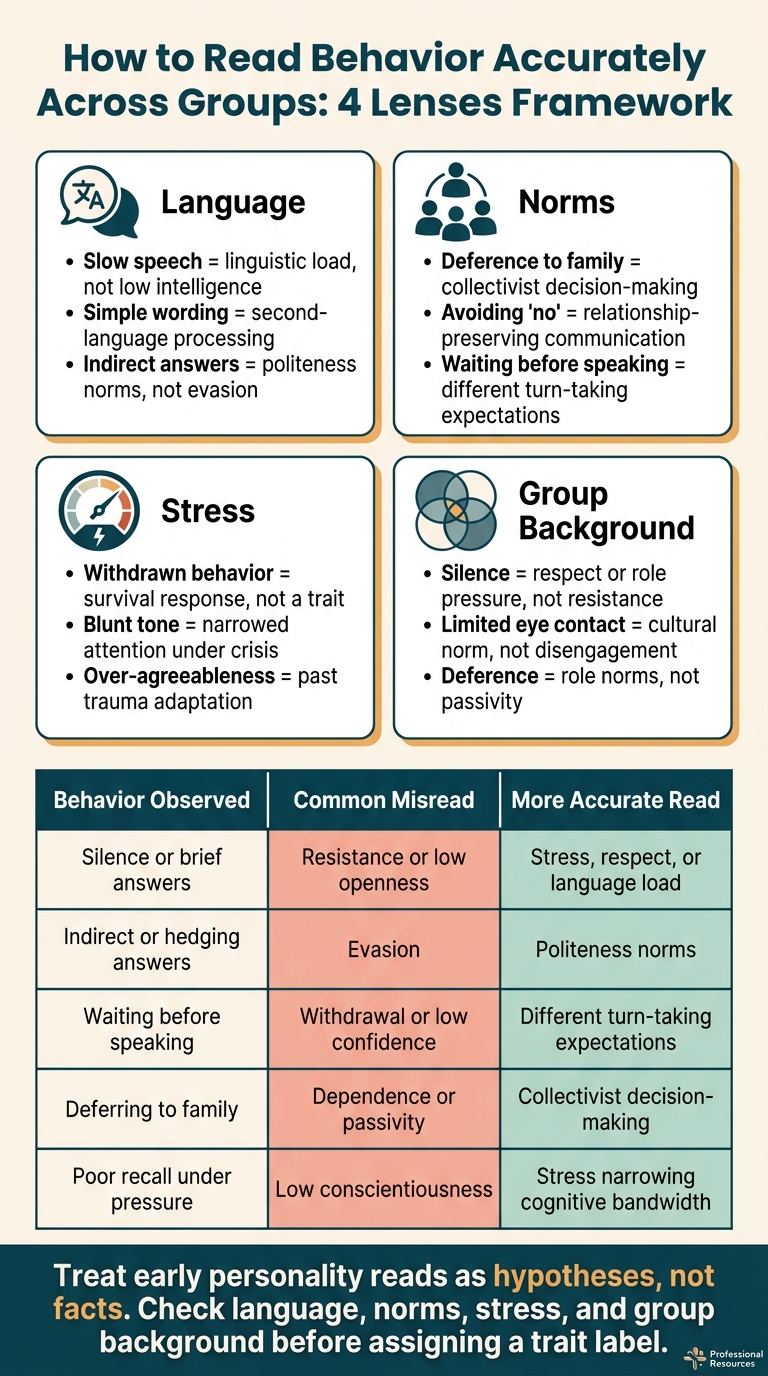
How to Read Behavior Accurately Across Groups: 4 Lenses Framework
A simple way to do this is to use the same check each time: language, norms, stress, and group background. The sections above show what each one can look like in practice. This framework helps you make the call.
Use 4 Lenses: Language, Norms, Stress, and Group Background
Look at each behavior through these four lenses: language, norms, stress, and group background. If one of those gives a better explanation than a trait label, pause before assigning the label.
Use the table below as a quick field check.
| Behavior observed | Context meaning | Caution before concluding a trait |
|---|---|---|
| High emotional reactivity | Acute stress response to life transitions (e.g., reentry, job loss) | Avoid labeling as "Neuroticism"; check for situational triggers [2] |
| Direct or blunt communication | Cultural or professional norms regarding efficiency | Avoid labeling as "Low Agreeableness"; check for language/norm defaults [1][2] |
| Reluctance to speak in groups | Organizational hierarchy or past negative dynamics | Avoid labeling as "Introversion"; check for safety and group context [1] |
| Rule-following under pressure | High-pressure role demands | Avoid labeling as "High Conscientiousness"; check for external pressure [1] |
| Narrowed focus or poor recall | High-stress environment or crisis state [15] | Do not assume low Conscientiousness; check for cognitive bandwidth [15] |
Use all four lenses together before you attach any trait to a person.
Treat Assessments as Hypotheses, Not Labels
Treat any score as a working idea, not a fixed judgment. Keep it provisional until it lines up with observed behavior and the person's own account. [1]
How Tools Like Personos Can Support Context-Aware Interpretation
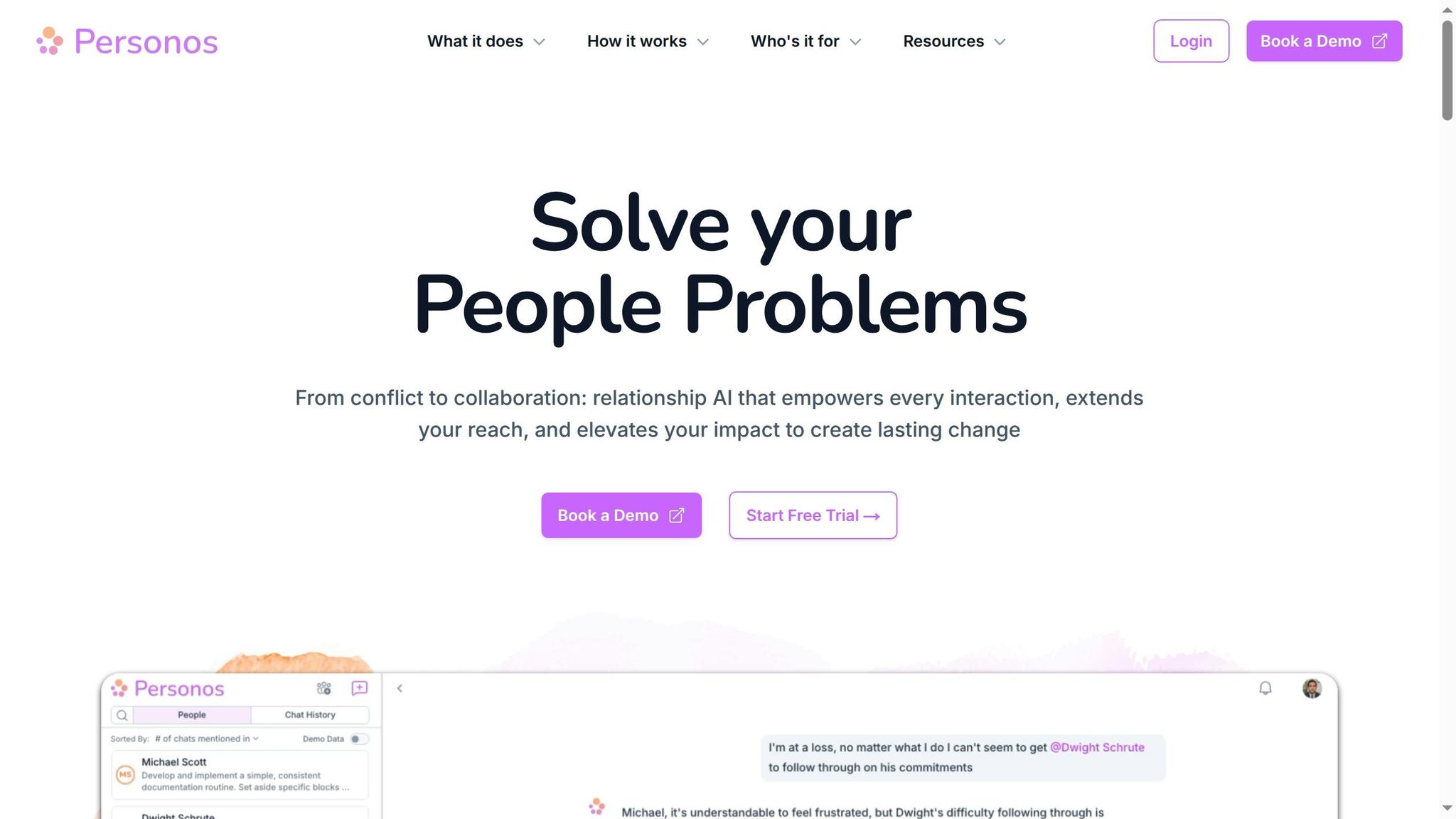
If your team uses AI support, the goal shouldn't be more scoring. It should be better interpretation.
Personos can help practitioners test trait readings against a person's history, goals, and relationship dynamics. That keeps scores tied to context instead of turning them into labels.
How to Adjust Meetings and Document Uncertainty
Once a read is provisional, the next step is to change the meeting approach and document it with care.
Adjust Communication Without Stereotyping
Use plain, neutral language. Treat each behavior as tied to the moment until you see it repeat in other settings. Ask directly: "Is there a way I can make this conversation easier for you?" or "What makes this easier to discuss?" Those questions give the client room to say what helps, instead of leaving you to guess.
What you say in the room should line up with what you write later.
When sharing personality-related insights with colleagues, Personos can share role-specific guidance with approved users instead of raw trait scores, which lowers the risk of misread or misuse. [1]
Give Feedback in Observable Terms
In case notes, supervision, and team handoffs, describe what you observed, not what you inferred. Replace "the client was resistant" with a clear account of the behavior you saw. That version can change as you learn more. A label, once written, tends to follow the person through the system.
Document emotional shifts as situational data, not fixed traits. Note when a behavior showed up, what was happening at the time, and how it differed from other sessions. Notes should record behavior and context, not reduce a person to a shorthand label. Precise documentation helps stop one early assumption from shaping how every later professional reads that file.
Conclusion: Read Behavior Slowly and Revise Often
Patience in interpretation is the core discipline. Write what happened, name the context, and leave the trait label open until the pattern repeats.
FAQs
How can I tell stress from personality?
Look at a person’s usual patterns next to how they react under pressure. Personality tends to stay fairly steady over time. Stress, on the other hand, is a short-term shift caused by outside demands.
Personos helps by comparing a client’s personality traits with their current situation, so you can tell whether a behavior reflects their baseline or a response to feeling overwhelmed.
What should I write instead of trait labels?
Instead of using trait labels, describe what the trait looks like in the moment: how the person communicates, how they may react under stress, what kind of support tends to help, and what language is most useful.
Keep the wording tied to the setting, the social norms, and the group’s background. For example: “In meetings, this person tends to prefer direct structure under pressure; try offering clear next steps and confirm expectations.” Personos does this by surfacing high-level, mutually helpful insights instead of raw scores or stereotypes.
When is behavior a real pattern?
Behavior counts as a real pattern when you assess it consistently over time, not from one observation or a single assessment.
To tell the difference between personality-driven behavior and short-term reactions, professionals need to watch for repeated signs of mood stability, stress responses, and coping habits as circumstances shift. Personos supports this by tracking goals, preferences, and repeated tendencies in context.