Ultimate Guide to Personality-Based Mediation Techniques
Use OCEAN-based personality insights and AI tools to tailor mediation, move past blame, and reach faster, lasting resolutions.
Rachel Johnson

Ultimate Guide to Personality-Based Mediation Techniques
Personality-based mediation focuses on resolving conflicts by tailoring strategies to individual personality traits, rather than relying on generic approaches. By understanding how people naturally handle disagreements - whether they avoid conflict, confront it directly, or fall somewhere in between - mediators can create more effective resolutions.
Key Points:
- Personality Traits Matter: The Five Factor Model (OCEAN: Openness, Conscientiousness, Extraversion, Agreeableness, Neuroticism) offers a framework for understanding how individuals approach conflict.
- Tailored Mediation Styles: Adjusting communication and strategies based on traits like introversion, emotional stability, or cooperation levels leads to better outcomes.
- Future-Focused Solutions: Shifting the focus from past grievances to actionable, forward-looking plans helps reduce emotional setbacks.
- Tools Like Personos: Platforms such as Personos use AI and personality assessments to guide mediators with real-time insights, customized strategies, and progress tracking.
Why It Works:
- Matching mediation methods to personality traits builds trust and reduces resistance.
- Tools like Personos streamline the process with dynamic reports, conversational AI, and tailored prompts to maintain engagement.
Bottom Line: Personality-based mediation improves conflict resolution by considering individual differences, leading to higher success rates and smoother communication.
Core Principles of Personality-Based Mediation
Understanding the Five Factor Model
The Five Factor Model breaks down personality into five key dimensions, often remembered by the acronym OCEAN: Openness to Experience, Conscientiousness, Extraversion, Agreeableness, and Neuroticism [1][2]. Unlike black-and-white personality tests, it places individuals on a spectrum for each trait, offering a more nuanced view [1][2].
These traits tend to remain stable over a lifetime, with studies estimating their heritability between 40% and 60% [1]. For mediators, this consistency provides a reliable framework to anticipate how someone might respond in conflict resolution scenarios.
Each dimension influences how people handle disagreements. For instance, someone high in Openness might gravitate toward creative or unconventional solutions, while someone with lower openness prefers familiar, practical approaches [1][2]. Conscientiousness reflects whether a person thrives on detailed planning or favors a more spontaneous approach [1]. Extraversion determines whether individuals recharge through active discussion or need quieter moments to reflect [1][2]. Agreeableness predicts cooperation levels, with research showing a positive link (r=0.32) between agreeableness and transformational leadership skills [2]. Lastly, Neuroticism measures emotional stability; individuals with higher scores are more prone to mood swings and tend to view situations as more threatening [1][2].
By understanding these traits, mediators can adapt their strategies to suit each individual's personality.
Adjusting Mediation Styles to Personality Traits
Using the Five Factor Model as a guide, mediators can fine-tune their approach based on specific traits. For those low in Agreeableness, it’s essential to emphasize fairness and highlight the personal benefits of cooperation [1][2]. Since Conscientiousness is the strongest predictor of job performance among these traits [1], highly conscientious individuals respond well to structured plans and clear timelines, while those scoring lower may need more flexibility to avoid resistance [1].
When mediating with introverts (low Extraversion), allow them time to think and avoid putting them on the spot, as excessive social interaction can drain their energy [1]. For individuals high in Neuroticism, creating a calm and secure environment is crucial because they are more likely to perceive minor frustrations as major issues [2]. Interestingly, women generally score higher than men in Neuroticism, Agreeableness, and Openness to Feelings, which can provide additional context for tailoring mediation styles [1].
Focusing on Future Solutions
Personality insights play a pivotal role in steering mediation away from past grievances toward constructive, future-oriented solutions. This is particularly vital for individuals high in Neuroticism, as they tend to dwell on negative emotions and may struggle to move beyond past conflicts [2]. Redirecting their focus to actionable steps can help prevent emotional setbacks.
Different personality profiles bring unique strengths to conflict resolution. For example, those high in Openness often excel at brainstorming unconventional settlement options [1], while highly conscientious individuals thrive with clear deadlines and measurable goals [1]. The key is to align the mediation process with each person's natural tendencies instead of forcing a one-size-fits-all approach. By doing so, mediators can create a process that feels intuitive and effective for everyone involved.
How to Deal With High Conflict People and High Conflict Situations Bill Eddy
Step-by-Step Guide to Personality-Based Mediation
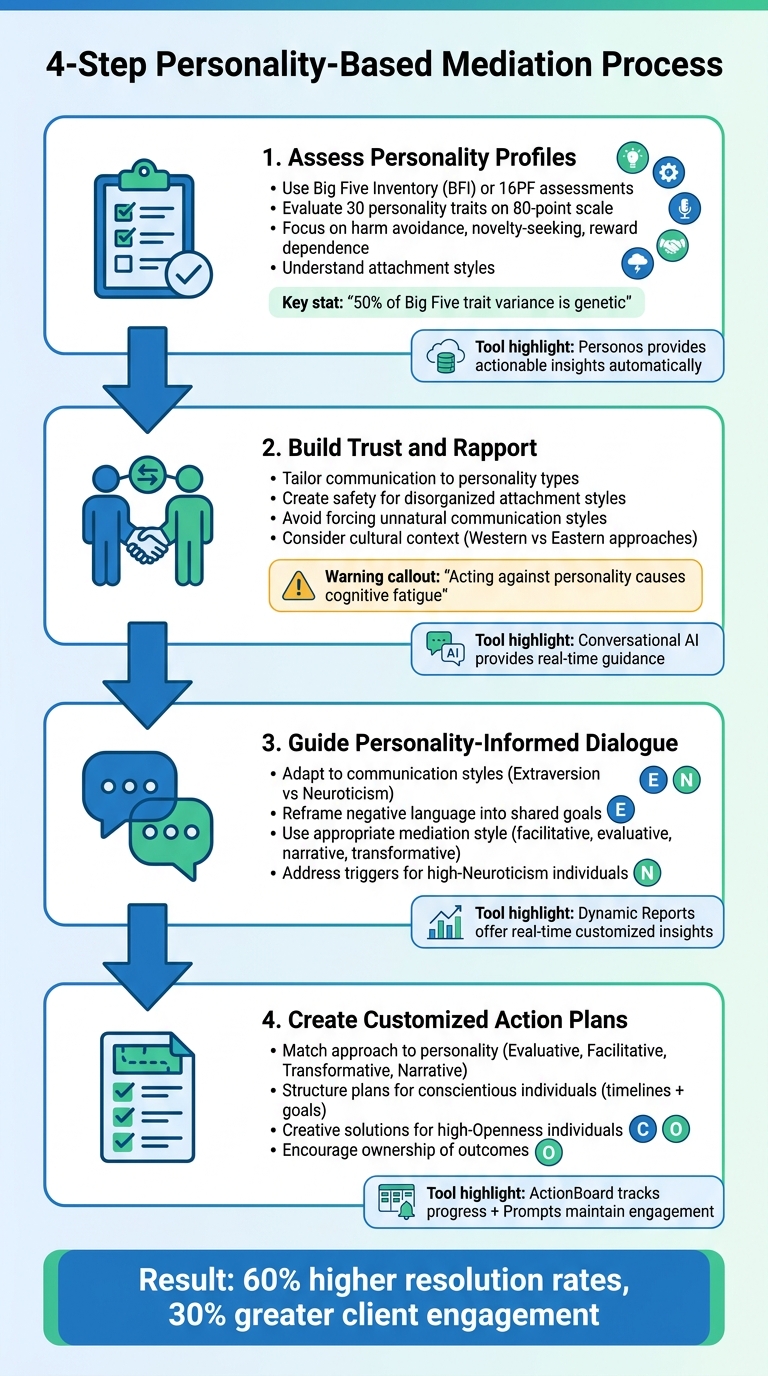
4-Step Personality-Based Mediation Process Guide
Step 1: Assess Personality Profiles
Start by evaluating each party's personality using tools like the Big Five Inventory (BFI) or 16PF. These assessments provide insights into how individuals handle conflict, stress, and decision-making. Focus on traits such as harm avoidance, novelty-seeking, and reward dependence. For example, someone with high harm avoidance might misinterpret neutral comments as threats. Additionally, understanding attachment styles can help predict trust levels and emotional reactions.
A useful tool for this step is Personos, which evaluates 30 personality traits on an 80-point scale. Unlike traditional methods that require manual interpretation, it provides actionable insights tailored to each person's profile, making it easier to prepare for mediation.
Interestingly, about 50% of the variance in Big Five traits is linked to genetics rather than environment. This consistency makes personality traits a dependable foundation for planning mediation strategies.
Step 2: Build Trust and Rapport
Once personality profiles are assessed, focus on building trust. Tailor your communication style to each personality type. For instance, individuals with disorganized attachment may need a sense of safety and stability before addressing deeper issues. Rushing into heavy topics with such individuals can lead to setbacks.
Avoid pressuring people into communication styles that clash with their natural tendencies. Research shows that acting against one's personality can lead to cognitive fatigue, making it harder to regulate emotions and make decisions. For example, introverts may struggle in high-energy discussions, while extroverts can become frustrated if they feel silenced.
Personos offers a conversational AI feature that provides real-time, personality-specific guidance for building trust, especially with resistant individuals. For high-conflict clients, it suggests strategies tailored to their unique traits, moving beyond generic conflict resolution approaches.
Cultural context also plays a role. In Western settings, encourage assertive individualism, while in Eastern contexts, focus on fostering group harmony. Adjust your approach to fit the cultural background of the parties involved.
Step 3: Guide Personality-Informed Dialogue
Once trust is established, use personality insights to guide the conversation. Adapt your approach to fit each person’s communication style. For example, someone high in Extraversion might dominate the discussion and feel drained if silenced, while someone high in Neuroticism may require extra care to avoid emotional triggers.
When tensions rise, reframe negative language into shared goals that both sides can work toward. This is particularly effective for highly agreeable individuals who value harmony but may shy away from addressing difficult topics. Instead of forcing uncomfortable conversations, help them approach these issues in a way that feels natural.
Incorporate techniques from facilitative, evaluative, narrative, or transformative mediation styles, depending on the needs of each personality. For instance, highly conscientious individuals might thrive in structured discussions with clear agendas, while those high in Openness may prefer creative, exploratory dialogues.
Personos enhances this process with Dynamic Reports, offering customized insights that help you adapt in real time and address potential blind spots in your mediation strategy.
Step 4: Create Customized Action Plans
Finally, translate these insights into tailored action plans. Align your mediation approach with each party’s personality. For example, use Evaluative mediation for those seeking fairness grounded in legal principles, Facilitative techniques for individuals who value autonomy, and Transformative or Narrative methods for parties focused on emotional healing or relationship repair.
For conscientious individuals, structure plans with clear timelines and measurable goals - they thrive on organization. Meanwhile, those high in Openness may respond better to creative, nontraditional solutions. Recognize that someone motivated by fairness might need a different approach than someone prioritizing relationship restoration.
Encourage parties to take ownership of their outcomes rather than imposing solutions. This strategy works particularly well for individuals with high self-efficacy, who believe in their ability to achieve desired results - a trait closely linked to extraversion and overall well-being.
Personos’ ActionBoard feature helps track progress on these plans while monitoring both client and mediator development. Its Prompts provide small, actionable steps to keep parties engaged between sessions, reducing the risk of falling back into old conflict patterns.
How Personos Supports Personality-Based Mediation
Key Features of Personos for Mediation
Personos offers four standout features designed specifically to support personality-based mediation. Conversational AI provides real-time, tailored guidance during difficult interactions. When mediators face resistant clients or crisis situations, the tool delivers advice that takes into account individual traits, relationship history, and the dynamics of the situation. This goes beyond standard conflict resolution tools by focusing on the unique personalities involved.
Dynamic Reports are another critical component, offering insights tailored to individuals, relationships, and groups. In mediation, relationship reports are especially helpful. They identify potential areas of conflict, recommend communication strategies suited to each personality, and flag blind spots that could slow progress. As the mediation process unfolds, these reports update in real time, ensuring mediators always have the most relevant information at hand.
Prompts extend the benefits beyond in-person sessions. Professionals can schedule small, actionable nudges to keep clients engaged with their plans. For example, a highly conscientious client might receive reminders about sticking to a structured timeline, while someone with high Openness could get suggestions to encourage creative problem-solving. The ActionBoard complements this by turning insights into measurable tasks, allowing mediators to track progress easily.
Comparing Personos to Other Tools
Personos sets itself apart from traditional tools and basic AI platforms with its unique features and scientific depth. Most personality assessment tools used in mediation fall into two categories: traditional typing systems like MBTI or DISC and basic AI tools that lack personality integration. Personos, however, is built on the Five Factor Model, backed by over 50 years of research across more than 90 countries [3]. Instead of broad categories, it measures 30 specific traits on an 80-point scale, providing a level of detail that’s critical for effective mediation. For instance, knowing a client scores 67 on harm avoidance is far more actionable than assigning them a generic label.
| Feature | Personos | Traditional Typing Tools (MBTI, DISC) | Basic AI Platforms |
|---|---|---|---|
| Personality Model | 30-facet Five Factor Model | 4–16 broad types or colors | No personality integration |
| Scientific Foundation | Supported by extensive research | Limited validation | N/A |
| Context Integration | Dynamic tagging for relationships/groups | Static descriptions | Manual input per session |
| Real-Time Guidance | AI chat with personality and situational awareness | None | Generic advice without personality data |
| Privacy Protection | Shares actionable insights only | Often displays full results | Varies |
| Task Management | Integrated ActionBoard | Requires separate apps | Requires separate apps |
One standout feature is the "Scientific Explanation" provided with every recommendation. This feature explains which personality traits, situational factors, and psychological principles informed the advice. It not only builds trust but also helps mediators deepen their understanding of the guidance, making it a learning tool as well as a practical one.
How Helping Professionals Use Personos
The features of Personos empower professionals to turn theoretical mediation strategies into real-world solutions. For example, case managers can use Conversational AI to identify resistance patterns and receive tailored strategies for de-escalation. The platform’s ability to recall past interactions and boundaries ensures consistent and relevant guidance as conflicts evolve.
Social workers handling large caseloads can benefit from Dynamic Reports, which streamline the process of generating insights for multiple clients. For instance, when working with a client who has disorganized attachment, the reports can highlight the need for stability before diving into deeper issues, avoiding the common pitfall of addressing heavy topics prematurely.
Counselors can use scheduled Prompts to provide emotion-regulation reminders, helping clients stay on track. The ActionBoard tracks whether these small steps are completed, offering clear documentation of progress. This feature is particularly useful when reporting outcomes to funders or stakeholders. Additionally, professionals can sponsor client access for just $9.00 per month, ensuring financial barriers don’t prevent participation in a personality-informed mediation process.
Conclusion: From Conflict to Collaboration
Turning conflict into collaboration requires a thoughtful approach, and the strategies outlined here can help pave the way.
Key Takeaways for Helping Professionals
Personality-based mediation, rooted in the Five Factor Model, offers a tailored approach that significantly improves conflict resolution. By adapting your mediation style to align with specific personality traits, you can achieve up to 60% higher resolution rates and 30% greater client engagement compared to generic methods[4][5]. For instance, clients with high neuroticism benefit from empathetic pacing, while those with low agreeableness respond better to structured conversations with clear boundaries.
Technology plays a vital role in enhancing your efficiency. Tools like Personos provide real-time, personality-driven guidance during critical moments and help maintain client engagement between sessions with scheduled prompts. Professionals using these tools report reduced burnout - an essential benefit for those managing heavy caseloads of 50+ clients[4]. Shifting from blame-focused discussions to future-oriented solutions not only resolves conflicts but also fosters collaboration through actionable plans.
These strategies offer a practical foundation for integrating personality-based methods into your professional practice.
Next Steps for Implementation
To put these insights into action, start with small, focused steps that can make a big difference.
Take advantage of a free Five Factor Model assessment available through Personos (personos.ai) to profile your next mediation case. This tool provides immediate access to conversational AI, offering tailored scripts based on your client’s personality traits and the specific context of the conflict. By identifying and mirroring one key personality trait, you can build trust more quickly - professionals report 20% faster trust-building during initial sessions using this approach.
Create a customized action plan with the help of Dynamic Reports, which give you a clear understanding of practitioner-client dynamics before your session. Afterward, use the ActionBoard to track progress and schedule a follow-up prompt seven days later to maintain momentum. For just $9.00 per seat monthly, you can sponsor client access, ensuring financial limitations don’t hinder the use of personality-informed care. The results - shorter resolution times, fewer repeat conflicts, and measurable progress - showcase the value of this approach to funders and stakeholders, while delivering lasting benefits to your clients.
FAQs
How do I use OCEAN traits in a mediation session?
When applying OCEAN traits (Openness, Conscientiousness, Extraversion, Agreeableness, and Neuroticism) in mediation, pay close attention to both verbal and non-verbal signals. These cues can reveal someone's personality traits, helping you fine-tune your approach. For instance:
- High Agreeableness: Use empathetic listening to build rapport and foster a sense of understanding.
- High Openness: Focus on brainstorming creative solutions that align with their openness to new ideas.
Tools like Personos can be incredibly helpful in this process. They analyze these subtle cues and offer real-time strategies, making it easier to build trust, minimize conflict, and adjust your techniques to suit each individual's personality profile. This personalized approach can significantly enhance the effectiveness of mediation.
What if someone refuses a personality assessment?
If someone declines a personality assessment, it’s essential to honor their choice. While these assessments can offer helpful insights, there are plenty of other ways to build trust. For example, focusing on active listening and paying attention to their behavior can reveal a lot about their preferences and communication style.
Tools like Personos can also be a game-changer. By analyzing observable traits in real-time, platforms like this provide guidance to improve communication and resolve conflicts - no formal assessments needed. This method not only respects individual autonomy but also encourages better understanding and teamwork.
How do I protect client privacy using Personos?
To safeguard client privacy while using Personos, it's crucial to stick to strong data security and confidentiality practices. Start by ensuring compliance with privacy regulations, such as HIPAA, to protect sensitive information. Limit access to the platform strictly to authorized personnel, and whenever feasible, anonymize client data to reduce risks.
Leverage Personos’ secure tools thoughtfully, including features like real-time guidance and dynamic reports, to uphold confidentiality standards. For more detailed information, refer to Personos’ privacy policy or consult your organization’s specific data security guidelines.