Ultimate Guide to Emotional Regulation for Leaders
Leaders who master emotional regulation use science-backed techniques and simple daily habits to stay calm, make better decisions, and lift team performance.
Rachel Johnson

Ultimate Guide to Emotional Regulation for Leaders
Emotional regulation is a must-have skill for leaders. It’s about managing your emotions effectively - whether calming anxiety, boosting motivation, or staying composed under pressure. Why does it matter? Your emotional state directly influences your team’s morale and productivity. Leaders who regulate their emotions make better decisions, build trust, and avoid burnout.
Here’s what you need to know:
- What It Is: Emotional regulation involves controlling which emotions you feel, when, and how you express them. Techniques like reframing challenges or taking mindful pauses can help.
- Why It’s Key for Leaders: Your emotions are contagious. A calm, balanced leader inspires confidence, while impulsive reactions can lower team performance.
- How to Improve: Tools like Personos offer personalized insights into emotional patterns, helping you track triggers and practice smarter responses.
- Science-Backed Techniques: Methods like cognitive reappraisal (reframing situations) and mindfulness training strengthen your brain’s ability to handle stress.
- Practical Tips: Use strategies like labeling emotions, deep breathing, or shifting focus to stay centered during tough moments.
Emotional Regulation For Leaders: Staying Calm Under Pressure
The Science Behind Emotional Regulation for Leaders
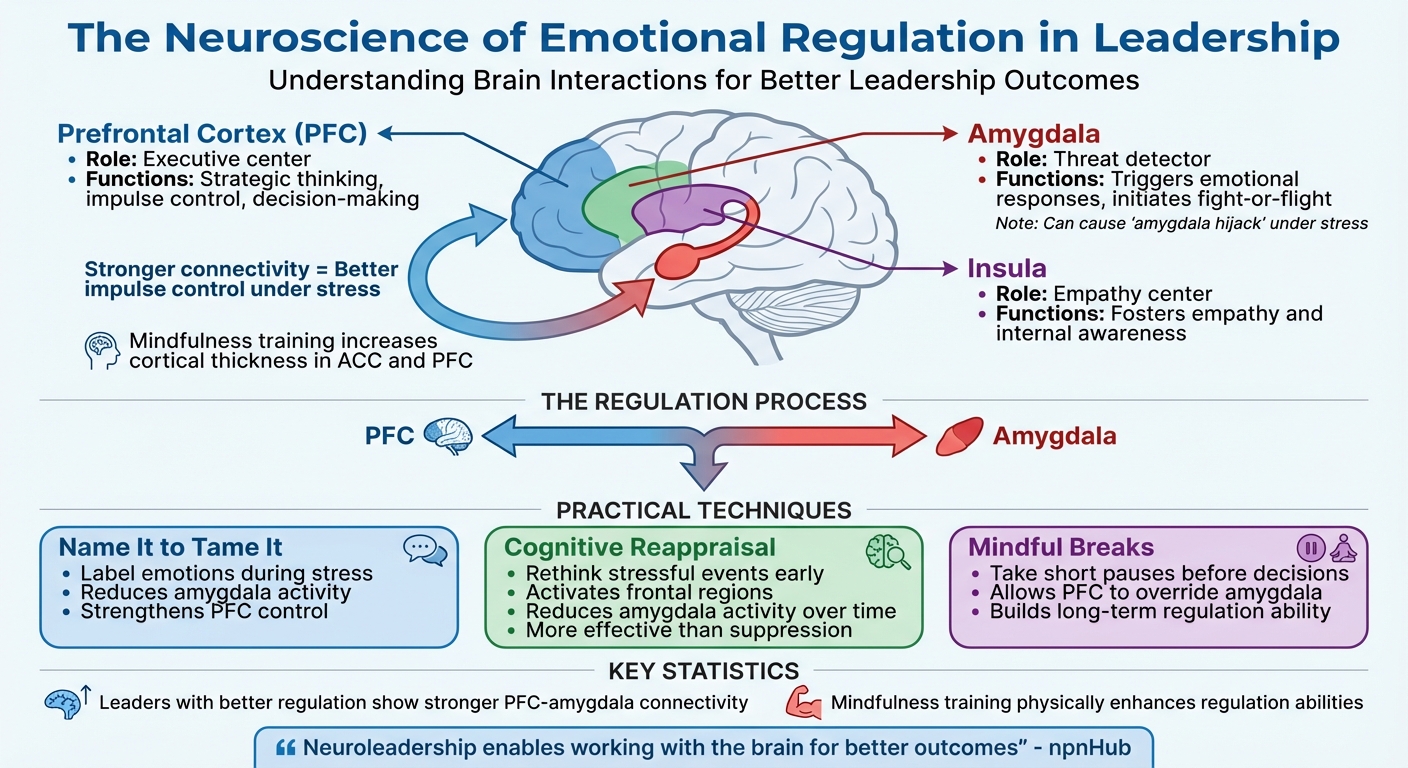
Brain Regions and Emotional Regulation Process for Leaders
Understanding the brain's role in emotional regulation gives leaders insight into their reactions and offers strategies to change those patterns. During high-pressure moments, several brain regions work together to shape your response. Let’s explore what’s happening inside your brain during those critical leadership situations and the mechanisms that explain these processes.
The Neuroscience of Emotional Regulation in Leadership
Certain brain regions are key players in managing emotions. The prefrontal cortex (PFC) acts as the brain’s executive center, responsible for strategic thinking, impulse control, and complex decision-making. On the other hand, the amygdala detects threats and triggers emotional responses, often initiating the fight-or-flight reaction [6]. When stress takes over, the amygdala can overwhelm rational thought in what’s known as an "amygdala hijack" [6].
"Neuroleadership enables working with the brain for better outcomes." - npnHub [6]
Other regions also contribute to emotional regulation. The anterior cingulate cortex (ACC) helps you identify mistakes and adapt to changes, while the insula fosters empathy and internal awareness - both critical for understanding team dynamics [6][7]. Research highlights that leaders with better emotional regulation show stronger connectivity between the PFC and amygdala, which enhances impulse control under stress [6]. Here’s the exciting part: mindfulness training can physically enhance regulation abilities by increasing cortical thickness in the ACC and PFC [6].
Simple techniques like "naming it to tame it" (labeling your emotions during stressful moments) and taking short mindful breaks before big decisions can help reduce amygdala activity and strengthen PFC control [6].
Core Emotional Regulation Models
Psychologist James Gross introduced the Process Model of Emotion Regulation, which explains how emotions arise from four factors: the situation itself, where we focus our attention, how we interpret the situation, and how we respond [2]. Leaders can regulate emotions either before they fully take hold (pre-activation strategies) or after they’ve started to emerge (response-focused strategies) [2].
One of the most effective pre-activation strategies is cognitive reappraisal - rethinking the meaning of a stressful event to change its emotional impact. By shifting your perspective early, you can prevent negative reactions. Neuroimaging studies reveal that reappraisal activates the frontal regions of the brain, which then reduce activity in the amygdala and insula over time [8]. On the flip side, suppression (concealing emotions after they’ve surfaced) is less effective and drains cognitive resources, which can hurt task performance [2].
"Reappraisal (which has its primary impact relatively early in the emotion-generative process) should differ importantly from other forms of emotion regulation such as expressive suppression (which has its primary impact relatively late)." - Kevin N. Ochsner and James J. Gross [8]
Cognitive reappraisal has been linked to better memory and stronger social skills, while suppression tends to negatively impact leadership performance [2]. Leaders should focus on deep acting - genuinely reframing challenges - rather than merely masking emotions, as masking is both less effective and more mentally taxing [2]. These models provide a foundation for understanding how personality traits influence emotional regulation.
How Personality Affects Emotional Regulation
Personality traits play a significant role in how leaders apply emotional regulation strategies. For instance, leaders high in Agreeableness are more likely to regulate emotions automatically, particularly in managing interpersonal conflicts [9]. Meanwhile, leaders prone to rumination - often linked to higher levels of neuroticism - show greater amygdala activity during reappraisal tasks, meaning their brains must work harder to manage negative emotions [8].
Although personality traits affect emotional regulation, the strategies you choose have a stronger influence on leadership success [2]. Tools like Personos can help by assessing individual personality patterns and emotional triggers, allowing leaders to craft personalized strategies that align with their natural tendencies.
"Repeated patterns become default patterns. Leaders can rewire their brains for better leadership outcomes, but only through intentional, sustained practice." - Kim Goodwin, Change Management Consultant [6]
The good news is that leadership is a skill rooted in the brain, and neuroplasticity means it’s never too late to improve. By practicing self-regulation and developing new perspectives, leaders can strengthen the neural pathways needed for resilience and effective decision-making [6].
Emotional Regulation Techniques for Leaders
Understanding emotional regulation is one thing, but applying it effectively in leadership requires practical strategies. Let’s explore how you can turn theory into actionable habits to navigate emotions - both yours and your team’s - more effectively.
In-the-Moment Regulation Skills
When stress levels spike, taking a moment to pause can make all the difference. This gives your prefrontal cortex - the part of your brain responsible for logical thinking - a chance to step in and override the impulsive reactions of your amygdala. One effective method is "name it to tame it": simply labeling your emotion, whether it’s frustration, anxiety, or anger, can help you engage your rational mind and reduce emotional intensity.
Another powerful tool is cognitive reappraisal. This involves reframing a situation to see it from a different perspective. For example, instead of viewing a failed product launch as a disaster, consider it as valuable feedback that can guide your next steps. This mindset shift not only helps you stay composed but also improves memory and social interactions. While distractions can temporarily calm intense emotions, reappraisal offers more enduring benefits.
Physical techniques are equally important. Deep, slow breathing activates your parasympathetic nervous system, which helps counteract the body’s stress response. Pay attention to physical cues like a racing heart or clenched jaw; when you notice them, step away briefly to reset.
Redirecting your focus, known as attentional deployment, is another effective strategy. If emotions run high during a meeting, shift your attention to objective details, like data or facts. Modifying the situation itself can also help - using humor to lighten a tense moment or changing the subject in a difficult conversation can lead to better outcomes.
Here’s a quick breakdown of some key strategies:
| Strategy | Type | Action | Outcome |
|---|---|---|---|
| Cognitive Reappraisal | Antecedent-focused | Shift perspective or meaning | Promotes positive emotions and better social interactions |
| Attentional Deployment | Antecedent-focused | Redirect focus or use distraction | Helps manage stress effectively |
| Situation Modification | Antecedent-focused | Adjust external circumstances | Improves leadership performance |
| Suppression | Response-focused | Inhibit outward emotions | Can harm memory and social connections |
While these techniques are great for immediate challenges, building long-term emotional resilience requires consistent daily practices.
Proactive Emotional Regulation Practices
Responding well in the moment is crucial, but proactive habits are what truly strengthen emotional resilience over time. Thanks to neuroplasticity, your brain can actually rewire itself with regular practice, improving the connection between your prefrontal cortex and amygdala. The goal here is to make emotional regulation a routine part of your day - not just a tool for emergencies.
Start your mornings with 5 to 10 minutes of mindfulness to set the tone for the day. Research shows mindfulness practices can significantly reduce stress (effect size 0.51), anxiety (0.49), and even improve overall quality of life (0.39) [12]. Between meetings, take short micro-breaks - just one or two minutes can help you recalibrate emotionally. A simple framework like the STOP technique - Stop, Take a breath, Observe your thoughts and feelings, and Proceed with intention - can work wonders.
Tracking your emotional patterns is another effective way to build self-awareness. Keep a journal or use body scanning techniques to identify triggers and typical responses. For example, an emotional awareness chart can help you document specific scenarios, your reactions, and the outcomes. At the end of the day, take a moment to reflect on your emotional wins and consider adjustments for areas where you struggled.
Interestingly, while 95% of people believe they are self-aware, studies suggest only 10% to 15% actually are [14]. This makes tools like 360-degree feedback incredibly valuable. It bridges the gap between how you see yourself and how others perceive you. Emotional intelligence is increasingly valued in the workplace - 71% of employers now prioritize it over IQ when evaluating candidates [13].
Lastly, don’t overlook the basics. Hunger, fatigue, and chronic stress can all drain your emotional reserves. Addressing these needs allows you to make better decisions, coach effectively, and engage more meaningfully with others.
Using Social and Relational Regulation
Individual techniques are essential, but emotional regulation doesn’t happen in a vacuum. Social regulation - how you manage emotions within your team - plays a huge role in creating a positive work environment. As Sigal Barsade from the Wharton School explains:
"People are not isolated 'emotional islands.' Rather, they bring all of themselves to work, including their traits, moods, and emotions, and their affective experiences and expressions influence others."
This concept of emotional contagion means your team often mirrors your emotional state. As a leader, maintaining a balanced emotional climate is key to fostering psychological safety.
Social regulation typically follows a four-step process: first, identify the emotional state of the person or group; second, determine whether intervention is necessary; third, choose the right strategy; and finally, implement it. Research highlights four effective approaches: enhancing positive emotions, taking another person’s perspective, offering soothing support, and modeling appropriate emotional behavior.
For example, if you’re frustrated with a colleague, try the "Just Like Me" technique. Remind yourself that they, like you, are human and prone to mistakes. In moments of serious conflict, consider caucusing - separating the parties temporarily to cool off before resuming the discussion. Humor can also be a powerful tool for diffusing tension and resetting the emotional tone.
Clear communication of boundaries is another way to prevent emotional triggers. With people speaking an average of 16,000 words a day, there are countless opportunities for social regulation. Interestingly, research shows that people often provide more emotional support to others than they seek for themselves. As Crystal Reeck from Fox School of Business notes:
"Social regulation not only improves the current emotional state of the child [or target] but also enhances their capacity to self-regulate in the future."
Suppressing emotions, however, can backfire. Studies reveal that when one party suppresses feelings during an exchange, both individuals experience heightened blood pressure and negative emotions - damaging trust and hindering relationship-building. Authentic emotional regulation, on the other hand, fosters trust and helps align team goals effectively.
sbb-itb-f8fc6bf
Emotional Regulation in High-Stress Leadership Scenarios
Navigating high-stress situations requires leaders to master emotional regulation. These moments demand the application of self-regulation techniques with precision and urgency. Let’s explore how leaders can manage their emotions effectively in three challenging circumstances.
Leading During Crises
When a crisis hits - be it a financial setback, a PR fiasco, or a safety issue - your body’s natural fight-or-flight response kicks in. While this instinct is designed to protect you, it can cloud your judgment when clarity is critical. The goal in such moments is to transition from a reactive state to one of social engagement.
Take the example of Robert E. Quinn, Professor Emeritus at the University of Michigan, who worked with a CEO during a pivotal technology opportunity in January 2021. An intimidating investor had caused board members to withdraw support, creating immense pressure. Quinn applied a five-step self-regulation method: Understanding the biological stress response, Awareness of physical signs like a racing heart, Recalling past successes, Intention focused on a greater purpose, and Trust in the process through co-regulation. By admitting vulnerability, Quinn helped the CEO shift from fear to possibility. Within a month, the CEO reported renewed board commitment and a more optimistic organizational outlook [15].
During crises, pay attention to your body’s stress signals. Are you scanning for threats or clenching your jaw? These signs indicate you may be outside your "window of tolerance." Use cognitive reappraisal to reframe the situation - not as a catastrophe, but as an opportunity to learn or grow. As evolutionary biologist Theodosius Dobzhansky once said:
"The fittest may also be the gentlest because survival often requires mutual help and cooperation" [15].
While crisis management demands quick thinking, addressing interpersonal conflicts requires a more deliberate approach.
Handling Conflict and Difficult Conversations
High-stakes conversations can push you into hyperarousal (overreacting) or hypoarousal (shutting down), both of which hinder effective communication. The PAUSE method can help: Pause the discussion if emotions run high, Acknowledge everyone’s feelings, Understand differing perspectives, Suggest solutions, and Establish clear next steps.
If you find yourself attributing negative motives to others during a disagreement, try the "Just Like Me" technique. This practice fosters empathy by reminding you that others share similar struggles and emotions [5].
Physical signs like a pounding heart or tight jaw are cues to ground yourself. Focus on the sensation of your feet on the floor or take a deep breath to redirect your brain from the emotional spike. Suppressing emotions, however, can backfire. As Margaret Cullen, a Licensed Marriage and Family Therapist, explains:
"Suppression doesn't make the emotion go away, it just stays inside you causing more pain" [11].
Acknowledging your emotions while staying composed not only keeps conversations productive but also strengthens trust.
Managing Performance Under Chronic Stress
Chronic stress can sap your cognitive resources and impair decision-making. The answer isn’t to push harder but to disrupt the cycle of rumination that amplifies stress.
Incorporating small recovery routines throughout your day can make a big difference. Take micro-breaks - just 1–2 minutes between meetings - to reset emotionally and release tension. Try the "Name it to Tame it" technique: pause and label your emotions with precision. For example, saying "I feel disappointed" instead of "I feel upset" can help you better process your feelings. Research shows this practice reduces stress and lowers the risk of depression [1].
Cognitive reappraisal is another powerful tool. Reflecting on past successes can help you stay composed and confident. Studies reveal that this approach improves memory and task performance compared to suppressing emotions [2]. When setbacks arise, remind yourself of moments when you successfully navigated uncertainty. This can foster hope and keep you within your "window of tolerance" where effective leadership thrives. As Debra Roberts, an expert in interpersonal communication, puts it:
"Emotional regulation isn't just about staying calm, it's about staying effective" [3].
Building a Long-Term Emotional Regulation System
While quick techniques can help manage immediate stress, creating a long-term system is what truly builds emotional resilience. With consistent practice, you can strengthen your ability to handle challenges over time.
Creating Personalized Regulation Routines
At the heart of any lasting emotional regulation system is the ability to pause before reacting. Start by identifying your triggers - those situations or moments that tend to spark intense emotions. Pay attention to physical factors, like hunger or exhaustion, which can make emotions feel even stronger. For instance, if you often feel reactive when you're tired or haven't eaten, HALT (Hungry, Angry, Lonely, Tired) can be a useful mental check before responding [5][4].
Take short breaks during the day to prevent emotions from piling up. Simple techniques like "Name it to Tame it" can help you shift from emotional overwhelm to rational thinking [4]. At the end of your day, try reframing setbacks as opportunities to learn rather than failures. Temporal distancing - reminding yourself that tough moments are temporary - can also help you keep perspective [10][16].
Creating Work Environments That Support Regulation
As you develop personal routines, aligning your work environment with these practices can amplify their benefits. Emotional regulation doesn't happen in isolation - your ability to manage emotions can influence the overall mood of your team.
To support clear thinking under pressure, design a work culture that keeps everyone within their "window of tolerance" - that mental space where stress feels manageable [3]. Set communication norms that encourage empathy, like using the "just like me" technique during conflicts, which helps team members see each other as flawed but relatable humans [5]. Provide reset spaces where anyone can take a moment to calm down when emotions run high [10]. Small touches, like placing affirmations or calming mantras around the office, can also serve as grounding tools during stressful moments [4]. And don’t shy away from showing vulnerability - acknowledging your emotions instead of suppressing them can actually reduce the physical toll of negative feelings [16].
Using Personos for Long-Term Regulation Success
Consistency is key to building a sustainable emotional regulation system, and this is where Personos can make a difference. This AI-driven platform tracks your emotional patterns over time, offering insights tailored to your personality. By identifying triggers - whether they’re tied to memories, sensory inputs, or stressful events - Personos helps you take proactive steps toward regulation [4][5].
Daily AI check-ins alert you to early signs of stress [5]. The platform also provides personalized prompts to help reframe negative experiences. For example, if a colleague's behavior triggers you, Personos might guide you through a "just like me" reflection, reminding you that everyone is dealing with their own challenges [5]. By combining technology with personal practice, you can expand your "window of tolerance" over time, staying in a calm and clear-headed state rather than slipping into fight-or-flight mode [3]. At $9 per seat per month, Personos Pro offers an affordable way for leaders to integrate personalized emotional regulation into their daily routines.
Conclusion
Emotional regulation involves recognizing, naming, and responding thoughtfully to your emotions [1]. As executive coaches Chantal Laurie Below and Jo Ilfeld suggest, the key to effective regulation is working with your emotions, not against them. Research backs this up, showing that strategies like cognitive reappraisal are linked to better leadership performance, while suppression can impair memory and increase mental strain [2].
Your emotions don’t exist in a vacuum - they impact your entire team. Sigal Barsade, a Management Professor at the Wharton School, puts it perfectly:
"People are not isolated 'emotional islands.' Rather, they bring all of themselves to work, including their traits, moods, and emotions, and their affective experiences and expressions influence others" [4].
This connection between personal emotional regulation and team dynamics highlights the need for mindful, intentional leadership.
Staying within your "window of tolerance" allows you to process situations clearly and respond purposefully [3]. Achieving this balance involves practicing techniques in the moment, like "Name it to Tame it" and the STOP method, while also building long-term systems to reinforce these habits.
Tools like Personos can play a big role in this journey. By tracking emotional patterns, identifying triggers, and offering daily check-ins, Personos helps expand your emotional resilience. At $9 per seat per month, Personos Pro is an easy addition to your leadership toolkit. As interpersonal communications expert Debra Roberts explains:
"Emotional regulation isn't just about staying calm, it's about staying effective - and it's one of the most critical leadership skills you can develop" [3].
FAQs
What are effective ways for leaders to manage their emotions in high-pressure situations?
Leaders can maintain their composure under pressure by using straightforward techniques like the STOP method: Stop, Take a breath, Observe, Proceed. This simple process creates a moment to pause, interrupt stress, and respond thoughtfully rather than reacting impulsively. Pair this with deep breathing - a few slow, intentional inhales and exhales - to calm the body, making it easier to think clearly and engage with the situation effectively.
Paying attention to physical stress cues, such as a tight chest or a clenched jaw, can also help. By mentally identifying and labeling emotions, leaders can reduce their intensity, paving the way for a more measured and thoughtful reaction. During tough conversations, practicing active listening - repeating key points, summarizing, and asking clarifying questions - can build understanding, ease tension, and buy a little extra time to stay grounded.
For an extra layer of support, tools like Personos provide real-time, AI-driven insights tailored to personality dynamics. These prompts can guide tone, phrasing, and timing, helping leaders handle difficult moments with confidence while fostering trust within their teams.
How does a leader's personality influence their ability to manage emotions effectively?
A leader's personality significantly influences how they identify, select, and implement strategies for managing emotions. Traits like emotional stability (low neuroticism) and conscientiousness often enable leaders to recognize when emotions need attention and apply effective techniques, such as reframing perspectives. On the flip side, individuals with high neuroticism may rely on less productive methods, like suppressing emotions, which can ultimately hinder performance.
By gaining insight into their personality traits, leaders can tailor their emotional regulation strategies to align with their natural strengths. Tools such as AI-driven coaching platforms offer real-time, customized guidance, helping leaders develop constructive habits like pausing before responding or viewing challenges from a different angle. This tailored approach not only helps leaders maintain composure under pressure but also enhances communication, builds psychological safety, and drives team success.
How can Personos help leaders develop better emotional regulation skills?
Personos equips leaders with tools to fine-tune their emotional regulation by delivering real-time, practical insights tailored to their communication style and emotional patterns. By leveraging advanced AI and principles of personality psychology, the platform evaluates elements like tone, pacing, and potential emotional triggers in both written and spoken interactions. It then provides instant prompts, guiding leaders to adjust their reactions, reshape their messaging, or manage emotions effectively in the moment.
As leaders continue using the platform, Personos develops a detailed profile of their emotional habits, pinpointing recurring stressors or situations that often lead to conflict. Based on these insights, it offers tailored strategies, such as mindfulness techniques or role-playing exercises, to help leaders practice and enhance their emotional management skills. This ongoing feedback helps leaders maintain composure during high-pressure situations, build stronger team relationships, and advance their emotional intelligence in ways they can track and measure.