Trust-Building Tips for Resistant Clients
Strategies to build trust with resistant clients: reframe resistance, pair empathy with honesty, set small goals, and tailor communication.
Nick Blasi

Trust-Building Tips for Resistant Clients
Resistant clients can be challenging, but their behavior often stems from past trauma, fear of change, or self-protection. Managing these high-stress interactions is a key part of learning how to reduce burnout for helping professionals. Instead of viewing resistance as defiance, it’s more productive to see it as a survival mechanism. Building trust with such clients requires patience, empathy, and clear communication. Here’s a quick breakdown of strategies:
- Understand Resistance: It can show up as minimal engagement, trivial conversation, charm as a distraction, or missed appointments.
- Reframe Resistance: View it as a form of self-protection rather than opposition.
- Nonjudgmental Presence: Accept clients as they are, stay authentic, and pay attention to nonverbal cues.
- Empathy + Honesty: Balance understanding with transparency to help clients feel in control.
- Collaborative Goals: Let clients guide the session and celebrate small progress steps.
- Personality Insights: Use tools like the Five Factor Model to tailor your communication style to the client’s traits.
Working With Resistant Clients: 5 More Tried and Tested Techniques
These strategies often rely on understanding a client's unique disposition, much like how personality insights in counseling can help tailor interventions to individual needs.
Core Principles of Trust Building
Building trust with resistant clients revolves around three key ideas: maintaining a nonjudgmental presence, reframing resistance as self-protection, and balancing empathy with honesty. These principles help you adapt your approach by leveraging personality psychology in client relationships, as tools like Personos suggest.
Stay Present Without Judgment
When working with hesitant clients, unconditional positive regard is non-negotiable. This means accepting clients as they are, even if you don't agree with all their choices [2]. Studies confirm that valuing clients without becoming overly attached increases the likelihood of success [2].
Pay attention to nonverbal cues, as they often reveal more than words. Counselor Bri-Ann Richter-Abitol explains her strategy:
"If I notice that a client is really anxious, I use immediacy and point out that it is scary to be here, and I applaud them for coming in" [3].
Michael Tursi, Assistant Professor at Pace University, emphasizes the ongoing need for self-awareness:
"As counselors, we have to be aware of situations in which we have difficulty providing positive regard and continue professional development to improve our abilities to provide nonjudgmental acceptance at times that it is difficult" [3].
Your authenticity plays a big role, too. Carl Rogers referred to this as congruence - aligning your internal feelings with what you express outwardly [2]. If clients sense you're hiding behind a professional mask, it can quickly erode trust.
Once you've established a nonjudgmental presence, the next step is to view resistance in a new light.
Reframe Resistance as Protection
Resistance isn't defiance - it's a protective mechanism. Many clients approach counseling cautiously, unsure if they can trust the process [3].
As Bri-Ann Richter-Abitol explains:
"Their fear or discomfort can come off as resistance or presenting a vibe that 'I don't want to be here.' … They just don't know how to feel about this space yet, and you need to give them time to figure that out" [3].
This perspective shift changes how you interpret their actions. A missed session, a one-word answer, or even humor used as deflection isn't necessarily a refusal to engage; it's often a way of testing the waters. Some clients may even push boundaries intentionally to see how you'll react [3].
Counselor Megan Craig highlights the importance of looking deeper:
"Just because your perception as a clinician is that a person is not trying doesn't mean that they're not trying. They might not be doing the homework you assign, but they're showing up every week. And that may be all that they can do right now" [3].
In 2020, nearly 1 in 5 American adults experienced mental illness, yet less than half sought treatment [3]. For those who do, resistance often stems from past trauma, societal barriers, or stigma around therapy. Understanding these factors fosters patience when progress feels slow.
By reframing resistance as protection, you pave the way for genuine empathy and honesty.
Show Empathy and Honesty
Empathy means understanding a client's emotions without judgment [2]. But empathy alone isn't enough - it must be paired with honesty. Transparent communication allows clients to feel in control, reducing pressure and encouraging them to advocate for their needs [3].
Adjust your pacing based on the client. Some may start with surface-level issues, like work stress, before diving into deeper concerns. This process isn't wasted time; it's part of building trust [3].
Recognize the courage it takes for clients to show up, even when therapy feels daunting. As psychoanalyst Deborah Anna Luepnitz puts it:
"Everyone who seeks therapy brings 'a desire for and a resistance to change–a yes and a no'" [4].
Your role is to honor both sides of that experience. Together, these principles form a solid foundation for creating meaningful connections with clients.
Practical Steps for Building Rapport
Building rapport starts with trust and empathy. From there, it’s about creating an environment where clients feel genuinely heard, respected, and in control of their journey.
Begin With Common Ground
Start conversations with neutral topics like daily routines, hobbies, or work-related stress. These can act as bridges to establish rapport. For younger clients, therapeutic games or activities can help break the ice, while adults may open up through discussions about their personal interests [3].
It’s also important to acknowledge the courage it takes for clients to show up. If you notice signs of anxiety - like shaky hands, avoidance, or prolonged silence - address these observations in a clear, nonjudgmental way. Recognizing these feelings can help clients feel seen and understood.
Pay close attention to cultural sensitivity when building this connection. Pronounce names correctly and understand that what may appear as reluctance could actually stem from "cultural resiliency", a survival strategy rather than defiance [3].
Create Goals Together
Empower clients by letting them set the agenda. Assure them they control the direction of the session and won’t be pressured to talk about anything they’re not ready to share. This transparency can ease the fear of the unknown, which often fuels defensiveness [3].
Focus on small wins instead of expecting immediate progress. As Megan Craig explains:
"Just because your perception as a clinician is that a person is not trying doesn't mean that they're not trying. They might not be doing the homework you assign, but they're showing up every week. And that may be all that they can do right now" [3].
Acknowledging these small steps helps build momentum over time.
Regular check-ins are key to keeping the process collaborative. Ask questions like, "Do you feel comfortable with me taking the lead, or do you prefer to guide the session?" or "What do you need more of? And less of?" These conversations help align goals with the client’s priorities [3]. Tools like Personos can provide insights into a client’s communication style, ensuring sessions remain client-focused.
Once goals are clear and mutual, the next step is to approach defensiveness with care.
Address Defensiveness Carefully
Defensiveness often requires patience and a slower pace. Some clients may need months - or even longer - of discussing neutral topics before they feel safe enough to share deeper issues [3].
When discomfort arises, try direct broaching by sharing your observations without judgment. For example, you might say, "Here’s what I’m noticing. Let me know if I’m right or wrong" [3]. This approach keeps the client in control and invites them to clarify or confirm your perception.
Remember, defensive behaviors like silence, one-word answers, or humor used as a shield aren’t obstacles - they’re clues. As Cory Newman from the University of Pennsylvania puts it, resistance "is not simply an impediment to treatment, but also a potentially rich source of information about each client" [1]. These behaviors can reveal fears or patterns rooted in past experiences.
If a client tests you with provocative remarks, respond with neutrality and acceptance. Often, these remarks are a way for clients to gauge whether they’ll be judged. Staying neutral reassures them and lays the groundwork for deeper, more meaningful work [3].
Using Personality Insights in Communication
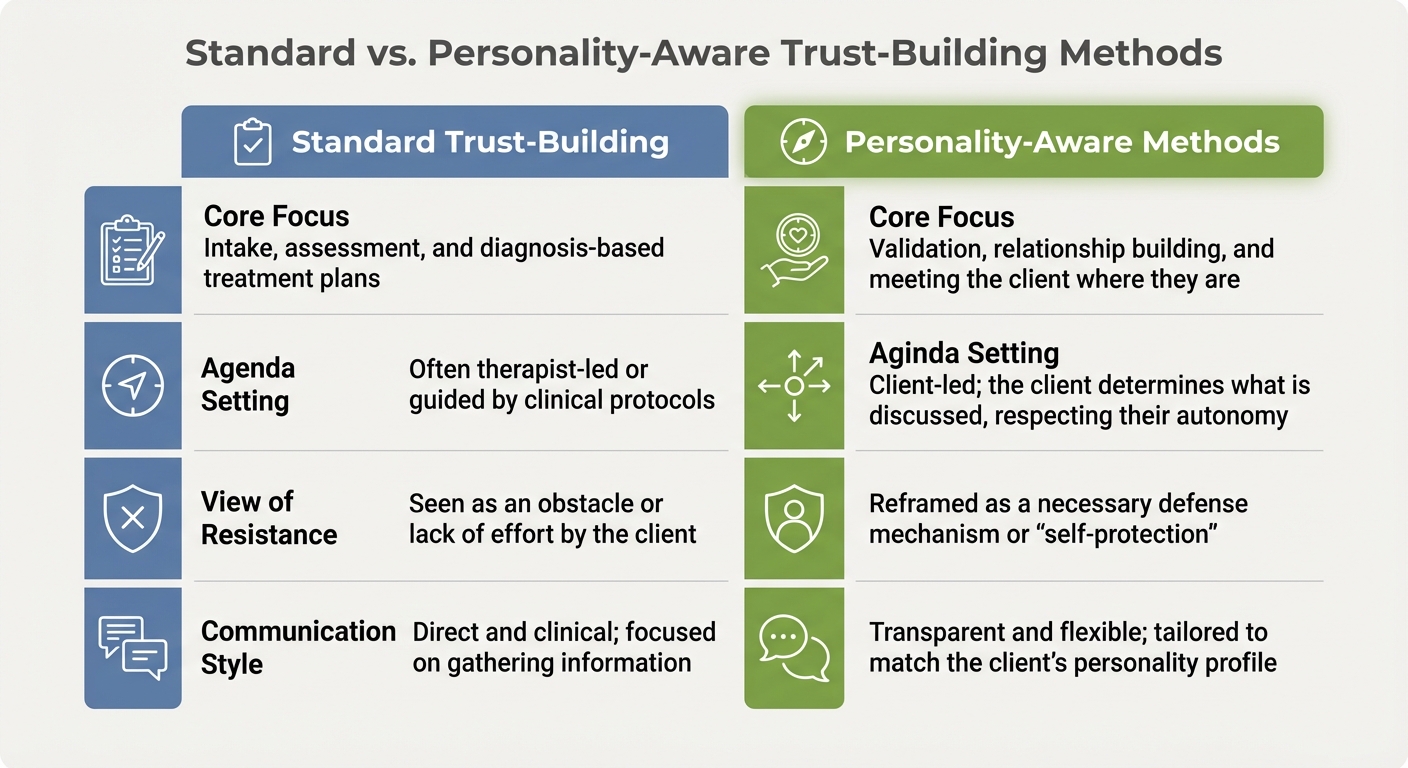
Standard vs Personality-Aware Trust-Building Methods for Resistant Clients
Apply Personality Traits to Communication
Understanding a client’s personality traits can be a game changer when it comes to building trust. The Five Factor Model provides a detailed framework by measuring 30 personality traits on an 80-point scale, offering insights into how people think, feel, and handle stress.
Take clients with high Neuroticism, for example. These individuals often experience intense anxiety that can manifest physically - like trembling hands, avoiding eye contact, or rigid posture. For them, directly acknowledging their fear is crucial. As Michael Tursi, assistant professor and LMHC, puts it:
"It's one thing to say, 'the therapeutic relationship is essential,' but there are some clients who really might not be willing to engage at all until they see certain things, especially nonjudgment, in their counselor" [3].
These clients often struggle with experiential avoidance, meaning they resist confronting uncomfortable emotions or thoughts. Recognizing this helps you approach their guarded behavior with more precision and care.
On the other hand, clients who score low in Agreeableness or have strong autonomy needs may resist any sense of control being imposed on them. They’re more likely to engage when they feel empowered to set the session’s agenda and assured that they won’t be pushed into discussing topics they’re not ready for [3][4]. Fred J. Hanna, a professor who studies resistance, explains:
"It is wise to reframe difficulty and resistance as a form of self-protection rather than subtly or not so subtly implying that such clients are being stubborn or misguided" [4].
In fact, research reveals that every participant in a study on experiential avoidance identified a "fear of judgment" as their main barrier to engaging with counselors [3]. By understanding these personality-driven tendencies, you can fine-tune your communication style to create a safe and welcoming environment. These insights allow you to move beyond a one-size-fits-all approach to a more tailored, flexible way of working with clients.
Standard vs. Personality-Aware Methods
The difference between traditional approaches and personality-aware methods lies in the level of customization. Conventional practices often stick to rigid protocols like intake forms, structured assessments, and diagnosis-driven treatment plans. Personality-aware methods, however, focus on building relationships and adapting to the client’s individual traits.
| Feature | Standard Trust-Building | Personality-Aware Methods |
|---|---|---|
| Core Focus | Intake, assessment, and diagnosis-based treatment plans [3] | Validation, relationship building, and meeting the client where they are [3] |
| Agenda Setting | Often therapist-led or guided by clinical protocols [3] | Client-led; the client determines what is discussed, respecting their autonomy [3][4] |
| View of Resistance | Seen as an obstacle or lack of effort by the client [3] | Reframed as a necessary defense mechanism or "self-protection" [4] |
| Communication Style | Direct and clinical; focused on gathering information [3] | Transparent and flexible; tailored to match the client’s personality profile [3] |
Tools like Personos make it easier to apply these insights in real-time. Based on the Five Factor Model, Personos offers practical strategies for navigating difficult interactions. For example, if you’re working with a resistant client, the platform’s conversational AI can suggest whether they need more autonomy, slower pacing, or a direct acknowledgment of their anxiety. Its Dynamic Reports feature provides detailed relationship insights, pointing out potential friction points and offering strategies to address them - both for you and your client.
For professionals juggling heavy caseloads, tools like this can reduce burnout while improving outcomes. Instead of relying on guesswork, you’ll have evidence-based recommendations tailored to each client. Features like the ActionBoard also help you track progress and document small victories - such as a client consistently attending sessions - which are increasingly important to funders and stakeholders as proof of success. By incorporating personality insights into your approach, you can build trust even with the most hesitant clients.
Methods for Maintaining Trust Over Time
Sustaining trust goes beyond initial tailored communication. It requires consistent awareness, tracking progress effectively, and understanding the cultural contexts that influence client relationships.
Introduce Mindfulness and Relaxation
When clients display signs of anxiety - like avoiding eye contact or fidgeting - it’s crucial to address it right away. Bri-Ann Richter-Abitol, a licensed mental health counselor, explains her approach:
"If I notice that a client is really anxious, I use immediacy and point out that it is scary to be here, and I applaud them for coming in" [3].
Acknowledging their emotions helps validate their experience and shows appreciation for their effort to seek help.
Relaxation strategies aren’t limited to teaching deep breathing techniques. Sometimes, it’s about adjusting the pace of sessions. For clients with trauma or broken trust, it may take time before they feel ready to discuss deeper issues. Starting with lighter topics, like hobbies or work, can help build comfort and trust gradually.
Your own emotional state plays a big role too. Staying calm and ending sessions on a positive, reassuring note can make a lasting impression. Camila Pulgar, a licensed clinical mental health counselor associate, emphasizes this:
"Take a couple of deep breaths and think about ways that the door stays open. … If clients get a good sense of counseling just with that interaction with you, maybe in a year or five years, they will come back" [3].
By regulating your emotions, you create an environment where clients feel safe to return, even if it’s years later.
Track Progress With Action Tools
Trust grows when progress is recognized, even if it doesn’t follow traditional markers of success. Tools like the Personos ActionBoard make it easier to document small wins and turn insights into actionable steps. For example, you can track strategies like addressing anxiety promptly or easing into heavier topics over time. These tools integrate personality-based recommendations from the Five Factor Model, ensuring your approach evolves alongside the client’s changing needs.
Personos Prompts also provide timely, personality-aware nudges between sessions, offering consistent support that reinforces trust and keeps clients engaged.
Develop Cultural Competence
Another key to maintaining trust is understanding the cultural factors that may influence a client’s hesitancy. Some clients may struggle to engage not because of their personality, but due to cultural stigmas around mental health or negative past experiences with medical systems. Expanding your knowledge of these issues allows you to adapt your approach and meet clients where they are.
Regularly checking in with clients can also strengthen trust. Asking what’s working, what they’d like more or less of, and how they feel about your partnership shows a willingness to evolve alongside their needs.
The National Alliance on Mental Illness reports that roughly 20% of American adults experienced mental illness in 2020, yet less than half sought treatment [3]. By pursuing specialized training and staying open to feedback, you can create a client-centered approach that prioritizes their experience and builds a foundation for long-term trust.
Conclusion
Building trust with resistant clients takes patience and a willingness to adapt, not force change. As Clifton Mitchell wisely puts it:
"You can't change your clients. You can only change how you interact with your clients and hope that changes results" [1].
Keep this in mind as you navigate each interaction, finding the right balance between setting boundaries and showing empathy.
Leverage personality psychology to refine your approach. By understanding individual traits, you can adjust your communication style and strengthen connections. This ties back to earlier strategies aimed at reducing resistance and creating rapport. Tools like Personos can provide real-time feedback and help translate insights into meaningful action.
It's also important to recognize that what might appear as resistance could actually reflect cultural resilience rather than opposition. Developing your multicultural awareness and holding regular check-ins can help you fine-tune your methods. Trust grows through consistent, thoughtful actions. With every interaction, the aim is steady progress.
FAQs
How can I tell if a client is resistant or just anxious?
Clients who resist often shy away from sharing personal information, hesitate to participate, or act oppositional. This is often rooted in discomfort or a fear of being vulnerable. On the other hand, anxious clients might appear nervous or unsure but are generally willing to engage once they feel a sense of safety. Paying close attention to both verbal and non-verbal cues, and using tools like Personos that adapt to individual personalities, can be key to distinguishing resistance from anxiety and fostering trust.
What do I say when a client shuts down or gives one-word answers?
When a client becomes quiet or offers only one-word responses, it might indicate resistance or a need to protect themselves. Instead of pushing for more, acknowledge their reaction calmly and encourage openness in a gentle way. For instance, you could say, "I notice you're feeling quiet right now, and that's completely fine. If you'd like, you can share what's on your mind or how you're feeling." This approach helps establish a sense of safety, fostering trust and deeper conversation.
How can personality insights (like the Five Factor Model) help build trust faster?
Personality insights, like those from the Five Factor Model (FFM), can play a key role in building trust more quickly. The FFM focuses on five traits: openness, conscientiousness, extraversion, agreeableness, and neuroticism. By understanding these traits, professionals can fine-tune their communication to better align with an individual's personality.
This approach minimizes misunderstandings, adjusts interactions to suit the person's needs, and shows genuine respect. For clients who might be resistant, this personalized method helps them feel seen and understood, laying the groundwork for stronger and faster trust development.