How Personality and Culture Impact Trust Building
Personality traits and cultural norms shape how people trust—practical strategies and tools to build trust across diverse teams.
Rachel Johnson

How Personality and Culture Impact Trust Building
Trust is not automatic - it’s built intentionally. Two key factors shape trust: personality traits and cultural background. Misunderstanding these can lead to communication breakdowns and lower team performance. High-trust organizations see 76% higher engagement and are 50% more productive. To build trust effectively, you need to:
- Understand how personality traits like Agreeableness, Conscientiousness, and Openness influence trust preferences by harnessing AI to bring the Five Factor Model into everyday practice.
- Recognize cultural differences in trust expectations, such as valuing results vs. relationships or individualism vs. group loyalty.
- Use tools like Personos to analyze personality and cultural dynamics for tailored trust-building strategies.
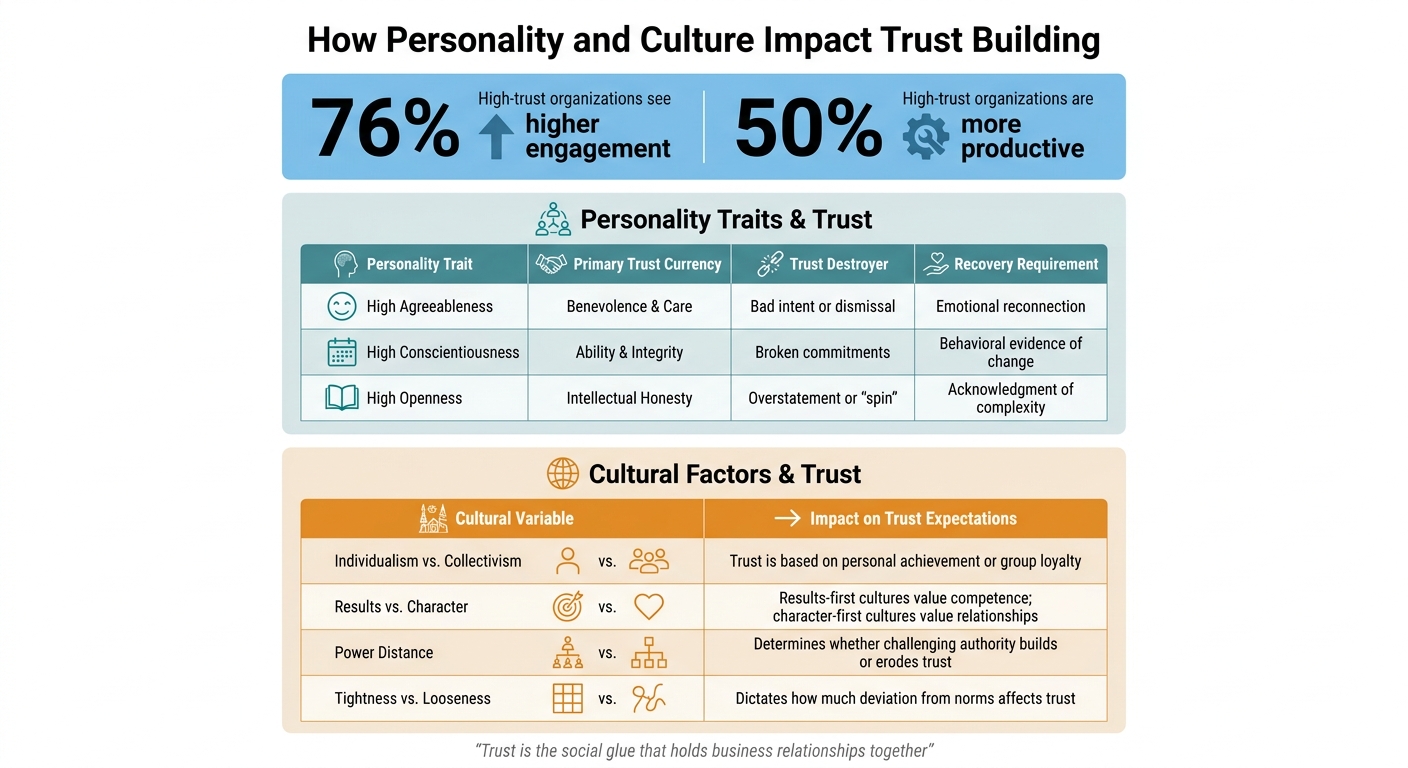
How Personality Traits and Cultural Factors Shape Trust Building
Building Trust and Cultural Contribution
How Personality Shapes Trust
Personality plays a key role in how people give and receive trust. Each personality trait acts as a kind of "trust currency", influencing what individuals value most when deciding whether someone is trustworthy.
As JobCannon puts it:
"Trust isn't a single thing - it's a collection of cognitive and emotional assessments about another person's competence, benevolence, and integrity" [7].
For instance, people high in Agreeableness are more likely to prioritize benevolence. They trust those who genuinely care and value relationships for their own sake. They’re also more forgiving of small mistakes, as long as the intentions seem good. On the other hand, individuals high in Conscientiousness focus on ability and integrity. They build trust through reliability and consistent actions. Meanwhile, those high in Openness value intellectual honesty. They’re more inclined to trust people who acknowledge complexity and admit uncertainty, rather than oversimplifying things. Understanding these tendencies can help you better navigate trust in everyday relationships.
Personality Traits That Affect Trust
The Big Five personality traits shape how people approach trust differently. For example:
- Agreeableness leads people to emphasize warmth and care, making them more likely to trust based on personal connections.
- Conscientiousness drives trust based on competence and reliability. These individuals look for consistent follow-through.
- Openness to Experience can even help bridge divides, as those high in this trait often see commonalities with others, even across different backgrounds [7].
Another factor worth noting is Propensity to Trust, a stable trait reflecting someone’s general willingness to be vulnerable to others. Research supports this concept, using a reliable five-item measure tested across diverse cultures [6].
Here’s a table summarizing how different traits influence trust dynamics:
| Personality Trait | Primary Trust Currency | Trust Destroyer | Recovery Requirement |
|---|---|---|---|
| High Agreeableness | Benevolence & Care | Bad intent or dismissal | Emotional reconnection |
| High Conscientiousness | Ability & Integrity | Broken commitments | Behavioral evidence of change |
| High Openness | Intellectual Honesty | Overstatement or "spin" | Acknowledgment of complexity |
How to Identify Personality Patterns in Others
Spotting personality patterns requires careful observation. For instance, if someone gets upset over minor delays, they likely value reliability - a key marker of Conscientiousness. On the other hand, people who strongly react to being excluded or dismissed may place a higher importance on relational care, a hallmark of high Agreeableness. Those high in Openness often ask nuanced questions and appreciate candid, honest discussions [7] [5].
Tools like Personos can make this process easier. Using the Five Factor Model, Personos measures 30 traits on an 80-point scale and provides real-time, situation-specific advice for building trust with resistant individuals. Its Dynamic Reports offer tailored strategies for improving practitioner-to-client relationships by analyzing detailed personality profiles.
Once you recognize these patterns, you can adjust your approach. For example:
- With high-Conscientiousness individuals, emphasize competence. Be clear about deadlines and demonstrate reliability through small, manageable commitments before moving on to larger tasks.
- For high-Agreeableness individuals, focus on building the relationship. Show genuine interest in their feelings and needs.
- When dealing with high-Openness types, establish credibility by being intellectually honest. For instance, admit when you’re unsure, using phrases like "I’m not certain about that" to build trust [7].
Understanding and adapting to these personality traits can help you strengthen trust in any interaction.
How Culture Influences Trust
Personality shapes how we trust, but culture defines what we expect from trust. Cultural norms act as unspoken rules, influencing everything from how we communicate to what behaviors we consider trustworthy.
Jeanne M. Brett and Tyree Mitchell explain it well:
"Trust is the social glue that holds business relationships together" [2].
But that "glue" doesn’t stick the same way everywhere. A study involving over 400 managers and executives from regions like America, Asia, Latin America, and the Middle East showed that trust expectations vary widely. The key difference? How much weight is placed on results (competence and achievements) versus character (integrity and goodwill) [3]. In some cultures, trust is earned through consistent performance. In others, it begins with personal connections and good intentions, with competence taking a backseat.
Another interesting aspect is the similarity effect. People tend to trust those they perceive as similar to themselves. Cultural differences can amplify this instinct, leading to greater hesitation when interacting with those from different backgrounds. For instance, one study found that White American students initially trusted their Chinese partners less, simply because they saw them as different [1]. Let’s dive into the cultural factors that shape these trust dynamics.
Cultural Factors That Shape Trust Expectations
Several cultural dimensions directly shape trust-building:
- Individualism vs. Collectivism: In individualistic cultures, like the United States, trust often hinges on personal achievements and competence. In collectivist cultures, trust is more about group loyalty and shared identity.
- Power Distance: This measures how much a culture accepts hierarchical differences. In high power-distance cultures, questioning authority might erode trust, while in low power-distance cultures, it could signal engagement and initiative [6].
- Tightness vs. Looseness: Tight cultures have stricter social norms, and breaking them can quickly harm trust. Loose cultures are more flexible, allowing for greater tolerance of deviations [6].
- Results vs. Character: In cultures that prioritize results (e.g., the U.S. and Northern Europe), competence builds trust first. In character-focused cultures (e.g., the Middle East and Latin America), relationships and integrity come before performance.
A study of 2,786 adults across 30 countries also found that propensity to trust - a person’s natural willingness to trust others - varies greatly by cultural region [6].
| Cultural Variable | Impact on Trust Expectations |
|---|---|
| Individualism vs. Collectivism | Trust is based on personal achievement or group loyalty |
| Results vs. Character | Results-first cultures value competence; character-first cultures value relationships |
| Power Distance | Determines whether challenging authority builds or erodes trust |
| Tightness vs. Looseness | Dictates how much deviation from norms affects trust |
Adjusting Your Approach for Different Cultures
To build trust across cultures, you need to adapt your approach. Start with your mindset. Research shows that genuine curiosity about others’ backgrounds - not surface-level judgments like accents or clothing - makes a real difference [3].
Pay close attention to communication style. Direct communicators may seem blunt to those who value subtlety, while indirect communicators might come across as inefficient to more straightforward colleagues [5]. Similarly, expressive individuals who process ideas out loud might misinterpret quieter, reflective types as disengaged.
When working in multicultural teams, include someone with high Openness to Experience. These individuals tend to connect more easily across differences and actively seek cultural understanding, which can help foster trust within the group [1].
Find common ground. The similarity effect is automatic, but you can counter it by emphasizing shared goals, values, or challenges [1][4]. For example, focus on a shared mission or mutual professional standards to create a sense of connection.
Use clear, behavior-specific language to avoid cultural misunderstandings. This clarity helps address common conflict triggers that often arise from misaligned expectations. Instead of asking, "Do you trust your supervisor?", try, "Does your supervisor follow through on commitments?" This makes feedback easier to understand and act on.
Lastly, practice global dexterity - the ability to adjust your behavior to fit different cultural contexts while staying true to your core values [4]. Learn when to be direct or indirect, when to prioritize results or relationships, and when to challenge or defer to authority, depending on the cultural setting you’re navigating.
Identifying Trust Barriers from Personality and Culture
Understanding how personality and culture influence trust is only the first step. The real challenge lies in pinpointing the root of trust issues. When trust falters, ask yourself: Is it a personality clash or a cultural misunderstanding? Identifying the source is key to finding the right solution.
Separating Personality Issues from Cultural Misunderstandings
Cultural barriers often stem from surface-level assumptions. Rachel Saef, Assistant Professor of Industrial-Organizational Psychology at Northern Illinois University, highlights that cultural differences create uncertainty about expected behaviors, while personality conflicts lead to doubts about someone's intentions. As Saef explains:
"Uncertainty makes it hard to know what to expect, how to behave, and whether something good or bad is going to happen." [1]
If mistrust seems tied to superficial traits, it could be a natural bias favoring the familiar. On the other hand, personality-based mistrust often lingers even when communication is clear. For example, if collaboration feels strained despite transparency, it might signal a deeper personality mismatch. A helpful indicator here is the trait of Openness to Experience. People with high openness are generally better at bridging trust gaps across cultures, while those with low openness often struggle to trust anyone outside their comfort zone [1].
By distinguishing these sources of mistrust, you can start applying more targeted strategies for rebuilding trust, which we’ll explore later.
Using Assessment Tools to Diagnose Trust Problems
After identifying whether the trust barrier stems from personality or culture, the next step is assessment. Generic tools often fall short when dealing with real-time trust challenges. For cultural gaps, tools like GlobeSmart from Aperian Global can help. GlobeSmart focuses on diagnosing cultural differences and improving intercultural skills [4]. However, it doesn't integrate individual personality profiles, which are equally important in trust-building.
For a more comprehensive approach, platforms like Personos (https://personos.ai) offer tailored solutions. Designed for professionals like social workers, case managers, and coaches, Personos provides Dynamic Reports that combine personality insights with cultural context. These reports go beyond static assessments by incorporating case notes, interaction history, and other relevant details, offering personalized strategies for trust-building. For example, they highlight potential friction points and suggest specific communication techniques based on personality traits.
Another standout feature is Personos' conversational AI chat. You can describe your trust issue, and it provides customized recommendations that factor in both personality and cultural nuances. Each suggestion is backed by psychological principles and traits, ensuring transparency in the guidance provided. At $9 per seat per month, it’s an affordable option for managing high caseloads effectively.
These tools make it easier to address trust barriers with precision, whether they stem from cultural misunderstandings or personality differences.
Strategies for Building Trust Across Personality and Culture
When working with diverse personality types and cultural backgrounds, trust-building requires a tailored approach. Trust hinges on three key elements: ability (competence), benevolence (caring), and integrity (honesty). The weight each person places on these elements varies, so your communication style should adapt to meet their preferences [7].
Communication Strategies for Different Personality Types
High-Conscientiousness individuals value ability and integrity most. They trust those who keep their promises and demonstrate reliability. To build trust, focus on delivering results consistently - meet deadlines, be transparent about deliverables, and establish a track record of dependability. For these individuals, trust isn’t restored with words alone; it requires a sustained pattern of trustworthy behavior over time [7].
High-Agreeableness individuals prioritize benevolence. They are more likely to trust someone who shows genuine care for their well-being. Building a personal connection is crucial before diving into tasks. Warmth, empathy, and prioritizing relationships help establish trust with this group [7].
High-Openness individuals place the greatest importance on intellectual integrity. They appreciate honesty, complexity, and nuance. Be upfront and avoid oversimplifying issues when communicating. Interestingly, these individuals are also more inclined to trust people from different cultures, as they often see others as reflections of themselves. This makes them valuable team members in multicultural settings [7][1].
Low-Agreeableness or High-Extraversion types respond well to direct, goal-oriented communication. Overemphasizing warmth may come across as disingenuous to them. Instead, focus on outcomes and demonstrate competence to build trust [7].
For professionals managing diverse teams, platforms like Personos (https://personos.ai) offer tools to provide real-time strategies tailored to individual personality profiles.
Creating Environments That Support Diversity
Trust-building in diverse teams goes beyond individual efforts - it requires fostering psychological safety at a broader level. Research highlights that employees in high-trust organizations report 76% higher engagement [5].
Include High-Openness Team Members
When forming cross-cultural teams, include at least one person who scores high on Openness to Experience. Rachel Saef, Assistant Professor of Industrial-Organizational Psychology at Northern Illinois University, explains:
"Because trust is a self-reinforcing phenomenon... including someone high in Openness in collaborations between people from different cultures may encourage cooperation and information sharing from people low in Openness" [1].
These individuals can act as bridges, easing tensions and encouraging collaboration in culturally diverse settings.
Develop a Shared Organizational Language
Creating alignment around organizational values is another key step. Sheila Margolis, President of the Workplace Culture Institute, emphasizes:
"Building a shared culture begins with a common language" [9].
By clearly defining expectations and behaviors, you help employees from various backgrounds understand what’s valued. This clarity should extend to recruitment, training, and performance management to ensure fairness and alignment.
Practice Early Vulnerability
Demonstrating vulnerability early on can help build trust. Actions like sharing information or seeking feedback signal good intentions, even in uncertain cultural contexts. As Saef notes:
"When we trust someone, uncertainty isn't as scary because we believe that the person has good intentions and will treat us well, even though we are uncertain about what they will do" [1].
This sets the stage for a self-reinforcing cycle where trust continues to grow. Once a supportive, diverse environment is in place, you can use conflict resolution as an opportunity to strengthen trust even further.
Using Conflict to Strengthen Trust
Handled properly, conflict can actually deepen trust. Since personality types perceive trust breaches differently, tailor your response to address their specific concerns. For instance:
- NF types lose trust over inauthenticity.
- SJ types lose trust when commitments are broken.
- NT types lose trust when faced with intellectual dishonesty or "spin" [7].
When conflicts arise, treat them as opportunities to reinforce trust by addressing the trust component most important to the other person. For a High-Conscientiousness individual, outline a clear plan to avoid future lapses and follow through. For a High-Agreeableness person, have an open, honest conversation about your intentions and show consistent care.
In cross-cultural conflicts, understanding the other party’s values is critical. Research whether they prioritize results (competence) or relationships (character) when assessing trustworthiness [3]. By addressing the root cause - whether it's tied to personality or cultural differences - you can turn conflict into a chance to build stronger, more trusting relationships.
Maintaining Trust Over Time
Sustaining trust isn’t a one-and-done effort - it demands ongoing attention and consistent action, especially when working with people from diverse backgrounds and varying personality types.
Monitoring Trust Levels and Warning Signs
When trust starts to break down, there are usually telltale signs: unclear communication, stalled teamwork, or employees retreating into silos instead of collaborating effectively [5]. Once people begin prioritizing self-preservation over teamwork, it’s a strong indicator that trust is already eroding.
It’s also important to differentiate between someone’s natural caution and genuine trust issues. Some individuals simply have a lower "propensity to trust" due to their personality, which calls for tailored management approaches. Misreading this caution as distrust can lead to unnecessary complications [8].
On the flip side, trust is thriving when you see behaviors like open communication, frequent feedback exchanges, and a willingness to share information without hesitation. Collaborative negotiation styles, high-quality interactions, greater job satisfaction, and a sense of fairness are all signs that trust is being upheld [8].
David Schoorman, a professor at Purdue University, highlights the significance of measuring trust accurately:
"Psychometric rigor is not an academic technicality. It is a strategic business asset. Organizations that measure trust well are better positioned to build it deliberately." [8]
When assessing trust in diverse teams, focus on behaviorally specific questions like, "I feel free to share new ideas." Avoid negatively phrased questions such as, "I cannot trust my supervisor", as these can introduce unnecessary cognitive strain or bias, especially in multicultural settings [8].
In addition to human observations, technology offers valuable tools for tracking and maintaining trust over time.
Using Technology for Long-Term Trust Maintenance
Technology can take these insights a step further by providing continuous, actionable feedback, making it easier to maintain trust in the long run. By combining personality assessments with an understanding of cultural dynamics, tech-driven solutions help leaders monitor trust levels and implement effective interventions.
For example, platforms like Personos use AI-powered prompts to deliver personalized, actionable nudges based on individual personality profiles. These prompts help leaders stay mindful of personality differences, even when they’re not in direct contact with their team members. The platform’s ActionBoard feature turns these insights into trackable action items, helping leaders document progress and reduce burnout, especially in complex or high-stress environments.
Another tool, GlobeSmart®, focuses on developing intercultural skills and leadership capabilities for global teams [4]. The effectiveness of such tools depends on their ability to work consistently across different regions - not just through simple translations, but by ensuring they’re culturally appropriate [8]. As Schoorman reminds us:
"A translated survey is not necessarily a comparable one." [8]
Technology can also identify an individual’s baseline trust level early in a relationship, such as during onboarding. This allows leaders to anticipate potential challenges and design engagement strategies that align with each person’s unique trust tendencies. This approach is particularly valuable in cross-border teams, where trust needs to develop quickly despite cultural differences.
Conclusion
Building trust across different personalities and backgrounds isn't just a nice-to-have - it’s an economic necessity. As Jeanne M. Brett and Tyree Mitchell explain:
"Trust is the social glue that holds business relationships together" [2].
When trust is present, partners can focus less on self-protection and more on achieving meaningful outcomes together.
Research shows that trust builds on itself. Early actions to establish trust can set off a chain reaction [1]. The first steps are critical - introducing even one team member with high Openness to Experience can encourage others to share information and collaborate more freely [1]. By understanding what drives trust for your colleagues - whether it’s competence, benevolence, or integrity - you can adapt your approach to connect more effectively [7].
Cultural differences may add layers of uncertainty, but they don’t have to be a roadblock. A study of over 400 managers and executives from regions like America, Asia, Latin America, and the Middle East highlights three key strategies for building trust across cultures: adopting the right mindset, learning about your colleagues’ backgrounds, and showcasing both results and strong character [3].
Modern tools can make this process easier. For example, GlobeSmart® focuses on developing intercultural skills [4]. Meanwhile, Personos takes things further by blending personality psychology with AI-driven insights. Designed for professionals like social workers, coaches, and nonprofit staff, Personos offers real-time advice tailored to individual personalities and cultural contexts. Its Dynamic Reports highlight specific trust drivers in each relationship, while AI prompts provide actionable recommendations, helping you stay mindful of personality dynamics even between interactions.
FAQs
How can I tell if a trust issue is personality-based or cultural?
Personality-based trust issues often emerge from individual traits, such as how someone manages emotions or their specific behavior patterns. On the other hand, trust issues tied to societal norms or stereotypes are typically shaped by broader expectations about trustworthiness within a group or community. If the problem seems rooted in someone's personal actions or tendencies, it’s probably linked to personality. However, if it’s influenced by generalized stereotypes or societal expectations, culture is likely playing a role. Tools like Personos can be useful for understanding and addressing these dynamics, especially in diverse environments.
What should I do first to build trust with someone who seems resistant?
To connect with someone who may be hesitant, it's important to start by setting clear expectations and following through on your promises. Show consistency in your actions - this builds credibility over time. Use emotional intelligence skills like empathy and self-awareness to better understand their perspective and create a more welcoming atmosphere. Tools like Personos can also be helpful, offering insights into personality traits that allow you to adjust your approach and build trust more effectively.
How can Personos help me build trust faster with clients or teams?
Personos uses AI-powered insights grounded in the Five Factor Model of personality to help build trust more effectively. It delivers real-time, customized guidance that allows you to adjust your communication style to match individual personality traits. By providing practical tips and personalized strategies, Personos promotes empathy and understanding, making interactions smoother - even in tough situations. This approach helps you establish trust quickly while maintaining strong, meaningful connections.