How Traits Predict Boundary Management at Work
Traits hint at boundary preferences; behavior and context reveal when people actually segment or integrate at work.
Nick Blasi

How Traits Predict Boundary Management at Work
People do not ignore boundaries for the same reason. Some want clear lines between work and personal life. Others are fine with overlap. And some look flexible on the surface but are just under pressure.
Here’s the short version:
- Traits can hint at boundary style
- Behavior shows what is happening right now
- Work pressure can hide true preference
- The best response is to match your timing, tone, and channel to the person
In plain terms, I’d read it like this:
- High conscientiousness often points to clearer separation, fixed hours, and stronger routine
- High extraversion + high openness often points to more overlap, mixed work/personal talk, and comfort with interruptions
- High agreeableness + high neuroticism can lead to saying yes too often, after-hours replies, and blurred limits
- Context matters because a person may act like an integrator even when they would rather separate
Research on boundary management often frames the issue around segmentation vs. integration. The key problem is that preference and behavior can split apart when workloads, team norms, or home setup get in the way. That gap helps explain why the same person may protect focus time one week and reply at 10:30 PM the next.
Masterclass: Strategies for Handling Personality Differences at Work
Quick comparison
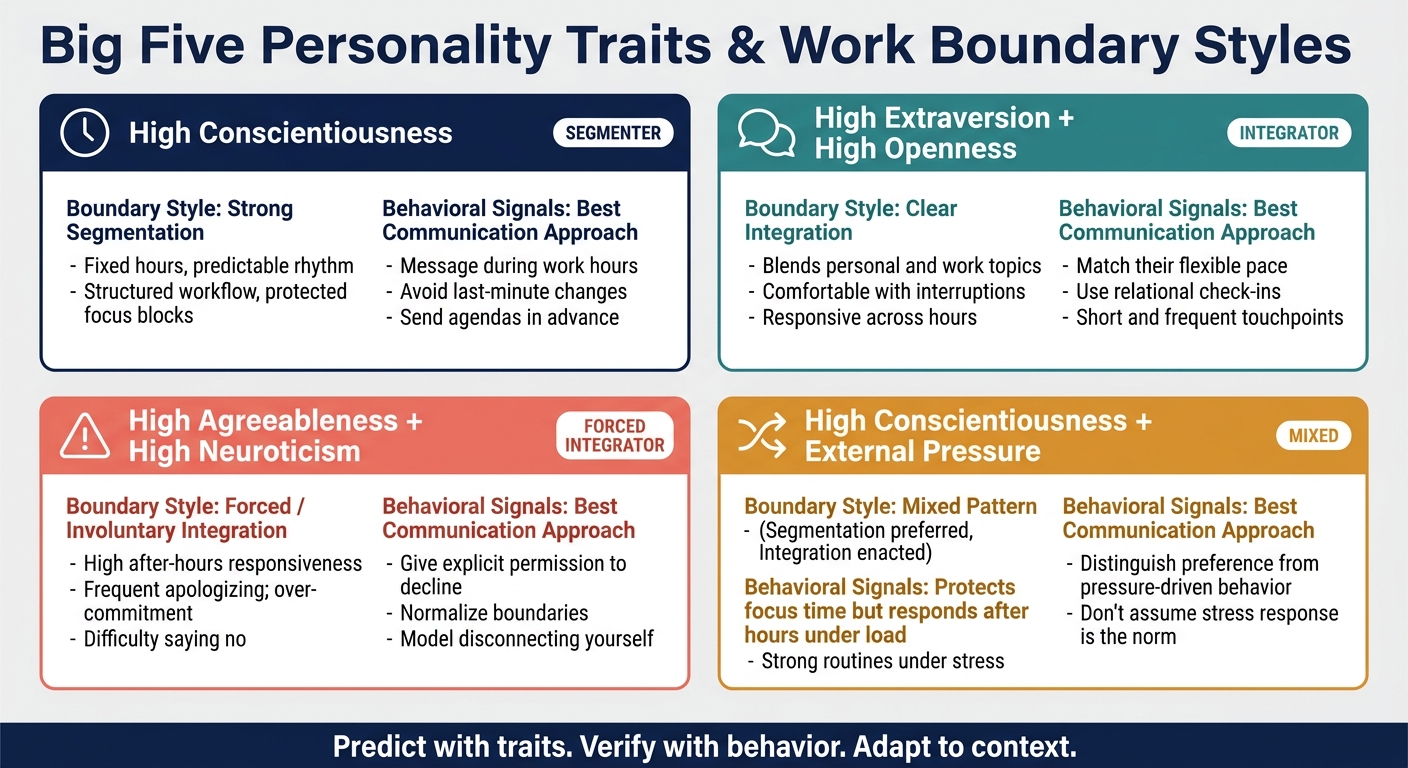
Big Five Traits & Work Boundary Styles: A Quick Reference Guide
| Pattern | What it often points to | What I’d look for | How I’d respond |
|---|---|---|---|
| High conscientiousness | More separation | Fixed hours, structured workflow, protected focus blocks | Message during work hours and avoid last-minute shifts |
| High extraversion + high openness | More overlap | Casual topic switching, flexible availability, comfort with interruptions | Use short check-ins and a more relational tone |
| High agreeableness + high neuroticism | Blurred limits from pressure or approval-seeking | Fast replies, over-committing, apologizing, trouble saying no | Give clear permission to decline and disconnect |
| High conscientiousness + pressure | Separation preferred, overlap enacted | Strong routines but after-hours replies under load | Don’t confuse stress behavior with true preference |
My takeaway: predict with traits, check with behavior, then factor in context before you decide how to communicate.
Read the trait patterns behind boundary style
Traits show patterns, not fixed rules. The best read usually comes from combinations of traits, not one trait on its own. With that in mind, the next move is to spot which traits often line up with each boundary style.
Traits that tend to align with more segmentation
High conscientiousness often lines up with segmentation because people who like structure usually want clear rules, steady routines, and protected focus time [6][7]. Higher stress sensitivity, or neuroticism, can push in the same direction. When work spills into personal time, these people may feel that cost more intensely and use separation to protect their energy [2][8].
Common signs include strict schedules, focus-first habits, silenced phones, and visible strain when work and personal life start to blur [6][7][8].
The opposite pattern usually points to looser, more blended boundaries.
Traits that tend to align with more integrated boundaries
High extraversion plus high openness tends to predict more flexible, permeable boundaries [3]. These people are often more at ease with mixed task-and-relationship communication, interruptions, and informal check-ins. On the other hand, lower extraversion tends to line up with more segmentation [3].
High agreeableness is linked to greater compliance with social requests, which can make it harder to say no [1]. When high agreeableness pairs with high neuroticism, a person may say yes just to avoid conflict or disapproval [1].
Use trait combinations, not single traits, for better predictions
Higher conscientiousness and agreeableness, along with lower neuroticism, tends to lean toward stronger, more defined boundaries. High extraversion and openness tends to lean toward weaker, more flexible ones [3]. Still, people can shift from one day to the next depending on workload and setting.
High agreeableness plus high neuroticism often leads to over-commitment and blurred boundaries [1].
The table below sums up the main combinations and the kind of behavior they often signal:
| Trait Combination | Likely Boundary Preference | Behavioral Signal |
|---|---|---|
| Higher conscientiousness and agreeableness, lower neuroticism | More segmentation | Predictable contact hours; clear boundaries around work and home [3] |
| High extraversion + high openness | More integrated boundaries | Blended task-and-relationship communication; comfort with interruptions [3] |
| High agreeableness + high neuroticism | Involuntary integration | Volunteers for extra work; fears saying "no" will damage relationships [1] |
| High conscientiousness + pressure | Segmentation preferred, integration enacted | Protects focus time but may still stay connected after hours [8] |
Day-to-day context often overrides trait tendencies. Next, look for these patterns in actual behavior.
Spot segmenting and integrating signals in real interactions
Use behavior to check the pattern you think you’re seeing. Segmenters and integrators tend to send clear signals in day-to-day work. It’s smart to watch for those signals before you change how you deal with someone.
Signs someone prefers segmenting
The clearest sign is time protection. Segmenters often set firm, rule-based limits, such as, "I don't take client calls after 6 PM" [1].
Space matters too. A segmenter will often avoid work talks in personal spaces and prefer a dedicated workspace so they can mentally "close the door" at the end of the day [4]. They also usually want clear role definitions [1].
What matters most is repetition. One busy week doesn’t tell you much. A pattern that shows up again and again does.
Signs someone prefers integrating
Integrators are more at ease when work and personal life overlap, even outside standard hours. They may check work across a long, mixed day [4]. They also tend to let personal conversations slide into work topics without much friction, which can make interactions feel more natural [4]. The main risk is hidden overload. Highly agreeable people may take on more than they can handle because saying no feels hard [5].
Another pattern to watch for is what researchers call a mixed pattern. That’s when someone segments in one area but integrates in another. For example, they may keep a dedicated home office but still answer emails across a long stretch of the day [4]. That’s not random behavior. It’s a mixed setup, and it’s showing up more often in knowledge work [4].
Trait-to-boundary-style table for quick reference
Use this before a meeting, supervision session, or client interaction to get your bearings fast:
| Trait Pattern | Likely Boundary Style | Visible Signs | Best Communication Approach |
|---|---|---|---|
| High Conscientiousness | Strong segmentation | Fixed hours, predictable rhythm, highly organized [5] | Respect schedules; avoid last-minute changes [5] |
| High Extraversion + High Openness | Clear integration | Blends personal and work topics; comfortable with interruptions; responsive across hours [4] | Match their flexible pace; relational check-ins work well [4] |
| High Agreeableness + High Neuroticism | Forced integration | High after-hours responsiveness; frequent apologizing; over-commitment [1][5] | Provide explicit permission to disconnect; normalize declining requests [5] |
| High Conscientiousness + External Pressure | Mixed pattern | Protects focus time but still responds after hours under load [8] | Distinguish between their preference and their current behavior; don't assume the pressure-driven response is the norm [8] |
The main point is simple: short-term pressure can change what you see on the surface without changing the person’s underlying style.
Once you spot the pattern, you can adjust your timing, tone, and channel to fit it.
Adjust your communication to fit the boundary style
Once you spot the style, adjust your outreach to match it. This matters most when you need to pick timing, tone, and channel on the fly.
How to communicate with segmenters
Segmenters tend to respond best to predictable outreach. Treat the signals above as a cue, not a label. Send non-urgent messages during core hours, avoid last-minute changes, and give people a heads-up when plans shift. That can lower stress, especially for colleagues who score higher in Neuroticism [5].
Keep your messages short and focused on the task. If you need to add work, frame it as a trade-off instead of just dropping one more thing on their plate. For example:
"Adding this task will reduce the quality of Project X; which should I deprioritize?" [1]
It also helps to send an agenda before meetings to help navigate personality types so the interaction feels more predictable.
How to communicate with integrators
Integrators need the same level of clarity, but the rhythm is different. They often prefer shorter, more frequent check-ins instead of one fixed block [4]. In many cases, a collaborative tone works better than a purely task-first approach.
The tricky part is that overload can be hard to spot. It doesn't always show on the surface. That's why direct check-ins matter, especially when agreeableness and neuroticism make it tougher for someone to say no. One good move is to model the boundary yourself first:
"I want to support this, and I need to prioritize my current deadline." [1]
How tools like Personos can support personality-aware communication
When you need to make this kind of adjustment across many relationships, tools can help you read the situation faster. Personos is a Five Factor Model platform that turns personality trait patterns into relationship-specific communication guidance. Its Dynamic Reports highlight where friction may show up between two people and what kind of approach fits that pairing. Individual scores stay private by default. Used well, this kind of guidance helps keep communication in line with both the person and the situation.
The last step is matching those choices to the wider work context.
Conclusion: Match communication to traits, boundaries, and context
Once you’ve spotted boundary signals, there’s one last filter: context.
Boundary style shifts with the situation. Traits can hint at the kind of boundary style a person may lean toward, but work context shapes how that style shows up day to day. So trait signals are a starting point, not a verdict.
Work norms can override personal preference. In some teams, people are pushed to stay plugged in even if that’s not how they’d choose to work. A conscientious colleague may prefer segmentation, but a constant-availability culture can override it [2].
Before you decide how to communicate, look at the setup around the person:
- Job demands
- Response-time norms
- Remote or hybrid work arrangement
- Home workspace
That’s why communication adjustment should come last, not first.
Predict with traits. Verify with behavior. Adapt to context.
FAQs
How can I tell preference from pressure?
Preference is your natural style. It’s the way you tend to operate without forcing it, like how comfortable you feel keeping work and personal life separate or blending them together.
Pressure is different. It shows up when you go against that natural style to fit workplace norms or meet other people’s expectations.
So if you keep saying yes to tasks you resent just to avoid conflict or disapproval, that leans more toward pressure than actual preference.
Can someone be both a segmenter and an integrator?
Yes. People often handle boundaries with some flexibility instead of sticking to just one style.
Someone might usually prefer segmenting or integrating, then shift depending on the situation. That can happen to avoid burnout, get through a heavy workload, or deal with changes at home or at work.
What matters most for well-being is having control over those boundaries and adjusting them when needed, not being locked into only one approach.
What if my coworker’s behavior changes week to week?
If a coworker’s boundary management style changes from week to week, that can point to shifts in stress, day-to-day hassles, or work-life pressure. In other words, boundary management often moves around. It’s not always a fixed trait.
Personos can help you spot personality patterns and adjust how you communicate. That makes it easier to support teamwork and build trust, whether your colleague’s boundaries are more rigid or more permeable.