Trait Matching for Cross-Functional Collaboration
Map Five-Factor traits to role demands to spot friction, match tasks, and tailor communication while protecting privacy.
Nick Blasi

Trait Matching for Cross-Functional Collaboration
Teams often do not struggle because people care less. They struggle because people work in different ways.
I’d sum up the article like this: if you map team traits with the Five Factor Model, you can spot friction early, match work to work style, and change how you communicate before casework slows down. The article points to a 5-minute assessment built on 30 facets and an 80-point scale, then shows how teams can use group views and pairwise reports without sharing raw scores.
Here’s the whole idea in plain English:
-
Job titles do not show work style
- Two people in the same role may handle deadlines, handoffs, and stress very differently.
-
Trait data should be used for development only
- Not for punishment.
- Not for performance calls.
- Not without clear consent.
-
Scores work best as patterns
- The Five Factor Model looks at Openness, Conscientiousness, Extraversion, Agreeableness, and Neuroticism.
- The point is to read combinations, not stamp people with fixed labels.
-
Most team friction shows up in a few places
- Documentation and follow-through
- Process change
- Meeting tone
- Crisis response
-
You can lower friction with simple changes
- Give detail-heavy work to people who like structure.
- Give outward-facing work to people with more social energy.
- Use direct feedback for direct people.
- Send pre-reads at least 24 hours early for people who like time to prepare.
-
Privacy matters
- Team views should show patterns at the group level.
- Pair reports can help two roles work better together while keeping raw scores hidden.
If I were using this in a nonprofit or human services team, I’d keep it to a simple 3-step loop: assess with consent, review likely friction, then assign work and communication methods with that in mind. That keeps the process easy to use in case conferences, outreach planning, and care coordination.
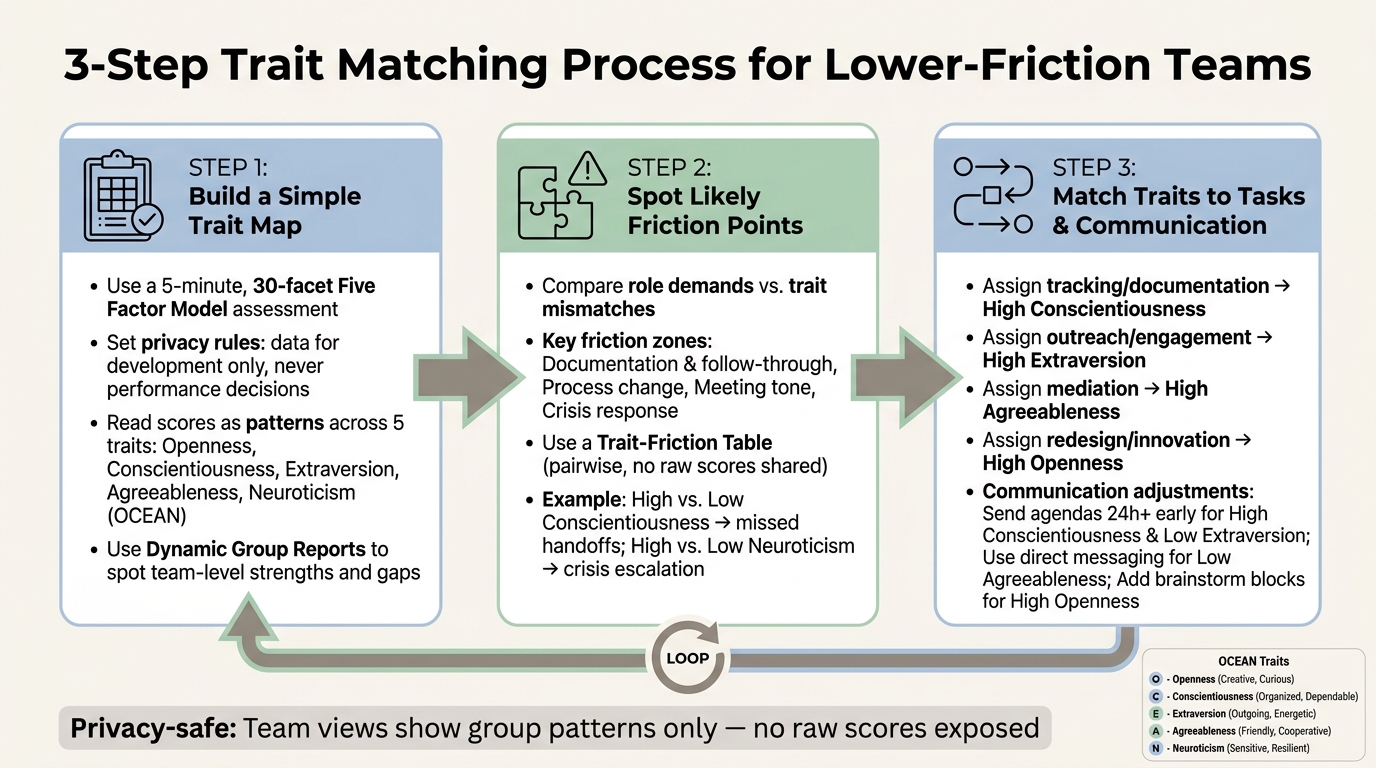
3-Step Trait Matching Process for Cross-Functional Teams
Step 1: Build a simple trait map for your team
Choose an assessment and set privacy rules before sharing results
Start with a brief, validated Five Factor Model assessment. Personos offers a 5-minute version built on 30 facets, along with team guidance meant to improve coordination in shared casework, outreach, and care planning.[1]
Set a clear ground rule from day one: personality data is for development only, not performance decisions or punishment. Coaching access should happen only when someone asks for it and gives explicit acceptance.[1]
Read individual scores as patterns, not fixed labels
A single score, by itself, usually doesn't say much. The useful part is how traits combine and how those combinations show up in day-to-day work.
Because the 30 facets can mix in many ways, it makes more sense to read profiles as patterns, not types.[1] From there, you can pull those patterns into a team-level view.
Use team-level views to spot strengths, gaps, and imbalance
Team views help you spot concentrated strengths, missing traits, and overloaded roles before friction starts slowing people down. They also help you see who may need more structure, who can work well in ambiguity, and who is a better fit for high-friction coordination.
Platforms like Personos generate Dynamic Group Reports that pull individual profiles into a shared view and account for organizational context such as program values, role descriptions, and team norms.[1] That matters because a static spreadsheet only shows isolated data points. A living team view updates as membership changes and shows how traits work together.
The table below shows how different team-mapping features support specific uses while keeping individual data protected:
| Feature | What It Shows | Ethical Safeguard |
|---|---|---|
| Dynamic Group Reports | How all personalities in a team interact collectively | Aggregates data; no individual scores exposed |
| Relationship Mapping | Where two specific roles are likely to clash or align | Raw scores hidden; only interaction guidance visible |
| Context Layers | How traits play out given actual job roles and team norms | Grounds personality data in professional reality |
| ActionBoard | Turns identified gaps into specific development tasks | Focuses on growth, not fixed personality judgments |
Use the team view to guide decisions about work, not to label people. The point is to flag likely friction early, before you start comparing role demands and task fit.
Step 2: Spot likely friction points across roles
Once the team map starts to show patterns, put those patterns next to each role’s day-to-day demands. The goal is simple: use the map to see where differences in work style are most likely to bump into each other. Start by looking at each role and asking which traits help that role run smoothly, and which gaps are most likely to throw things off.
Compare role demands with trait mismatches that disrupt work
In nonprofit teams, friction often shows up around Conscientiousness, Openness, Agreeableness, and Neuroticism.
Take Conscientiousness. A case manager with a higher score may want documentation done on time and every handoff confirmed in writing. A peer outreach worker with a lower score may treat those same deadlines as more flexible and put more energy into relationship-building out in the field. Neither style is wrong. But when both people share a care plan, that gap can lead to a missed handoff or an incomplete record, which slows service delivery.
Openness causes a different kind of tension. If a program director introduces a new intake process, a team member with higher Openness may jump in fast. A colleague with lower Openness may hold back until the reason for the change makes sense. If no one explains that reason clearly, new tools and process updates can stall.
Gaps in Agreeableness often surface in case conferences or care planning meetings. A higher-Agreeableness team member may hold back a concern to keep the peace. A lower-Agreeableness colleague may bring up that same concern so directly that the room goes quiet. Either way, the team can miss the kind of open discussion that leads to better client decisions.
Watch how stress reactivity affects crisis coordination
Neuroticism, or stress reactivity, matters most when the pressure is on. During a client crisis, a week with an overloaded caseload, or an unexpected transition, mismatched stress patterns can create real problems.
A highly reactive team member may escalate fast, rush decisions, or lose composure as a client situation gets worse. A colleague with lower stress reactivity may see that response as too much and start to pull back. That’s where coordination can break down at the exact moment the team needs to stay aligned. It helps to identify the person who stays steady under pressure and make that person the crisis point person.
Use a trait-friction table for quick team review
This table works well in case conferences or planning meetings. It compares trait pairings, not full profiles, so raw scores stay private.
Use it to review likely clashes before they show up in casework.
| Trait Pairing | Likely Friction Point | Impact on Casework or Outreach | Recommended Adjustment |
|---|---|---|---|
| Higher vs. lower Conscientiousness | Urgency vs. deliberation | Missed handoffs or incomplete care plans due to different views on deadlines | Set explicit, intermediate milestones and standardized documentation templates |
| Higher vs. lower Openness | Structure vs. flexibility | Tension during process changes or when adopting new outreach methods | Explain the "why" behind changes; allow limited flexibility during rollout |
| Higher vs. lower Agreeableness | Empathy vs. directness | Conflict avoidance in care planning or perceived insensitivity during case reviews | Use structured feedback protocols so critical issues are addressed without damaging rapport |
| Higher vs. lower Neuroticism | Stress reactivity | Escalation or rushed decisions during client crises or high-pressure transitions | Assign stabilizers to lead crisis communication; provide extra support for higher-reactivity members |
Relationship Reports can show how two roles will likely interact without exposing raw scores to the wider team [1]. These friction points set up the next step: matching traits to tasks and communication methods.
Step 3: Match traits to tasks and communication methods
Use the friction points from Step 2 to sort out two things: who should handle the work and how to reach each person in a way that lands well.
Assign responsibilities based on trait strengths and role needs
Treat trait-based task matching as a working default, not a hard label.
In practice, that means giving tracking and documentation to staff with high Conscientiousness, outreach and partner engagement to people with high Extraversion, mediation to those with high Agreeableness, and stalled or stuck work redesign to teammates with high Openness.
The point isn't to box people in. It's to give work to the people most likely to move it forward without extra friction.
Adjust communication by trait: structure, tone, pace, and detail
How you assign work matters. But how you communicate about that work matters just as much.
For a high-Conscientiousness colleague, send the agenda and relevant files at least 24 hours before the meeting. They tend to do better when they have time to review details and come in prepared.
For high-Openness teammates, add a short brainstorming block instead of moving straight into decisions. If you skip that step, you may miss good ideas that would've surfaced with a little room to think.
For low-Agreeableness teammates, skip the warm-up and get to the point. They often engage better when the discussion is direct and centered on the goal.
For low-Extraversion staff, smaller group check-ins and written pre-reads usually work better than large-group discussions. It gives them space to process before they respond.
Personos can do this with Relationship Reports that show how two people are likely to interact without exposing raw scores [1].
Add reusable role-fit and communication tables
Use the tables below as quick references for case conferences, outreach planning, and care coordination.
| Nonprofit Role | Helpful Trait Ranges | Risk Factors When Mismatched | Collaboration Fit |
|---|---|---|---|
| Case Manager | High Conscientiousness | Burnout; bottlenecking | Pairs well with high-Openness colleagues for creative problem-solving |
| Outreach Coordinator | High Extraversion | May miss admin details or dominate quieter teammates | Pairs well with high-Agreeableness colleagues in community mediation |
| Program Director | High Openness | Decision lag during crises | Needs high-Conscientiousness partners for execution |
| Peer Navigator | High Agreeableness | Difficulty enforcing firm boundaries | Fits well with high-Extraversion roles for community engagement |
| Mediator / Family Lead | High Agreeableness | Avoids necessary conflict | Supports emotional safety in family case conferences |
| Trait Pattern | Preferred Channel & Pacing | Meeting Design | Feedback Style | Best-Fit Tasks |
|---|---|---|---|---|
| High Conscientiousness | Email/Asynchronous; steady pace | Clear agenda sent 24h+ in advance; strict start/end times | Objective, metric-based, task-specific | Care plan tracking, documentation, compliance |
| High Openness | Collaborative docs; flexible pacing | Brainstorming-heavy; open-ended prompts | Conceptual, growth-oriented | Service design, pilot programs, complex problem-solving |
| High Extraversion | Face-to-face or video; fast-paced | Interactive, group-based discussion | Public recognition; energetic | Community outreach, partner engagement |
| Low Agreeableness | Direct messaging; concise | Brief, goal-oriented check-ins | Straightforward, blunt, results-focused | Interagency negotiation, critical auditing |
| Low Extraversion | Written prep; deliberate pace | Small groups; agenda sent 24h+ in advance | Private, one-on-one, reflective | Deep-dive case analysis, report writing |
Conclusion: A repeatable process for lower-friction teamwork
The three steps in this guide, assess ethically, read patterns carefully, and adjust before friction escalates, create a loop your team can use before each meeting.
That matters because teams often run into the same avoidable problems. One person wants more structure. Another moves at a faster pace. Someone else needs a different communication style. If you don’t spot those gaps early, friction shows up fast.
The good news is that teams can use trait-based guidance without sharing raw scores. That makes the process easier to use in case conferences, outreach planning, and care coordination. As roles, caseloads, and team membership shift, the map should shift too.
Key takeaways for your next case conference or outreach plan
- Job titles do not predict working style. A case manager and an outreach coordinator can aim for the same outcome and still work in very different ways. Without a trait lens, those differences can turn into friction.
- Scores are patterns, not verdicts. A high-Neuroticism score points to stress reactivity that may need planning around. It is not a character judgment.
- Predict friction before it happens. Use the trait-friction table from Step 2 to spot likely tension points before the work begins, not after things go sideways.
- Tailor how you communicate, not just what you say. The same update might work better as a structured email, a quick check-in, or a more open brainstorm depending on the person and the task.
For teams that want built-in support, Personos turns Five Factor insights into role-specific guidance through Relationship Reports and an ActionBoard that tracks follow-through.
The aim is simple: less friction, more energy for client and community service.
FAQs
How do we introduce trait matching without making staff feel judged?
Position trait matching as a team support tool, not a performance measure. The point isn't to judge someone's worth. It's to start better conversations.
Used well, trait matching can show where people naturally complement each other. It can also help staff tweak how they communicate, which often cuts down on friction before it turns into a bigger issue.
Personos helps here by keeping individual data private. There's no need to share personal scores with the team. That matters, because people are often more open when they know their data won't be put on display.
And instead of boxing people into fixed labels, Personos gives actionable, role-specific guidance. The result is simple: staff can feel more understood, and more ready to work well with the people around them.
What if someone’s trait pattern doesn’t seem to match their job duties?
A trait pattern that looks out of step with a role doesn’t always mean someone is in the wrong job. More often, it suggests there’s room to rethink how their natural strengths show up in the work instead of labeling them a poor fit.
Personos pairs a 30-facet personality profile with role and company context to give tailored, role-aware guidance. The goal is simple: help people use their natural tendencies as assets, cut friction, and increase impact.
How often should a team update its trait map and collaboration plan?
Regularly. Team dynamics shift over time, especially when people rotate in or out or the team’s situation changes. That means the trait map and collaboration plan should be updated to match what’s happening now, not what was true six months ago.
It also helps to revisit them as work and life circumstances change. Tools like Personos can help by adjusting with those changes while keeping shared team insights and key decisions in one place.