Team Trust with EQ: Guide for Nonprofit Leaders
Practical EQ strategies for nonprofit leaders to rebuild daily team trust, reduce burnout, tailor feedback by personality, and track trust metrics.
Rachel Johnson

Team Trust with EQ: Guide for Nonprofit Leaders
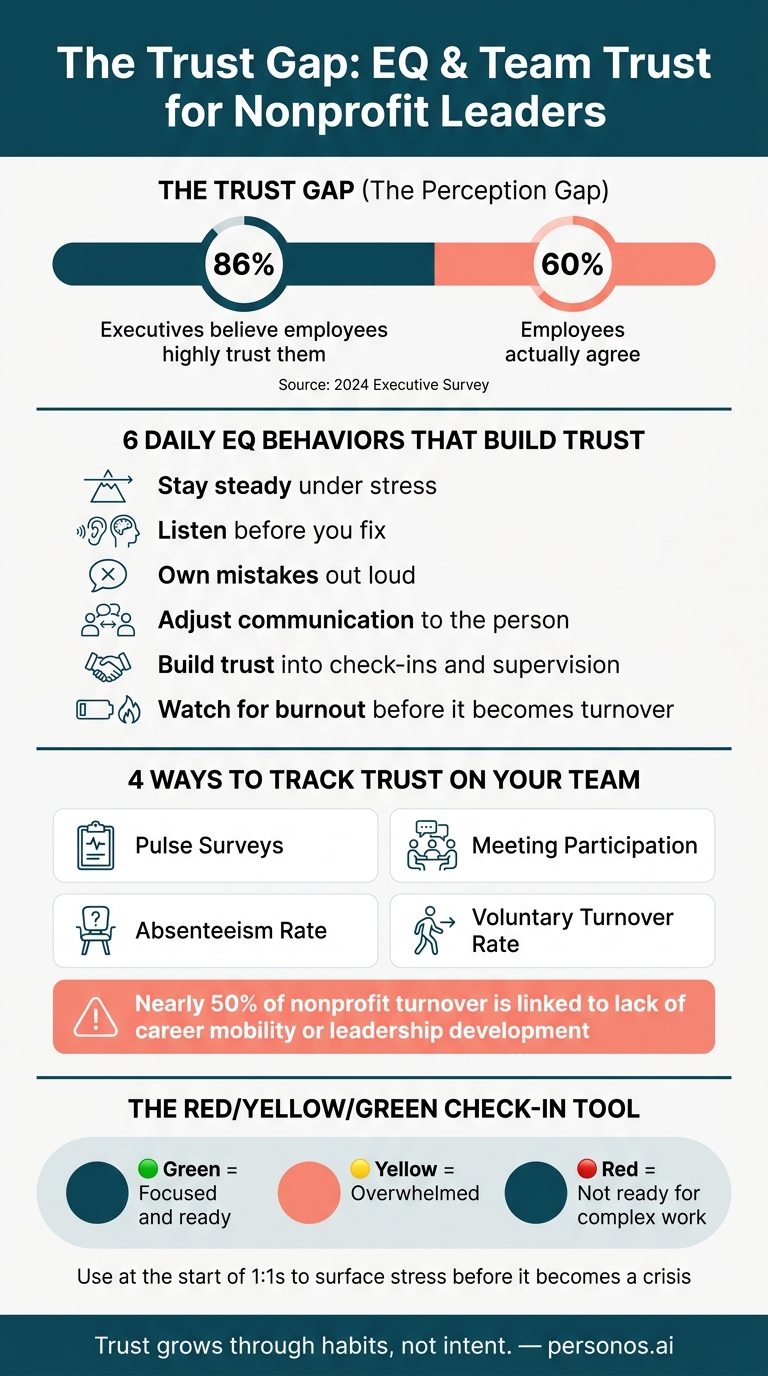
Trust breaks faster than most nonprofit leaders think. In one 2024 survey, 86% of executives said employees highly trusted them, but only 60% of employees agreed. That gap can hurt staff retention, team communication, and client care.
If I want to build trust on a nonprofit team, I need to keep it simple:
- Stay steady under stress
- Listen before I fix
- Own mistakes out loud
- Adjust my communication to the person
- Build trust into check-ins, debriefs, and supervision
- Watch for burnout before it turns into turnover
This article shows that trust is not built by one speech or policy. It grows through small daily actions, trauma-aware leadership, and clearer communication based on how different people take feedback, conflict, and change.
A few points stand out:
- Burnout and turnover weaken trust fast
- EQ helps me stay calm, read the room, and respond with care
- Personality differences shape how staff hear the same message
- Trust should be tracked through pulse surveys, participation, absenteeism, and turnover
If I lead people in hard, people-first work, trust has to show up in my habits, not just my intent.
The Trust Gap: What Nonprofit Leaders Need to Know About EQ and Team Trust
Fear Isn’t the Enemy - It’s the Catalyst: Emotional EQ for Nonprofit Leaders
Build trust through everyday EQ behaviors
Trust grows when leaders stay steady when things get tense.
Use self-awareness and self-regulation to lead predictably
Staff need to know they won't get a different version of you every time pressure goes up. A good place to start is noticing your own stress signals before they run the show. A slow breath or short pause before you answer can help you stay deliberate [1].
When things feel heavy, say so without dumping that weight on your team. There's a big difference between naming pressure in the organization and venting in a way that leaves staff carrying your frustration. One builds trust. The other chips away at it.
Practice empathy and trauma-aware listening in supervision
In nonprofit supervision, what staff say out loud often isn't the whole story. Pushback can point to burnout, role confusion, or fear. Listen for the need behind the behavior before you respond.
Trauma-aware listening means slowing down long enough to recognize emotional labor before you jump into fixing the problem. If a staff member tells you a client interaction was really hard this week, don't lead with a checklist. Start with acknowledgment. Shift from "Did you finish the report?" to "What's getting in the way right now?" That small change moves the conversation from compliance to collaboration [3].
Handle conflict and resistant team members without escalating
When a team member seems withdrawn or resistant, a better question is: What unmet need might be driving this? Resistance often points to overload, not defiance. When you swap the label for curiosity, you give the conversation room to go somewhere useful.
Reflective statements can help a lot. For example: "It sounds like you're frustrated with how decisions are being communicated - is that right?" That kind of response slows things down and shows you're trying to understand, not score points. From there, it's much easier to work on a fix together.
Owning a misstep out loud, "I handled that conversation poorly, and I want to address it", does more for team trust than acting like nothing happened [5]. Repair isn't a one-and-done move. It's part of how teams stay steady and feel safe over time. Follow-through is what turns one good talk into trust people can count on.
How you say this matters too, because different personalities hear the same message differently.
Use personality-aware communication to reduce friction
Trust also comes down to fit. The same message can land in two completely different ways depending on the person hearing it. When communication misses the mark, it can quietly undo earlier repair work, even if the intent was good.
Personality-aware communication means adjusting how you deliver a message without boxing people in or making snap judgments. EQ helps leaders understand how they show up. Personality insight helps them think ahead about how someone else might take what they say.
Adapt feedback, meetings, and expectations to personality traits
Once trust starts to recover, the next move is to cut friction in day-to-day communication. A staff member high in conscientiousness will often want clear timelines and a plain reason behind a decision. That kind of clarity helps people feel understood, not managed.
Introverted or quieter staff members often have more to give than group meetings let them show. Rotating meeting leadership and offering a private follow-up can make it easier for them to speak up and add more.
A staff member high in openness may respond better when they have space to question assumptions. Someone lower on that trait may need more context before a change feels safe enough to accept.
A simple question can go a long way:
"I'd love your honest take - what's one thing that could go better?"
Asked in a direct check-in, it can bring hidden issues to the surface before they turn into bigger problems.
Use assessments carefully without stereotyping staff
Use assessments privately and treat them as a starting point for conversation, not a label. Personality scores should support growth discussions, not put a cap on what someone can do.
Where Personos fits better than generic AI or HR tools
Most generic AI tools and HR platforms can spot friction through pulse surveys, sentiment dashboards, or engagement trends. What they usually can't do is explain why a specific conversation went sideways, or how to handle a hard check-in with a certain team member based on their personality and your shared history.
Personos was built for those moments. It combines the scientifically validated Five Factor Model with contextual notes and real-time AI guidance to help nonprofit leaders act on the why in the moment, with personality and context in view, not one-size-fits-all advice. That matters most when burnout is high and communication leaves little room for mistakes.
Lead trust-first teams in burnout and trauma-heavy environments
When burnout climbs, even the right message can hit the wrong way. Chronic stress and vicarious trauma switch on the brain’s stress response, which can leave staff on edge and make clear thinking harder [4]. In teams that deal with trauma day in and day out, trust starts to crack when people feel unsafe, ignored, or buried in too much work. Leaders have to manage their own stress first. If they don’t, they can add to the team’s fear without meaning to. In that setting, a calm leader isn’t just “nice to have.” It signals safety.
How burnout weakens trust and increases turnover
Burnout grows through overload. As stress builds, patience gets thin, communication starts to fray, and teamwork suffers. People don’t just leave because the job is hard. They leave when they stop believing there’s any path forward for them.
Retention gets better when leaders are steady, fair, and responsive to workload limits. That kind of consistency tells staff that the pressure is being seen, not brushed aside.
Apply trauma-informed leadership to policies and team routines
Trauma-informed leadership puts psychological safety, transparency, and empowerment first [7]. In practice, that looks like predictable meeting schedules, clear role expectations that are written down and reviewed often, and shared decision-making whenever it makes sense.
When something goes wrong, repair has to be more than a quick apology. It means naming the harm, changing the process, and then following through. Building reflection time into debriefs shows that the organization cares about processing, not just output. That’s how routines make trust visible.
Trauma-informed leadership means making care visible in routines, not just language.
Support stressed staff without overstepping or minimizing
Validating someone’s stress doesn’t mean lowering the bar. It means starting with what’s real before asking for more.
Look for changes in behavior, such as:
- Going quiet in meetings
- Avoiding eye contact
- Using unusually terse communication [2]
These are often early signs that stress is eroding trust.
One simple tool for 1:1s is the Red/Yellow/Green check-in, borrowed from aviation. Green means focused. Yellow means overwhelmed. Red means not ready for complex work [8]. Asking staff to rate themselves at the start of supervision gives leaders useful information to work with. When someone says red, the better next step is to ask what barriers they’re facing, not whether their work is done [3].
Leaders can also normalize asking for help by modeling it themselves. Used well, these check-ins make trust part of the daily rhythm instead of a one-time fix. From there, those habits can show up in check-ins, debriefs, and supervision.
Turn trust into daily systems, metrics, and next steps
Build trust into check-ins, debriefs, and supervision
Good intentions matter. But they don't carry a team very far unless they show up in the calendar.
Make check-ins part of a set rhythm, not something a manager does only when things feel off. A regular one-on-one gives leaders a steady place to talk about blockers, growth, and support. Some teams also use 360-degree feedback and peer learning circles to make coaching a normal part of the job [3].
After hard cases, crises, and major decisions, schedule after-action debriefs. A structured debrief gives the team space to name the impact, look at what happened, and confirm next steps [6]. Clear work-hour boundaries matter too. When leaders actively discourage after-hours messages, they help stop mission-driven energy from sliding into burnout [6].
Track trust, psychological safety, and retention signals
Once those routines are in place, check whether trust is getting better.
Short pulse surveys and 360-degree feedback can surface early warning signs before they grow into culture problems [3]. You can also watch day-to-day behavior. Meeting participation, along with response tone in email and chat, can point to how safe people feel speaking up [2].
Retention signals matter just as much. Nearly 50% of voluntary turnover in the nonprofit sector is driven by a lack of career mobility or leadership development [3]. Track internal promotions, stretch assignments, absenteeism, and voluntary turnover so leaders have data they can bring into board or funder conversations.
Key takeaways for nonprofit leaders
Trust grows through predictable behavior, personality-aware communication, trauma-informed routines, and measurable follow-through. Leaders who show empathy and accept accountability create the conditions for staff to do hard work without burning out.
Use AI only when it sharpens daily judgment, not when it takes judgment's place. Personos turns personality profiles and context into real-time guidance for conflict, supervision, and burnout-sensitive communication.
FAQs
How can I rebuild trust after a leadership mistake?
Rebuilding trust takes more than a generic apology. People process hurt, doubt, and repair in different ways, so your message should fit each team member’s personality and the way they like to communicate.
Show sincerity with steady, transparent follow-through. Be open about what happened, model vulnerability, and ask for feedback with Start, Stop, Continue. Then back it up with everyday actions that show accountability, integrity, and benevolence. Tools like Personos can help guide these high-stakes conversations.
What are the first signs burnout is hurting team trust?
Early signs often show up in small, easy-to-miss ways. Staff may pull back, mentally check out, or start acting out of self-protection instead of a shared sense of purpose.
You might also notice people holding back ideas, more silos, and more conflict. Another red flag is "niceness syndrome": people avoid hard conversations, then slide into passive-aggressive behavior. Over time, that wears down psychological safety.
How do I tailor feedback to different personality styles?
Move past one-size-fits-all feedback. Shape how you communicate based on each person’s personality, preferences, and emotional needs. Start with your own self-awareness, too. If you don’t know your default style or blind spots, it’s easy to miss the mark.
What feels like accountability to one person can land as criticism to another. Same message, different reaction.
Tools like Personos can help with in-the-moment, situation-specific guidance based on the Five Factor Model. That makes your feedback more likely to connect, lower conflict, and build trust.